Platemaker/Imager Program Guide: Training, Costs and Career Fit
Learn what a Platemaker/Imager program covers, which credentials and formats to compare, what may affect cost, and how to evaluate its connection to print and graphic-image work.
By David Slack · Staff Writer Assessment.com · Published October 7, 2026 · Last updated November 5, 2026
A Platemaker/Imager program teaches technical skills for preparing film, digital data, and surfaces used to reproduce printed or graphic images. It is a focused area within graphic communications, not a general communications degree. Colleges may use different program titles and organize coursework differently, so the name alone cannot tell you exactly what you will study or which equipment you will use. The program may interest students who like detail-oriented technical work and want to understand how digital or film-based image information is prepared for reproduction. Before choosing one, find out how much instruction is hands-on, what credential the school awards, and what kinds of work its curriculum is designed to support. Not sure whether Platemaker/Imager fits you? Take the Free MAPP Career Assessment to see how your motivations, interests, and natural preferences align with this degree and the careers it can lead to.
Degree & Program Decision Insights
Explore your personal fit, education requirements, career potential and next steps.
01Motivational Fit
Discover whether this program fits you
Explore your preferences against the focus of Platemaker/Imager. These prompts are not personal MAPP results.
Subject curiosity. Would you choose to explore “platemaking” in depth? Ask for a sample learning activity to test that interest.
Breadth of interest. Consider the place of “stripping” in this field. Is this another part you would choose to explore, or mainly a requirement you would tolerate?
Work reality. Related work can involve this task: “Generate prepress proofs in digital or other format to approximate the appearance of the final printed piece.” Would you want that activity to be a regular responsibility?
Interest in studying a field can differ from enjoying its related work.
Which part would you want to do repeatedly, and what would you try before deciding?
Discover Your Personal Program Fit
Before investing your time and money in your education, discover how this program aligns with your natural motivations, work preferences and career goals.
Explore these official instructional-field associations. They describe possible occupational routes, not measured outcomes of this program.
Prepress Technicians and WorkersSOC 51-5111 · O*NET 51-5111.00$48,690/year median (May 2025); -15.3% projected change (2025–2035); 2,100 projected openings/year.
Typical occupational entry: postsecondary nondegree award (BLS).
U.S. occupational wages are not guaranteed graduate earnings; OEWS excludes self-employed workers.
Projected openings include replacements as well as growth.
U.S. national estimates. A crosswalk does not establish entry-level eligibility; advanced, management and teaching roles can require further qualifications.
Compare the focus and route of these distinct instructional fields; their credentials and admission requirements are not interchangeable.
Printing Press OperatorCIP 10.0307. A program that prepares individuals to apply technical knowledge and skills to set up, operate, and maintain printing presses.
Explore your motivations. Use MAPP as a starting point for reflecting on your interest in “platemaking”, then test that interest against a sample learning task.
Examine the work. Compare Prepress Technicians and Workers on daily work and entry qualifications, as well as pay.
Compare actual providers. Ask for the exact credential, course sequence and assessment methods. Compare how each provider teaches “stripping”, its entry criteria and its itemized costs.
Check the evidence before applying. Confirm prerequisites and any recognition or professional requirements for your intended route; ask for applicable rules and published outcome definitions in writing.
Verify the institution’s current offering, admissions requirements and outcomes; a search result does not establish your eligibility.
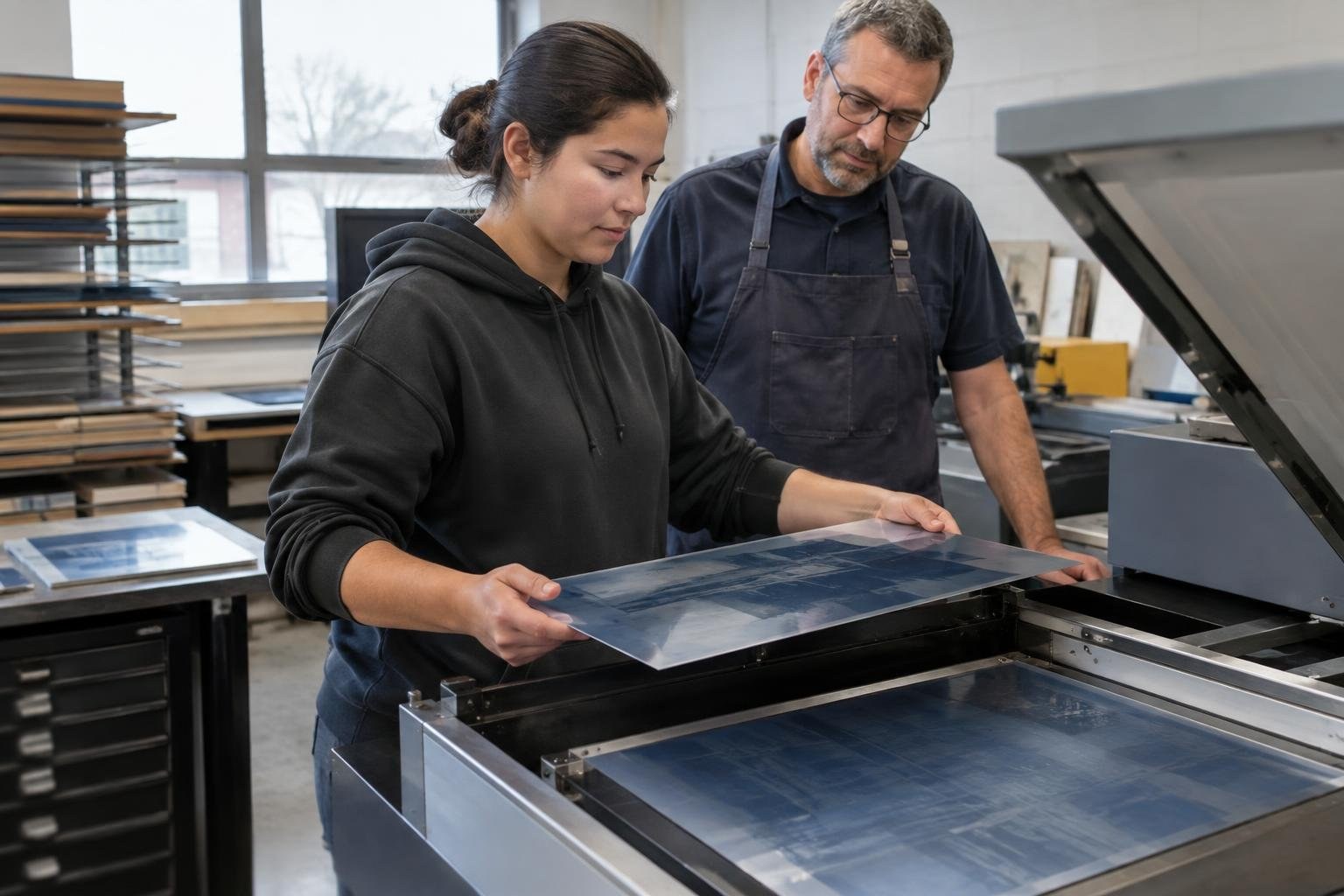
Image preparation and plate production in a supervised educational setting
What Is a Platemaker/Imager Program?
Platemaker/Imager is a graphic communications program category focused on technical preparation of film, digital data, and surfaces used to reproduce printed or graphic images. The federal SEVIS lookup table identifies Platemaker/Imager as CIP 10.0306. A related graphic communications listing describes the program as preparing individuals to apply technical knowledge and skills to that image-reproduction work.
This definition describes the program’s general purpose, not a guaranteed course list, job title, or level of study. Colleges may use different titles or arrange instruction in different ways. Check the official catalog for the exact award, curriculum, admissions requirements, and equipment used.
It is also useful to distinguish the subject from nearby fields. CIP listings identify Printing Press Operator and Computer Typography and Composition Equipment Operator as separate categories. That does not mean programs never overlap; it means prospective students should compare the skills and tasks each particular curriculum emphasizes.
What You May Study and How to Check the Curriculum
The program’s stated purpose centers on preparing film, digital data, and surfaces so images can be reproduced in print or graphic form. The description identifies the work area, but it does not prescribe a standardized national sequence of courses. One college could organize instruction differently from another, so use the catalog and department conversations to understand what you would actually learn.
When examining course descriptions, look for a clear connection between each class and the program’s purpose. Ask whether students learn to handle image information, prepare files or materials, check work for accuracy, and understand how preparation connects to reproduction. These are questions to ask rather than assumptions about what every school teaches.
Find out whether classes include demonstrations, supervised practice, projects, or access to industry-relevant tools. Request a sample assignment or a tour of the learning space if possible. Confirm whether software, materials, protective equipment, or lab access costs extra. A course title alone may not reveal the amount of hands-on practice.
Finally, ask how the program checks that students can apply what they learn. Possible assessment formats vary by school; verify whether the program uses practical evaluations, projects, exams, or another method rather than assuming a particular capstone or portfolio is required.
Who Might Like This Program and What Entry Requirements to Check
This program may suit students who enjoy technical processes, careful visual work, and understanding how an image moves from information or material toward reproduction. It may appeal to someone who prefers specific production tasks to a broad survey of communication topics. Those are possible preferences, not admissions requirements or a personality test.
Consider how you respond to precise, repeatable work. Ask yourself whether you are comfortable following technical steps, checking small details, learning specialized tools, and correcting errors. Also consider whether you want a hands-on environment, a computer-centered workflow, or a mix. The program definition alone cannot confirm what day-to-day work at a particular employer looks like.
Admissions requirements are set by the college. Check for prerequisites, minimum academic standards, placement assessments, application materials, and any equipment or software expectations. If the catalog is unclear, contact admissions and the program department separately. Ask whether students need prior art, design, computer, or print experience; do not assume that they do or do not.
Parents and counselors can help students evaluate readiness by comparing the published requirements with the student’s current preparation and interests. A campus visit or conversation with an instructor can help clarify expectations that a short program description leaves open.
Tuition, Total Cost and Financial Aid
The available program descriptions do not establish a typical tuition price, average total cost, or financial-aid package. Costs depend on the school and the student’s circumstances. Request a written estimate for the full program rather than relying on a headline tuition rate or an estimate for one term.
Ask the school to itemize tuition, mandatory fees, course materials, required software, equipment access, lab charges, and any other costs connected with participation. Also ask whether students must purchase or maintain a computer or other technology. Confirm which expenses are optional and which are required to complete coursework.
For an accurate comparison, use the same assumptions for every school: residency status, number of credits, enrollment pace, transfer credits, and housing or commuting costs. If a program is offered online, ask whether technology, shipping, or any in-person requirement adds expense. Get answers in writing when possible.
Check with each college’s financial-aid office about federal and state aid eligibility, institutional scholarships, payment plans, and deadlines. Students may also ask an employer about tuition assistance if they are already working. Financial support varies; do not count an award toward your budget until eligibility and amount are confirmed.
Accreditation, Certification and Licensure: What to Verify
Program titles and classification codes help identify a subject area, but they do not establish a school’s accreditation status or guarantee that a credential meets an employer’s expectations. The sources identifying CIP 10.0306 do not specify a required professional license, certification, or accrediting body for graduates.
Ask the college what accreditation applies to the institution and, if relevant, the specific program. Verify the accreditor through an authoritative government or accreditor directory instead of relying only on a school’s marketing language. Ask whether the credential transfers to another institution and whether credits apply to a related program.
If the school advertises certification preparation, request the certification’s full name, eligibility rules, exam fees, and the portion of the curriculum that supports it. Separately confirm any requirements with the organization that issues the credential. A course or degree does not automatically mean a student qualifies for a separate certification.
Before enrolling, ask employers in the region or industry you hope to enter what credentials and experience they expect for relevant roles. That conversation can help you assess whether a program’s claims match the requirements you encounter outside the college.
Credential Levels, Format and Time to Completion
The CIP classification identifies Platemaker/Imager as a graphic communications program, but it does not establish which credential levels every college offers. Check whether the school awards a certificate, associate degree, bachelor’s degree, or another credential, and make sure the award shown in the catalog is the one you plan to pursue.
Ask for the total credits or other completion requirements and a sample schedule. Compare full-time and part-time options, course availability by term, transfer-credit policies, and any prerequisite sequence. These details determine how long a student may take; a general program label is not enough to calculate a completion date.
Delivery format also needs school-specific confirmation. If the program is online or hybrid, ask how students access required tools, complete any practical work, and receive feedback. If it is campus-based, find out when labs or equipment spaces are available. Do not assume that a program can be completed remotely simply because some classes are online.
For students considering further education, request a written explanation of how credits transfer and which institutions have accepted them. Confirm transferability with the receiving college before making a decision; acceptance can depend on that institution’s policies and the individual courses.
Careers, Job Searches and Employment Outlook
The program description connects Platemaker/Imager training with preparing film, digital data, and surfaces for printed or graphic image reproduction. CIP listings also identify related categories such as Printing Press Operator and Computer Typography and Composition Equipment Operator. These classifications are useful clues for exploring adjacent work, not proof that a credential qualifies someone for a particular opening.
Potentially relevant job searches may use terms such as platemaker, imager, prepress, or graphic production. Treat these as search terms to investigate, not a list of guaranteed job outcomes. Read current job postings in your area and note which tasks, experience, software, and qualifications employers actually request.
Avoid relying on unsourced wage promises. For labor-market research, identify a specific occupation and location, then consult current U.S. Bureau of Labor Statistics or O*NET information and compare those data with local postings.
Ask colleges for the methods and date behind any graduate employment or earnings claims they publish. Find out whether results are program-specific, how many graduates were included, and whether outcomes reflect jobs related to the field. A career outcome is influenced by location, experience, employer needs, and the skills a student can demonstrate.
Find out which Career or College Major is right for you!
Before comparing schools, decide what matters most: a specific credential, hands-on equipment experience, affordability, transfer options, or a schedule that fits work and family responsibilities. Write down your priorities so a polished website or appealing program title does not distract from requirements that affect your decision.
Curriculum: Which courses directly teach image preparation, and what practical work do students complete?
Tools: What equipment and software are available, and are they included in the cost?
Instruction: Who teaches the program, and how can students get technical help?
Format: Which classes are online, in person, or hybrid, and are there required campus visits?
Outcomes: What jobs have recent graduates pursued, and how were those results measured?
Transfer: Can credits apply toward another credential, and will the receiving institution confirm acceptance?
Compare answers from more than one school when possible. If a representative gives a broad assurance, ask for the relevant catalog language or policy. The most useful program is one whose actual requirements, costs, and instruction suit your goals and circumstances.
Ways to Make the Education More Affordable
Before enrolling, build an affordability plan around the complete published cost. Check whether you can begin with transferable courses or a shorter credential, but confirm transfer and continuation pathways with both institutions. A low initial price may not reduce total cost if credits do not count toward the next program.
Ask financial aid staff to explain grants, scholarships, federal aid, work-study eligibility, payment plans, and application deadlines that may apply to you. Eligibility rules vary, and not every student qualifies for every type of support. Compare aid offers using the amount that does not need repayment separately from loans.
If you work, ask your employer whether education benefits are available and whether the school or program must meet specific conditions. Look into community or professional scholarships only after confirming the award’s requirements, deadline, and permitted use.
For families, discuss a realistic monthly budget that includes transportation, supplies, and time away from paid work. Avoid borrowing based only on a projected future salary. Compare the total amount borrowed with verified program outcomes and your own career plan.
Related Programs and Alternatives
Platemaker/Imager sits within a wider graphic communications landscape. Official classification lists distinguish it from Printing Press Operator and Computer Typography and Composition Equipment Operator. The distinctions can help students identify subjects to compare, but course content and career preparation must be checked at each school.
Printing Press Operator: Consider this alternative if you want to investigate instruction focused on operating printing presses. Confirm the actual equipment and tasks in the curriculum.
Computer Typography and Composition Equipment Operator: Consider this alternative if you want to explore computer-based typography or composition work. Ask how much the program covers layout and preparation compared with image reproduction.
Graphic Communications, Other: Consider this broader or differently focused category if a school’s program does not fit neatly into the named pathways. Read its course list carefully.
Graphic design or visual communication: Consider these fields if your main interest is creating visual concepts and layouts rather than preparing materials for image reproduction. Compare the actual programs, since titles and emphases differ.
General communications: Consider this direction if you want to study communication topics beyond technical graphic production. The subject and occupational pathways may differ substantially.
Use the official program title and course descriptions in any comparison. Classification labels are useful navigational tools, but they cannot tell you whether a particular program suits your goals.
From Program to Career: A Realistic Pathway
Think of career planning as a series of decisions, not a promised ladder. A possible path to investigate is: Platemaker/Imager coursework → entry-level image-preparation or graphic-production opening → experience with particular production processes → deeper specialization or supervisory opportunities. The availability and requirements of each step depend on employers and local conditions.
To make this plan practical, search current job postings for roles that sound relevant. Compare their requirements with the program’s classes and ask the school where graduates have worked. If postings request a skill the curriculum does not appear to cover, ask whether students can gain it through an elective, project, internship, or another experience.
Build evidence of your skills during training when the program permits it. Ask instructors whether you can keep examples of non-confidential coursework or document projects in a portfolio. Seek work-based learning only if the college confirms it is available and explains how placements are arranged.
Questions to Ask Before Enrolling
Use these questions during a college visit, advising appointment, or call with admissions. Request written answers when a policy or cost estimate affects your decision.
What exact credential will I earn, and what are the completion requirements?
Which courses teach the preparation of film, digital data, or image-reproduction surfaces?
What equipment and software will I use, and are there additional charges?
What are the full estimated costs for my residency and enrollment status?
What accreditation applies, and how can I independently verify it?
Are any licenses or certifications relevant to my intended work, and does this program prepare students for them?
Can I complete the program online, and what practical work or campus attendance is required?
How are transfer credits evaluated, and can the school provide a written plan?
What support, career services, employer contacts, or work-based learning options are available?
How does the school calculate and report graduate employment outcomes?
Which financial aid and scholarship deadlines should I meet?
If the answers are vague, compare another program before committing. Clear information about costs, curriculum, and outcomes helps families make a more grounded decision.
Frequently asked questions
What is a Platemaker/Imager program?
A Platemaker/Imager program prepares students to apply technical knowledge and skills to film, digital data, and surfaces used to reproduce printed or graphic images. The precise classes and equipment experience depend on the college, so review its current course descriptions and ask what students practice hands-on.
Is a Platemaker/Imager program difficult?
It depends on the program’s technical content and your preparation. Ask to see a sample course sequence, the software or equipment used, and the amount of time spent practicing each skill. If you are comparing programs, look for clear explanations of prerequisites and support for students who are new to the subject.
How much does a Platemaker/Imager program cost?
Compare each school’s tuition and mandatory fees for your residency and enrollment status, then include supplies, equipment or software access, transportation, and any other program-specific charges the school confirms. Request a written estimate for the full credential, not only the per-credit price.
Can I study Platemaker/Imager online?
The program description is focused on preparing film, digital data, and surfaces to reproduce printed or graphic images. Whether a credential can be completed online is a school-specific question, especially because students may need access to relevant equipment or software. Ask how online students complete every practical requirement before applying.
Does a Platemaker/Imager program require a license or certification?
Do not assume that completing a program automatically grants a professional license or certification. The sources available for this guide identify the instructional program category, not occupation-specific licensing rules. Ask the college what credentials it prepares students for, and check with relevant employers or licensing bodies about requirements where you plan to work.
How is Platemaker/Imager different from a printing press operator program?
A closely related CIP category is Printing Press Operator, listed separately from Platemaker/Imager in the federal classification source. Compare the actual curricula: ask whether each program emphasizes image preparation, press operation, or another part of graphic production. Program titles alone may not tell you what equipment and tasks students will learn.
People Also Ask
What does a Platemaker/Imager do?
Platemaker/Imager is a graphic communications instructional program category. Its stated focus is technical preparation of film, digital data, and surfaces for reproducing printed or graphic images. A school’s catalog is the best place to confirm the actual credential and courses.
What should I expect to learn in a Platemaker/Imager program?
Start with the program’s current catalog, then ask the department which image-preparation tasks students practice, what equipment and software are available, and whether students complete a portfolio or other applied project. Verify details directly because program titles do not guarantee identical curricula.
Is Platemaker/Imager the same as printing press operation?
A Platemaker/Imager program is categorized separately from Printing Press Operator in the CIP listings. That distinction is a useful starting point, but it does not replace a curriculum comparison. Ask each college which production tasks its courses emphasize.
How long does it take to complete Platemaker/Imager training?
Program duration depends on the credential, the college’s course sequence, your enrollment pace, and transfer credit. Ask for the published credit requirement and a sample schedule for both full-time and part-time study before estimating how long you will need.
What salary can I expect after Platemaker/Imager training?
There is no salary figure in the sources used for this guide. For a realistic estimate, identify the exact occupation and region you are considering, then consult current government labor-market data and compare it with the school’s documented graduate outcomes. Do not treat a program title as a promise of a particular job or wage.
How can I make a Platemaker/Imager program more affordable?
Ask the college for a complete cost estimate for your situation, including tuition, fees, supplies, equipment or software expenses, and any other required charges. Then check eligibility for federal and state aid, scholarships, payment plans, and employer support if applicable.
A Platemaker/Imager program may be worth exploring if you want to learn how film, digital data, and image-reproduction surfaces are prepared for printed or graphic images. The exact training, equipment, credential, cost, and career preparation depend on the college and program. Compare curriculum and hands-on access, ask for complete cost and outcomes information, and check whether the program connects to the work you want to do before enrolling.
Want to see your options? Try our comprehensive Degree, Program & College Search tool
We use cookies to offer you a better browsing experience, analyze site traffic and personalize content.
Read about how we use cookies and how you can control them in our
Privacy Policy.
If you continue to use this site, you consent to our use of cookies.
×
Exciting News!
Be one of the first to Beta Test the new AI-Powered Assessment.com Platform.