Broadcast Journalism Degree Guide: Courses, Careers, and How to Choose
Explore what a broadcast journalism degree teaches, the careers it may prepare you for, program formats and costs, and how to decide whether it fits your goals.
By Tome Fierre · Staff Writer Assessment.com · Published October 7, 2026 · Last updated November 5, 2026
A broadcast journalism degree prepares students to report, produce, and deliver news through media such as radio, television, and video. Depending on the program, students may study journalism principles and ethics while learning practical production methods. The National Center for Education Statistics classifies broadcast journalism as CIP 09.0402 and describes preparation for work such as broadcast journalist, editor, producer, director, or manager. The exact curriculum and career preparation differ by college. Not sure whether broadcast journalism fits you? Take the Free MAPP Career Assessment to explore how your motivations, interests, and preferences may align with this degree and related careers.
Degree & Program Decision Insights
Explore your personal fit, education requirements, career potential and next steps.
01Motivational Fit
Discover whether this program fits you
Explore your preferences against the focus of Broadcast Journalism. These prompts are not personal MAPP results.
Subject curiosity. Would you choose to explore “the principles of broadcast technology” in depth? Ask for a sample learning activity to test that interest.
Breadth of interest. Consider the place of “broadcast reporting” in this field. Is this another part you would choose to explore, or mainly a requirement you would tolerate?
Work reality. Related work can involve this task: “Record commercials for later broadcast.” Would you want that activity to be a regular responsibility?
Interest in studying a field can differ from enjoying its related work.
Which part would you want to do repeatedly, and what would you try before deciding?
Discover Your Personal Program Fit
Before investing your time and money in your education, discover how this program aligns with your natural motivations, work preferences and career goals.
U.S. occupational wages are not guaranteed graduate earnings; OEWS excludes self-employed workers.
Projected openings include replacements as well as growth.
U.S. national estimates. A crosswalk does not establish entry-level eligibility; advanced, management and teaching roles can require further qualifications.
Explore your motivations. Use MAPP as a starting point for reflecting on your interest in “the principles of broadcast technology”, then test that interest against a sample learning task.
Examine the work. Compare Broadcast Announcers and Radio Disc Jockeys and News Analysts, Reporters, and Journalists on daily work and entry qualifications, as well as pay. Explore Broadcast Announcers and Radio Disc Jockeys.
Compare actual providers. Ask for the exact credential, course sequence and assessment methods. Compare how each provider teaches “broadcast reporting”, its entry criteria and its itemized costs.
Check the evidence before applying. Confirm prerequisites and any recognition or professional requirements for your intended route; ask for applicable rules and published outcome definitions in writing.
Verify the institution’s current offering, admissions requirements and outcomes; a search result does not establish your eligibility.
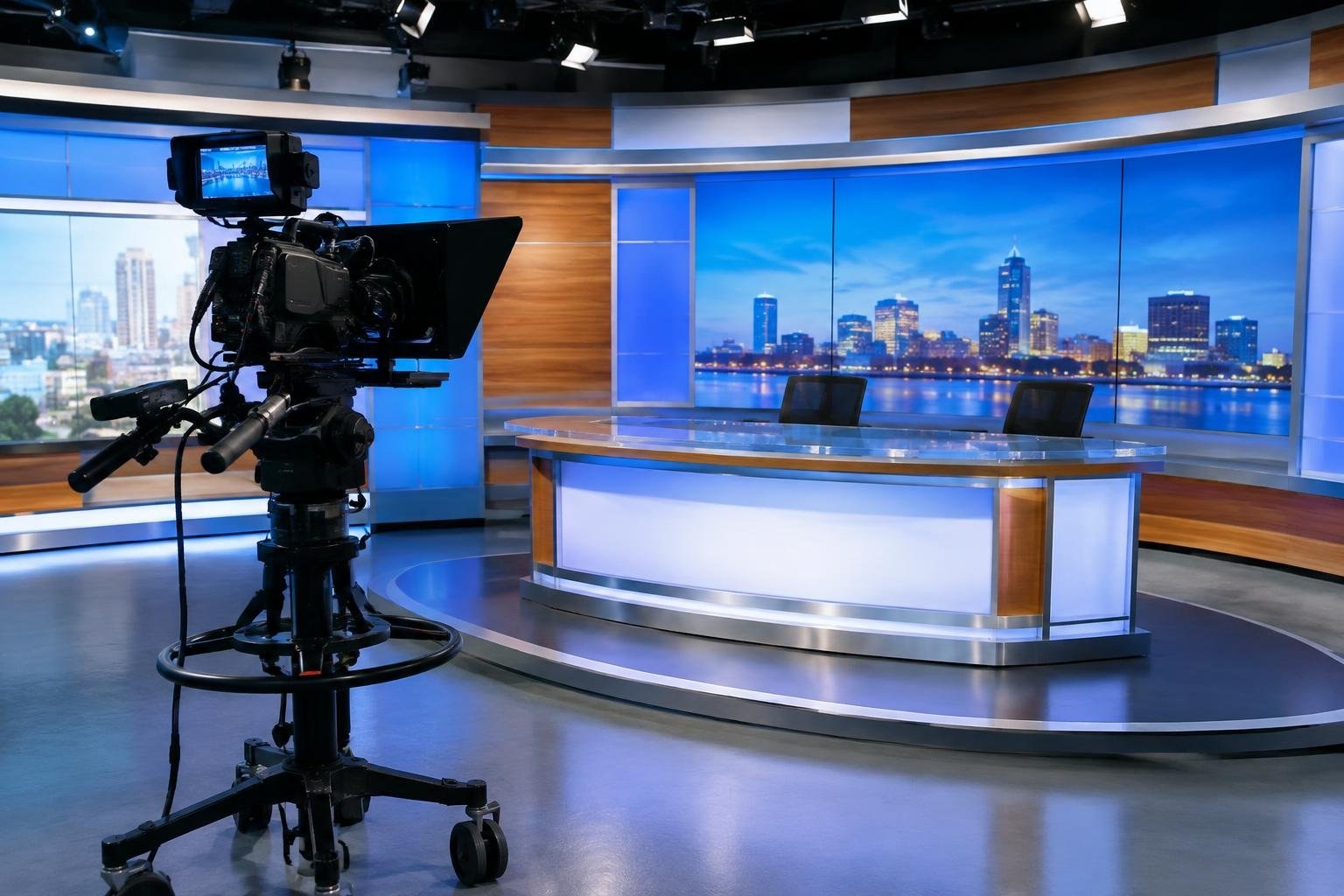
A student team working with cameras, microphones, and a studio news set
What Is a Broadcast Journalism Degree?
A broadcast journalism degree is a college program focused on the methods and techniques used to report, produce, and deliver news through radio, television, and video or film. The National Center for Education Statistics definition for CIP 09.0402 names broadcast journalists, editors, producers, directors, and managers as possible professional directions. It does not promise employment in those roles.
Colleges may use labels such as broadcast journalism, broadcast news, or journalism and mass communication for programs with overlapping content. Names alone do not establish what students learn. Compare required courses, production practice, and the kinds of media projects students complete. The NCES definition is a useful starting point, while the school catalog is the guide to a specific program.
Broadcast journalism is related to print journalism and broader communication studies, but the emphasis can differ. A program centered on broadcast news focuses on reporting and delivering news through audio and video formats; a broader journalism curriculum may also emphasize print news, editing, or management. Check course descriptions to see the actual distinction. A related journalism program description describes preparation for print journalists, news editors, and news managers.
What Do You Study in Broadcast Journalism?
Broadcast journalism courses can combine journalism concepts with hands-on production. The 2024–2025 Nicholls State University catalog, for example, lists television production work involving cameras, microphones, sets, lights, and videotape. This is an example of one catalog, not a required national curriculum.
A 2019–2020 Nicholls catalog describes a broadcast journalism workshop involving radio and television news writing, video news-story production, and television news graphics. Together, these examples show why prospective students should look past the major name: courses can address both editorial decisions and the process of making a finished news segment.
Questions to ask about the curriculum
Which reporting and writing courses are required?
Do students practice audio, television, and video production, or only selected formats?
When do students gain access to production courses, and are there prerequisites?
Can students complete substantial reporting or production projects?
Are internships, practicums, or a capstone required, optional, or unavailable?
Ask the department for a sample degree plan and recent course descriptions. A catalog establishes what is listed as coursework, but you should confirm whether classes are offered regularly and how students access production facilities.
Who Is This Program For, and What Are the Entry Requirements?
This field can appeal to students who are curious about current events and want to explain information to an audience. It may also interest people who like collaborative, deadline-driven projects and want to work across writing and media production. Those are useful questions for self-reflection, not admission criteria or a required personality profile.
Consider whether you want to investigate stories, make editorial choices, and communicate through audio or video. Think, too, about whether you prefer a mix of planning and practical production or a course of study centered more heavily on theory or another communication format. Students who are uncertain can review sample assignments and talk with current students or faculty before deciding.
Admission requirements vary by college
Check admissions pages for each college and ask whether entry to the major is separate from admission to the institution. If a program asks for prior media work, confirm what formats it accepts; do not assume professional experience is required.
When comparing options, separate the college’s general admission criteria from requirements for upper-level production classes. Ask about course prerequisites, equipment orientation, and whether students can begin building experience early. These details matter to both recent high school graduates and adults transferring credits or returning to education.
Tuition, Costs, and Financial Aid
There is no reliable universal tuition figure for broadcast journalism in the program descriptions cited here. Total cost depends on the institution and the student’s plan, so compare current tuition and mandatory fees directly with each college. Ask whether production courses involve extra charges for equipment, materials, or facility access, and whether commuting, housing, or technology will add to your budget.
Request a term-by-term estimate, not only a per-credit price. The total amount you pay can be affected by enrollment pace, transfer credit, course availability, and the time needed to finish. Ask the financial aid office to distinguish grants and scholarships from loans, and to explain what conditions apply to any award.
Ways to investigate affordability
Compare estimated net cost after grants and scholarships, not just published tuition.
Ask whether credits from prior college work can transfer and how the school evaluates them.
Check whether part-time study changes financial aid eligibility or total time to completion.
Ask about paid campus work, employer tuition assistance, and local or field-related scholarships.
Include travel, technology, and any course-related production expenses in your personal estimate.
These are planning questions, not a claim that every school offers each funding option. Get current, written estimates from the institutions you are considering and review award terms before committing.
Degree Levels, Format, and Time to Completion
Broadcast journalism may be offered within several credential levels, but the evidence here does not establish how commonly each level is available or set a standard credit total or duration. A certificate, associate degree, bachelor’s degree, graduate certificate, master’s degree, or doctorate can represent different amounts and kinds of study. Ask schools what the credential includes and which jobs or further study it is meant to support.
Completion time depends on the specific degree map, course load, transfer credit, and when required courses are offered. A full-time plan may differ substantially from a part-time schedule, especially if production classes have prerequisites or limited seats. Online, hybrid, and campus formats also vary by college.
Check the format behind the label
Ask whether production courses require on-campus equipment or in-person attendance, how remote students complete practical work, and whether internships or other placements are part of the program. Do not assume that an “online” label means every requirement can be completed from home. Request a sample schedule for the exact credential and format you would enroll in.
Careers, Jobs, and Employment Outlook
The NCES program definition connects broadcast journalism with professional broadcast journalists, editors, producers, directors, and managers. These are possible career directions, not guaranteed results, and the definition does not specify the education or experience required for each job. A separate journalism program description identifies print journalists, news editors, and news managers, illustrating that journalism career paths can extend beyond broadcast formats.
Career direction
How the degree may relate
What to verify
Broadcast journalist
The program is specifically oriented toward reporting and delivering news through broadcast media.
Reporting experience, sample work, and role-specific hiring criteria.
Editor
Programs may teach how news is processed and delivered; some include news graphics or production work.
Whether the employer expects editing experience with particular media or tools.
Producer
Production coursework can introduce the coordination and creation of news programming.
Experience, project responsibility, and employer-specific requirements.
Director or manager
These are professional directions named in the NCES program description.
Whether the position requires substantial experience or additional qualifications.
No salary or job-growth figure is provided here because the supplied program sources do not report current occupational wage or outlook data. A major is not an occupation, and an occupation’s pay cannot be inferred from its degree label. Before deciding on return on investment, research each target job title using current wage and outlook information, then compare local postings for education and experience requirements.
To explore related career paths, see Assessment.com’s guides to reporters and correspondents, broadcast news analysts, editors, producers and directors, and film and video editors. Media employers and job duties can differ, so look for actual role descriptions rather than assuming that all graduates enter the same market. Treat claims about future demand, top salaries, or guaranteed placement with caution unless the school provides clear, current, and independently verifiable evidence.
Find out which Career or College Major is right for you!
Experience, Portfolios, Certification, and Licensure
Catalog descriptions provide examples of coursework, not evidence of any individual student’s experience or a standard curriculum. The 2024–2025 Nicholls State University catalog lists television production procedures. Its 2019–2020 catalog describes a broadcast journalism workshop covering radio and television news writing, video news-story production, and television news graphics. Ask each department whether it offers newsroom practice, internships, student media, collaborative projects, or other ways to produce work outside class; offerings vary by school.
How to prepare work for employers
Keep a portfolio or reel of work you are allowed to share, with a clear note about your role on each project.
Practice explaining how you researched, reported, produced, or edited a story.
Seek feedback on accuracy, clarity, sound, visuals, and organization.
Ask faculty and career services about internships, student media, and professional networking opportunities.
Read job postings for your intended role and use them to identify skills to develop while in school.
A degree and a professional credential are not automatically the same thing. Confirm requirements for a specific job and location with the employer or relevant authority rather than assuming one certificate applies across the field.
Graduate School and Specialization
The NCES description of broadcast journalism names possible professional directions but does not state that graduate study is required. Check the current requirements for the specific role you want rather than assuming an advanced degree is necessary.
Before applying to graduate school, identify the role you want and compare the program’s prerequisites, curriculum, cost, and time commitment with other ways to build relevant experience, such as reporting projects, internships, or specialized coursework. Ask admissions staff what students study and produce, and confirm that the program’s stated focus matches your goals.
Related Degrees and Alternatives
Related options include journalism, mass communication, communication, video or film production, and public relations. Their titles do not guarantee a standard curriculum, so compare course lists and the work students complete. You can browse degree fields and use Assessment.com’s guide to choosing college majors as you compare options.
Journalism: Consider this if you want to explore news work beyond broadcast; a related program description emphasizes print journalists, editors, and news managers.
Mass communication: Consider this if you want a wider survey of media fields. A Nicholls catalog places broadcast production courses in its mass communication course listings.
Communication: Consider this if you want to compare a broader communication-focused curriculum with a news-production concentration; inspect the actual degree requirements.
Video or film production: Consider this if you are more interested in production work than in gathering and delivering news. Confirm whether programs focus on news or other kinds of content.
Public relations: Consider this if your goal is communications work outside newsroom reporting. A Nicholls catalog separately lists public relations practice and case studies, illustrating that programs may distinguish it from broadcast journalism.
Compare broadcast journalism with a broader journalism degree by asking how much required work centers on radio, television, and video news versus print or other formats. Compare it with communication by asking whether the curriculum builds reporting and production practice or emphasizes other communication topics. Use course requirements, project examples, and career plans, not titles alone.
How to Choose a Broadcast Journalism Program
Do not choose a program based only on its name, a promotional salary claim, or a broad list of possible careers. Compare what students must learn and make, whether the format works for you, and how the total cost fits your finances. The following steps can help you make a grounded decision.
Check program identity. Confirm the school’s stated credential and whether the curriculum is specifically broadcast journalism or a broader major with a few production electives.
Review courses. Look for required reporting, writing, ethics, and production study, and ask which media formats students practice.
Investigate practical work. Ask to see examples of student work and find out how students access equipment, project feedback, and internships.
Verify outcomes. Request the school’s definitions, time period, and methodology for any employment or salary statistics it publishes.
Calculate total cost. Compare net price estimates, fees, course-related expenses, transfer credit, and realistic time to completion.
Check credentials and requirements. Ask whether employers or state authorities relevant to your intended role require any specific credential. Do not confuse degree completion with a license.
Compare format and support. Confirm online attendance expectations, course availability, advising, and access to career services.
The NCES CIP entry can help confirm the program category, while college catalogs show the courses a particular institution lists. Neither alone can establish whether a program is a good personal fit.
Questions to Ask Before You Enroll
Use these questions when speaking with admissions staff, department advisers, financial aid offices, and current students:
What is the full program name and credential, and what courses are required?
What will I pay after grants and scholarships, including fees and production-related costs?
How do transfer credits affect my degree plan and expected completion date?
Which courses include practical reporting or production, and what work will I complete?
Are internships or student media opportunities available, and how do students find them?
Can all requirements be completed in my preferred format, or are campus visits required?
What outcome data does the school publish, how is it measured, and which graduates are included?
What career advising and employer connections can students access?
Does my intended job require additional education, certification, or a license?
Which financial aid offers are grants, scholarships, work, or loans, and what terms apply?
Write down the answers and compare schools using the same questions. If an important claim is only verbal, ask for the relevant policy or estimate in writing.
From Degree to Career
A career plan is a set of choices to explore, not a guaranteed progression. The NCES description associates broadcast journalism with possible work as a broadcast journalist, editor, producer, director, or manager, but does not promise advancement or set a standard career path.
To investigate options, compare job descriptions and the work involved in roles such as reporters and correspondents, broadcast news analysts, editors, producers and directors, and film and video editors. The NCES program definition identifies several of these as possible professional directions; individual employers set hiring requirements.
When comparing study options, review each program’s actual courses and production work. Browse degree fields or read Assessment.com’s guide to choosing a college major as you consider related education. Revisit your plan as you learn more about the work and the preparation it may require.
Frequently asked questions
What is a broadcast journalism degree?
A broadcast journalism degree focuses on gathering, processing, and delivering news through radio, television, and video or film. Programs may combine journalism principles with production practice. Coursework varies by school, so compare actual class requirements and opportunities to produce work before enrolling.
Is broadcast journalism a hard major?
The academic and practical demands depend on the program. Some curricula cover journalism ethics and media history alongside production work such as coordinating cameras, microphones, sets, lights, and recorded video. Students should review prerequisites and ask how much practice is built into required courses.
What jobs can you get with a broadcast journalism degree?
Graduates may pursue broadcast journalism, editing, producing, directing, or management work, but a degree does not guarantee a role. The federal program definition identifies these as professional directions associated with broadcast journalism. Review current job postings to understand employers’ education and experience expectations.
How much can you make with a broadcast journalism degree?
Pay depends on the specific occupation, employer, location, and experience. The program sources here do not provide current wage estimates, so avoid relying on a single salary figure for the major. Compare wage data for specific job titles and geographic areas using current U.S. Bureau of Labor Statistics information.
Can you earn a broadcast journalism degree online?
Some programs may offer online coursework, but whether a fully online route is practical depends on how the school teaches production and provides access to equipment and hands-on work. Ask which courses must be completed in person and how remote students produce and submit broadcast work.
Does broadcast journalism require math?
The supplied program descriptions do not establish a universal math requirement. Requirements vary by college and credential. Check the degree map and course catalog for required general education, statistics, research, or other quantitative courses before applying.
Do you need graduate school for broadcast journalism?
Not every broadcast journalism role has the same education requirements. The program definition lists professional roles in journalism, editing, producing, directing, and management, but it does not specify hiring rules. Check current job postings and ask program advisers whether graduate study is relevant to your intended career.
How is broadcast journalism different from journalism or mass communication?
Journalism, mass communication, and related media programs can overlap, but titles alone do not tell you how much broadcast production a curriculum includes. Compare required courses, practical production work, and the kinds of news media the program prepares students to cover.
People Also Ask
What does a broadcast journalism major study?
Broadcast journalism focuses on reporting and delivering news through radio, television, and video or film. Programs may combine journalism knowledge with news writing and production practice. Review each school’s curriculum to see which media formats and production skills it actually teaches.
What is the CIP code for broadcast journalism?
The program’s CIP classification is 09.0402. CIP codes are used to classify instructional programs, while college catalogs explain the actual courses and requirements students must complete. Use both the program title and the course list when comparing degrees.
How long does a broadcast journalism degree take?
Duration depends on credential level, enrollment pace, transfer credit, and school requirements. Request a degree map showing required credits and a realistic completion plan for your circumstances.
How much does a broadcast journalism degree cost?
There is no reliable single cost for this degree in the supplied evidence. Compare each college’s current tuition, mandatory fees, equipment or production costs, and likely time to completion. Ask financial aid offices for a personalized estimate and compare net cost, not just the advertised tuition rate.
Is broadcast journalism a good major for becoming a producer?
Broadcast journalism programs can lead toward several kinds of work, including journalism, editing, production, directing, and management. The right next step depends on the specific role. Check current job postings for education, experience, portfolio, and technical requirements before choosing a program.
Should I choose broadcast journalism or a general communication degree?
The best choice depends on whether you want substantial practice reporting and producing broadcast news or a broader course of study. Compare required classes and finished student work rather than relying only on labels such as journalism, communication, or mass communication.
Broadcast journalism may suit students interested in reporting and producing news for radio, television, or video. A degree does not guarantee a specific job or career path, so compare program courses, costs, practical work, and the requirements of roles you may want to pursue. To explore how your interests may connect with education and career options, use Assessment.com’s MAPP career assessment.
Want to see your options? Try our comprehensive Degree, Program & College Search tool
We use cookies to offer you a better browsing experience, analyze site traffic and personalize content.
Read about how we use cookies and how you can control them in our
Privacy Policy.
If you continue to use this site, you consent to our use of cookies.
×
Exciting News!
Be one of the first to Beta Test the new AI-Powered Assessment.com Platform.