Neurobiology and Neurosciences, Other: Degree Guide to Programs, Careers and Fit
Explore what Neurobiology and Neurosciences, Other can include, how programs vary, what students may study, and how to evaluate costs, career paths, and personal fit.
By Kieth Nelson · Staff Writer Assessment.com · Published October 9, 2026 · Last updated November 5, 2026
Neurobiology and Neurosciences, Other is a broad field-of-study category for programs about the nervous system and neuroscience topics that are not classified under a more specific listed program. The name does not point to one nationally standard set of courses. One college may emphasize the biological basis of brain function, while another may connect neuroscience with physiology, behavior, or biomedical research. Students may encounter neuroscience through a certificate, undergraduate major, graduate program, or another credential, but availability and curriculum depend on the institution. The field can connect to research, biology, bioinformatics, clinical research coordination, and further study in healthcare or science. A degree does not by itself guarantee access to a particular occupation or professional license. For students and parents, the key question is what a particular program teaches and where its coursework can lead. Compare the catalog, prerequisites, research options, total cost, and the education required for target jobs before deciding. Not sure whether this field fits? Explore Assessment.com’s education resources and guidance on choosing college majors as part of your decision process.
Degree & Program Decision Insights
Explore your personal fit, education requirements, career potential and next steps.
01Motivational Fit
Discover whether this program fits you
Explore your preferences against the focus of Neurobiology and Neurosciences, Other. These prompts are not personal MAPP results.
Subject curiosity. Would you choose to explore “neurobiology and neurosciences not listed above” in depth? Ask for a sample learning activity to test that interest.
Choosing a learning environment. Compare actual Neurobiology and Neurosciences, Other offerings. Would their reading, projects or practical work suit how you prefer to learn? Confirm the format rather than assuming one from the field name.
Work reality. Related work can involve this task: “Follow strict safety procedures when handling toxic materials to avoid contamination.” Would you want that activity to be a regular responsibility?
Interest in studying a field can differ from enjoying its related work.
Which part would you want to do repeatedly, and what would you try before deciding?
Discover Your Personal Program Fit
Before investing your time and money in your education, discover how this program aligns with your natural motivations, work preferences and career goals.
Typical occupational entry: bachelor's degree (BLS). BLS lists 5 years or more of related work experience as typical for this occupation; this programme is not a direct promise of entry.
U.S. occupational wages are not guaranteed graduate earnings; OEWS excludes self-employed workers.
Projected openings include replacements as well as growth.
U.S. national estimates. A crosswalk does not establish entry-level eligibility; advanced, management and teaching roles can require further qualifications.
Compare the focus and route of these distinct instructional fields; their credentials and admission requirements are not interchangeable.
Neurobiology and BehaviorCIP 26.1504. Compare its emphasis on neuronal systems and circuits and higher level studies of behavior and cognition with this program’s focus.
Neurobiology and AnatomyCIP 26.1503. Compare its emphasis on molecular and cellular studies of neuronal and glial cells and circuits and neural transmitters and receptors with this program’s focus.
NeuroanatomyCIP 26.1502. Compare its emphasis on cellular and circuit anatomy and mapping of neuronal pathways with this program’s focus.
Explore your motivations. Use MAPP as a starting point for reflecting on your interest in “neurobiology and neurosciences not listed above”, then test that interest against a sample learning task.
Examine the work. Compare Medical Scientists, Except Epidemiologists and Natural Sciences Managers on daily work and entry qualifications, as well as pay. Explore Medical Scientists, Except Epidemiologists.
Compare actual providers. Ask for the exact credential, course sequence and assessment methods. Compare how each provider teaches “Neurobiology and Neurosciences, Other”, its entry criteria and its itemized costs.
Check the evidence before applying. Confirm prerequisites and any recognition or professional requirements for your intended route; ask for applicable rules and published outcome definitions in writing.
Verify the institution’s current offering, admissions requirements and outcomes; a search result does not establish your eligibility.
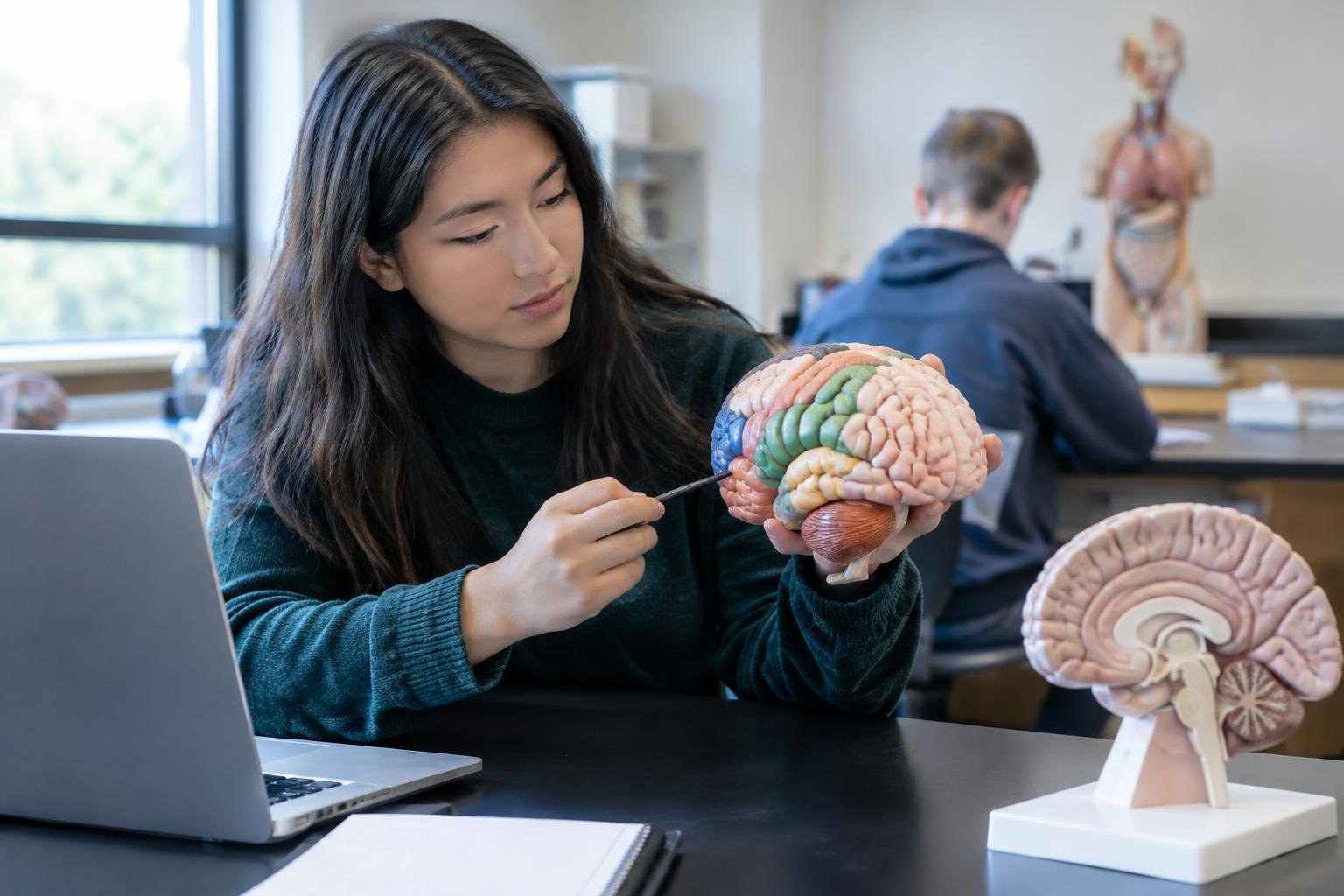
Student learning about brain structure and neuroscience
What Is Neurobiology and Neurosciences, Other?
Neurobiology and Neurosciences, Other is a classification for instructional programs in neurobiology and neuroscience that are not listed under a more specific category. In practical terms, it describes a broad academic area rather than a single standardized major. A college may use a different program name, and the name alone cannot tell you which subjects or methods are required.
Neuroscience investigates the nervous system. Depending on the program, study may link brain function with physiology, behavior, biology, or biomedical questions. Arizona State University describes one related undergraduate concentration as integrating neurobiology, physiology, and behavior to examine how animals, including humans, function, think, and behave. That is an example of a related program, not a template that every college follows.
When comparing programs, look past labels such as “neuroscience,” “neurobiology,” or “biomedical neuroscience.” Read the degree requirements and course descriptions, and ask an adviser how the curriculum differs from biology, psychology, or a more specialized neuroscience major.
See an official example of a biological sciences concentration that combines neurobiology, physiology, and behavior.
What Do You Study in a Neuroscience Program?
There is no universal course list for this “Other” category. Start by checking whether a program is primarily biological, behavioral, biomedical, or interdisciplinary. Course titles and descriptions should clarify what students will learn and how much emphasis the institution places on laboratory science, research, and quantitative work.
At the undergraduate level, a related program may connect nervous-system study to physiology and behavior. Graduate neuroscience education can be broader and interdisciplinary: Penn State describes a program that combines multiple disciplines with expertise in a selected area and encourages interdisciplinary research. Its stated preparation expectations include undergraduate biology, chemistry, physics, and mathematics courses.
Ask whether students can join faculty research, complete a thesis or capstone, or take laboratory courses. These features should be verified in the current catalog; they should not be assumed from the word “neuroscience.” Also check whether a program includes clinical placements or is research-focused. Those are different educational experiences and may support different goals.
Review Penn State’s published graduate neuroscience program description and preparation expectations.
Who Is This Program For? Interests and Entry Requirements
Students drawn to this field often want to understand how the brain and nervous system relate to biological function, thinking, or behavior. The subject can appeal to people who enjoy asking how complex systems work, studying evidence, and linking ideas across more than one discipline. Those interests are possibilities, not entry requirements or personality rules.
Be prepared to check the science demands carefully. Penn State’s graduate neuroscience admissions information expects a bachelor’s degree in a biological, physical, or behavioral science and previous coursework in biology, chemistry, physics, and mathematics. That is a specific graduate-program example, not a general admissions rule for every neuroscience credential.
Undergraduate admissions, transfer rules, GPA expectations, and application materials differ by college. For graduate admissions, compare the program’s stated prerequisites and ask whether applicants from another major can complete missing coursework. Southern Illinois University’s catalog, for example, describes distinct expectations for its graduate routes, including a published GPA threshold for a particular master’s concentration. Do not apply that threshold to other schools or concentrations.
Check the official graduate catalog for an example of program-specific admissions expectations.
Credential Levels, Online Options, and Completion Time
The credential menu for this subject varies by school. The supplied program classification spans certificate, associate, bachelor’s, post-bachelor’s certificate, graduate certificate, master’s, first-professional, and doctoral categories, but that does not mean every institution offers each level. Confirm the actual award and program status with the college.
Examples show how different the options can be. Manhattanville University offers undergraduate B.A. and B.S. neuroscience options. Penn State describes graduate neuroscience study, and the University of Florida offers a fully remote Graduate Biomedical Neuroscience Certificate intended for post-baccalaureate students and working professionals. These examples are not interchangeable: a certificate, bachelor’s degree, and doctoral program serve different educational purposes.
Time to completion depends on the credential, course load, transfer credits, and program rules. Ask the registrar or department for a written plan based on your circumstances. For online and hybrid options, clarify whether all required coursework is remote and whether research, laboratories, or other program activities require campus attendance.
See Manhattanville’s stated undergraduate neuroscience degree options and the University of Florida’s online graduate certificate description.
Tuition, Total Cost, and Financial Aid
No single tuition figure represents every neuroscience program. The amount a student pays depends on the institution, credential, enrollment pattern, residency classification, and the costs included in the school’s estimate. Compare tuition and mandatory fees with books, laboratory or course expenses, technology needs, transportation, and living costs where applicable.
Request a total-cost estimate for the full program, not only a per-credit or per-term price. Ask how transfer credits affect the number of remaining courses and whether aid applies to the intended program and enrollment load. Check federal and institutional aid eligibility, scholarships, grants, payment plans, and employer education assistance directly with the relevant offices. Do not assume that an online option costs less or that a scholarship will renew automatically.
For a fair comparison, record the net amount the student expects to pay, the time required, and any additional education likely to be needed for the intended career. If the college cannot explain charges or aid terms clearly, pause before committing.
Skills to Look For in the Curriculum
Neurobiology and neuroscience study can build knowledge of biological and nervous-system concepts, research literacy, and the ability to connect ideas across related disciplines. Which practical skills a student develops depends on required courses and experience. Do not assume that every degree includes the same laboratory techniques, data tools, clinical exposure, or programming.
Review course descriptions and ask what students actually practice. Look for opportunities to interpret scientific evidence, communicate findings, collaborate on research, or work with biological and behavioral questions. If a target occupation uses data analysis or specific lab methods, ask the department whether students receive instruction in those skills and how they can demonstrate them to employers or graduate programs.
A useful program comparison asks not only “What topics are covered?” but also “What will I be able to do at the end, and how will I show it?” A research project, documented lab experience, or clear portfolio of academic work may help a student explain their preparation, where the program offers such opportunities.
Careers, Jobs, and Employment Outlook
Possible career directions associated with this field include bioinformatics scientist, biological scientist or biologist, clinical research coordinator, geneticist, medical scientist, molecular and cellular biologist, postsecondary biological science teacher, and natural sciences manager. The program title alone does not qualify a graduate for each role. Some positions may require additional education, experience, or role-specific qualifications.
Think in stages. A student may first seek a research-support or science-related role, then build experience or continue to graduate study before pursuing more specialized research, teaching, or leadership work. The appropriate pathway depends on the employer and occupation. For example, a student interested in teaching at the postsecondary level should ask departments about the degree expectations for teaching and research positions; someone interested in healthcare should verify the separate education and licensing path for the specific profession.
There is no single salary or employment outlook for this degree category because it connects to different occupations. Compare current pay and projected demand by exact job title, geographic area, and typical entry requirements. Treat any broad promise about jobs or earnings as a reason to ask for role-specific evidence, not as a guarantee.
Explore science career areas, including bioinformatics scientists, clinical research coordinators, and medical scientists.
Find out which Career or College Major is right for you!
Accreditation, Licensure, and Additional Credentials
A neuroscience degree and a professional license are not the same thing. The program classification covers academic study; it does not establish that a graduate is licensed for a healthcare occupation. If a goal involves patient care or another regulated profession, identify the exact job and verify its education, examination, supervised-practice, and licensing rules with the relevant state authority or professional body.
For research and laboratory-oriented goals, ask prospective employers or graduate programs what credentials and experience they expect. A certificate may add focused study, but it should not be assumed to replace a required degree or professional qualification. Likewise, a college’s general neuroscience program is not automatically accredited for a separate regulated profession. Verify accreditation for the particular program when it is relevant to the career path.
When a school describes a program as preparation for healthcare or graduate study, ask which pathway it supports and which requirements remain after graduation. Manhattanville’s accelerated neuroscience option, for instance, describes pre-health advising for applications to medical, dental, pharmacy, and other advanced programs; advising is not admission to those programs or professional licensure.
Read the university’s description of its accelerated neuroscience and pre-health advising pathway.
How to Choose a Program and Compare Colleges
Before choosing a college, compare the actual curriculum and the work a student can complete. A useful checklist includes:
Are the course requirements aligned with the student’s interests and intended next step?
Are research, laboratory, internship, or capstone options described clearly?
What prerequisites must be completed before admission or before upper-level courses?
Can transfer credits apply, and who will confirm that in writing?
What is the estimated total cost after grants and scholarships?
Does the online or campus format fit the student’s schedule and learning needs?
What advising and career services can students access?
How does the institution report program completion and career outcomes?
Check that the institution and any career-relevant specialized program hold the accreditation needed for the student’s goals. For a graduate program, contact faculty or admissions staff about research fit and prerequisite gaps. For undergraduate study, ask whether students can explore more than one area before choosing a concentration.
Assessment.com’s college major guidance can help students and parents organize a discussion about goals and fit. For more exploration, use education resources and compare career directions before committing.
Related Degrees and Alternatives
Neuroscience is interdisciplinary, so a neighboring major may be a better match if the student wants a different center of attention. Compare sample course plans rather than choosing based on a major’s reputation.
Biology: consider it if you want broad study of living systems rather than a sustained focus on the nervous system.
Psychology: consider it if your main interest is behavior and mental processes; check how much biological neuroscience the program includes.
Biochemistry or molecular biology: consider it if you prefer molecular-level questions and laboratory science.
Physiology: consider it if you want to study how organisms and body systems function.
Bioinformatics or computational biology: consider it if you want more emphasis on biological data and computation.
Biomedical sciences: consider it if you want a broader biomedical foundation or are planning to investigate health-related graduate pathways.
These are comparison prompts, not claims that programs have identical requirements. A biology degree, for example, may differ substantially between colleges. Ask whether each alternative provides the specific courses, research experience, and prerequisites needed for the student’s planned next step.
Manhattanville’s undergraduate neuroscience offerings include both a B.A. and a B.S.; its separate accelerated option connects neuroscience with biomedical sciences and pre-health advising. These examples show why comparing the curriculum and intended pathway matters more than comparing degree labels alone.
Advantages, Tradeoffs, and Is It Worth It?
A degree’s value depends on the student’s intended work, cost, time, and willingness to continue studying if a desired role requires further education. A neuroscience program may offer an intellectually focused way to explore brain and nervous-system questions, and interdisciplinary study can connect biological, behavioral, and biomedical perspectives. At the same time, the broad “Other” title may not communicate a specific specialization to employers unless the student can explain the coursework and experience behind it.
Before enrolling, write down a target role or next educational step, the requirements for that step, and how the program meets them. Estimate total education costs and consider whether the student is comfortable with a possible graduate-school pathway. If the answers are uncertain, compare a broader biology or psychology program and ask an adviser which courses keep multiple options open.
No major is automatically worth the investment for every student. A careful fit decision weighs academic interest, the realities of the desired work, program quality, affordability, and the time needed to reach the goal.
Questions to Ask Before Enrolling
Use these questions with a college adviser, department representative, or family member before paying a deposit:
What exact credential will appear on the transcript and diploma?
Which required courses distinguish this program from biology, psychology, or biomedical sciences?
What prerequisites, GPA expectations, and application materials apply to this student?
What is the full estimated cost, and what aid is available and renewable?
Can the student complete research, laboratory work, an internship, or a capstone?
Are courses online, hybrid, or campus-based, and are any in-person requirements included?
Will transfer credits count toward the major, and can the school confirm that before enrollment?
Which careers or graduate programs does the department help students prepare for?
Does the student’s intended profession require a separate degree, license, or certification?
What completion, graduate-school, or employment information can the institution provide?
Ask for answers tied to the student’s intended program and catalog year. Save written cost estimates and degree plans, and revisit them if the student changes major or enrollment status.
Is Neurobiology and Neurosciences, Other Right for You?
Neurobiology and Neurosciences, Other may be worth exploring if a student is curious about brain and nervous-system science and wants to connect biological ideas with behavior, research, or biomedical topics. It may be less suitable if the student expects a guaranteed healthcare job, a fixed salary outcome, or a uniform curriculum based only on the program name.
Compare real course plans, admissions requirements, learning format, costs, and the credentials required for the careers that interest the student. A discussion about personal motivation and work preferences can help students and parents judge whether this field, a neighboring major, or another education path is a stronger match.
Frequently asked questions
What is a Neurobiology and Neurosciences, Other degree?
Neurobiology and Neurosciences, Other is a broad program category for instruction in neurobiology and neuroscience that does not fit a more specifically listed category. The title alone does not identify a standard curriculum. Review each institution’s course list and concentration details to learn whether it emphasizes brain biology, behavior, biomedical research, or another focus.
Is a neurobiology or neuroscience degree hard?
It can be challenging because neuroscience-related study may connect biological systems with behavior and may include demanding science coursework. The level of difficulty depends on the student’s preparation, program design, and selected courses. Ask about prerequisites, laboratory work, quantitative coursework, and academic support before enrolling.
What jobs can I get with a neuroscience degree?
Possible directions listed for this field include biology, molecular and cellular biology, bioinformatics, clinical research coordination, medical science, genetics, and postsecondary biological science teaching. These are not guaranteed outcomes. Employers may require additional education, experience, or qualifications, so check current role requirements as well as the program’s career preparation.
How much can you make with a neurobiology degree?
There is no single salary for this degree category because it connects to different occupations and education levels. Compare pay by the specific job title, location, experience, and required credentials rather than treating a degree name as a salary predictor. Use current occupational data when evaluating a career plan.
Can I earn a neuroscience credential online?
Online study is available for at least some neuroscience-related credentials. The University of Florida describes its Graduate Biomedical Neuroscience Certificate as fully remote. That example does not establish that every undergraduate or graduate neuroscience program is online, so confirm the delivery format and any in-person course or research expectations directly with each school.
Does neuroscience require a lot of math and science?
Not necessarily in the same way at every institution. Neuroscience programs can draw on biological, physical, behavioral, and mathematical sciences. Penn State’s graduate program, for example, expects applicants to have completed undergraduate coursework in biology, chemistry, physics, and mathematics. Check the target program’s published prerequisites before assuming how much math or science is required.
Do you need graduate school after a neuroscience major?
Not for every job connected with the field. A bachelor’s degree may be relevant to some entry-level research or science-related positions, while advanced research, teaching, or professional healthcare pathways may call for graduate or professional education. Identify a specific role first, then verify the education and licensure requirements that apply to it.
People Also Ask
What does Neurobiology and Neurosciences, Other mean?
It is a broad classification for neuroscience and neurobiology instruction that is not covered by a more specifically named program. Its exact focus depends on the college.
What do you study in a neuroscience major?
Some programs study the nervous system through biological, behavioral, and biomedical perspectives. Course requirements differ, so review the degree plan and catalog at each school.
What degree levels are available in neuroscience?
Credential offerings vary. The field can appear at certificate, bachelor’s, master’s, or doctoral levels, but students need to confirm which options a particular institution offers.
Are neuroscience programs available online?
Some neuroscience-related study can be remote. The University of Florida identifies its graduate biomedical neuroscience certificate as fully remote; other programs may use different formats.
What careers are related to neurobiology?
Possible job directions include biology, bioinformatics, molecular and cellular biology, clinical research coordination, and medical science. Required education differs by occupation.
How is neuroscience different from biology or psychology?
Compare the program’s required science courses, research experience, and emphasis. Neuroscience programs may integrate nervous-system biology with behavior or other disciplines, while a related major may focus more narrowly on one area.
Neurobiology and Neurosciences, Other may suit students who want to understand the nervous system and brain-related questions but whose interests do not fit a more narrowly named neuroscience specialty. Programs and credential levels vary, so compare the actual courses, research opportunities, cost, delivery format, and next-step requirements at each institution. For students and parents, the most useful decision is not simply whether neuroscience sounds interesting, but whether a specific program supports the student’s academic goals and intended career path.
Want to see your options? Try our comprehensive Degree, Program & College Search tool
We use cookies to offer you a better browsing experience, analyze site traffic and personalize content.
Read about how we use cookies and how you can control them in our
Privacy Policy.
If you continue to use this site, you consent to our use of cookies.
×
Exciting News!
Be one of the first to Beta Test the new AI-Powered Assessment.com Platform.