Orthotist/Prosthetist Degree Guide: Courses, Careers and Program Fit
Learn what orthotist/prosthetist programs teach, how training differs from assistant pathways, what credentials may be needed, and how to compare costs, careers, and program fit.
By Kieth Nelson · Staff Writer Assessment.com · Published October 25, 2026 · Last updated November 5, 2026
An orthotist/prosthetist program prepares students to help design, fit, and adapt devices that support movement or replace a missing limb. Orthoses include supportive braces; prostheses replace all or part of a missing limb. The field combines human movement science, materials and device design, and patient care. Programs and credential pathways vary, so the title alone does not tell you whether a course of study prepares you to be a practitioner or an assistant. For prospective students and families, the key decision is whether the curriculum, supervised experience, and additional credential requirements fit the career you have in mind.
Degree & Program Decision Insights
Explore your personal fit, education requirements, career potential and next steps.
01Motivational Fit
Discover whether this program fits you
Explore your preferences against the focus of Orthotist/Prosthetist. These prompts are not personal MAPP results.
Subject curiosity. Would you choose to explore “biomechanics” in depth? Ask for a sample learning activity to test that interest.
Breadth of interest. Consider the place of “gait analysis” in this field. Is this another part you would choose to explore, or mainly a requirement you would tolerate?
Work reality. Related work can involve this task: “Instruct patients in the use and care of orthoses and prostheses.” Would you want that activity to be a regular responsibility?
Interest in studying a field can differ from enjoying its related work.
Which part would you want to do repeatedly, and what would you try before deciding?
Discover Your Personal Program Fit
Before investing your time and money in your education, discover how this program aligns with your natural motivations, work preferences and career goals.
Explore these official instructional-field associations. They describe possible occupational routes, not measured outcomes of this program.
Orthotists and ProsthetistsSOC 29-2091 · O*NET 29-2091.00$81,110/year median (May 2025); +12.9% projected change (2025–2035); 700 projected openings/year.
Typical occupational entry: master's degree (BLS). BLS lists internship/residency as typical occupational training. Check the exact professional credential and jurisdiction requirements for this occupation; the classification association alone does not establish eligibility.
Medical Appliance TechniciansSOC 51-9082 · O*NET 51-9082.00$48,030/year median (May 2025); +3.5% projected change (2025–2035); 1,300 projected openings/year.
Typical occupational entry: high school diploma or equivalent (BLS). BLS lists moderate-term on-the-job training as typical occupational training.
U.S. occupational wages are not guaranteed graduate earnings; OEWS excludes self-employed workers.
Projected openings include replacements as well as growth.
U.S. national estimates. A crosswalk does not establish entry-level eligibility; advanced, management and teaching roles can require further qualifications.
Rehabilitation ScienceCIP 51.2314. Compare its emphasis on sensory and motor function and dysfunction and biomechanics and kinesiology with this program’s focus.
Explore your motivations. Use MAPP as a starting point for reflecting on your interest in “biomechanics”, then test that interest against a sample learning task.
Examine the work. Compare Orthotists and Prosthetists and Medical Appliance Technicians on daily work and entry qualifications, as well as pay. Explore Orthotists and Prosthetists.
Compare actual providers. Ask for the exact credential, course sequence and assessment methods. Compare how each provider teaches “gait analysis”, its entry criteria and its itemized costs.
Check the evidence before applying. Confirm prerequisites and any recognition or professional requirements for your intended route; ask for applicable rules and published outcome definitions in writing.
Verify the institution’s current offering, admissions requirements and outcomes; a search result does not establish your eligibility.
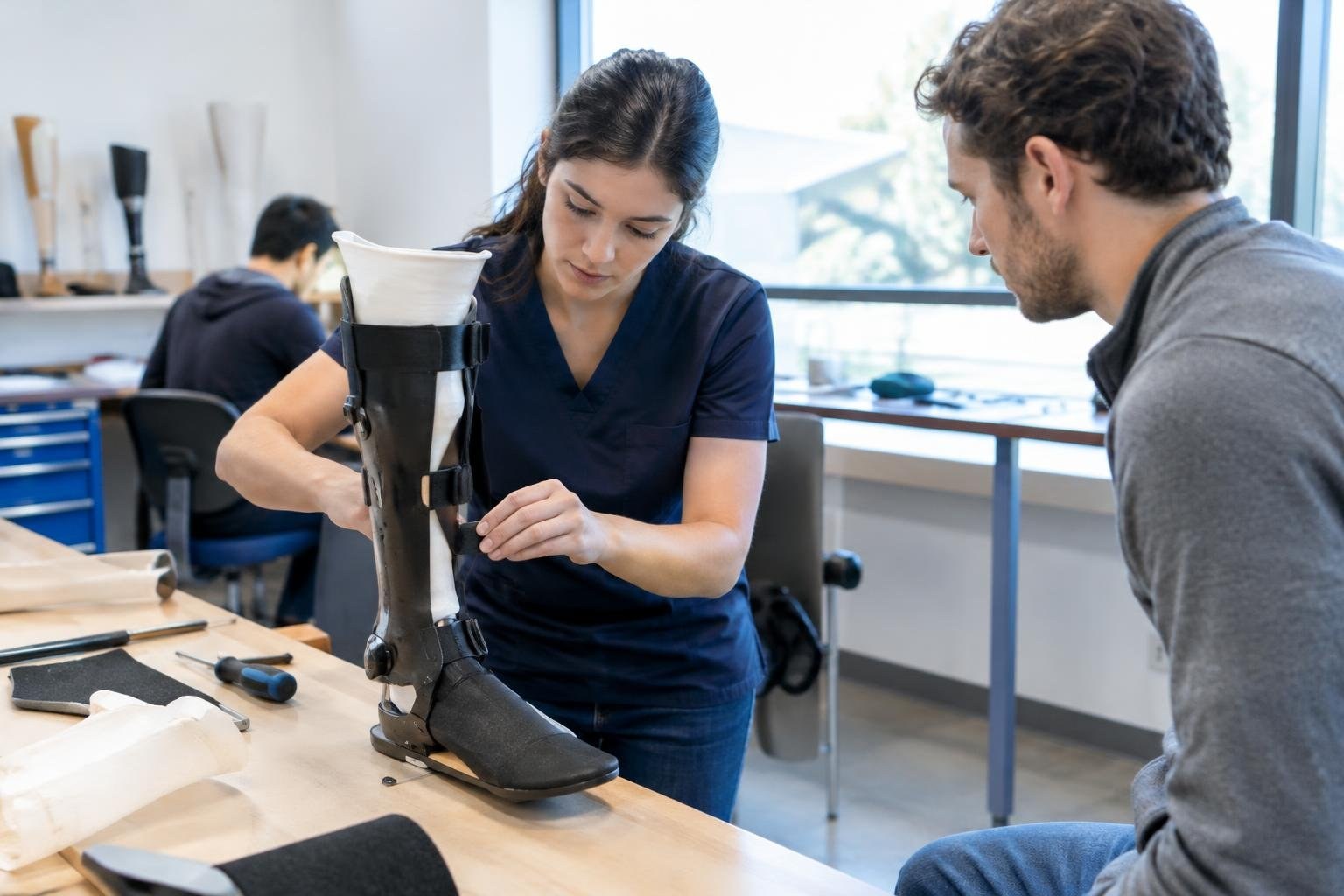
Orthotics and prosthetics student learning device design and fit in a lab
What Is an Orthotist/Prosthetist Degree?
An orthotist/prosthetist degree or program focuses on devices that support or replace parts of the body. Orthotists work with orthoses such as braces; prosthetists work with prostheses such as artificial limbs. The U.S. Bureau of Labor Statistics describes orthotists and prosthetists as professionals who measure, design, fit, and adapt these medical devices for patients with disabling conditions.
The National Center for Education Statistics (NCES) uses CIP code 51.2307 for Orthotist/Prosthetist. Its program description covers preparing people to design and fit orthoses and prostheses in consultation with physicians and other therapists. The code identifies a field of study, not a guarantee that a specific institution offers a program or that a graduate meets every employment requirement.
Names can be confusing. An orthotist/prosthetist practitioner pathway is distinct from an assistant-focused program. Oakland University, for example, describes an Orthotist and Prosthetist Assistant Studies concentration within an undergraduate program. Before applying, check the actual credential awarded and the roles it is designed to support.
Related areas include rehabilitation, exercise science, biomechanics, and medical device technology. They may share subjects, but they do not automatically provide the same training or eligibility for practitioner positions.
Sources: U.S. Bureau of Labor Statistics overview of orthotists and prosthetists; NCES CIP 51.2307 listing; Oakland University program information.
What Do You Study in Orthotist/Prosthetist Programs?
Programs in this field combine health science, technical design, and patient-facing skills. NCES’s description for CIP 51.2307 names subject areas including biomechanics, gait analysis, pathomechanics, kinesiology, pathology, neuroanatomy, materials science, patient measurement, impression taking, model modification, device finishing, fitting, alignment, and patient counseling.
In practice, that range means students learn to connect how a person moves and what a device is made from with the way a brace or prosthesis should be measured and fitted. Coursework may introduce how clinicians assess a patient, how devices are designed or adapted, and how to communicate about use and follow-up. The particular course sequence and depth depend on the institution and credential.
Practical learning matters
The program description includes device fitting and alignment, assistive and restorative technology, and follow-up. These topics point to applied learning as well as classroom study. Oakland University says its assistant concentration develops skills for face-to-face patient care under the direction of a certified orthotist or prosthetist. Ask a program which labs, supervised experiences, or patient-care activities are included and how they are assessed.
Do not rely on a short course list to judge program quality. Request the full curriculum and identify when students practice measurement, fabrication-related work, fitting, documentation, and communication. A prospective student should also ask which experiences are mandatory and whether the school arranges them.
Sources: NCES program description for CIP 51.2307; Oakland University assistant studies concentration.
Skills You Can Develop
Students build a blend of scientific, technical, and interpersonal skills. The exact competencies depend on the program, but the field description and program examples point to several useful areas:
Movement and anatomy knowledge: use concepts from biomechanics, gait, kinesiology, and pathology to understand the body and movement challenges.
Measurement and observation: gather and interpret patient measurements and observations that inform device design and fitting.
Technical problem-solving: consider materials, alignment, device construction, and adjustments in response to a patient’s needs.
Patient communication: explain devices and care steps clearly, listen to patient concerns, and contribute to counseling and follow-up.
Teamwork: coordinate with physicians, therapists, and other care providers as appropriate to the role.
These skills connect to practitioner and assistant work, but the level of responsibility differs. Oakland University describes its assistant concentration as preparation for patient-facing work under a certified practitioner’s direction. Students should ask programs how they distinguish assistant preparation from practitioner education.
Sources: NCES CIP program description; Oakland University assistant pathway.
Who Is This Program Best For?
This program may appeal to students who like applying science to practical problems and are interested in how devices can support a person’s movement or daily activity. The work, as described by the BLS and NCES, involves both devices and patients, so it may suit someone who wants a mix of technical detail and human interaction.
Consider whether you enjoy learning about anatomy and movement, working carefully with measurements and physical materials, making iterative adjustments, and communicating with people about individualized needs. A student who wants a healthcare role with little patient contact, or a primarily theoretical engineering degree, may want to compare other programs.
Does orthotist/prosthetist study match you?
Salary, a credential’s name, or a promising job title cannot tell you whether the day-to-day work will feel worthwhile. Compare the study demands and likely tasks with your interests, motivations, and preferred work style. Assessment.com’s MAPP assessment can be one reflection tool as you explore career and degree options. Treat an assessment as a starting point for questions, not as a substitute for reviewing curricula, talking with practitioners, or checking requirements.
Sources: BLS role overview; NCES CIP description.
Admissions, Program Length, and Academic Difficulty
There is no single admissions checklist for every orthotist/prosthetist or assistant program. Requirements may depend on the institution, credential level, and whether the student is entering an undergraduate program or continuing from an earlier qualification. Oakland University’s assistant pathway is described for students with an associate of applied science degree in a health-related field who want to continue to a bachelor’s degree.
Ask each school for its current prerequisites, application materials, transfer-credit rules, and minimum academic requirements. Clarify whether prior healthcare coursework is expected, whether prerequisite courses must be completed before applying, and how the institution evaluates international or transfer coursework if relevant.
Training length also varies by credential and prior education. The supplied sources identify multiple credential levels in the broader field and describe both master’s-level practitioner education and an undergraduate assistant concentration, but they do not establish a universal duration or credit count. Request a term-by-term plan for your own situation, including part-time, transfer, and clinical or practical requirements.
Coursework can be challenging because it crosses science, movement, materials, and application. To prepare, strengthen foundational anatomy and science knowledge, build careful study habits, and ask to see a sample schedule. Confirm that any accelerated or online option still includes the practical learning needed for the intended role.
Sources: Oakland University admission context for its assistant concentration; Purdue career information on practitioner education.
Online, Hybrid, and On-Campus Study
Some academic content may be delivered online, but do not assume that a fully online degree can provide every element of practical preparation. The field includes patient measurement, device fitting, alignment, and face-to-face care in the program descriptions and university information. Those activities may require access to a lab, clinical setting, or supervised in-person instruction.
When comparing online, hybrid, and campus formats, ask for a clear account of where and how practical work takes place. Find out whether students must travel for labs, arrange their own placements, attend scheduled residencies, or complete assessments in person. Also ask whether the program’s format meets the expectations of the credentialing body or employers you are targeting.
For students who work or have family responsibilities, flexibility matters, but so does access to supervised learning. Compare the full schedule and travel demands rather than judging a program only by whether it advertises online courses.
Sources: NCES CIP description of applied program content; Oakland University description of face-to-face assistant preparation.
Tuition, Costs, and Financial Aid
The total cost depends on the school, residency classification, degree level, study pace, and the practical requirements attached to the program. Build a full estimate that includes tuition, mandatory fees, books, supplies, device or lab-related costs, travel to required in-person activities, and living expenses. Ask whether any program-specific costs are billed separately from tuition.
Compare each institution’s current cost-of-attendance estimate and financial aid offer. Potential funding sources to investigate include federal or state aid for which you qualify, institutional grants and scholarships, and employer tuition support. Eligibility and availability vary; confirm details directly with the relevant school or funding program.
Transfer credit can affect the number of courses a student needs to complete, but do not assume all previous coursework will count. Request a written transfer evaluation before making a commitment. For a student moving from an associate degree into a bachelor’s pathway, ask specifically which credits apply to the major and which remain as prerequisites or electives.
To assess affordability, compare likely borrowing with the full credential pathway, not only the first year’s bill. If becoming a practitioner requires additional education beyond an undergraduate program, include that next step in the long-term budget.
Sources: Oakland University assistant pathway and prior-degree context; Purdue description of practitioner education.
Careers, Jobs, Pay, and Employment Outlook
Orthotist/prosthetist study is tied to a focused set of roles rather than a broad promise of a particular job. The BLS identifies orthotists and prosthetists as professionals who measure, design, fit, and adapt supportive braces and artificial limbs. The program context also identifies medical appliance technicians, assistant-focused work, and postsecondary health specialties teaching as related career directions, but each may have different education and experience expectations.
Career direction
How the study may apply
Education and requirements to verify
Pay and outlook information
Orthotist or prosthetist
Applies device design, measurement, fitting, movement science, and patient-care learning.
Purdue states that a master’s degree in orthotics and prosthetics is required for practitioners. Check current employer and state requirements and any relevant certification expectations.
Use the current BLS occupational profile for national pay and outlook information; results vary by location and employer.
Orthotist/prosthetist assistant
An assistant-focused undergraduate concentration can prepare students for face-to-face patient care under a certified practitioner’s direction.
Confirm the specific credential, permitted responsibilities, and employer expectations for the position.
Pay and job outlook depend on the job classification and location; confirm the appropriate occupational data before comparing offers.
Medical appliance technician
Related technical interests may include creating or adapting medical devices.
Job titles and entry requirements can vary. Review actual employer postings and the responsibilities attached to each role.
Check the relevant BLS occupation profile rather than assuming practitioner pay applies.
Postsecondary health specialties teacher
May be a longer-term direction for people who develop relevant clinical and teaching qualifications.
Teaching requirements depend on the institution and position; confirm education and experience expectations.
Use data for the specific teaching occupation and setting.
Practitioner, assistant, technical, and teaching jobs are not interchangeable. For a grounded comparison, use the BLS profile for the exact occupation, note the data year and geography, and distinguish a national median from an individual starting salary.
Employers and work settings should also be researched directly. Ask programs where graduates seek employment and whether they can share outcome information with the cohort size, date, and job types clearly defined. Do not treat an advertised career list as a placement guarantee.
Sources: BLS orthotist and prosthetist profile; Oakland University assistant concentration; Purdue practitioner education information.
Find out which Career or College Major is right for you!
Completing a degree and meeting professional requirements are separate questions. Purdue’s career information says orthotists and prosthetists must complete a master’s degree in orthotics and prosthetics. Certification requirements can also appear in employer hiring criteria: a USAJOBS posting for an orthotist/prosthetist position calls for current board certification by the American Board for Certification in Orthotics and Prosthetics (ABC) or the Board for Orthotist/Prosthetist Certification (BOC), with continuing education consistent with the certifying body’s requirements.
That federal job posting is evidence of one employer’s requirements, not proof that every employer or state applies the same rules. Before enrolling, check the current requirements for your intended role, location, and employer type. Ask schools which certification exams or eligibility pathways their curriculum is designed to support, and verify those answers with the relevant certification organization.
For assistant work, Oakland University describes patient care under a certified orthotist or prosthetist. That distinction is important: an assistant concentration should not be assumed to qualify graduates for independent practitioner responsibilities. Confirm role scope and supervision expectations in writing.
Several pathways may appeal to students interested in the same broad area, but they lead to different training and work. Use the intended job as your anchor, then compare prerequisites, hands-on work, patient contact, and additional credentials.
Orthotist/prosthetist practitioner education: consider this route if your goal is to practice as an orthotist or prosthetist and you are prepared for specialized graduate-level education.
Orthotist/prosthetist assistant studies: consider this if you want patient-facing work under a certified practitioner’s direction and are exploring an assistant-focused pathway.
Exercise science: consider this if human movement and physical activity interest you more broadly; check whether a program includes the specific orthotics and prosthetics concentration or preparation you want.
Rehabilitation-related study: consider this if you prefer a wider focus on supporting people’s function and recovery rather than device design and fitting.
Biomedical or mechanical engineering: consider these areas if technical design is your primary interest and direct patient care is less central. Verify whether the curriculum covers the clinical preparation required for orthotics and prosthetics roles.
Medical device technology: consider a device-oriented program if you are drawn to technical production or adaptation but do not plan to pursue a practitioner role.
These are comparison directions, not claims that one credential substitutes for another. Oakland University’s example makes the distinction between an assistant concentration and practitioner preparation especially clear. A student who chooses a broader or adjacent degree should ask employers and credentialing bodies whether it can support the intended career.
Sources: Oakland University assistant studies information; NCES description of the orthotist/prosthetist field; Purdue practitioner education information.
Experience, Professional Development, and Employer Preparation
Hands-on experience can help students understand the work behind a job title. Ask about supervised patient-care activities, practical labs, research opportunities, and projects involving measurement, device design, fitting, or follow-up. The NCES program description includes these applied subject areas, while Oakland’s assistant concentration emphasizes face-to-face patient care under a certified practitioner’s direction.
How to stand out to employers
Be able to explain which role you are pursuing and how your credential prepares you for it.
Describe practical experience accurately, including the level of supervision and your specific contribution.
Show that you can connect movement and anatomy concepts with device fitting and patient communication.
Keep records of relevant coursework, supervised experiences, and any current certification or continuing education.
Review real job postings early so you can identify qualifications to discuss with your program advisor.
Do not claim certification or independent clinical qualifications based only on completing coursework. Keep a clear record of which requirements are met and which remain. Ask a program how it supports professional development and whether students can speak with recent graduates or employers.
Sources: NCES CIP program content; Oakland University assistant preparation; USAJOBS example of employer certification expectations.
Graduate School and Further Education
Graduate study may be necessary for a student whose goal is to become an orthotist or prosthetist. Purdue’s career information states that practitioners must complete a master’s degree in orthotics and prosthetics. A student already considering an undergraduate assistant pathway should ask what further education would be needed to move toward practitioner work; an assistant concentration is not the same credential.
Work backward from the job: identify the education and credentials requested in current postings, then compare those expectations with each program’s official curriculum and advising information.
Sources: Purdue practitioner education guidance; Oakland University assistant pathway context.
How to Choose the Right Orthotist/Prosthetist Program
Program choice matters because the same broad field can include distinct practitioner and assistant routes. Compare the exact award, curriculum, practical preparation, advising, cost, and outcomes rather than relying on a program title or promotional career list.
Credential and career target: Is this a practitioner program or assistant pathway? What roles does the institution say it prepares students for?
Curriculum and practical learning: Does it cover movement science, measurement, device fitting, and patient communication? Which experiences are supervised and required?
Accreditation and eligibility: What accreditation applies to the institution and program, if any? Verify the status with the accreditor and confirm whether graduates meet the requirements of relevant certification bodies and employers.
Cost and financial aid: What is the total estimated cost, including fees, materials, travel, and living expenses? What aid is available and renewable?
Format and completion plan: Which courses are online, hybrid, or on campus? How do part-time study, transfer credit, and practical requirements affect the timeline?
Career information: What are the program’s graduation and employment outcomes, how are they calculated, and how many students are represented? What services connect students with employers or supervised experience?
Ask for answers in writing and consult official institution, accreditor, certification, and state sources where applicable. Assessment.com’s education resources can help you continue exploring study options; the MAPP assessment can be a separate input when reflecting on career and degree fit.
Sources: USAJOBS example requirements; Oakland University program pathway information; Purdue career education information.
Questions to Ask Before Enrolling
Before applying or paying a deposit, use this checklist with a parent, counselor, or advisor:
What exact credential will I earn, and which career path is it designed to support?
What are the current admission prerequisites and transfer-credit rules?
What is the total cost through completion, including required practical experiences?
Which labs, patient-care experiences, or supervised placements are required, and who arranges them?
What certification or other requirements do the employers and locations I am considering expect?
How are practical skills taught in an online or hybrid option?
What are the program’s completion and employment outcomes, and how are they measured?
What financial aid, scholarships, or employer assistance might apply to my situation?
Can I speak with a current student, graduate, or advisor about the day-to-day program?
Finally, compare the actual work with your interests. The field involves technical detail and patient contact. If you are unsure which part appeals to you, explore related healthcare roles and degree options before committing. Assessment.com’s career and education resources, alongside conversations with school advisors and practitioners, can help structure that exploration.
Sources: BLS occupation overview; NCES field description; USAJOBS example credential requirements.
Frequently asked questions
Is an orthotist/prosthetist program hard?
Orthotist/prosthetist study is demanding because it brings together anatomy, movement science, materials, device design, and patient care. Students may need to connect classroom concepts to measurements, fittings, and adjustments. The balance of science, technical work, and clinical experience varies by program. Reviewing course requirements and asking about supervised practice can help you judge whether the workload and learning style suit you.
What do orthotists and prosthetists do?
Orthotists and prosthetists measure, design, fit, and adapt devices such as braces and artificial limbs for people with disabling conditions. The work combines technical problem-solving with communication and patient interaction. It can be a good fit for students interested in both healthcare and making or adapting devices, but becoming a practitioner typically requires more education than an assistant-focused bachelor’s concentration.
What degree do I need to become an orthotist or prosthetist?
The path depends on the role. A practitioner pathway requires specialized education; Purdue’s career information says orthotists and prosthetists must complete a master’s degree in orthotics and prosthetics. An assistant pathway is different: Oakland University describes an undergraduate concentration intended to prepare students for patient care under a certified practitioner’s direction. Confirm program and employer requirements before choosing a credential.
Can I study orthotics and prosthetics online?
Some programs offer online or hybrid coursework, but this field includes practical device and patient-care skills that may require in-person learning or supervised experience. The available sources describe hands-on preparation in assistant and practitioner pathways but do not establish that a fully online route is available. Ask each institution how labs, clinical experiences, and assessments are delivered.
Does orthotist/prosthetist study require math and science?
The work calls for scientific and technical learning, including biomechanics, gait, kinesiology, pathology, and materials science. Students also need to interpret measurements and apply design concepts. The supplied program description does not specify a required math sequence, so check the curriculum and prerequisites at each school rather than assuming that programs have identical quantitative requirements.
Do orthotists and prosthetists need certification or a license?
Requirements depend on the role and employer. A USAJOBS posting for an orthotist/prosthetist position requires current board certification from ABC or BOC and continuing education in line with the certifying body’s requirements. This is an example of an employer requirement, not a universal rule for every job or state. Confirm current requirements with the relevant employer and state authorities.
What is the difference between an orthotist/prosthetist and an assistant?
An assistant-focused program prepares students for a different scope of work from a practitioner pathway. Oakland University describes its Orthotist and Prosthetist Assistant Studies concentration as preparing students for face-to-face patient care under the direction of a certified orthotist or prosthetist. Practitioner education is more advanced. Compare the role, supervision, credential, and career goal rather than treating the degrees as interchangeable.
How much does an orthotist/prosthetist degree cost?
Tuition depends on institution, residency, degree level, enrollment pace, and required learning experiences. Also account for fees, materials, travel to required in-person activities, and living expenses. Since prices change and differ by school, use each institution’s current cost-of-attendance information and compare the total cost after grants and scholarships, not tuition alone.
People Also Ask
What is the difference between an orthosis and a prosthesis?
An orthosis supports or aligns a body part, often with a brace. A prosthesis replaces a missing body part, such as an arm or leg. Orthotists and prosthetists assess patients and measure, design, fit, and adapt these devices. The appropriate device and care plan depend on a patient’s circumstances and the healthcare team.
What subjects are covered in orthotist/prosthetist programs?
The field draws on anatomy and movement science, material selection, measurement, device design, fitting, and patient communication. The program description for CIP 51.2307 also includes topics such as gait analysis, pathology, neuroanatomy, diagnostic imaging, device alignment, and follow-up. The exact mix of courses and practical work depends on the institution and credential.
Do orthotists and prosthetists work with other healthcare professionals?
The CIP 51.2307 program description includes work in consultation with physicians and other therapists. Oakland University’s assistant concentration describes patient care under a certified orthotist or prosthetist. These examples show why collaboration and clear communication matter, though the precise team and responsibilities vary by role and workplace.
Are orthotics and prosthetics programs available in hybrid formats?
No single format can be assumed for every program. Online lectures may be possible, but learning device fabrication, fitting, and patient-care skills may involve practical or supervised in-person work. Ask whether the program requires campus labs, clinical placements, or other in-person experiences and whether students arrange or receive help locating them.
How should I choose an orthotics and prosthetics school?
Start with the job you want. Ask whether the program is a practitioner or assistant pathway, what credential it awards, which required courses and supervised experiences it includes, and whether graduates meet the education expectations of relevant employers and certifying bodies. Then compare total cost, transfer policies, schedule, and support for clinical or practical learning.
What does CIP code 51.2307 mean?
CIP 51.2307 identifies the field as Orthotist/Prosthetist and describes study related to designing and fitting orthoses and prostheses. CIP codes classify fields of study; they do not by themselves confirm that an individual institution offers a particular degree, that a program is accredited, or that a graduate meets every employment or credential requirement.
An orthotist/prosthetist program may suit students who want to combine health science, technical design, and direct patient care. The route to becoming an orthotist or prosthetist involves substantial specialized education, and the degree alone may not meet every employer or state requirement. Compare curricula, supervised experience, certification preparation, total cost, and your interest in hands-on patient work before enrolling. Assessment.com’s education and career resources can help you explore related paths, and the MAPP assessment can offer another perspective on career and degree fit.
Want to see your options? Try our comprehensive Degree, Program & College Search tool
We use cookies to offer you a better browsing experience, analyze site traffic and personalize content.
Read about how we use cookies and how you can control them in our
Privacy Policy.
If you continue to use this site, you consent to our use of cookies.
×
Exciting News!
Be one of the first to Beta Test the new AI-Powered Assessment.com Platform.