Music Performance Degree Guide: Courses, Careers, Costs, and Fit
A Music Performance program centers on developing skill as a solo or ensemble performer. Learn about degree levels, auditions, coursework, costs, career paths, and how to compare programs.
By David Slack · Staff Writer Assessment.com · Published October 12, 2026 · Last updated November 5, 2026
A Music Performance degree or program develops a student’s ability to perform music, often on a particular instrument or in voice, either as a soloist or in an ensemble. Students build technique and repertoire, prepare for performances, and may study musical context, collaboration, or conducting depending on the program. The name can describe different credentials, from undergraduate degrees to post-baccalaureate certificates and graduate study. The right option depends on the kind of performer and working life a student hopes to build. Prospective students and parents should look beyond the program title to audition standards, instruction, ensemble opportunities, cost, and the experience graduates need for their chosen path.
Degree & Program Decision Insights
Explore your personal fit, education requirements, career potential and next steps.
01Motivational Fit
Discover whether this program fits you
Explore your preferences against the focus of Music Performance, General. These prompts are not personal MAPP results.
Subject curiosity. Would you choose to explore “master musical instruments and performing art as solo and/or ensemble performers” in depth? Ask for a sample learning activity to test that interest.
Choosing a learning environment. Compare actual Music Performance, General offerings. Would their reading, projects or practical work suit how you prefer to learn? Confirm the format rather than assuming one from the field name.
Work reality. Related work can involve this task: “Copy parts from scores for individual performers.” Would you want that activity to be a regular responsibility?
Interest in studying a field can differ from enjoying its related work.
Which part would you want to do repeatedly, and what would you try before deciding?
Discover Your Personal Program Fit
Before investing your time and money in your education, discover how this program aligns with your natural motivations, work preferences and career goals.
Explore these official instructional-field associations. They describe possible occupational routes, not measured outcomes of this program.
Music Directors and ComposersSOC 27-2041 · O*NET 27-2041.00$73,710/year median (May 2025); +1.2% projected change (2025–2035); 4,200 projected openings/year.
Typical occupational entry: bachelor's degree (BLS). BLS lists less than 5 years of related work experience as typical for this occupation; this programme is not a direct promise of entry.
Typical occupational entry: master's degree (BLS). Postsecondary teaching is a separate appointment and may require advanced study; this programme alone is not a promise of a teaching post.
U.S. occupational wages are not guaranteed graduate earnings; OEWS excludes self-employed workers.
Projected openings include replacements as well as growth.
U.S. national estimates. A crosswalk does not establish entry-level eligibility; advanced, management and teaching roles can require further qualifications.
Compare the actual offering and credential before committing your time or money.
Request the itemized fees, materials and equipment associated with “master musical instruments and performing art as solo and/or ensemble performers”; confirm what tuition includes.
Compare the full attendance budget, course availability and time away from paid work, rather than tuition alone.
No institution- and credential-matched cost, debt or graduate-earnings amount is reported here; occupational pay is not program ROI.
Financial aid depends on the school, program and student’s eligibility.
Explore your motivations. Use MAPP as a starting point for reflecting on your interest in “master musical instruments and performing art as solo and/or ensemble performers”, then test that interest against a sample learning task.
Examine the work. Compare Music Directors and Composers and Art, Drama, and Music Teachers, Postsecondary on daily work and entry qualifications, as well as pay. Explore Music Directors and Composers.
Compare actual providers. Ask for the exact credential, course sequence and assessment methods. Compare how each provider teaches “Music Performance, General”, its entry criteria and its itemized costs.
Check the evidence before applying. Confirm prerequisites and any recognition or professional requirements for your intended route; ask for applicable rules and published outcome definitions in writing.
Verify the institution’s current offering, admissions requirements and outcomes; a search result does not establish your eligibility.
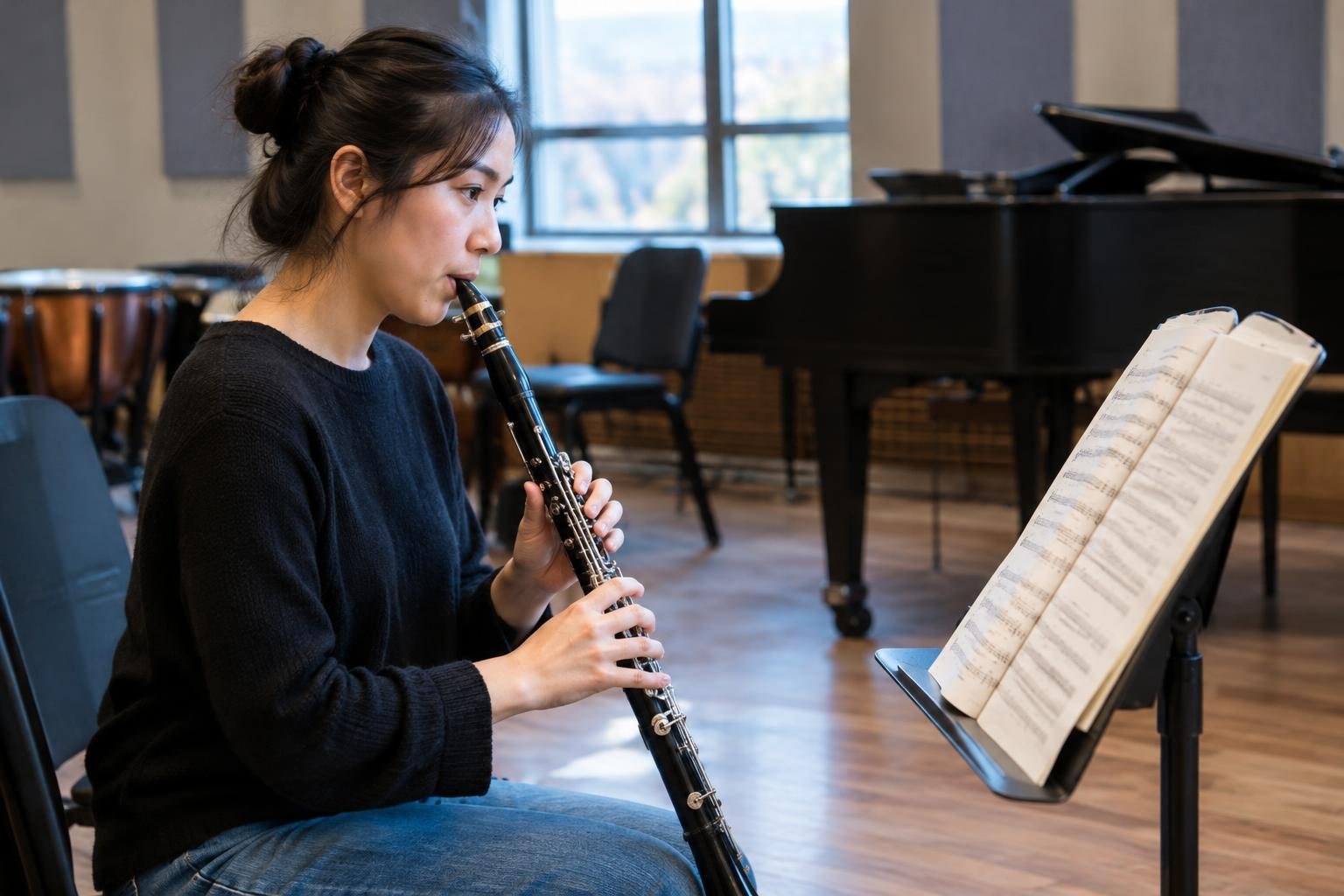
A student practicing an instrument with sheet music in a campus rehearsal space
What Is a Music Performance Degree?
Music Performance, General is an area of study focused on developing the ability to perform on one or more instruments, individually or as part of an ensemble. The supplied program description emphasizes mastery of instruments and performing arts. Schools may use different names and offer distinct concentrations, so a program title alone does not tell you what instrument, repertoire, or performance experience is included.
Available credentials span multiple levels. For example, UConn lists graduate options that include performer certificates, master’s degrees, a Doctor of Musical Arts, and a PhD. These are examples at one institution, not a complete list or a guarantee that every school offers the same options. Review UConn’s graduate program overview and compare it with the official catalogs of schools you are considering.
When comparing Music Performance with music education, composition, or music history, focus on the balance of applied performance, ensemble work, teaching preparation, and academic study. Similar department names can lead to different training experiences.
What Do Music Performance Students Study?
Course plans are school-specific. A performance-focused program may combine instrument or voice study with solo and group performance, musicianship, and other music courses. Before applying, review the actual catalog and ask how private instruction, rehearsals, juries, recitals, and repertoire development fit into each term.
Graduate certificates show one form of focused post-baccalaureate study. Columbus State describes its certificate as an intensive year emphasizing performance and repertoire development for students preparing for a professional appointment or advanced study. Kansas describes its graduate certificate as an intensive period of study in performance or conducting for accomplished performers and conductors. These examples apply to those certificate programs, not every undergraduate major. Read the Columbus State certificate description and review the University of Kansas catalog.
Ask whether the program includes recitals, ensemble assignments, coaching, or other performance milestones, and whether these are required or optional. The answers help you see how the degree turns practice into demonstrated work.
Skills You Can Develop
Performance study develops musical technique, preparation habits, listening, interpretation, and the ability to rehearse and present work. Students also need to communicate with collaborators, respond to feedback, organize practice, and prepare material for auditions or public performances. The balance between these skills depends on the instrument, faculty, ensembles, and curriculum.
Technology may enter through notation, recording, remote lessons, or other tools, but programs do not all teach the same software or technical skills. Ask faculty which tools students use and whether students leave with recordings or other work samples. A portfolio of recordings, repertoire, ensemble participation, and performance experience can help a student describe their work to employers or graduate programs.
Do not assume that the degree alone establishes professional readiness. Consider how the school helps students apply performance skills in real settings and how much independent practice is expected.
Who Is This Program Best For?
This field may appeal to students who enjoy sustained, detailed practice and want their work to culminate in performances, collaboration, or a professional music path. Students may prefer solo work, group playing, conducting, or a mix. There is no single personality profile required, but an honest interest in repeated practice and constructive feedback is useful to consider.
Performance programs can set a high musical bar. The University of Northern Colorado, for example, says admission to its graduate certificate is open to applicants who demonstrate exceptional musical ability and hold a bachelor’s degree in music or an equivalent diploma. That is a program-specific rule; undergraduate entry standards and other graduate programs may differ. Check UNC’s stated certificate admission requirements.
For a high school student, parent, or career changer, a practical first step is to discuss readiness with a music teacher, then compare requirements with recent repertoire and performance experience. If you are unsure whether the daily work suits you, use career and degree exploration as one input, alongside lessons, rehearsals, and conversations with performers.
Admissions, Auditions, and Preparation
Entry requirements vary by institution and credential. Performance-focused programs may ask applicants to audition, submit recordings, or demonstrate prior study. Graduate programs may require a relevant bachelor’s degree or equivalent preparation. Do not rely on a general description: check the admissions page and catalog for the exact audition format, repertoire, academic records, deadlines, and any interview or language requirements.
Auditions are also a chance to assess the program. Ask who evaluates candidates, whether the audition is live or recorded, what feedback applicants receive, and whether admission to the university and admission to the music program are separate decisions. Confirm whether audition results affect scholarships or placement, rather than assuming they do.
Prepare early. Select repertoire that matches the posted requirements, schedule coaching, check recording or accompanist needs, and allow time to confirm application materials. For graduate applications, verify the prior-degree and performance expectations directly with the program.
Credential Levels, Format, and Time to Completion
There is no single completion time for all Music Performance credentials. It depends on the award, transfer credit, course load, and the institution’s required performance work. Some post-baccalaureate options are designed for concentrated study: Columbus State describes its certificate as an intensive year, while the University of North Texas describes a non-degree artist certificate as a two-year period of post-baccalaureate performance study. Those examples should not be used to estimate the length of a bachelor’s or another school’s program.
Programs may be campus-based, hybrid, or include some online learning, but delivery should be checked against the performance requirements. Ask whether applied lessons, ensembles, recitals, or auditions require in-person attendance; whether online students receive regular individual feedback; and whether any residency or campus visit is required.
For a transfer student or adult learner, request a written credit evaluation and a term-by-term completion plan. For every format, compare the time needed for coursework with the separate time commitment for practice and rehearsals.
Tuition, Costs, and Financial Aid
Tuition depends on the institution, residency status, credential level, enrollment pattern, and required fees. Music students should also ask whether lesson fees, instrument access, accompanists, travel, recording, equipment, or performance clothing create additional expenses. These costs are not uniform, so use each school’s current cost of attendance and department information rather than relying on a generic estimate.
Compare the full cost to completion, not just the advertised price per credit. Include housing and transportation when relevant, and ask how tuition changes if a program takes longer than planned. Request a written estimate that separates tuition, fees, books, living costs, and other program expenses.
Complete the financial-aid process on time and ask about institutional scholarships, music-specific awards, need-based aid, grants, work opportunities, and payment plans. Confirm eligibility, renewal rules, and whether an award depends on maintaining a particular major, performance role, or enrollment load. Do not assume an audition automatically brings scholarship support.
Careers, Jobs, and Employment Outlook
There is no meaningful single salary or job-growth figure for a Music Performance degree because graduates may pursue different occupations and employment arrangements. A performer, music director, composer, and postsecondary teacher do not share one job description or qualification path. Income can also depend on experience, location, number of engagements, and whether work is full-time, freelance, or combined with teaching or other employment. Research pay and outlook for each specific occupation rather than treating degree-level estimates as a promise.
Career direction
How performance study may apply
What to verify
Musician or singer
Instrumental or vocal performance and repertoire provide a direct connection.
Audition expectations, experience, types of engagements, and income arrangements.
Music director or composer
Performance skills can support musical understanding and collaboration.
Whether additional conducting, composition, arranging, or leadership training is needed.
Postsecondary art, drama, or music teacher
Advanced performance and subject expertise may be relevant.
Hiring institution’s required degree level, teaching experience, and other qualifications.
These are possible directions, not guaranteed outcomes. For example, UConn lists graduate degrees and certificates in music, while its program options do not establish that a credential alone qualifies someone for a specific job. Explore musician and singer careers, review music director and composer paths, and compare postsecondary teaching as separate goals.
Potential employers and settings can include performance organizations, educational institutions, community groups, and other music-related settings. Actual opportunities depend on location, specialization, and experience. Digital production and distribution tools may affect how music is created and shared, but do not assume that technology replaces the need for live musical skill or guarantees new work.
Find out which Career or College Major is right for you!
Look for practical experience while studying. Depending on the school and instrument, options may include ensembles, recitals, community performances, research, assistant work, or internships. Build a clear record of repertoire, recordings, collaborations, and performance roles. Ask faculty and career staff how students find opportunities and whether students can participate without conflicting with required coursework.
How to stand out to employers
Keep recordings and performance materials organized and current.
Describe your contribution to ensembles and projects clearly.
Seek feedback from teachers and experienced performers.
Develop complementary skills such as teaching, conducting, arranging, or production only when they fit your goals.
Build relationships through reliable collaboration and professional communication.
A certificate or degree is not the same as a professional license. Music Performance programs may prepare students for music work, but requirements for teaching or other regulated roles depend on the job and state. Verify those rules with the appropriate state agency or employer. The University of Kansas describes its graduate certificate as focused on performance or conducting rather than academic study; it should not be mistaken for a teaching license. See the program’s stated purpose.
Graduate School and Advanced Performance Study
Graduate study can deepen performance, repertoire, or conducting work after undergraduate preparation. Depending on the institution, options may include a master’s degree, a graduate certificate, a performer or artist certificate, a Doctor of Musical Arts, or a PhD. The degree titles do not mean the same thing: compare program goals, admission standards, coursework, performance expectations, and whether the credential is academic or non-degree.
UConn’s published graduate options include Performer’s Certificates, Master of Arts, Master of Music, Doctor of Musical Arts, and Doctor of Philosophy. The University of North Texas describes its Graduate Artist Certificate as a non-degree post-baccalaureate program. Compare UConn’s listed graduate options with UNT’s artist certificate description.
Consider further study when it is a clear match for a target role, advanced performance goal, or desired specialization. Ask prospective employers, teachers, or mentors what qualifications are expected before taking on additional tuition and time.
Related Degrees and Alternatives
Compare Music Performance with alternatives based on the work you want to do, not just the shared word “music.”
Music Education: consider it if teaching is central and you want a program built around education preparation.
Music Composition: consider it if creating and developing original music is a stronger interest than performance as the main focus.
Music Theory or History: consider these if analysis, research, or musical context appeals more than intensive applied performance.
Music Technology or Production: consider it if recording, sound, or production work is a stronger goal; compare technical coursework and facilities.
General Music Studies: consider a broader curriculum if you want music study without making performance the primary concentration.
Non-degree post-baccalaureate certificate: consider it if you already have substantial preparation and want concentrated performance study rather than another full degree.
These are comparison categories, not claims that every college offers each one. For example, an advanced performance certificate at Kansas is described as an intensive option for accomplished performers or conductors who do not wish to pursue academic study. Check the certificate’s scope and compare it with the exact alternatives at your schools.
When weighing degree against certificate, compare total time and cost, admission prerequisites, opportunities to perform, and whether the award meets a specific career or graduate-school requirement.
Accreditation, Transfer, and Professional Requirements
Accreditation and recognition should be checked at both the institution and program level. Confirm the institution’s current accreditation through an authoritative source and ask the department whether any specialized accreditation, professional recognition, or membership applies to the specific program. Do not infer accreditation from a university name or assume that one credential transfers automatically to another institution.
For transfer students, request written confirmation of how credits, performance study, and prior coursework will count toward the new degree. For students planning to teach, ask which state or employer requirements apply beyond the music credential. Licensing rules can differ by location and job type, and a performance degree should not be presented as an automatic teaching qualification.
Also check how performance readiness is assessed: auditions, juries, recitals, repertoire expectations, and progress reviews. Ask for the relevant catalog language and written answers from admissions or the department, especially when a decision affects financial aid or time to completion.
Keeping the Education Affordable
Affordability is more than tuition. A less expensive school may still involve higher travel, housing, lesson, instrument, or performance costs. A scholarship may reduce expenses but come with renewal or participation conditions. Compare net cost and realistic completion time across programs, then consider whether the training and opportunities justify the amount you would borrow or pay.
Ways to manage costs may include applying for need-based aid and scholarships, asking about music department awards, comparing in-state and out-of-state charges, considering transfer credit, and checking whether part-time enrollment changes aid eligibility or program sequencing. If working while enrolled, confirm that lesson and rehearsal schedules are compatible with your job and that the chosen course load will not extend the program unexpectedly.
Ask the financial-aid office to explain awards in writing, including renewal criteria and any requirements tied to performance participation. Use the same cost categories for every school so the comparison is fair.
How to Choose a Music Performance Program
Before committing, students and parents can use this checklist to surface details that are easy to miss:
What instrument, voice, or performance focus does the program support?
What are the audition materials, deadlines, and live or recorded requirements?
How often will students receive individual instruction and performance feedback?
Which ensembles, recitals, and other performance activities are available or required?
What is the estimated total cost, including music-related fees and living expenses?
What grants or scholarships are available, and what are their renewal conditions?
Can credits transfer, and how will the institution evaluate prior music study?
Which classes or performances require campus attendance?
What career services, faculty connections, and practical experience opportunities are available?
What qualifications will the jobs I am considering require beyond this degree?
Ask for current written answers from both admissions and the music department. Compare program requirements and total cost before making a deposit or accepting an award.
Students still deciding among majors can also use Assessment.com’s college-major guidance and explore how personal motivations relate to future study and work.
From Degree to Career: Possible Pathways
Career paths are not automatic promotions, but planning can help connect study to next steps. One possible sequence is:
Performance study → ensemble, audition, or teaching experience → build a body of recordings and repertoire → pursue performing engagements or a focused specialization.
Performance study → advanced performance or conducting certificate → develop deeper repertoire or conducting experience → apply for relevant professional appointments.
Music degree → graduate study in music → build teaching or research experience → pursue academic work when qualifications and openings align.
Each route depends on preparation, opportunity, location, and the requirements of a specific role. For instance, a post-baccalaureate certificate may suit an accomplished performer seeking intensive work, while a doctoral program has a different scope. Review program descriptions and career expectations together, rather than assuming that an additional credential guarantees a job.
Frequently asked questions
Is a Music Performance degree hard?
Music Performance can be demanding because students must keep developing technique while preparing repertoire, rehearsing with others, and meeting performance deadlines. The challenge depends on the student’s instrument, prior preparation, program expectations, and workload. Ask current students how often they perform and how much practice time they plan for outside class.
Is a Music Performance degree worth it?
It can be worthwhile for students who want structured performance training, faculty guidance, ensemble opportunities, and a credential connected to their goals. Value depends on cost, financial aid, the quality and focus of the program, and the work a student plans to pursue. Compare those factors rather than assuming a degree guarantees a performing job or a particular income.
What jobs can I get with a Music Performance degree?
Potential paths include performing as a musician or singer, directing or composing music, and teaching at the postsecondary level. The degree itself does not guarantee employment, and some roles may require advanced study, teaching qualifications, professional experience, or a strong audition portfolio. Check the requirements of specific jobs and local employers before choosing a program.
How much can you make with a Music Performance degree?
There is no single salary for Music Performance graduates. Earnings depend on the occupation, location, experience, employment arrangement, and how much work is available. A musician’s income can also differ from that of a music director or postsecondary teacher. Research current pay for the specific occupations you are considering instead of relying on a degree-wide average.
Can I earn a Music Performance degree online?
Some music study can be delivered online, but performance training may depend on live instruction, rehearsals, auditions, and recitals. A remote course or degree format may not provide the same in-person ensemble experience as a campus program. Ask each school which requirements must be completed on site and how individual performance feedback is delivered.
Does a Music Performance degree require math?
Music Performance is not generally centered on advanced mathematics, but programs may include music theory and musicianship, which involve recognizing patterns, rhythm, intervals, and musical structure. The level and form of theory requirements vary by program. Review the course sequence and ask whether placement or remedial theory work is available if you are concerned.
Do I need graduate school for a music career?
Not every performance career requires graduate school. Advanced programs and post-baccalaureate certificates can offer focused performance or repertoire development for musicians who already have substantial preparation. Teaching and academic roles can have additional education requirements. Start with the job or professional appointment you want, then verify its qualifications before deciding whether further study is useful.
Do music performers need a license or certification?
A certificate, degree, or professional credential is not automatically the same as a license to teach or perform. Requirements depend on the job, employer, and state. If you want to teach in a public school or pursue another regulated role, verify the relevant state and employer requirements separately from the music department’s admission and graduation rules.
People Also Ask
What is a Music Performance major called?
It may be called Music Performance, Performance, Instrumental Performance, Vocal Performance, or a related name. Names and concentrations differ by institution, so compare the curriculum and applied study rather than relying on the title alone.
What is the difference between music performance and music education?
A performance major centers on developing musicianship and performance ability. Music education typically also prepares students to teach and may include education coursework or supervised teaching. Requirements vary, so compare each program’s curriculum and the qualifications for the job you want.
Do you need an audition for a Music Performance degree?
Auditions are common for performance-focused programs, but materials and standards are school-specific. A school may provide audition repertoire, format, and deadline guidance. Ask whether it accepts recorded auditions, what live requirements remain, and whether placement decisions affect scholarship eligibility.
What classes do Music Performance majors take?
Music study may include performance classes, private instruction, ensemble work, music theory, and other coursework, but the mix varies by degree and school. Review the official degree plan and ask how often students perform, receive individual feedback, and take part in ensembles.
What degree is best for becoming a professional musician?
A bachelor’s degree is one common route for extended undergraduate training, while graduate certificates and advanced degrees can offer further specialization after prior study. The right level depends on current ability, career goal, and the program’s stated admission requirements.
Can music performance students study remotely?
Some online coursework may be possible, but a student should check how a program delivers individual performance instruction, ensemble requirements, auditions, and recitals. A fully remote format may not suit every student’s performance goals or learning preferences.
Music Performance may suit students who want sustained, disciplined work on an instrument or voice and are willing to build experience beyond coursework. Before enrolling, compare actual lesson and ensemble opportunities, audition expectations, total cost, and the career paths you hope to pursue. Programs and outcomes differ, so look for a close match between the training offered and the work you want to do. If you are still weighing options, explore how your interests and motivations connect to music and other fields.
Want to see your options? Try our comprehensive Degree, Program & College Search tool
We use cookies to offer you a better browsing experience, analyze site traffic and personalize content.
Read about how we use cookies and how you can control them in our
Privacy Policy.
If you continue to use this site, you consent to our use of cookies.
×
Exciting News!
Be one of the first to Beta Test the new AI-Powered Assessment.com Platform.