Molecular Biochemistry Degree Guide: Courses, Careers, Cost & Fit
Explore what molecular biochemistry programs teach, how certificates and graduate degrees differ, what to compare before enrolling, and how to connect study with research and career goals.
By Kieth Nelson · Staff Writer Assessment.com · Published October 7, 2026 · Last updated November 5, 2026
Molecular biochemistry focuses on the chemical processes that make living systems work. Students explore biological molecules, cells, genes, metabolism, and the methods researchers use to investigate them. Programs may lead to a certificate, bachelor’s degree, master’s degree, or doctorate, and the title and curriculum can differ from one college to another. Students often consider this field because they are interested in biomedical or biological research, biotechnology, or preparation for further science education. A degree can build relevant knowledge, but career options depend on the level earned, practical experience, and the qualifications employers or graduate programs require. Not sure whether molecular biochemistry fits you? Take the Free MAPP Career Assessment to see how your motivations, interests, and natural preferences align with this degree and the careers it can lead to.
Degree & Program Decision Insights
Explore your personal fit, education requirements, career potential and next steps.
01Motivational Fit
Discover whether this program fits you
Explore your preferences against the focus of Molecular Biochemistry. These prompts are not personal MAPP results.
Subject curiosity. Would you choose to explore “the chemical mechanisms of regulation and catalysis” in depth? Ask for a sample learning activity to test that interest.
Breadth of interest. Consider the place of “protein synthesis and other syntheses” in this field. Is this another part you would choose to explore, or mainly a requirement you would tolerate?
Work reality. Related work can involve this task: “Determine the three-dimensional structure of biological macromolecules.” Would you want that activity to be a regular responsibility?
Interest in studying a field can differ from enjoying its related work.
Which part would you want to do repeatedly, and what would you try before deciding?
Discover Your Personal Program Fit
Before investing your time and money in your education, discover how this program aligns with your natural motivations, work preferences and career goals.
Explore these official instructional-field associations. They describe possible occupational routes, not measured outcomes of this program.
Biochemists and BiophysicistsSOC 19-1021 · O*NET 19-1021.00$127,410/year median (May 2025); +12.3% projected change (2025–2035); 2,900 projected openings/year.
Typical occupational entry: doctoral or professional degree (BLS).
Medical Scientists, Except EpidemiologistsSOC 19-1042 · O*NET 19-1042.00$103,410/year median (May 2025); +12.6% projected change (2025–2035); 10,500 projected openings/year.
Typical occupational entry: doctoral or professional degree (BLS).
U.S. occupational wages are not guaranteed graduate earnings; OEWS excludes self-employed workers.
Projected openings include replacements as well as growth.
U.S. national estimates. A crosswalk does not establish entry-level eligibility; advanced, management and teaching roles can require further qualifications.
Compare the actual offering and credential before committing your time or money.
Request the itemized fees, materials and equipment associated with “the chemical mechanisms of regulation and catalysis”; confirm what tuition includes.
Compare the full attendance budget, course availability and time away from paid work, rather than tuition alone.
No institution- and credential-matched cost, debt or graduate-earnings amount is reported here; occupational pay is not program ROI.
Financial aid depends on the school, program and student’s eligibility.
Explore your motivations. Use MAPP as a starting point for reflecting on your interest in “the chemical mechanisms of regulation and catalysis”, then test that interest against a sample learning task.
Examine the work. Compare Biochemists and Biophysicists and Medical Scientists, Except Epidemiologists on daily work and entry qualifications, as well as pay. Explore Biochemists and Biophysicists.
Compare actual providers. Ask for the exact credential, course sequence and assessment methods. Compare how each provider teaches “protein synthesis and other syntheses”, its entry criteria and its itemized costs.
Check the evidence before applying. Confirm prerequisites and any recognition or professional requirements for your intended route; ask for applicable rules and published outcome definitions in writing.
Verify the institution’s current offering, admissions requirements and outcomes; a search result does not establish your eligibility.
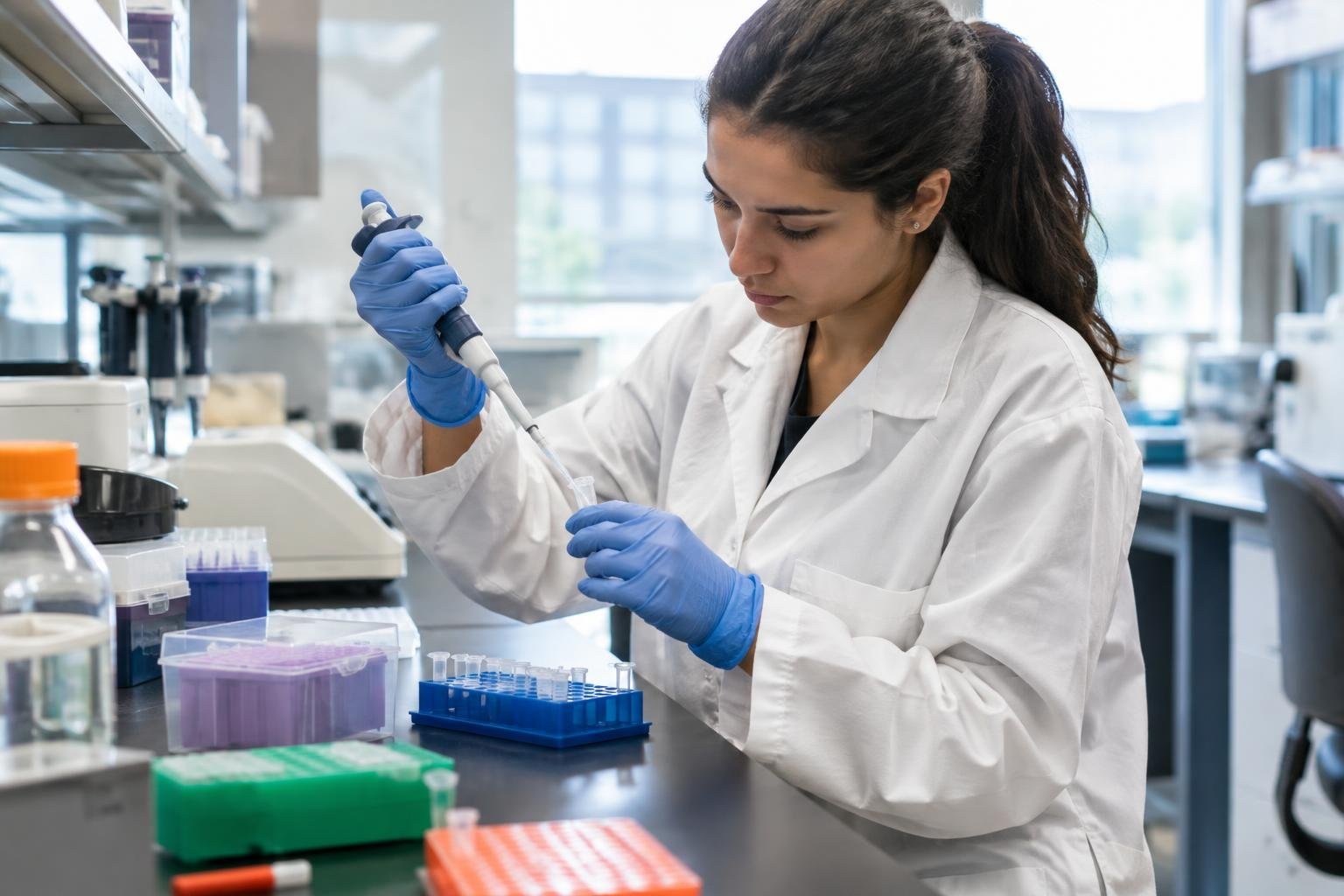
A student working carefully with laboratory equipment in a molecular biology setting
What Is Molecular Biochemistry?
What Is a Molecular Biochemistry Degree?
Molecular biochemistry examines the molecular processes behind biological activity. It connects chemistry with the study of cells, genes, proteins, metabolism, and other components of living systems. Programs may prepare students to investigate biological questions, develop research skills, or continue into advanced science or professional education.
The name is not used identically at every college. A related program may be called biochemistry and molecular biology, molecular biology, biomedical sciences, or cell and molecular biology. Compare the required courses and learning outcomes rather than assuming two programs with similar names are interchangeable. For example, New York Medical College describes its M.S. in Biochemistry and Molecular Biology as preparation for investigating biological concepts at the molecular level.
Credentials also differ. The supplied university examples include undergraduate study, graduate certificates, master’s degrees, and Ph.D. programs. A certificate may be designed to build a focused set of competencies, while a degree typically represents a broader course of study. Review what each credential qualifies you to do next; do not assume a certificate is equivalent to a degree.
What Do Molecular Biochemistry Students Study?
What You Study: Courses, Research, and Practical Learning
Coursework can move from foundational biology and chemistry into specialized molecular topics. Examples identified in a biochemistry program overview include molecular biology, cell biology, medical molecular genetics, metabolic regulation, bioinformatics, enzymology, neurobiology, and molecular pharmacology. These subjects help students examine how biological components work, how processes are regulated, and how molecular changes relate to larger biological questions.
At advanced levels, a curriculum may include required courses, electives, and a thesis project. Research-focused programs may also ask students to analyze scientific papers and communicate research findings. The University of Miami’s graduate bulletin, for example, describes a journal-club course in which master’s students critically review published work and present research findings.
Some programs emphasize computational approaches to biological problems. Baylor College of Medicine describes graduate work involving quantitative modeling and advanced computational methods to study biological systems and improve understanding of human health. Ask whether a program’s emphasis is primarily laboratory-based, computational, clinically oriented, or a combination.
Curriculum details are school-specific. Before applying, check course prerequisites, elective options, thesis or capstone expectations, and whether research or lab work is required. A program’s title alone will not tell you how much time students spend developing practical skills.
Skills Developed Through Molecular Biochemistry
Skills You Can Build
Depending on the curriculum and your experience, study may develop a working understanding of molecular and cellular biology, genetics, metabolic processes, and bioinformatics. Research and thesis work can also provide practice in evaluating scientific literature, framing questions, interpreting results, and explaining findings. The University of Miami’s journal-club example specifically includes critical review and presentation of research.
Some programs also build computational and quantitative approaches for investigating biological systems. Such skills may be relevant to research settings that use models or biological data, but the depth of training varies. Ask for examples of projects and the software, methods, or laboratory techniques students actually learn.
These abilities are most useful when linked to demonstrable experience. A project, thesis, presentation, or documented laboratory contribution can help show what you can do beyond listing a major on a résumé. Avoid assuming every program provides the same practical preparation.
Who Should Consider Molecular Biochemistry?
Who Is This Program Best For?
Molecular biochemistry may appeal to students who enjoy asking how biological systems work at a small scale, are curious about biomedical research, and are comfortable studying detailed scientific ideas. It can also suit learners who want to explore laboratory or computational approaches to biological questions.
You do not need to arrive with a fixed career plan. It is useful, however, to identify whether you are more interested in research, further professional education, or a specific science-related occupation. If your goal is professional school, look at the prerequisites for the particular schools and programs you may apply to. A biomedical sciences graduate certificate at the University of North Carolina at Charlotte, for example, is described as preparation for professional biomedical schools including medical, veterinary, and dental schools. That does not mean completing the certificate guarantees admission.
Does molecular biochemistry match you? Consider whether you enjoy careful, evidence-based work and whether you are willing to spend time on foundational science. Salary, prestige, and broad claims about job growth cannot substitute for fit with daily tasks and educational requirements. Assessment.com’s MAPP Career Assessment, Degree Matching, and Career Matching can help you reflect on preferences and compare possible directions.
Admissions, Time to Completion, and Difficulty
Admission Requirements, Length, and Academic Difficulty
Requirements depend on the credential and institution. When comparing programs, check whether applicants need prior coursework in biology, chemistry, or another science. One overview of master’s study in biochemistry describes a bachelor’s degree in biochemistry, chemistry, or another biological science as a typical prerequisite. This is not a universal admissions rule, so use the specific program’s current application requirements.
Graduate applications may also ask applicants to explain their interest in research and career plans. Baylor College of Medicine’s graduate program information identifies motivation for biomedical research and realistic science-career plans among application considerations. Ask each school which materials are required, such as transcripts, recommendations, a statement, or an interview; do not assume every program uses the same process.
Difficulty often comes from the detail and pace of science courses, the need to connect concepts across biology and chemistry, and the expectations of research or thesis work. Preparation can include reviewing prerequisites, asking about academic support, and speaking with current students about workload. Completion time depends on credential, course load, transfer credits, and research requirements, so request an individualized plan rather than relying on a generic estimate.
Credential Levels, Online Options, and Completion Planning
Certificates, Degrees, and Program Formats
Available pathways can include certificates, undergraduate study, master’s programs, and doctoral study. The purpose of each credential matters. A graduate certificate may provide targeted advanced training for people who already hold a bachelor’s degree; the University of Rhode Island describes its cell and molecular biology graduate certificate in those terms. A biomedical sciences certificate may instead provide core competencies or exposure intended to help prepare students for professional biomedical education.
Some graduate programs allow doctoral admission after either a bachelor’s or master’s degree. Southern Illinois University’s catalog gives that option for its multidisciplinary biomedical and biological sciences program. This is an example, not a general rule; programs differ in prerequisites, sequencing, and whether a master’s degree is earned along the way.
Online, hybrid, and campus formats should be compared by required activities, not marketing labels. The University of Miami lists an executive Ph.D. option online, while research and laboratory expectations may differ across programs. Confirm where courses, research, lab sessions, presentations, and any required campus activities take place before enrolling.
What Does Molecular Biochemistry Cost?
Cost, Financial Aid, and Affordability
There is no single reliable price for a molecular biochemistry degree. Total cost depends on the school, credential, residency classification, course format, fees, and how long you take to finish. Research programs may also have costs associated with required materials, travel, or attendance that are not obvious from a per-credit tuition figure.
Ask each college for a written estimate of total attendance costs for your expected schedule. Include tuition, mandatory fees, books and supplies, technology, transportation, housing if applicable, and any program-specific expenses. Compare the net amount after grants, scholarships, employer support, or other aid for which you are eligible. Verify deadlines and renewal conditions directly with the institution and aid provider.
To control cost, ask whether prior coursework can transfer, whether part-time study is possible, and whether the degree plan can be completed without adding unplanned terms. If comparing a certificate with a full degree, evaluate what each credential enables you to do next rather than choosing solely by its initial price. Do not take on debt based on an assumed salary or guaranteed job outcome.
What Can You Do With Molecular Biochemistry?
Careers, Jobs, and Employment Outlook
Molecular biochemistry can support further study and research-related directions, but the degree name alone does not determine eligibility for a particular job. Program examples point to biomedical research, molecular-level investigation of biological concepts, and computational approaches to understanding biological systems. The role you can pursue depends on your credential, experience, and the employer’s requirements.
Potential areas to investigate include laboratory research, molecular biology and biotechnology, biomedical research, and computational or quantitative biological research. Treat these as fields to explore, not guaranteed job placements. At the bachelor’s level, compare local job advertisements to see what employers ask for in education and practical experience. For research leadership or highly specialized scientific work, investigate whether graduate education is commonly expected in your target setting.
Pay and employment outlook should be researched by occupation and location, not inferred from a major label. Look up current wage and outlook data for the exact job titles you are considering, then compare those figures with real postings and required qualifications. The supplied program information does not establish a universal salary or job-growth rate for molecular biochemistry graduates.
Science and health research increasingly use computational approaches alongside biological knowledge. Baylor College of Medicine’s program description identifies quantitative modeling and advanced computational methods as one research direction. Students interested in this area should ask what data, methods, and tools they will actually learn and whether project work is available.
Find out which Career or College Major is right for you!
Research Experience, Certifications, and Licensure
Experience, Research, and Credentials
Experience can help translate scientific coursework into evidence of what you know how to do. Ask about faculty research, thesis projects, journal clubs, lab placements, and opportunities to present findings. The University of Miami’s example of critical paper review and research presentations shows one way a graduate curriculum can incorporate scientific communication.
Look for projects where you can explain your contribution, methods, and learning. If your interests are computational, ask whether students can work on quantitative modeling or biological data. If you prefer laboratory research, ask what facilities and supervised practical work are available.
Degree completion and professional authorization are different matters. A molecular biochemistry credential by itself should not be assumed to grant a professional license or guarantee eligibility for medical, veterinary, dental, or other regulated practice. Verify the separate admissions, examination, training, or licensing requirements for any regulated career you are considering.
How to stand out: build relevant project experience, learn to explain scientific results clearly, keep a record of methods and tools you have used, and connect with faculty or research groups. Seek references from people familiar with your work. Confirm that any certificate or credential you pursue is recognized by the employers or programs you plan to approach.
Graduate School Options
Graduate School and Further Study
Graduate options include master’s and doctoral study in biochemistry, molecular biology, biomedical sciences, or closely related areas. A master’s program may deepen knowledge of molecular-level biological concepts and may include courses, electives, and a thesis. A doctoral path may suit students aiming for sustained research training, although the structure and career implications vary by institution and field.
Some programs accept doctoral applicants with a bachelor’s degree, while others may expect additional preparation. Southern Illinois University’s catalog describes Ph.D. admission with either a bachelor’s or master’s degree. Review how a program handles prerequisites, funding, research mentoring, degree milestones, and whether a master’s credential is awarded during doctoral study.
Professional school is another possible next step for some students, but a science certificate or degree is not an admission guarantee. Check required prerequisite courses and application criteria for each medical, veterinary, dental, or other professional program you may consider.
Related Degrees: What Should You Compare?
Related Degrees and Alternatives
Compare molecular biochemistry with adjacent fields by reading the curriculum and considering the work you want to do. Similar titles can have substantial overlap, but emphasis and opportunities can differ by school.
Biochemistry: consider this if you want a broader focus on chemical processes in living systems.
Molecular biology: consider this if you are most interested in molecular mechanisms and biological research.
Biotechnology: consider this if you want a program that connects biological knowledge with applied technologies; verify what practical training is included.
Biomedical sciences: consider this if your goal is broad preparation for biomedical or professional-school study. Some certificates explicitly describe this preparation.
Cell and molecular biology: consider this if you want focused advanced study in cellular and molecular topics.
Genetics: consider this if the study of genes and inheritance is your main interest; compare actual course requirements.
Bioinformatics or computational biology: consider this if you are drawn to data and computational approaches to biological questions.
For a meaningful comparison, line up required courses, lab and research access, graduate-school prerequisites, total cost, and job requirements. Avoid choosing from a program title or a single salary estimate.
How to Choose a Molecular Biochemistry Program
Accreditation and Choosing a College Program
Start by confirming the institution’s current accreditation status through authoritative education sources, then check whether a particular program has additional accreditation or approval relevant to your intended path. Do not assume that a degree title or a school’s marketing description demonstrates that a credential meets a professional requirement.
Compare these factors before applying:
Curriculum: Are the required courses and electives aligned with your interests?
Research and facilities: Can students take part in the kind of laboratory, thesis, or computational work they want?
Faculty access: How are research projects supervised and how do students find mentors?
Format: Are labs, research meetings, and required presentations accessible in the advertised delivery format?
Cost: What is the full expected cost, and what aid is available?
Outcomes: Can the school explain where graduates go and what additional education or experience they pursue?
Transfer and progression: Will prior courses count, and does the credential meet prerequisites for your next step?
Ask for current answers in writing, especially about transfer credit, research access, completion requirements, and professional-school preparation. Assessment.com education-matching tools can help you compare programs against your interests and goals, but confirm admissions and credential requirements with the institutions themselves.
Advantages, Drawbacks, and Value
Is Molecular Biochemistry Worth It?
Potential advantages include studying biological systems in depth, developing a foundation for research-oriented learning, and exploring molecular, biomedical, or computational directions. Some programs also offer certificates for focused preparation or graduate study for advanced research training.
Tradeoffs include the time and expense of education, the possibility that a preferred occupation requires further study, and differences in hands-on experience between programs. A degree should be judged against your actual objective: the job or next credential you want, its entry requirements, and whether the likely path is affordable for you.
Before deciding, find several current job postings or graduate-program requirements that match your interests. Note the education, experience, and skills they request, then ask colleges how their curriculum prepares students for those expectations. This practical comparison is more useful than treating a degree as a universal route to a specific outcome.
Realistic Pathways From Study to Work
From Degree to Career: Possible Pathways
There is no guaranteed sequence from study to a particular role. Use pathways as planning examples, then check actual education and experience requirements with employers.
Undergraduate science coursework → supervised research experience → laboratory or biotechnology job search → additional specialization or graduate study.
Master’s study → thesis or research project → application to research-focused roles or doctoral programs.
Biomedical sciences certificate → completion of relevant prerequisites and application preparation → apply to professional schools if eligible.
Molecular biology study → computational or quantitative project work → pursue research settings that use biological modeling or data.
Each route depends on academic preparation, performance, available opportunities, and the selection criteria of employers or graduate schools. Treat examples as options to investigate, not promises.
A Program Evaluation Checklist
Questions to Ask Before Enrolling
What is the institution’s current accreditation status, and is any additional program approval needed for my goal?
What is the full estimated cost for my likely course load, including fees and required materials?
What do graduates do next, and what education or experience do those paths require?
Can I participate in a lab, thesis, research group, or computational project?
Are all required components available in the format advertised?
Will my previous coursework transfer, and what conditions apply?
Does the program meet prerequisites for graduate or professional schools I may consider?
What scholarships, grants, employer benefits, or other aid might apply, and what are the renewal rules?
How are research mentors assigned, and what support is available if I need academic help?
Which current job postings do the program’s courses and projects prepare me to pursue?
Write down answers and compare programs side by side. A careful review can reveal whether a lower-cost option offers the preparation you need or whether a more specialized program better fits your goals.
Program Information to Review
Want to see your options? Try our comprehensive Degree, Program & College Search tool
Review current program information directly with the institutions before applying. Useful starting points include Baylor College of Medicine’s graduate degree programs, the University of North Carolina at Charlotte’s biomedical sciences certificate, the University of Miami’s graduate bulletin, and the Southern Illinois University graduate catalog. For course examples, see the New York Medical College M.S. program and Youngstown State University’s molecular biology and biotechnology catalog information.
Frequently asked questions
What is molecular biochemistry?
Molecular biochemistry studies biological processes at the molecular level, including how molecules such as proteins, DNA, and enzymes function in living systems. Programs may cover cell and molecular biology, genetics, metabolism, bioinformatics, and related subjects. Exact course requirements and research expectations vary by school and credential.
Is molecular biochemistry hard?
It can be challenging because the subject combines detailed biological concepts with chemistry, data interpretation, and, in some programs, intensive laboratory or research work. The level of difficulty depends on your preparation, course sequence, and the program’s expectations. Reviewing sample course plans and asking about tutoring or research support can help you judge the fit.
Is a molecular biochemistry degree worth it?
Molecular biochemistry can be a useful foundation for research-related study and for some science roles, but its value depends on your target job, the credential you earn, and the experience you gain. Compare program cost and outcomes with actual job requirements. Some research or professional pathways may require graduate education or additional qualifications.
What can you do with a molecular biochemistry degree?
Possible directions include laboratory and biomedical research, molecular biology, biotechnology, and further study in related sciences. The exact job titles available depend on the credential, practical experience, and employer requirements. Review job postings in your area to see whether they ask for a bachelor’s degree, graduate training, specific techniques, or prior research experience.
How much can you make with a molecular biochemistry degree?
A reliable salary figure depends on the specific occupation, location, experience, and degree level, not just the name of a major. Compare current wage information for the job titles you are considering, then check local postings for required qualifications and pay ranges. Do not treat a degree’s title as a guarantee of earnings.
Can you study molecular biochemistry online?
Some related coursework or graduate study may be offered online, but research and laboratory components can require hands-on participation. The available format differs by program. Ask whether all required labs, research, examinations, and any on-campus activities can be completed remotely before enrolling.
Does molecular biochemistry require math?
Expect chemistry and quantitative reasoning to be relevant, although the amount of required math varies by curriculum and specialization. Bioinformatics and quantitative research approaches can involve computational or statistical work. Request the program’s course sequence and prerequisites to understand the level of mathematics expected.
Do you need graduate school for molecular biochemistry careers?
Not every possible role requires graduate school, but advanced research and specialized academic pathways may call for a master’s or doctoral degree. Program examples include master’s and Ph.D. study, and one university catalog indicates that its Ph.D. applicants may enter with a bachelor’s or master’s degree. Requirements are specific to each institution and role.
What certifications help with molecular biochemistry jobs?
There is no single credential that applies to every molecular biochemistry role. Employers may value relevant laboratory, computational, or research experience, while regulated occupations can have separate requirements. Start with job postings in your intended field and verify any credential or license with the relevant employer or licensing body.
People Also Ask
What does molecular biochemistry study?
Molecular biochemistry studies biological systems through the molecules and chemical processes that support life. It brings together areas such as cell biology, molecular biology, genetics, metabolism, and related research methods. The precise mix depends on the college and credential.
What is the difference between a molecular biochemistry certificate and a degree?
A bachelor’s degree is an undergraduate credential, while a master’s or doctorate involves further study and may include advanced coursework, research, or a thesis. Certificates offer more focused study, but their purpose and admission rules vary. Check each institution’s catalog before comparing credentials.
What courses are in a molecular biochemistry program?
Course topics can include molecular biology, cell biology, medical molecular genetics, metabolic regulation, bioinformatics, enzymology, neurobiology, and molecular pharmacology. A master’s program may also include electives and a thesis. Students should verify course requirements in the current catalog.
Can molecular biochemistry be completed fully online?
Some programs offer online coursework or executive doctoral formats, but that does not mean every laboratory or research requirement is remote. Confirm the format of each required component, including practical work, research supervision, and any campus visits, directly with the program.
How long does it take to earn a molecular biochemistry degree?
Completion time depends on credential, enrollment pace, transfer credit, and research requirements. Rather than rely on a general estimate, ask a college for the required credits, typical course sequence, and expected time to finish for full-time and part-time students.
How does molecular biochemistry compare with molecular biology?
Compare molecular biochemistry with biochemistry, molecular biology, biotechnology, and biomedical sciences. The names overlap, but course emphasis and career preparation can differ. Use the course catalog and job postings for your preferred work to identify which program offers the most relevant preparation.
How can students gain research experience in molecular biochemistry?
Research-oriented experience can help you apply classroom learning and understand whether laboratory or computational research suits you. Ask programs about undergraduate research, thesis options, faculty projects, and opportunities to present or discuss scientific findings.
Molecular biochemistry may suit students who want to understand life at the molecular level and are willing to build a strong foundation in biological and chemical sciences. The degree can support further study and research-focused directions, but the credential alone does not guarantee a particular job, salary, or admission to professional school. Before committing, compare actual curricula, research access, costs, and the qualifications requested for jobs you might pursue. Personal fit matters as much as the program title.
We use cookies to offer you a better browsing experience, analyze site traffic and personalize content.
Read about how we use cookies and how you can control them in our
Privacy Policy.
If you continue to use this site, you consent to our use of cookies.
×
Exciting News!
Be one of the first to Beta Test the new AI-Powered Assessment.com Platform.