Biochemistry and Molecular Biology Degree Guide: Courses, Careers, and Fit
Explore what biochemistry and molecular biology students study, how programs differ, career directions, costs to investigate, and questions to ask before choosing a degree.
By Tome Fierre · Staff Writer Assessment.com · Published October 7, 2026 · Last updated November 5, 2026
A biochemistry and molecular biology degree examines how chemical processes and molecules help living systems function. Students explore areas such as molecular genetics, protein structure, and enzymology, with the mix of coursework and research depending on the college and credential level. Graduates may pursue laboratory roles or explore biotechnology, pharmaceutical, environmental science, and further-study pathways. The major can also be part of preparation for professional or graduate school, but the degree alone does not guarantee admission or a particular job. If you are comparing majors, look beyond the name: course content, research access, cost, and the education required for your intended work all matter.
Degree & Program Decision Insights
Explore your personal fit, education requirements, career potential and next steps.
01Motivational Fit
Discover whether this program fits you
Explore your preferences against the focus of Biochemistry and Molecular Biology. These prompts are not personal MAPP results.
Scientific investigation. Would you enjoy investigating general biology and explaining your conclusions from evidence?
Breadth of interest. Consider the place of “general and organic chemistry” in this field. Is this another part you would choose to explore, or mainly a requirement you would tolerate?
Work reality. Related work can involve this task: “Develop new methods to study the mechanisms of biological processes.” Would you want that activity to be a regular responsibility?
Interest in studying a field can differ from enjoying its related work.
Which part would you want to do repeatedly, and what would you try before deciding?
Discover Your Personal Program Fit
Before investing your time and money in your education, discover how this program aligns with your natural motivations, work preferences and career goals.
Typical occupational entry: bachelor's degree (BLS). BLS lists 5 years or more of related work experience as typical for this occupation; this programme is not a direct promise of entry.
U.S. occupational wages are not guaranteed graduate earnings; OEWS excludes self-employed workers.
Projected openings include replacements as well as growth.
U.S. national estimates. A crosswalk does not establish entry-level eligibility; advanced, management and teaching roles can require further qualifications.
Compare the focus and route of these distinct instructional fields; their credentials and admission requirements are not interchangeable.
Molecular BiologyCIP 26.0204. Compare its emphasis on such topics as molecular signaling and transduction and regulation of cell growth with this program’s focus.
BiochemistryCIP 26.0202. Compare its emphasis on bio-organic chemistry and protein chemistry with this program’s focus.
Explore your motivations. Use MAPP as a starting point for reflecting on your interest in “general biology”, then test that interest against a sample learning task.
Examine the work. Compare Biochemists and Biophysicists and Natural Sciences Managers on daily work and entry qualifications, as well as pay. Explore Biochemists and Biophysicists.
Compare actual providers. Ask for the exact credential, course sequence and assessment methods. Compare how each provider teaches “general and organic chemistry”, its entry criteria and its itemized costs.
Check the evidence before applying. Confirm prerequisites and any recognition or professional requirements for your intended route; ask for applicable rules and published outcome definitions in writing.
Verify the institution’s current offering, admissions requirements and outcomes; a search result does not establish your eligibility.
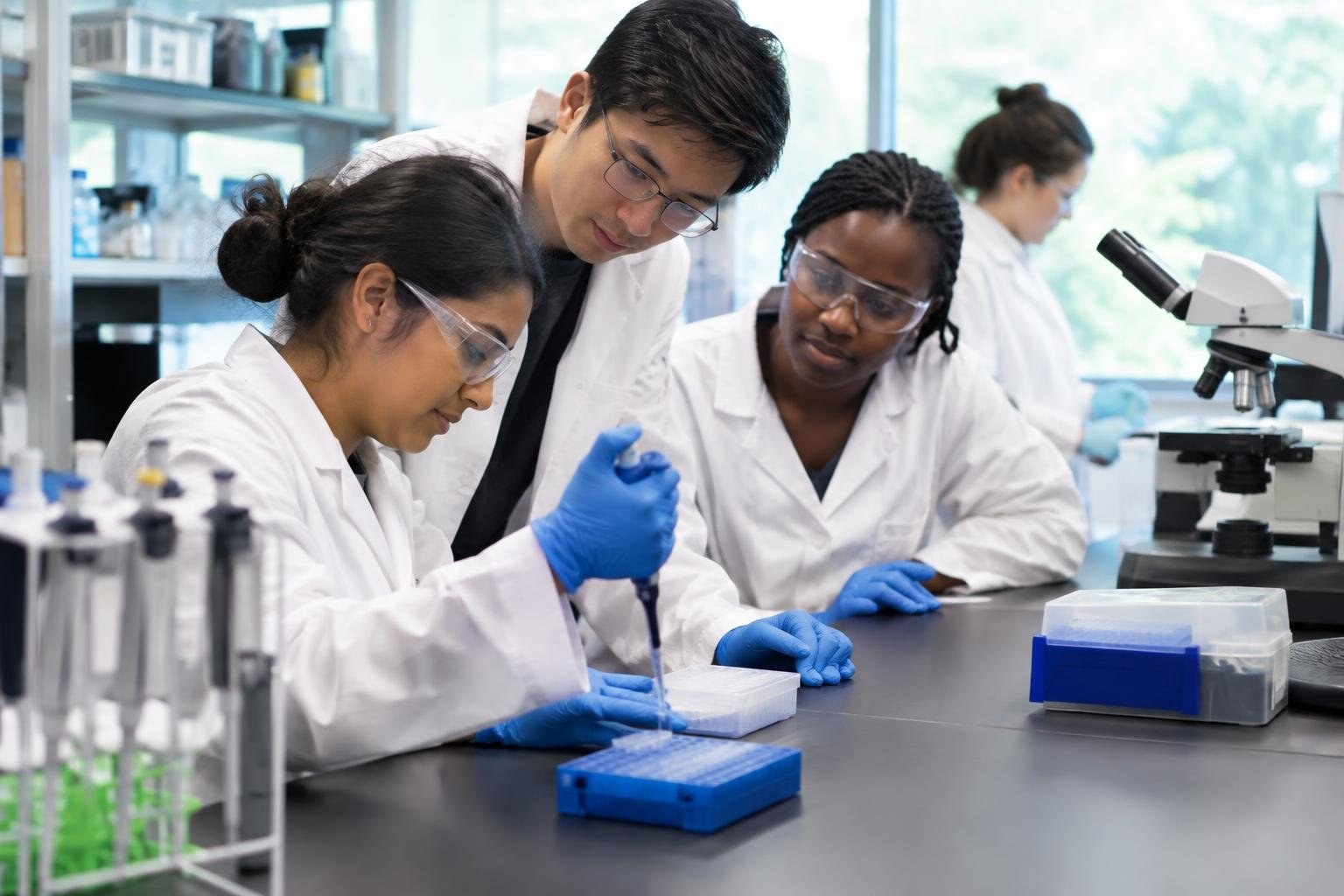
Undergraduate laboratory learning and collaborative research
What Is a Biochemistry and Molecular Biology Degree?
Biochemistry and molecular biology brings together the study of chemical processes in living organisms and the molecules involved in biological activity. Depending on the program, students may examine molecular genetics, protein structure, and enzymology. The focus is smaller-scale than broad organismal or ecological study: students ask how molecules and chemical reactions relate to biological functions.
Colleges may offer related study through a major, concentration, certificate, master's degree, or doctorate. Names and course requirements are not standardized across every institution. A program called biochemistry may include molecular biology, while another may place more emphasis on molecular biology, biotechnology, or biomedical science. Read the required courses and research descriptions to understand what a particular credential actually covers.
It is also distinct from professional training for a specific licensed occupation. A science degree can support preparation for further study, but admission to a medical, dental, pharmacy, or other professional program is a separate process.
What Do Students Study?
Coursework typically depends on the college and credential. One useful way to review a curriculum is to ask what questions its courses teach students to investigate: how biological molecules are structured, how molecular processes work, and how researchers use evidence to explain them. Molecular genetics, protein structure, and enzymology are examples of subjects associated with biochemistry and molecular biology.
Look at more than course titles. Compare how much of the program is devoted to foundational science, specialized topics, laboratory practice, and independent or group research. Ask whether undergraduates can join faculty projects and whether research experience is built into the degree or must be pursued separately.
At the graduate level, research communication may be part of the training. For example, one university's master's curriculum includes a journal club in which students critically review published work and present research findings. That is one program example, not a requirement for every degree.
When comparing catalogs, check prerequisites between courses, laboratory components, research expectations, and whether the curriculum leaves room for electives connected with your interests. These details can make two similarly named programs quite different in practice.
Skills You Can Build
Biochemistry and molecular biology coursework can help students develop subject knowledge in molecular genetics, protein structure, and enzymology. Research-based study can also offer practice reading scientific papers, assessing evidence, and communicating findings. The specific skills you develop depend on course design and your participation in laboratories, research projects, or internships.
These skills can connect to laboratory technician work, where a science background may be relevant, and to further study aimed at research careers. Students interested in biotechnology or pharmaceutical work should ask programs how they connect course learning to current laboratory practice and what opportunities students have to demonstrate their skills.
Do not assume that having the degree title alone proves proficiency in every laboratory method or makes a graduate ready for independent research. Review job descriptions and compare them with the actual training and experience offered by the program.
Who Is This Degree Best For?
This major may appeal to students who are curious about how living systems work at a chemical and molecular scale and who enjoy asking evidence-based questions. It can be worth exploring if you are interested in laboratory science, molecular genetics, biomedical questions, or research. You do not need to fit a single personality type to succeed; preparation, study habits, available support, and the actual demands of the program matter.
Think about the work you want to do day to day. Would you enjoy carefully investigating a focused scientific question? Are you comfortable spending time understanding detailed concepts and interpreting evidence? Do you want a career that may require graduate study, or are you looking for a more direct route to employment? Your answers can help distinguish this major from broader or more applied alternatives.
Does Biochemistry and Molecular Biology Match You?
Salary, reputation, and projected job growth are only part of a degree decision. Also consider whether the subject and likely work fit your interests, motivations, and preferred way of solving problems. The Free MAPP Career Assessment, Degree Matching, and Career Matching tools can help you explore alignment, but use them as starting points alongside conversations with advisors and program research.
Admissions, Completion Time, and Academic Demands
Admission rules are set by individual colleges. Requirements may differ among undergraduate, certificate, master's, and doctoral programs, so check the official admissions page for each option. Ask what prior coursework the program expects, what application materials it requires, and whether research interests or faculty contact are relevant to admission.
Time to completion likewise depends on credential level, course load, transfer credit, and program structure. A certificate is not interchangeable with a bachelor's degree, and graduate study involves a different level of specialization. Some doctoral programs may admit students with a bachelor's degree or a master's degree; this varies by institution and program.
The academic challenge is not identical for everyone. Before enrolling, review sample course sequences and ask about tutoring, advising, and access to research opportunities. If you have been away from school, ask whether the college recommends refreshing prerequisite knowledge before beginning advanced coursework.
Online, Hybrid, and Campus Options
Program format varies. Some programs include research or laboratory experiences, while other offerings may be designed around coursework or preparation for further study. An online label does not by itself tell you whether a student can complete every requirement remotely.
Ask a program directly whether labs, research, examinations, or meetings require campus attendance. Find out how online students access faculty guidance, research supervision, and any required facilities. For a certificate intended to provide exposure to biomedical sciences, confirm whether its content matches your intended next step; for a research-focused graduate degree, examine how the program provides meaningful research training.
Compare the schedule with your responsibilities and the practical experience you want. A flexible format may help with access, but the fit depends on the curriculum and how its hands-on or research components are delivered.
Tuition, Costs, and Financial Aid
The research available for this guide does not establish a single tuition amount for biochemistry and molecular biology programs. Costs depend on the college, credential, student circumstances, and charges listed by the institution. Request a written estimate of total cost rather than comparing tuition alone.
Ask whether the estimate includes mandatory fees, laboratory or technology charges, books and supplies, and living expenses where applicable. For online study, confirm any additional technology or in-person requirements. Compare the net price after grants and scholarships with the amount you would need to borrow or pay from other sources.
Contact each college's financial aid office about eligibility for grants, scholarships, work-study, employer tuition support, and payment plans. Ask how transfer credits affect the time and total cost to finish. Do not assume a certificate or online program costs less without checking the full charges and aid package.
Before accepting an offer, put competing programs side by side: estimated total cost, expected completion plan, aid that does not need to be repaid, and likely additional education needed for your career goal.
Careers, Jobs, and Employment Outlook
This degree does not correspond to one guaranteed job title. Graduates may seek laboratory technician positions or explore biotechnology, pharmaceutical, and environmental science fields. Some students use the major as preparation for medical, dental, pharmacy, or graduate school. The education needed depends on the role: a bachelor's degree may support technician work, while independent research typically requires graduate education.
Use the table as a starting point, not a promise of eligibility. Employers set requirements, and job titles can cover different responsibilities.
Career direction
Education or preparation to investigate
How the degree may apply
Laboratory technician
A bachelor's degree may be relevant; verify each employer's requirements.
Scientific coursework can provide subject preparation for laboratory work.
Biochemistry or molecular biology research
Graduate education is typically needed for independent research.
Advanced study can develop deeper knowledge and research experience.
Biotechnology roles
Requirements vary by job and employer.
Molecular biology and biotechnology are related areas of study.
Pharmaceutical industry roles
Check qualifications for each position; some career goals may require further study.
Knowledge of biological processes can be relevant to work in the sector.
Environmental science roles
Requirements vary by position and specialization.
Some graduates pursue environmental science after studying biochemistry.
Medical, dental, or pharmacy school pathway
Admission to a professional program is a separate process with its own requirements.
The degree may serve as an academic foundation, depending on prerequisites.
No salary or employment outlook figure should be treated as specific to the major itself. Research the current pay and outlook for the exact occupation, location, and education level you are considering. Compare entry-level openings with longer-term research roles, and check whether additional training is expected.
When evaluating industry change, focus on skills and adaptability rather than assuming any degree guarantees protection from automation or guarantees a new opportunity. Ask faculty and career services how the curriculum connects students to evolving laboratory and research work.
Find out which Career or College Major is right for you!
Internships, Research, and Professional Preparation
Experience can help you test whether research or laboratory work suits you and make your preparation more visible to employers or graduate programs. Ask about faculty research, supervised projects, internships, and opportunities to present your work. Graduate-level journal clubs and research presentations are examples of ways some programs build practice in evaluating and explaining scientific findings.
Keep a record of projects, responsibilities, and techniques you have actually used. Seek advice from faculty, academic advisors, and career services about research opportunities and appropriate professional organizations. Do not list a credential or technique on a résumé unless you have completed the relevant training and can explain your experience accurately.
How to Stand Out to Employers
Connect course learning to a project, internship, or supervised research experience.
Be prepared to explain the question you investigated and how you evaluated evidence.
Use job postings to identify skills employers request and discuss gaps with an advisor.
Build relationships with faculty and supervisors who can speak to your work.
Check whether your target occupation requires further education or a separate credential.
Completing a degree does not automatically confer professional licensure or certification. Check the rules and hiring requirements for the exact occupation and location you intend to pursue.
Graduate School and Other Education Pathways
Further study can be a logical next step for students who want deeper specialization, independent research, or preparation for a professional school. Options include a master's or doctorate in biochemistry and molecular biology, or related programs in the biological and biomedical sciences. A graduate certificate may provide exposure to biomedical science subjects for students preparing for professional biomedical schools, depending on its design.
Doctoral programs can serve as an admissions home for multiple research fields. For example, one university's biological and biomedical sciences program brings together doctoral areas including genetics, pharmacology, cell biology, and molecular biophysics. Program structures differ, so compare the research areas, advising model, funding information, and degree requirements.
Before applying, identify why you need another credential. Review the entry requirements and outcomes for specific programs, and speak with faculty in research areas that interest you. A graduate degree is a substantial commitment; it should connect to a defined career or learning goal rather than be treated as an automatic next step.
Related Degrees and Alternatives
Related fields can overlap, but they may emphasize different questions or preparation. Compare actual course requirements rather than choosing by title alone.
Biology: Consider this if you want a broader study of living systems rather than a stronger focus on chemical processes and molecules.
Molecular biology: Consider this if your strongest interest is molecular genetics and biological activity at the molecular level.
Biochemistry: Consider this if you want to emphasize the chemical processes of living organisms; program boundaries vary.
Biotechnology: Consider this if you want a program explicitly designed around molecular biology and biotechnology applications.
Biomedical sciences: Consider this if you want broad exposure to biomedical subjects or preparation for a professional biomedical school.
Genetics: Consider this if you want to focus your study on heredity and genetic systems; check whether a program is research- or application-oriented.
Pharmacology: Consider this if your academic interests are centered on drugs and their effects; review the specific program's prerequisites and career preparation.
Environmental science: Consider this if environmental systems and applied environmental work are your primary interests.
Use these comparisons to generate questions, not to assume every program with a particular title has the same curriculum. Ask which careers graduates pursue and what additional education is common for those roles.
Advantages, Drawbacks, and Is It Worth It?
Potential advantages: The subject connects molecular-scale science with questions about living systems; students can explore research and laboratory paths; and the degree may support further study in biomedical, professional, or scientific fields.
Potential drawbacks: A degree may not be enough for every research career, and students seeking independent research work should expect graduate education to be relevant. Course titles alone do not show how much hands-on experience a program offers. The range of career directions also means you need to research job requirements rather than assume a major leads to one clear occupation.
Whether it is worth the investment depends on total cost, the education required for your goals, the program's practical opportunities, and your fit with the work. Compare likely pathways and financial aid before deciding. If your preferred job requires additional education, include that time and cost in your plan.
How to Choose the Right Program
Make a shortlist based on what you want to learn and the next step you hope to take. Then compare programs using their official catalogs and direct questions to admissions staff, faculty, and current students.
Curriculum: Are molecular genetics, protein structure, enzymology, or other subjects you care about included?
Research access: Can students participate in supervised research, and how are findings discussed or presented?
Faculty and facilities: Are there faculty working in areas that match your interests, and what learning resources can students use?
Format and time: Which components are online or on campus, and what is the realistic completion plan for your enrollment pattern?
Cost and aid: What is the full estimated cost, and what grants, scholarships, or other aid may be available to you?
Preparation for next steps: Does the program support applications to graduate or professional school, or connect students with relevant employers?
Accreditation and recognition: Confirm institutional and program credentials through appropriate official sources, and ask whether they matter for your intended next step.
Outcomes and transfer: Ask how graduates use the degree and how prior credits are evaluated.
For any career with separate certification or licensing rules, confirm requirements with the relevant authority in the location where you plan to work. Do not assume a general science degree automatically meets a professional requirement.
From Degree to Career
From Degree to Career: Possible Pathways
Career progression is not automatic. Use these examples as planning models and verify the education and experience required for each role.
Bachelor's study → laboratory technician role → supervised experience → specialized laboratory or research work. A bachelor's degree may be relevant to technician roles, but employer requirements differ.
Bachelor's study → graduate study → research training → independent research career. Graduate education is typically needed for independent research.
Bachelor's study → prerequisites and application → professional school → profession-specific training. A science degree may help provide academic preparation, but admission and later credential requirements are separate.
Use career conversations, program advising, and current job descriptions to test whether a proposed path is realistic for your circumstances.
Questions to Ask Before Enrolling
What courses and prerequisites are required, and how much choice do students have?
What supervised laboratory, research, or internship opportunities are available?
What is my estimated total cost after grants and scholarships, including applicable fees and supplies?
Which parts of the program require campus attendance, and can the format fit my schedule?
How will the college evaluate transfer credits, and will they change my expected completion plan?
What do graduates do next, and how does the program support graduate or professional school applications?
For the careers I am considering, what education, certifications, or licenses do employers or authorities require?
What academic advising, research mentoring, and career services can I access?
Where can I verify the institution's accreditation and any program-specific recognition?
Write down answers and compare them across colleges. If an answer affects your cost, completion time, or eligibility for a next step, ask for the relevant policy in writing.
Frequently asked questions
What is the difference between biochemistry and molecular biology?
Biochemistry studies chemical processes in living organisms, while molecular biology focuses more directly on biological activity at the molecular level, including genetics and the behavior of molecules such as proteins. Many programs combine the subjects because they overlap. Compare required courses, lab and research opportunities, and career preparation rather than relying on the degree title alone.
What do you study in a biochemistry and molecular biology degree?
Students commonly consider courses and research involving molecular genetics, protein structure, and enzymology. The exact course sequence varies. Some graduate programs also include research discussion and presentations, while undergraduate programs may offer laboratory or research experiences. Review a specific college's course catalog and ask how students gain hands-on experience.
Is biochemistry and molecular biology a hard major?
The program can be demanding for students who are less comfortable with detailed scientific concepts, interpreting evidence, and sustained laboratory or research work. Difficulty depends on your preparation, course design, and strengths. Ask colleges about introductory course expectations, tutoring, lab workload, and opportunities to gain research experience before committing.
What jobs can I get with a biochemistry and molecular biology degree?
Possible directions include laboratory technician work, biomedical research, and positions in biotechnology, pharmaceutical, or environmental science organizations. A bachelor's degree may qualify graduates for some technician roles; independent research commonly requires graduate education. Job titles and requirements differ, so check the qualifications for specific positions in your intended field.
How much can you make with a biochemistry and molecular biology degree?
There is no single salary for this degree. Earnings depend on the job title, education level, experience, employer, and location. Compare salary data for particular occupations rather than treating the major itself as a job or pay guarantee. Also check whether the roles you are considering require graduate education or additional experience.
Can you earn a biochemistry and molecular biology degree online?
Some graduate certificates and doctoral programs offer online study, but the format and hands-on requirements depend on the institution and program. An online option should be evaluated for its research, laboratory, and advising arrangements, not just its schedule. Ask whether required work takes place in person and how remote students access faculty and research opportunities.
Do you need graduate school for a career in biochemistry?
A graduate degree is not required for every related job. A bachelor's degree may be sufficient for some technician positions, while independent research roles typically require graduate study. Decide based on the work you want to do, and look at actual job postings and program outcomes to understand the qualifications employers expect.
How does this major compare with a biology degree?
Biochemistry and molecular biology programs share an interest in living systems at the molecular level. Biochemistry emphasizes chemical processes, while molecular biology often focuses on molecular genetics and biological mechanisms. The boundaries can blur, so compare course requirements, research topics, and the work you hope to pursue after graduation.
People Also Ask
What is a biochemistry and molecular biology degree?
Biochemistry and molecular biology examines chemical processes and molecular activity in living organisms. Programs may focus on molecular genetics, proteins, and enzymes, with specific courses and research varying by college.
What can I do with a biochemistry degree?
It can prepare students for some laboratory technician work and provide a foundation for biotechnology, pharmaceutical, or environmental science careers. Independent research roles commonly require graduate education, and requirements vary by employer.
How long does a biochemistry degree take?
There is no single completion time that applies across certificates, bachelor's programs, and graduate degrees. Transfer credits, part-time enrollment, and program requirements affect the timeline, so ask each college for an individual degree plan.
How much does a biochemistry degree cost?
Program costs vary by college, residency, credential, enrollment format, and individual financial aid. Compare the full estimated cost of attendance and confirm which laboratory, technology, and other fees apply before enrolling.
Can I go to graduate school with a biochemistry degree?
Yes, graduate options include master's and doctoral study in biochemistry and molecular biology or related biomedical sciences. Some doctoral programs accept applicants with a bachelor's or master's degree; check each program's admission requirements.
Does biochemistry and molecular biology include lab work?
The degree can lead toward research and laboratory work, but the amount of hands-on study varies. Ask whether the curriculum includes laboratory courses, faculty research, internships, or other supervised experience.
A biochemistry and molecular biology degree can suit students who want to understand living systems at the chemical and molecular level and are ready to build evidence-based research skills. It can lead toward laboratory work, biotechnology, pharmaceuticals, environmental science, or further study, but the right path depends on the program, experience, and education you pursue. Compare curricula, hands-on opportunities, total cost, and likely career steps before enrolling. Above all, weigh career prospects alongside the kind of problems and work you find motivating.
Want to see your options? Try our comprehensive Degree, Program & College Search tool
We use cookies to offer you a better browsing experience, analyze site traffic and personalize content.
Read about how we use cookies and how you can control them in our
Privacy Policy.
If you continue to use this site, you consent to our use of cookies.
×
Exciting News!
Be one of the first to Beta Test the new AI-Powered Assessment.com Platform.