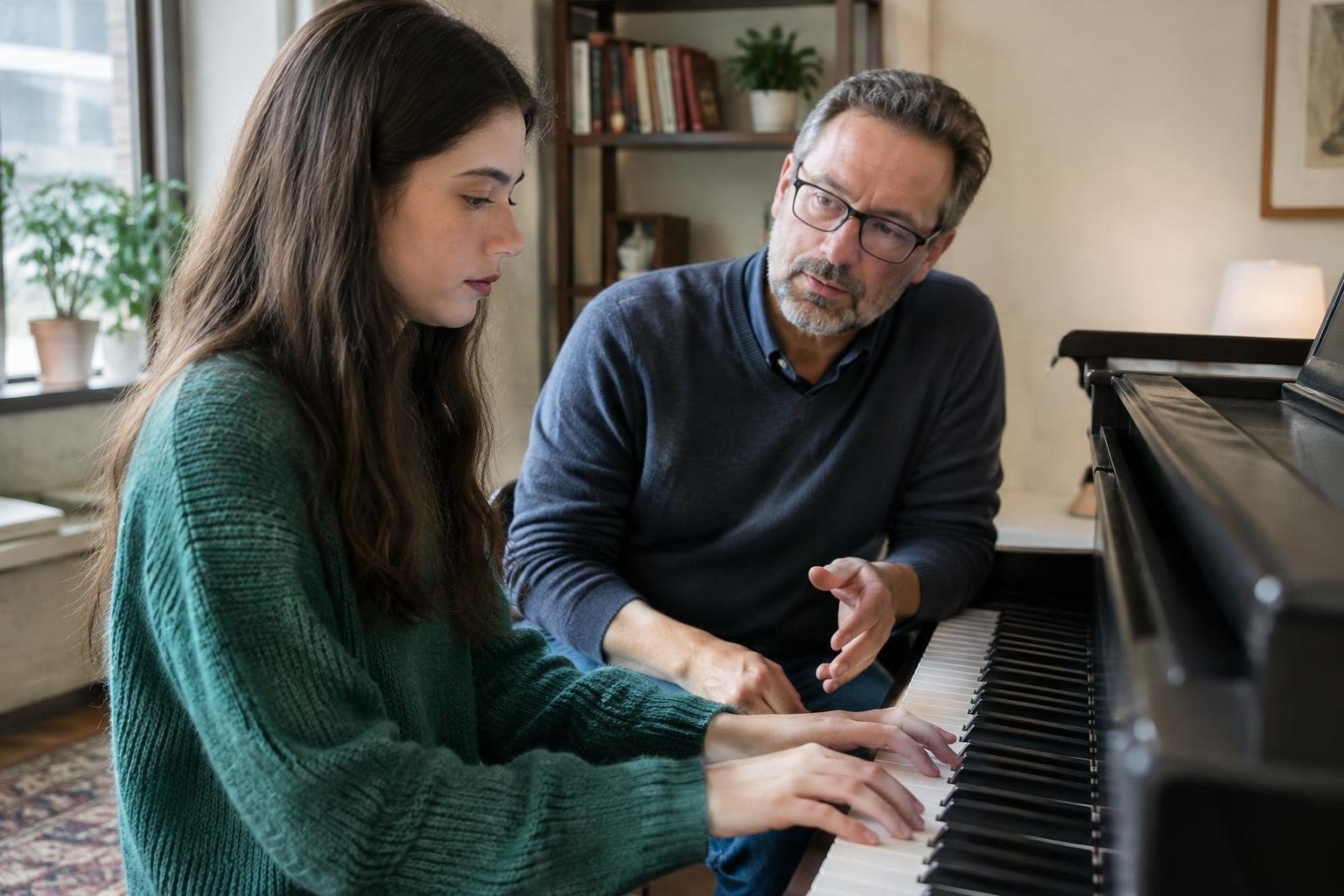
Music Pedagogy Degree Guide: Courses, Careers, Costs, and Program Fit
A music pedagogy degree combines musical study with methods for teaching music. Learn about program formats, preparation, costs, career routes, and how to compare options.
By David Slack · Staff Writer Assessment.com · Published November 1, 2026 · Last updated November 5, 2026
A music pedagogy degree focuses on how to teach music, not only how to perform it. Students develop musical knowledge and learn ways to help others build technique, understanding, and confidence. Depending on the program, they may concentrate on an instrument, voice, music theory, or a broader music education pathway. Graduates may pursue private instruction, tutoring, school or institutional teaching, and further study leading toward postsecondary teaching. The right credential depends on the intended students and setting: a program designed for private lessons is not automatically a route to public-school licensure. Prospective students and parents should compare course content, teaching experience, admissions expectations, and full program cost before deciding. Not sure whether music pedagogy fits you? Take the Free MAPP Career Assessment to explore how your motivations, interests, and natural preferences align with education and music-related career options.
Degree & Program Decision Insights
Explore your personal fit, education requirements, career potential and next steps.
01Motivational Fit
Discover whether this program fits you
Explore your preferences against the focus of Music Pedagogy. These prompts are not personal MAPP results.
Subject curiosity. Would you choose to explore “music theory” in depth? Ask for a sample learning activity to test that interest.
Breadth of interest. Consider the place of “music composition” in this field. Is this another part you would choose to explore, or mainly a requirement you would tolerate?
Work reality. Related work can involve this task: “Prepare students for performances, exams, or assessments.” Would you want that activity to be a regular responsibility?
Interest in studying a field can differ from enjoying its related work.
Which part would you want to do repeatedly, and what would you try before deciding?
Discover Your Personal Program Fit
Before investing your time and money in your education, discover how this program aligns with your natural motivations, work preferences and career goals.
Typical occupational entry: master's degree (BLS). Postsecondary teaching is a separate appointment and may require advanced study; this programme alone is not a promise of a teaching post.
Musicians and SingersSOC 27-2042 · O*NET 27-2042.00$47.80/hour median (May 2025); +0.3% projected change (2025–2035); 17,400 projected openings/year.
Typical occupational entry: no formal educational credential (BLS). BLS lists long-term on-the-job training as typical occupational training.
U.S. occupational wages are not guaranteed graduate earnings; OEWS excludes self-employed workers.
Projected openings include replacements as well as growth.
U.S. national estimates. A crosswalk does not establish entry-level eligibility; advanced, management and teaching roles can require further qualifications.
Compare the focus and route of these distinct instructional fields; their credentials and admission requirements are not interchangeable.
Music, OtherCIP 50.0999. Any instructional program in music not listed above.
Music, GeneralCIP 50.0901. Compare its emphasis on music and dance with this program’s focus.
Music Performance, GeneralCIP 50.0903. A program that generally prepares individuals to master musical instruments and performing art as solo and/or ensemble performers.
Explore your motivations. Use MAPP as a starting point for reflecting on your interest in “music theory”, then test that interest against a sample learning task.
Compare actual providers. Ask for the exact credential, course sequence and assessment methods. Compare how each provider teaches “music composition”, its entry criteria and its itemized costs.
Check the evidence before applying. Confirm prerequisites and any recognition or professional requirements for your intended route; ask for applicable rules and published outcome definitions in writing.
Verify the institution’s current offering, admissions requirements and outcomes; a search result does not establish your eligibility.
Music pedagogy is the study and practice of teaching music. The field connects musical understanding with the ability to explain, demonstrate, and adapt instruction for learners. Programs may cover music theory, composition, performance on one or more instruments, musical styles, teaching methods, and communication with students.
Credential names are not consistent across institutions. Music pedagogy may appear as a degree concentration, certificate, or area of study within a music or music education program. Examples in university offerings include instrument pedagogy, music theory pedagogy, and graduate certificates. Some certificates are designed for people already pursuing a graduate music degree or who have completed relevant prior study, rather than as a stand-alone entry credential.
Music pedagogy is related to music education, but the labels do not guarantee identical preparation. One program may emphasize teaching a selected instrument to learners at different skill levels; another may be structured toward classroom teaching and licensure. Read the course plan and stated outcomes to learn what the program actually prepares you to do.
What Do You Study in Music Pedagogy?
Music pedagogy students learn to connect musical skills with effective instruction. Depending on the program, study can include music theory, composition, performance, music history or literature, teaching methods, and how to communicate musical ideas to learners. A pedagogy concentration may focus on teaching selected instruments to students at different levels, including choosing methods suited to a learner's experience and needs.
Programs may also include teaching practice, observed instruction, research, or performance assessments. Graduate music education study can extend undergraduate preparation through topics such as learning psychology, philosophy, education policy, research methods, and classroom pedagogy. These are examples from particular university offerings, not a universal curriculum.
What to look for in the course plan
Which instrument, voice, or music subject is the focus?
How much time is devoted to applied music versus teaching methods?
Do students practice teaching, and with which age groups or ability levels?
Are there performance, written, research, or capstone requirements?
Does the curriculum align with the work setting you want?
Request a current degree map and ask how often required courses are offered. A course title alone cannot show how much supervised teaching or performance experience the program includes.
Skills You Can Develop
Students build musical and teaching abilities together. Musical preparation can include interpreting theory, demonstrating technique, and understanding different musical works or styles. Teaching-focused work develops the ability to break a complex skill into steps, give useful feedback, and adjust explanations when a learner is not progressing.
These strengths can matter in private lessons, tutoring, music programs, and educational institutions. Clear communication is especially important because a teacher must explain what to practice and why, while listening carefully to a student's questions and performance. Students also benefit from planning, patience, self-evaluation, and the ability to respond constructively to feedback.
Experience that can make skills visible
Keep a record of teaching practice, repertoire, lesson plans, performances, and relevant projects. Where appropriate, create a portfolio with sample lesson materials or recordings, following student privacy and permission rules. Ask instructors what evidence of teaching skill graduates commonly use when applying for work.
Music technology may be relevant to a particular program or job, but tools vary. Ask which software, recording equipment, or online teaching methods are actually part of the curriculum instead of assuming that every program teaches the same platforms.
Who Is Music Pedagogy Best For?
Music pedagogy may suit students who enjoy music and also want to help others learn. It involves more than playing well: teaching requires explaining ideas, observing how a learner responds, and adjusting instruction. Students who like sustained practice, musical problem-solving, and working with people may find the mix rewarding.
You do not need one particular personality or learning style. Some students prefer one-to-one instruction; others are drawn to classroom or institutional settings. Consider whether you enjoy coaching someone through repeated practice, communicating corrections with care, and balancing creative expression with structure.
Admissions questions for students and parents
There is no single admission checklist for every music pedagogy program. Ask each school whether applicants need an audition, a performance sample, prior music study, an interview, academic prerequisites, or other materials. For graduate certificates, verify whether the credential is open to outside applicants or intended for students already enrolled in a related degree. Some programs explicitly target current graduate students or people with a relevant bachelor's degree.
Before applying, contact the department about the instrument or subject area, faculty availability, audition expectations, and the experience expected at entry. A well-matched program should be clear about both admission criteria and what students are expected to know before starting.
Credential Levels, Time, and Academic Demands
Completion time depends on the credential, the student's prior education, enrollment pace, and the specific program. Music pedagogy can be offered through different levels and formats, including certificates and undergraduate or graduate study. A post-master's certificate, for example, may be designed to be taken alongside a doctoral program rather than as an independent route through the field.
Do not estimate time from the credential label alone. Ask for the number of required courses, sequence of performance or teaching work, course availability, and whether part-time students can follow the same pathway. Transfer credits, prerequisites, and auditions can affect an individual plan.
Academic demands vary too. Students may need to manage practice and performance alongside written study, teaching preparation, or research. Program-specific examinations may be part of completion: one university's requirements describe written and performance exams for doctoral students and limit retakes for a required exam part. Confirm current rules directly with the program before relying on a web summary.
To prepare, maintain a regular practice routine, strengthen music reading and theory as appropriate to the program, and gain experience explaining musical ideas to another person.
Online, Hybrid, or On Campus?
Music pedagogy programs may be campus-based, hybrid, or offer some online coursework. A format that works for theory or research classes may not meet the needs of applied music, performance, or supervised teaching. The exact balance depends on the institution and concentration, so verify requirements before committing.
Ask the department to distinguish online course access from a fully online degree. Find out whether lessons, juries, auditions, rehearsals, teaching practice, exams, or residencies require an in-person visit. Also ask whether remote students can access the faculty expertise and practice facilities relevant to their chosen instrument or subject.
Compare the schedule with work, family, and transportation responsibilities. If a program requires regular campus attendance or teaching placements, include travel and time away from other commitments in your decision. Get the expectations in writing, especially if you are considering a program advertised as flexible or distance-based.
Music Pedagogy Degree Costs and Financial Aid
There is no single tuition figure for music pedagogy. Total cost depends on the school, credential, residency classification where relevant, enrollment format, and the time needed to complete the program. Music study may also involve costs beyond tuition, so ask the institution for an estimate tailored to the specific course plan.
Request a written breakdown that includes tuition, mandatory fees, books and scores, instrument or equipment needs, technology, performance or recital expenses, travel for teaching placements, and living costs if relocation is involved. Do not compare schools using tuition alone; also compare the number of credits, course availability, and required time on campus.
Ways to plan for affordability
Complete the institution's financial aid process and ask about grants, scholarships, and music-specific awards.
Ask whether work-study, assistantships, or employer tuition support are available to students in your credential level.
Compare transfer-credit policies before enrolling in courses elsewhere.
Ask how scholarship renewal depends on academic or performance standards.
Build a budget for the full program, not just the first term.
Financial aid and award rules vary. Confirm eligibility, deadlines, renewal conditions, and the net cost with the school's financial aid office before making a decision.
Music Pedagogy Careers, Jobs, and Outlook
Music pedagogy can prepare students for teaching-focused work, but the degree title does not determine a single job or salary. Possible directions include private music instruction, tutoring, music education, and music-related performance. Postsecondary teaching may be a longer-term pathway that depends on advanced qualifications and relevant experience; requirements differ by institution and subject.
Career direction
How music pedagogy may apply
What to verify
Private music instructor
Teaching methods and musical expertise can support lessons in an instrument, voice, or theory.
Student demand, subject specialization, work arrangement, and experience expected.
Music tutor
Music knowledge can support individual or small-group instruction.
Employer requirements and the learners or topics served.
School music teacher
Music pedagogy is relevant, but a separate teacher preparation and licensing pathway may be needed.
State rules, approved program status, and grade-level requirements.
Postsecondary music teacher
Advanced musical and pedagogical preparation may relate to college-level teaching.
Degree expectations, performance or teaching record, and position requirements.
Musician or performer
Performance study can support music work alongside teaching.
Audition, portfolio, experience, and the specific employer or engagement.
Pay and employment outlook cannot be inferred from a major name. They vary by occupation, region, hours, experience, and employer. Research the specific role and local market you intend to enter; do not treat a national occupation figure or a school's marketing claim as a guaranteed graduate outcome.
Find out which Career or College Major is right for you!
A music degree and a professional teaching license are not the same thing. If your goal is to teach in a public school, check the licensing rules for the state and grade level where you plan to work. A music education degree may be designed to lead toward state licensure, but that outcome is program- and jurisdiction-specific.
One university source describes a Bachelor of Music in Music Education pathway as preparing students for a North Carolina Class A teaching license. Treat that as a specific example, not a promise about other schools or current requirements. Contact the institution and the relevant state education authority to confirm that the program meets current requirements, including any exams, field experiences, or additional steps.
For private lessons, tutoring, and postsecondary teaching, requirements may differ by employer and setting. Ask prospective employers or institutions what credentials they expect. Also verify whether the program's accreditation or approval is relevant to the credential you want; do not assume that an institution's general accreditation automatically establishes licensure eligibility.
Related Degrees and Alternatives
Compare music pedagogy with nearby pathways by asking what work each program is designed to prepare you for. Program names can overlap, and individual schools may combine subjects in different ways.
Music education: Consider this if you want a broader focus on classroom teaching or a state school-teaching pathway. Check licensing outcomes and education coursework.
Music performance: Consider this if performing is your main goal and you want a curriculum centered on applied performance and repertoire.
Music theory: Consider this if your strongest interest is analyzing and explaining musical structure; investigate whether teaching preparation is included.
Music composition: Consider this if creating and developing original music is a priority.
Musicology: Consider this if you want to study music history, cultures, and scholarship.
General music: Consider this if you want broader musical study before deciding on a specialized teaching or performance focus.
These are comparison prompts, not fixed definitions of every institution's curriculum. Review required courses, applied instruction, teaching experience, and graduate-school options. If you want a public-school license, compare only programs that clearly document how their curriculum relates to the rules where you plan to teach.
How to Choose a Music Pedagogy Program
Use the same questions for every school so that you compare real program differences rather than promotional language. Start with the teaching context you want: private lessons, school music, college-level instruction, or a combination. Then see whether the curriculum, credential, and practical experience match that goal.
Program comparison checklist
What credential will I earn, and is it intended to stand alone or be completed alongside another degree?
Which instrument, voice, theory area, or student population can I focus on?
What audition, prior-study, academic, or interview requirements apply?
How much supervised teaching or applied performance is included?
What are the complete program costs and available aid?
Which courses, exams, and teaching experiences require in-person attendance?
Does the program meet the licensing requirements for my intended state and grade level?
What graduate study or career preparation does the department describe?
How do credits transfer, and how often are required courses offered?
Ask to speak with a faculty adviser and, if possible, current students. Request clear answers about outcomes and requirements, and verify any licensing claims with the responsible state authority. Assessment.com's college major guidance can help families structure the broader decision alongside school-specific research.
From Music Degree to Career
A realistic route depends on the learner, credential, and setting. These examples show possible sequences, not guaranteed promotions or employment outcomes.
Instrument teaching: Music pedagogy study → private lesson instructor or tutor → teaching experience and a stronger student portfolio → specialization by instrument, age group, or skill level.
School music: Music education pathway → supervised teaching and required state steps → school music position → further study or leadership responsibilities, depending on qualifications and opportunity.
College teaching: Music study and pedagogy experience → graduate study or other relevant preparation → teaching or assistant work where available → postsecondary instruction when qualifications and openings align.
Performance and teaching: Applied music study → performance or ensemble experience alongside instruction → a portfolio of teaching and performance work → a more specialized mix of engagements.
Build relevant experience while studying. Ask faculty about opportunities to teach, observe instruction, assist with ensembles, or present work. Keep evidence of your musical development and teaching practice, while following rules for consent and privacy when documenting students.
Questions to Ask Before Enrolling
Before making a deposit or accepting an offer, students and parents can use this checklist to surface details that are easy to miss:
What is the total cost for the full credential, including fees and required materials?
Which scholarships, grants, or other aid are available, and what conditions apply?
Does the curriculum prepare me for my intended teaching or performance setting?
Is the instrument or subject I want supported by available faculty?
How many teaching or performance experiences are part of the program?
What are the current audition, examination, and completion requirements?
Are classes online, hybrid, or in person, and which activities require campus attendance?
If I need a school teaching license, has the program confirmed eligibility in my state?
Can my previous coursework transfer, and what is the effect on time to completion?
What career guidance, mentoring, or employer connections can the department document?
Write down answers from the program and compare them across schools. If an answer affects your ability to work in a particular role, verify it with the relevant employer or licensing authority rather than relying on an informal assurance.
Frequently asked questions
What is music pedagogy?
Music pedagogy is the study and practice of teaching music. Programs may combine music theory and performance with teaching methods for specific instruments, voices, or subjects. The curriculum and credential vary by institution, so review the actual program requirements rather than relying on the title alone.
Is a music pedagogy degree hard?
It can be demanding because students may need to balance advanced music study with learning how to explain skills to others. Depending on the program, requirements may include performance work, teaching practice, or assessments. Ask the department for sample course plans and any audition or examination expectations before applying.
What jobs can I get with a music pedagogy degree?
Possible directions include private music instruction, tutoring, music education, and, with the right qualifications, postsecondary teaching. Some graduates may also pursue performance or music-related work. The degree by itself does not guarantee a job, school teaching license, or eligibility for a particular teaching position.
How much can you make with a music pedagogy degree?
There is no single salary for music pedagogy graduates. Pay depends on the role, employer, location, experience, hours, and whether work is salaried or private-lesson based. Compare current pay information for the specific occupation and region you are considering, and avoid treating a degree-level salary estimate as a guaranteed outcome.
Can you earn a music pedagogy degree online?
Some music-related coursework may be available online, but performance and teaching components can require live instruction or in-person participation. Do not assume a fully online program is suitable for your goals. Ask the school which classes, assessments, auditions, and supervised teaching activities must be completed on campus or in person.
What is the difference between music pedagogy and music education?
Music pedagogy is centered on how to teach music, often with a focus on particular instruments, voice, or music theory. Music education programs may prepare students for broader classroom teaching and can include education-focused coursework. These labels overlap, so compare the curriculum and licensing outcomes rather than relying only on program names.
Do you need a graduate degree to teach music?
Not always. Postsecondary teaching roles may expect advanced study, and a school music teaching job may require a state teaching license. Private instruction has different requirements, which can vary by employer and student expectations. Check the qualifications for actual jobs in your intended setting before choosing a credential level.
Does a music pedagogy degree qualify you to teach in public schools?
Requirements depend on the program and the type of teaching you plan to do. A music degree does not automatically provide a public-school teaching license. Some music education programs are designed around a state license; confirm the current state requirements and whether the specific program meets them before enrolling.
People Also Ask
What do you study in music pedagogy?
Music pedagogy studies how to teach music. Coursework may pair musical study with methods for teaching instruments, voice, or music theory, depending on the program.
What can you do with a music pedagogy degree?
Music pedagogy can prepare students for music instruction, tutoring, and related education work. Specific jobs depend on the credential, teaching setting, and any additional licensing or experience required.
How long does a music pedagogy degree take?
There is no standard completion time for every music pedagogy credential. Length depends on whether the student pursues a certificate, undergraduate degree, graduate study, or a program alongside another degree.
What are the requirements for a music pedagogy program?
Entry requirements are set by each institution. Ask whether applicants need an audition, prior music study, a portfolio, an interview, or particular academic preparation before applying.
How much does a music pedagogy degree cost?
Costs depend on the institution, credential, enrollment format, and required music activities or materials. Request a full cost estimate that includes fees, equipment, travel, and living expenses where applicable.
Does music pedagogy lead to teacher certification?
A music pedagogy qualification alone does not necessarily meet public-school teacher licensing rules. Confirm that the program is approved for the state and teaching level where you want to work.
Are music pedagogy programs offered online?
Some programs offer online or hybrid courses, but applied music and teaching experiences may require live participation. Ask the department what must be completed in person.
Music pedagogy may be a good fit if you want to develop as a musician while helping other people learn. The right pathway depends on the students you hope to teach, the instrument or subject you want to specialize in, and whether you need a formal teaching license. Compare the curriculum, total cost, teaching experience, and career requirements at each school before enrolling. A degree title alone does not guarantee a specific job or license. To explore how your interests and motivations connect to education and career options, take the Free MAPP Career Assessment.
Want to see your options? Try our comprehensive Degree, Program & College Search tool
We use cookies to offer you a better browsing experience, analyze site traffic and personalize content.
Read about how we use cookies and how you can control them in our
Privacy Policy.
If you continue to use this site, you consent to our use of cookies.
×
Exciting News!
Be one of the first to Beta Test the new AI-Powered Assessment.com Platform.