Water Resources Engineering: Programs, Courses and Career Paths
Learn what water resources engineering programs cover, how certificate and doctoral pathways differ, what to ask about cost and online study, and how to evaluate potential next steps.
By David Slack · Staff Writer Assessment.com · Published October 7, 2026 · Last updated November 5, 2026
Water resources engineering is an engineering specialty concerned with water systems and related challenges. Programs may cover areas such as hydrology, groundwater, hydraulics, water quality, and drainage. Depending on the pathway, a student might take focused graduate coursework or pursue research-oriented doctoral study. The right choice depends on your prior education, the subject matter you want to study, and the kind of work or further education you are aiming for. Not sure whether water resources engineering fits you? Assessment.com’s MAPP Career Assessment can help you consider how your motivations and preferences align with related work and education options.
Degree & Program Decision Insights
Explore your personal fit, education requirements, career potential and next steps.
01Motivational Fit
Discover whether this program fits you
Explore your preferences against the focus of Water Resources Engineering. These prompts are not personal MAPP results.
Exploring an open field. The classification for Water Resources Engineering does not provide a detailed curriculum. Which questions within this field would you want to investigate? Ask for actual course and project examples before deciding.
Choosing a learning environment. Compare actual Water Resources Engineering offerings. Would their reading, projects or practical work suit how you prefer to learn? Confirm the format rather than assuming one from the field name.
Work reality. Related work can involve this task: “Prepare, maintain, or revise quality assurance documentation or procedures.” Would you want that activity to be a regular responsibility?
Interest in studying a field can differ from enjoying its related work.
Which part would you want to do repeatedly, and what would you try before deciding?
Discover Your Personal Program Fit
Before investing your time and money in your education, discover how this program aligns with your natural motivations, work preferences and career goals.
The classification alone does not establish a credential level, duration or delivery format.
Duration is not established by this classification; confirm the actual schedule, enrollment intensity and completion requirements.
Field focus (not a school course list):
apply mathematical and scientific principles to the design, development and operational evaluation of systems for collecting, storing, moving, conserving and controlling surface- and groundwater, including water quality control, water cycle management, management of human and industrial water requirements, water delivery, and flood control
Entry prerequisites and delivery format depend on the actual offering; verify its catalog.
U.S. occupational wages are not guaranteed graduate earnings; OEWS excludes self-employed workers.
Projected openings include replacements as well as growth.
U.S. national estimates. A crosswalk does not establish entry-level eligibility; advanced, management and teaching roles can require further qualifications.
Civil Engineering, GeneralCIP 14.0801. Compare the official Civil Engineering, General field description and actual course requirements; confirm which parts support your intended specialization.
Explore your motivations. Use MAPP as a starting point for reflecting on your interest in “Water Resources Engineering”, then test that interest against a sample learning task.
Examine the work. Compare Environmental Engineers and Civil Engineers on daily work and entry qualifications, as well as pay. Explore Environmental Engineers.
Compare actual providers. Ask for the exact credential, course sequence and assessment methods. Compare how each provider teaches “Water Resources Engineering”, its entry criteria and its itemized costs.
Check the evidence before applying. Confirm prerequisites and any recognition or professional requirements for your intended route; ask for applicable rules and published outcome definitions in writing.
Verify the institution’s current offering, admissions requirements and outcomes; a search result does not establish your eligibility.
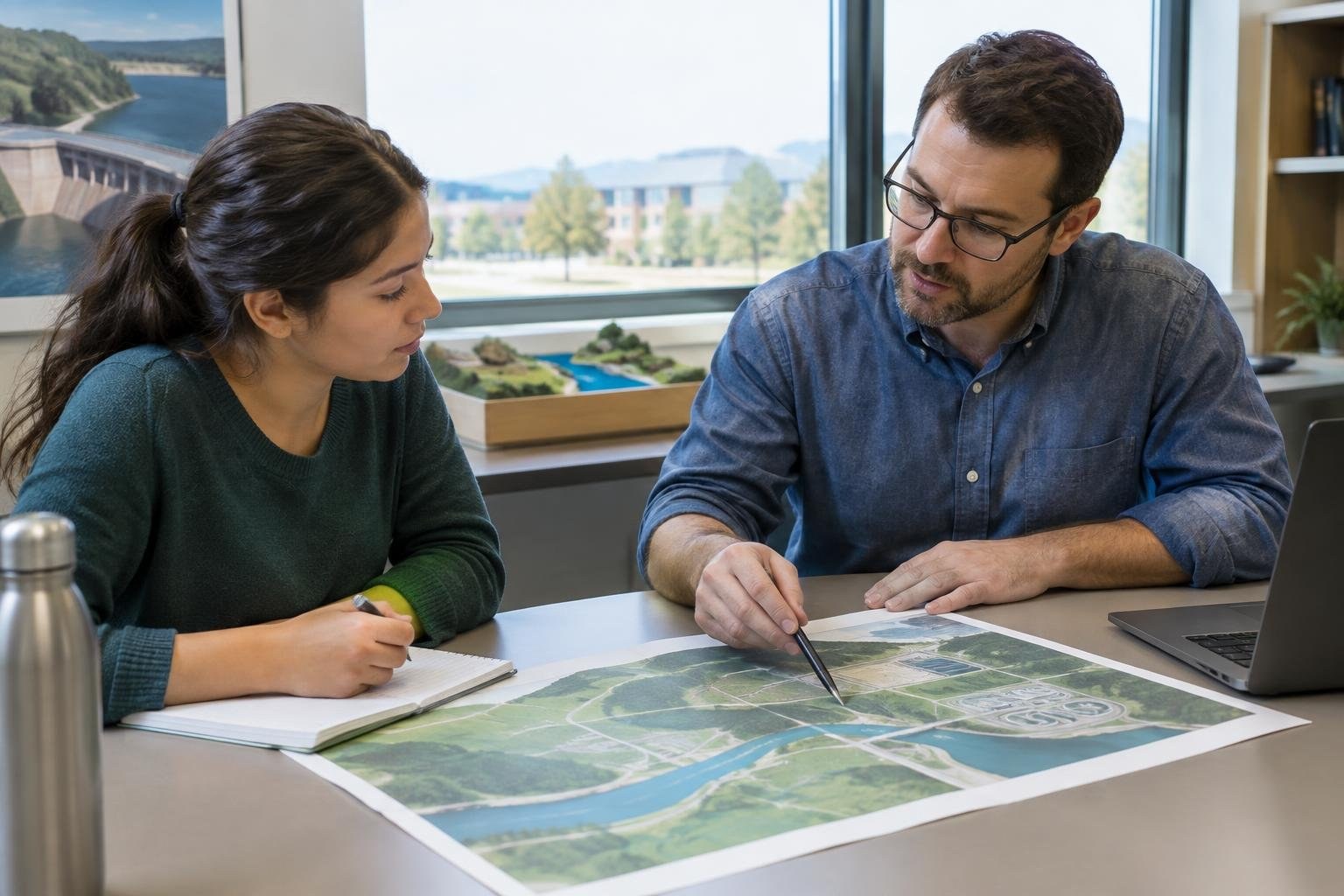
A student and instructor discussing a water-resources system diagram
What Is Water Resources Engineering?
Water resources engineering is an engineering specialty centered on water-related systems and problems. The available program examples point to a subject area that can include groundwater, hydrology, hydraulics, water quality, surface-water flow, and drainage. It is not one uniform degree: schools offer distinct credentials and organize the subject differently.
For example, Oregon State University describes graduate-certificate specialization in groundwater engineering, hydraulics, hydrology, and water quality. The University of North Dakota lists engineering hydrology, surface and groundwater flow, open-channel hydraulics, and roadway drainage among its online certificate topics. Use the actual course list, rather than the program name alone, to determine what a particular curriculum emphasizes.
What Do You Study in Water Resources Engineering?
What You May Study
Coursework depends on the institution and credential. Across the available program descriptions, recurring subject areas include:
Hydrology: engineering study of water movement and related systems.
Groundwater and subsurface flow: topics that may focus on the movement of water below the surface.
Hydraulics: the study of water flow, including open-channel hydraulics.
Water quality: a specialization identified in Oregon State’s graduate-certificate description.
Drainage: roadway drainage appears among the subjects listed by the University of North Dakota.
These are examples, not a guaranteed course sequence. Compare required courses, electives, prerequisites, and any culminating work before enrolling. Ask whether courses are available in the order you need and whether the curriculum serves your intended specialization.
Skills You May Develop and How to Prepare
Skills and Academic Demands
The named course subjects indicate the kinds of technical questions students may encounter: how water moves through surface and subsurface systems, how hydraulic behavior is analyzed, and how water quality or drainage is considered. Programs can vary in their balance of these topics, so the most useful way to judge their academic demands is to inspect course descriptions and ask about prerequisites.
Before applying, consider whether you are interested in engineering problems that involve water systems and whether you are ready for advanced technical study. If your prior education is in a different area, ask admissions staff whether prerequisite coursework or preparation is expected. Do not assume that every certificate has identical entry requirements.
Who Is Water Resources Engineering Best For?
Who Should Consider This Field?
Water resources engineering may appeal to students who want to focus their engineering education on water-related subjects. The program descriptions show that the specialty can involve hydrology, groundwater, hydraulics, water quality, flow, and drainage. Those topics give prospective students a concrete way to test their interest before committing.
It may be less suitable if you are looking for a broad, nontechnical course of study or if the listed subjects do not match the problems you want to work on. That is not a judgment about ability: it is a prompt to compare programs and alternatives. Look beyond general claims about a field and ask whether you would want to spend time learning the specific material in the curriculum.
Does Water Resources Engineering Match You?
Salary expectations and the perceived status of a specialty cannot tell you whether its day-to-day subject matter is a good fit. Consider your interests, preferred types of problems, preparation, and willingness to complete the credential. Assessment.com’s MAPP Career Assessment, Degree Matching, and Career Matching tools can provide another perspective as you compare options.
Credential Levels, Admissions and Completion Time
Credential Levels, Admission and Time to Complete
Water resources engineering is available through more than one type of education pathway. The supplied examples include graduate certificates and doctoral study. The University of Kansas describes a four-course, 12-credit-hour graduate certificate and requires applicants to meet its graduate-study admission policy; its catalog calls for official transcripts showing a bachelor’s degree. That is one institution’s example, not a universal admissions rule.
Other schools set their own requirements. Auburn’s graduate certificate page specifies a 2.75 GPA for a bachelor’s degree program on or related to civil engineering. Check the current admissions page for the exact program you are considering, including prerequisites, transcript requirements, minimum GPA, application materials, and whether professional experience is relevant.
Do not infer a completion time from credit totals alone. Ask each institution how often courses are offered, whether part-time study is possible, and how long students typically take. Confirm whether the program is fully online, hybrid, or campus-based and whether any components require attendance.
Can You Study Water Resources Engineering Online?
Online and On-Campus Options
Online study is available for some water resources engineering graduate certificates. Oregon State and the University of North Dakota both describe online certificate options. Their course descriptions provide examples of subjects students may study, but delivery details and requirements should be verified on the current program pages.
Before enrolling online, check whether classes are asynchronous or scheduled, how students interact with instructors, and whether any course or program requirement involves in-person attendance. Ask how online students access advising and technical support. If you need to work while studying, verify the expected weekly workload and course sequence directly with the school rather than assuming that an online label means a flexible schedule.
Cost and Financial Aid: What to Verify
Tuition, Total Cost and Financial Aid
There is no single price for a water resources engineering credential. Ask each school for a written estimate of the complete program cost and clarify which expenses are included. Compare tuition, mandatory fees, course materials, technology charges, and any costs tied to a campus visit or other requirement. A per-credit figure is useful only when you know the number of credits and the fees that apply to you.
Ask the financial aid office whether the specific program qualifies for aid, and whether scholarships, employer tuition assistance, payment plans, or other funding may be available to you. If you already hold a degree or are employed, check with the school and employer before assuming that credits will transfer or that benefits cover this certificate. Compare net cost, not just the advertised tuition rate.
Ways to Make the Decision More Affordable
Request a program-specific total-cost estimate in writing.
Ask whether required courses can be completed in a sequence that works with your budget and schedule.
Check eligibility for institutional aid and employer support before you enroll.
Confirm transfer-credit rules before counting on prior coursework to reduce your requirements.
Careers, Jobs and Employment Outlook
Find out which Career or College Major is right for you!
Career possibilities depend on your prior education, experience, the credential earned, and the requirements of individual employers. Oregon State describes its online certificate as preparation for careers in water management, while Texas A&M says its water resources engineering Ph.D. prepares students for engineering practice, education, leadership, and research, including work in industry, government laboratories, and academia.
Those descriptions suggest different potential uses for study, not a promise of a particular job. A graduate certificate may add focused subject knowledge to an existing background; a research doctorate is a different commitment and is explicitly oriented toward independent research. Before enrolling, review job postings for roles you might want and note the education, experience, and credentials they actually request.
For a responsible comparison, identify a specific job title and check current U.S. Bureau of Labor Statistics or O*NET information for that occupation and location. Do not treat a credential as a guarantee of employment or earnings.
Certification, Licensure and Experience
Certification, Professional Experience and Licensure
A graduate certificate is an academic credential; it should not be assumed to grant a professional license. Licensing rules depend on the profession and jurisdiction. If your intended work requires a license, check the relevant state licensing authority before choosing a program and ask the school how its curriculum relates to those requirements.
ASCE describes a Water Resources Engineering certification pathway with experience criteria that include at least 10 years of progressively responsible civil engineering experience after the first bachelor’s degree, including eight years in water resources engineering. This is a specific professional certification pathway, not a general entry requirement for every water resources engineering program or role. Confirm the current ASCE criteria directly before planning around them.
To build a stronger application or professional profile, ask programs and employers about relevant projects, research, internships, and work experience.
Graduate School Options: Certificate or Ph.D.?
Graduate Study and Research
Graduate study can take different forms. A certificate concentrates on selected courses; a doctorate represents a deeper research commitment. Texas A&M characterizes the Ph.D. in water resources engineering as research-oriented and says candidates must conduct independent research that is their original work. It describes preparation for engineering practice, education, leadership, and research in settings that include industry, government laboratories, and academia.
Consider doctoral study if independent research is central to your goals, and investigate whether the faculty and research areas at a particular institution align with your interests. If you want to strengthen or redirect an existing professional background through selected coursework, compare certificate options instead. Neither route should be chosen based on the credential title alone; review expectations, course content, admissions, and likely total commitment.
Related Degrees and Pathways to Compare
Related Degrees and Alternatives
Compare water resources engineering with adjacent study areas based on the courses and outcomes you want, rather than assuming that similar names mean similar preparation. Relevant alternatives to investigate include:
Civil engineering: consider a broader civil engineering program if you want to compare water topics with other civil engineering coursework.
Environmental engineering: compare programs if water quality or environmental systems are your main interest.
Hydrology: investigate this subject if water movement and hydrologic processes are the focus you want.
Water management: consider programs that emphasize managing water resources rather than engineering coursework.
Groundwater engineering: compare specialization options if subsurface water is your primary interest.
Hydraulics: examine programs with a stronger emphasis on flow and hydraulic systems.
These are comparison categories, not claims that every institution offers a degree under each title. Use catalogs to check actual program names, prerequisites, course requirements, and credential levels.
How to Choose the Right Program
How to Choose a Water Resources Engineering Program
Start with the work or further study you have in mind, then compare programs against that goal. Review the curriculum in detail: one option may emphasize groundwater, while another lists engineering hydrology, open-channel hydraulics, or roadway drainage. Ask whether the courses you need are required or electives and whether they are offered often enough for your planned schedule.
Next, verify academic and practical details directly with the institution:
What credential will appear on your transcript?
What are the current admission requirements and prerequisites?
How many credits and courses are required, and what is the expected completion schedule?
Is the program online, hybrid, or campus-based, and are there in-person requirements?
What is the full cost for your situation, including fees and course materials?
Does the school describe the program as preparing students for a specific career or further study?
How should you verify accreditation and any professional certification or state licensure requirements?
What advising, career support, and financial aid apply to this particular credential?
Use written answers and current official program materials to compare options. Assessment.com’s Degree Matching and Career Matching tools can help you consider how this field compares with other paths; use them alongside curriculum and admissions research, not in place of it.
Questions to Ask Before Enrolling
Use this checklist with an admissions adviser, program director, and financial aid office:
What exact courses and learning outcomes are included?
What prior degree, coursework, GPA, or other preparation is required?
How many credits must I complete, and what is the realistic completion schedule?
What is the full cost, and which expenses are not included in the tuition estimate?
Are courses fully online, and are any in-person activities required?
What are the rules for transfer credit and prior learning?
What accreditation applies to the institution or program, and where can I verify it?
Does the program meet a licensing or professional certification requirement I need?
What career services, employer connections, or research opportunities are available to students in this credential?
Which financial aid, scholarships, or employer-payment arrangements may apply?
Get answers that apply to the specific credential and start term you are considering. Policies can differ across programs at the same institution.
Is Water Resources Engineering Worth It?
The value of a program depends on its total cost, the time you can commit, your prior preparation, and how the curriculum supports your goals. A focused certificate may suit someone seeking targeted coursework, while a research-oriented Ph.D. serves a different purpose and demands independent original research. Neither credential is automatically the best choice for every student.
Before deciding, compare the program’s courses with the work you want to pursue, check actual employer requirements, and investigate relevant licensing rules. Consider alternatives if their curricula better match your interests. A thoughtful choice weighs practical opportunity alongside the subject matter you will study and the commitment you are ready to make.
Is Water Resources Engineering Right for You?
You may want to explore this pathway if you are drawn to engineering questions involving water and the subjects listed in program curricula. You may prefer another program if its course content or credential level better matches your goals. Use the available program information, direct questions to schools, and consider Assessment.com’s MAPP Career Assessment and matching tools as part of your decision.
Frequently asked questions
What is water resources engineering?
Water resources engineering is a specialized area of engineering focused on water-related systems and problems. Example graduate courses include groundwater engineering, hydrology, hydraulics, water quality, surface and groundwater flow, open-channel hydraulics, and roadway drainage. The exact curriculum depends on the school and credential.
Is water resources engineering hard?
It can be challenging if you are not prepared for technical engineering coursework, but difficulty varies with your academic background, course load, and program design. Before applying, review the course descriptions and prerequisites, then ask the program whether you may need to refresh relevant technical subjects.
Can I study water resources engineering online?
Some water resources engineering graduate certificates are offered online. Oregon State University and the University of North Dakota describe online certificate options. Check each program’s current delivery details, course sequence, admission requirements, and whether any requirements must be completed in person.
How much can you make with a water resources engineering credential?
There is no reliable salary estimate in the information available for this guide. Earnings vary by occupation, employer, location, experience, and education. For a useful estimate, identify the specific job you want and check current U.S. Bureau of Labor Statistics or O*NET data for that occupation and geographic area.
Do I need a Ph.D. to work in water resources engineering?
Not necessarily. A graduate certificate may provide focused coursework, while a Ph.D. is research-oriented and is intended to prepare students for engineering practice, education, leadership, or research. The level you need depends on the role you are targeting and its employer requirements.
Does a water resources engineering certificate qualify me for professional licensure?
A certificate does not automatically grant professional licensure. Requirements depend on the specific profession and state. If a job you want requires a professional license, confirm the current rules with the relevant state licensing board and ask the school how its curriculum relates to those requirements.
How should I choose a water resources engineering program?
Compare course topics, prerequisites, credential level, total cost, course availability, online or in-person requirements, and how the program connects to your goals. For a graduate certificate, verify the credit total and whether the courses match the specialization you want, such as hydrology, groundwater, hydraulics, or water quality.
People Also Ask
What do you learn in water resources engineering?
Water resources engineering programs may cover hydrology, groundwater, hydraulics, water quality, surface and groundwater flow, open-channel hydraulics, and roadway drainage. Course selection varies by institution and credential.
Are water resources engineering certificates available online?
Yes, online graduate certificate options are described by Oregon State University and the University of North Dakota. Confirm current course delivery and any in-person requirements directly with each school.
What is the difference between a graduate certificate and a Ph.D. in water resources engineering?
A graduate certificate can be a focused coursework option, while doctoral study involves independent research. Texas A&M describes its Ph.D. as research-oriented and connected to practice, education, leadership, and research careers.
What specializations can I study in water resources engineering?
Some certificates focus on particular topics. Oregon State’s catalog identifies groundwater engineering, hydraulics, hydrology, and water quality as specialization areas associated with its water resources engineering graduate certificate.
What should I include when estimating the cost of a program?
Ask for a complete estimate that accounts for tuition, fees, course materials, and any other program-specific expenses. Compare total program cost rather than relying only on a per-course price, and check available financial aid or employer support with the institution.
Does a graduate certificate make me a licensed engineer?
The credential alone does not establish professional licensure. Ask the relevant state licensing board about requirements for the occupation and location you have in mind, and verify whether your degree pathway meets them.
Water resources engineering applies engineering knowledge to water systems, including topics such as hydrology, groundwater, hydraulics, water quality, and drainage. The available pathways range from focused graduate certificates to research-oriented doctoral study, but the exact curriculum and requirements depend on the institution. Compare programs by course content, admission requirements, delivery format, total cost, and how well the credential supports your intended next step. If you are unsure whether this subject and its related careers fit your interests, consider using Assessment.com’s Degree Matching and Career Matching tools before choosing a program.
Want to see your options? Try our comprehensive Degree, Program & College Search tool
We use cookies to offer you a better browsing experience, analyze site traffic and personalize content.
Read about how we use cookies and how you can control them in our
Privacy Policy.
If you continue to use this site, you consent to our use of cookies.
×
Exciting News!
Be one of the first to Beta Test the new AI-Powered Assessment.com Platform.