Respiratory Care Therapy Degree Guide: Courses, Careers, Requirements, and Fit
Learn what respiratory care therapy programs teach, how clinical education and credentials fit together, what respiratory therapists do, and how to compare program costs, formats, and career fit.
By Tome Fierre · Staff Writer Assessment.com · Published October 12, 2026 · Last updated November 5, 2026
Respiratory care therapy is a health profession focused on evaluating and supporting people with breathing and cardiopulmonary needs. A respiratory care therapy degree program combines biomedical and respiratory-system study with clinical procedures, equipment use, patient communication, and supervised practice. Program titles may use “respiratory care” or “respiratory therapy,” and the credential awarded can vary by institution. Graduates commonly pursue respiratory therapist roles after completing an appropriate degree and meeting the examination and licensing requirements that apply where they plan to work. The work calls for comfort with science and technology, careful attention to patient needs, and the ability to collaborate in clinical settings. Prospective students and parents should look beyond the program name to its clinical training, accreditation, total cost, and licensure preparation. Not sure whether respiratory care fits you? Take the Free MAPP Career Assessment to explore how your motivations, interests, and natural preferences align with this degree and related careers.
Degree & Program Decision Insights
Explore your personal fit, education requirements, career potential and next steps.
01Motivational Fit
Discover whether this program fits you
Explore your preferences against the focus of Respiratory Care Therapy/Therapist. These prompts are not personal MAPP results.
Care and responsibility. Would you want to develop the skills involved in therapeutic procedures, while taking the other person’s needs and professional boundaries seriously?
Breadth of interest. Consider the place of “the applied basic biomedical sciences” in this field. Is this another part you would choose to explore, or mainly a requirement you would tolerate?
Work reality. Related work can involve this task: “Demonstrate respiratory care procedures to trainees or other healthcare personnel.” Would you want that activity to be a regular responsibility?
Interest in studying a field can differ from enjoying its related work.
Which part would you want to do repeatedly, and what would you try before deciding?
Discover Your Personal Program Fit
Before investing your time and money in your education, discover how this program aligns with your natural motivations, work preferences and career goals.
Typical occupational entry: associate's degree (BLS). Check the exact professional credential and jurisdiction requirements for this occupation; the classification association alone does not establish eligibility.
Health Specialties Teachers, PostsecondarySOC 25-1071 · O*NET 25-1071.00$107,310/year median (May 2025); +17.9% projected change (2025–2035); 24,900 projected openings/year.
Typical occupational entry: doctoral or professional degree (BLS). BLS lists less than 5 years of related work experience as typical for this occupation; this programme is not a direct promise of entry. Postsecondary teaching is a separate appointment and may require advanced study; this programme alone is not a promise of a teaching post.
U.S. occupational wages are not guaranteed graduate earnings; OEWS excludes self-employed workers.
Projected openings include replacements as well as growth.
U.S. national estimates. A crosswalk does not establish entry-level eligibility; advanced, management and teaching roles can require further qualifications.
Explore your motivations. Use MAPP as a starting point for reflecting on your interest in “the applied basic biomedical sciences”, then test that interest against a sample learning task.
Examine the work. Compare Respiratory Therapists and Health Specialties Teachers, Postsecondary on daily work and entry qualifications, as well as pay. Explore Respiratory Therapists.
Compare actual providers. Ask for the exact credential, course sequence and assessment methods. Compare how each provider teaches “anatomy, physiology, and pathology of the respiratory system”, its entry criteria and its itemized costs.
Check the evidence before applying. Confirm prerequisites and any recognition or professional requirements for your intended route; ask for applicable rules and published outcome definitions in writing.
Verify the institution’s current offering, admissions requirements and outcomes; a search result does not establish your eligibility.
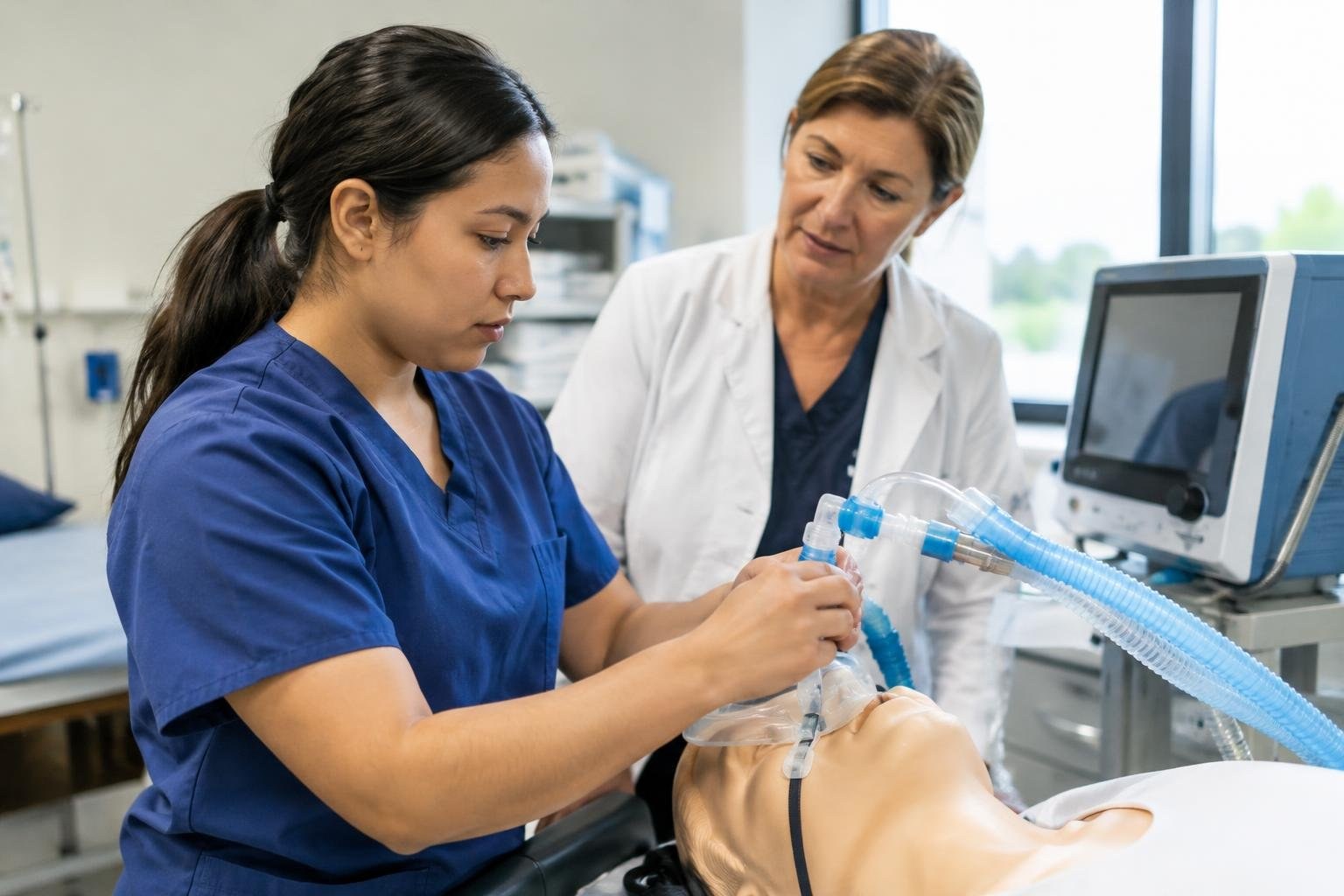
Respiratory care student and instructor practicing with respiratory equipment
What Is a Respiratory Care Therapy Degree?
Respiratory care therapy, also called respiratory care or respiratory therapy in program names, is an allied health field concerned with clinical support for patients with breathing and cardiopulmonary needs. A program prepares students to contribute to care in coordination with physicians and other healthcare professionals. It is not the same as medical school or a general biology major: the education is directed toward patient care procedures and the respiratory equipment used in clinical practice.
The field classification associated with CIP code 51.0908 is Respiratory Care Therapy/Therapist. That classification describes an area of study, not a guarantee that a particular college awards every possible credential or that a credential alone grants permission to practice. Institutions may use titles such as respiratory care, respiratory therapy, or respiratory care therapist. Check the exact credential and curriculum on the school's official program page.
For a look at the work itself, explore Assessment.com's respiratory therapist career guide.
How it differs from nearby fields
Respiratory care focuses on respiratory assessment and therapies, while nursing education covers a broader range of patient care. Other diagnostic and treatment programs may focus on different body systems or technologies. Compare course requirements and day-to-day responsibilities rather than assuming that similar healthcare job titles require interchangeable education.
What Do You Study in Respiratory Care?
Students study the science behind breathing and learn how that knowledge applies to patient care. The field's educational description includes biomedical science, respiratory anatomy and physiology, respiratory-system disease, clinical medicine, therapeutic procedures, data collection, record keeping, equipment operation and maintenance, patient communication, and care for different patient populations. Exact course names and depth differ from one school to another.
Expect a blend of classroom instruction and practice. Lone Star College describes graduates as prepared to participate in patient assessment, diagnostic testing, and clinical procedures. Those experiences let students practice translating observations into accurate documentation and communicate findings as part of a clinical team.
What clinical learning adds
Clinical practice is where students connect concepts and procedures to patient care under program and site supervision. Ask whether the school arranges placements, how students are evaluated, and what happens if a placement site or schedule changes. A program that lists clinical education should explain its expectations clearly, including any required travel or in-person attendance.
When comparing curricula, look for a coherent sequence: foundational science, respiratory-care concepts, practical skill development, and supervised clinical application. Do not rely on a brief marketing summary in place of the course catalog and program handbook.
Skills You Develop
Respiratory care students build technical, analytical, communication, and professional skills. Technical learning includes operating and maintaining respiratory equipment and carrying out procedures taught in the program. Analytical work includes collecting patient information, recognizing relevant changes, and documenting accurately. Clinical preparation also requires students to explain procedures and communicate respectfully with patients and colleagues.
Scientific reasoning: connect respiratory-system knowledge with clinical observations.
Technical care: learn safe, structured use of respiratory equipment and procedures.
Communication: explain care steps, listen to patient concerns, and share clear information with the team.
Documentation: record information carefully and follow clinical procedures.
Adaptability: respond calmly to changing patient needs while staying within training and professional scope.
These abilities are relevant to respiratory therapist work, but a degree does not substitute for professional credentials or state authorization. Review the program's clinical competencies and ask how instructors assess skills before graduation.
Who Is This Program Best For?
This field may suit students who are curious about human biology and want to apply science in a patient-facing setting. It can also appeal to learners who enjoy practical problem solving, precise equipment use, teamwork, and work with clear procedures. You do not need to arrive with a fixed personality type; an important question is whether you are willing to develop both technical judgment and compassionate communication.
Consider the realities as well as the subject matter. Clinical education involves direct patient contact and in-person skill practice, and programs may have demanding science coursework and structured clinical schedules. If you prefer independent desk work, minimal interaction, or a fully online learning experience, compare alternative healthcare or science fields before deciding.
Does respiratory care match you?
Salary, reputation, and job prospects matter, but they cannot tell you whether the daily work suits your motivations and preferences. Assessment.com's MAPP assessment can be one input for exploring careers and education options; use it alongside conversations with practitioners, program visits, and careful curriculum review. Explore guidance on choosing a college major as part of that process.
Admissions, Program Length, and Academic Demands
Admissions rules are set by each college. Before applying, ask for the current list of prerequisite courses, minimum academic standards, placement or readiness requirements, application deadlines, health documentation, and any interview or background-check steps that apply to clinical learners. Do not assume that requirements at one school carry over to another.
Respiratory care programs commonly involve science learning and clinical preparation, so students should be ready to manage both academic work and practical instruction. If you have been away from school, ask whether prerequisite refreshers or academic support are available. Transfer students should confirm in writing which prior credits apply to the respiratory care sequence, not just general education requirements.
How long does it take?
Completion time depends on the award, course load, prerequisites, transfer credit, and clinical scheduling. The supplied field classification includes multiple credential levels, but this does not establish that every level is available at every institution or a standard time to completion. Get a term-by-term degree plan from each school and ask how repeating a course or delaying a clinical placement would affect the timeline.
Online, Hybrid, or On-Campus: What to Expect
Some colleges may offer online coursework, but a respiratory care program includes skills and clinical experience that should not be assumed to be fully remote. A program's online label may describe only selected classes. Determine exactly which lectures, labs, skills checks, examinations, and clinical experiences take place in person.
For working adults and students with family responsibilities, ask about class meeting times, clinical shifts, placement locations, and attendance rules before enrolling. Compare the practical schedule with transportation, childcare, employment, and other commitments. If a school cannot explain how students complete clinical learning, get clarification from the program director before making a deposit.
Tuition, Total Cost, and Financial Aid
There is no single tuition figure that applies to all respiratory care programs. Calculate the full cost for the specific school and time period you are considering. Include tuition, mandatory fees, books, equipment or supplies listed by the program, transportation to campus and clinical sites, and living costs if attendance requires a move. Ask whether fees can change as students enter clinical courses.
Compare the net cost after grants, scholarships, and other aid rather than comparing published tuition alone. Complete the federal student aid application if eligible, ask the college about institutional and state aid, and check whether an employer offers education assistance. Grants and scholarships generally have different eligibility and repayment terms from loans, so understand each award before accepting it.
Affordability questions for families
What is the estimated total cost through completion, including program-specific fees?
Are clinical travel and required supplies included in the estimate?
What aid is renewable, and what academic or enrollment conditions apply?
Can credits transfer from a lower-cost institution without delaying the clinical sequence?
What is the likely borrowing amount after grants and scholarships?
Ask the financial aid office for an individualized estimate and compare it with the program's actual degree plan. Avoid choosing solely on the basis of a low first-term price if additional costs or delayed completion could change the total.
Careers, Jobs, and Employment Considerations
Respiratory therapist is the directly related career path supported by the supplied program and career sources. Graduates may seek entry-level respiratory therapist roles after completing the required education and satisfying the applicable professional examination and state licensing rules. A degree by itself does not guarantee a job, salary, license, or a particular work setting.
Career direction
How respiratory care study may relate
What to verify
Respiratory therapist
Directly aligned with respiratory-care education, patient assessment, diagnostic testing, and clinical procedures.
Accepted degree, examination pathway, state license, and employer requirements.
Respiratory-care educator or instructor
Respiratory care knowledge may be relevant to teaching in a healthcare education setting.
Required degree level, clinical experience, and institution-specific qualifications.
Other diagnostic or patient-support roles
Some skills may transfer, but the respiratory care degree does not automatically qualify a graduate for another regulated occupation.
Occupation-specific education, certification, and licensing requirements.
Compare current local job postings and official labor-market data before making a financial decision. See Assessment.com's overview of healthcare practitioner and technical careers to consider adjacent occupations.
Digital documentation and increasingly capable clinical technologies may change how healthcare teams record, share, and review information. Students should learn to use approved tools accurately while maintaining sound judgment, patient communication, and the ability to follow clinical protocols. Technology supports, but does not replace, required professional preparation.
Accreditation, Certification, and State Licensure
Program approval and professional licensing are separate issues. Before enrolling, verify that the respiratory care program has the accreditation status required for the educational and examination pathway you intend to follow. Ask the school for its current accreditor, program status, and where to verify that information independently. Do not rely only on an old brochure or a general institutional accreditation statement.
Professional credentials and licenses also differ. The New York State Education Department's respiratory therapy profile identifies the National Board for Respiratory Care's Certified Respiratory Therapist examination and Registry Examination, including written and simulation exams. Indiana University School of Medicine notes that states use different credential requirements in their licensing processes: many states use CRT, while some require RRT. Requirements can vary by state, so verify current rules with the licensing authority where you intend to practice.
A Long Island University program description outlines a sequence in which a candidate achieving the high cut score receives CRT and becomes eligible for the Clinical Simulation Examination; passing that examination leads to RRT. Treat this as an example of a stated pathway, not a universal or permanent rule. Confirm current examination details with the relevant credentialing body and your state authority.
Credential Pathways and Further Education
Some students start with an associate degree and later pursue a bachelor's degree in respiratory care. A bachelor's route may also be available as an initial program at some institutions. The right choice depends on the entry requirements for the occupation and state, the curriculum, the student's longer-term goals, and whether the cost and added study are worthwhile for that individual.
Indiana University School of Medicine describes an advanced-standing pathway for graduates of eligible CoARC-accredited associate programs at regionally accredited colleges or universities. Transfer and advanced-standing decisions are institution-specific. Get a written evaluation of credits before assuming that an associate degree will shorten a bachelor's program by a particular amount.
Students interested in education, leadership, or research may consider further study, but the exact credential required depends on the position and employer. Ask potential graduate programs or employers what qualifications they expect. Do not treat an advanced credential as necessary unless it supports a clear professional goal.
Related Degrees and Alternatives
Compare respiratory care with related healthcare options according to the work you want to do, not only the program title. Nursing offers a broader patient-care focus; respiratory care centers on breathing-related clinical support. Other diagnostic and treatment fields emphasize different systems, technologies, or therapies. A health science degree may offer broader academic study, while a focused respiratory care program is oriented toward a defined clinical discipline.
Nursing: consider it if you want a wider scope of patient-care topics and a different clinical role.
Cardiovascular technology: consider a diagnostic path centered on cardiovascular testing and technology.
Medical laboratory science: consider laboratory testing and analysis with less routine bedside interaction.
Emergency medical services: consider time-sensitive prehospital care and a different training and credential pathway.
General health sciences: consider broader study if you are not ready to commit to a specific clinical occupation.
These comparisons are starting points, not statements that credentials transfer between fields. Check the education, clinical training, certification, and licensing rules for each alternative. Assessment.com's degree directory and healthcare career pages can help you broaden the comparison.
Advantages, Challenges, and Is the Degree Worth It?
A respiratory care program can create a focused route into a clinical profession, but the commitment is significant: students need to complete the prescribed academic and practical training, meet examination requirements, and satisfy applicable state licensing conditions. The value depends on the total price, time to completion, the student's interest in the actual work, and whether local employers seek the credential.
Potential benefits include applied science learning, a defined professional direction, and the chance to work directly with patients and clinical teams. Tradeoffs include the intensity of science and clinical coursework, the need for in-person experience, possible scheduling constraints, and the additional steps between graduation and employment in a licensed role. No degree guarantees a particular salary or hiring outcome.
To evaluate whether the investment makes sense, build a realistic budget, talk to current students or graduates, ask about completion and licensure outcomes, and compare local job requirements. A well-matched program is one that supports your education and career goals without leaving avoidable questions about clinical access, accreditation, or total cost.
How to Choose the Right Respiratory Care Program
Use a consistent checklist for every program you consider. Ask the college to provide clear answers and documents rather than relying on broad claims about outcomes or flexibility.
Accreditation: What is the program's current status, and does it meet the requirements relevant to your planned credential and state?
Curriculum: Which science, clinical, and practical courses are required, and what competencies are assessed?
Clinical education: Who arranges placements, where are they located, and what attendance schedule should students expect?
Cost: What is the estimated total through completion, including fees, supplies, and travel?
Format: Which courses are online, hybrid, or campus-based, and which components require in-person attendance?
Completion and outcomes: What are the recent program completion and examination outcomes, and how are those figures calculated?
Licensure preparation: How does the curriculum align with the credential and license requirements in your intended state?
Transferability: Which credits will count toward the program and any later bachelor's degree?
Support: What tutoring, advising, clinical-placement assistance, and career services are available?
Funding: What aid is available, what conditions apply, and what amount would need to be borrowed?
Compare the written answers side by side. For career exploration alongside school research, use Assessment.com's education resources and MAPP assessment as decision supports, not as replacements for reviewing official program and licensing information.
Next Steps: Questions to Ask Before Enrolling
Before applying, a student and parent can work through these questions together:
What exact credential will the program award?
Can the college document the program's current accreditation status?
What are the admission prerequisites, deadlines, and progression rules?
How much will the full program cost after aid, including clinical-related expenses?
Where and when will clinical experiences occur?
Does the program's credential pathway align with the state where I hope to work?
What are the current program completion and examination outcomes, and what do those numbers include?
Will previously earned credits transfer, and has the institution confirmed that in writing?
What kinds of jobs do local employers advertise, and what qualifications do they require?
Does the day-to-day work match my interests, strengths, and preferred work environment?
Then map a plausible pathway: respiratory care education, completion of required clinical and academic work, the applicable examination and license, and an entry-level respiratory therapist role. With experience, a graduate may explore specialization, teaching, or further education if those opportunities align with qualifications and employer requirements. Progression is not automatic, so seek guidance from the program and employers.
Explore related careers and majors through Assessment.com, and use the MAPP career assessment to reflect on fit before you make a final choice.
Frequently asked questions
What is respiratory care therapy?
Respiratory care therapy programs prepare students to support care for people with breathing and cardiopulmonary needs. Study commonly combines biomedical and respiratory-system knowledge with clinical procedures, equipment, patient communication, and supervised clinical experience. Program requirements vary, so review the curriculum and clinical placement arrangements for each school.
Is respiratory care therapy school hard?
Respiratory care programs can be challenging because they combine science coursework, technical procedures, patient interaction, and clinical learning. Students need to apply classroom knowledge carefully and communicate clearly in clinical settings. The demands vary by program, and students can ask schools about prerequisites, tutoring, clinical schedules, and progression requirements before applying.
What degree do you need to become a respiratory therapist?
An associate degree or bachelor's degree in respiratory care or respiratory therapy is a common educational route described by the supplied university and health-system sources. The education needed for a license is not identical in every state. Confirm the program's accreditation and ask the licensing authority in the state where you plan to work what credentials and examinations it requires.
Can I earn a respiratory care degree online?
Some coursework may be offered online or in hybrid formats, but respiratory care education includes practical and clinical learning. A fully online course schedule should not be assumed to replace hands-on skill development or clinical placements. Ask each institution which activities require campus attendance and where clinical experiences take place.
Do respiratory therapists need a license?
Many states use the Certified Respiratory Therapist credential in their licensing process, while some require the Registered Respiratory Therapist credential, according to Indiana University School of Medicine. Requirements differ by state and can change. Confirm current licensing rules directly with the state authority and verify that the program supports the examination pathway you need.
What do respiratory therapists do?
Respiratory therapists work with patients and respiratory-care equipment, and program preparation may include patient assessment, diagnostic testing, and clinical procedures. The role is distinct from nursing and from physician practice, although respiratory therapists collaborate with other members of the care team. Compare actual course plans and job duties if you are also considering nursing or another clinical field.
How much do respiratory therapists make, and what is the job outlook?
Pay and hiring conditions can differ by location, employer, experience, and role. Before deciding, check current official labor-market information and compare local job postings for the locations where you could work.
Find out which Career or College Major is right for you!
Should I choose an associate or bachelor's degree in respiratory care?
A bachelor's degree may support degree advancement or broader educational options, but it does not automatically replace examination or state licensing requirements. Indiana University School of Medicine describes an associate-to-bachelor's pathway for eligible graduates of qualifying programs. Compare transfer rules and the career or education goal you want the next credential to serve.
People Also Ask
What is respiratory care therapy and what does the degree teach?
Respiratory care therapy is a health-professions field that prepares students to support respiratory treatment under clinical supervision. Programs cover respiratory-system science, procedures, equipment, patient communication, and clinical practice. The degree is an educational pathway; state licensing and professional examination requirements are separate steps that vary.
How do I choose a respiratory care program?
Start with the program's accreditation and confirm it qualifies graduates for the credential and state license you intend to pursue. Then compare required clinical hours or placements, prerequisites, completion format, transfer policies, tuition and fees, and published student outcomes. Ask the program to explain costs and clinical arrangements in writing before you commit.
Does respiratory care training include clinical experience?
Respiratory care education is hands-on as well as academic. Lone Star College describes program preparation that includes patient assessment, diagnostic testing, and clinical procedures. Ask schools whether clinical learning is organized through affiliated healthcare sites, how placements are assigned, and whether students must travel or attend at set times.
Are there different levels of respiratory care degrees?
Not necessarily. Certificate, associate, bachelor's, and other credential levels appear in the study-field classification, but that list does not mean every institution offers every level or that every credential qualifies someone to practice. Verify each school's award and the education required by the licensing authority where you want to work.
How can I tell if respiratory care is a good career fit?
Respiratory care may appeal to students who like applied health science, technical equipment, and patient-facing work. It may be less appealing to someone seeking a fully remote occupation or a program without clinical learning. Consider shadowing or talking with practitioners, then compare the everyday work with your interests and preferred work style.
What is the difference between CRT and RRT?
The credential sequence depends on exam results and current rules. A Long Island University program page describes a route in which a high cut score earns CRT and eligibility for the Clinical Simulation Examination; passing that examination leads to the RRT credential. Check current National Board for Respiratory Care and state licensing requirements before planning around any pathway.
Respiratory care therapy can suit students who want clinically focused work combining respiratory science, equipment, careful observation, and direct patient care. The path also requires substantial hands-on learning, and practicing as a respiratory therapist may require examinations and state licensure beyond earning a degree. Compare accredited program status, clinical arrangements, total cost, and state requirements before enrolling. If you are weighing this field against other healthcare paths, use the MAPP career assessment to explore how your preferences align with respiratory care and related options.
Want to see your options? Try our comprehensive Degree, Program & College Search tool
We use cookies to offer you a better browsing experience, analyze site traffic and personalize content.
Read about how we use cookies and how you can control them in our
Privacy Policy.
If you continue to use this site, you consent to our use of cookies.
×
Exciting News!
Be one of the first to Beta Test the new AI-Powered Assessment.com Platform.