Hearing Instrument Specialist Programs: Courses, Careers, and How to Choose
Learn what Hearing Instrument Specialist programs teach, how credentials and state licensing can differ, and what to compare before choosing a program.
By Kieth Nelson · Staff Writer Assessment.com · Published October 12, 2026 · Last updated November 5, 2026
A Hearing Instrument Specialist program prepares students to assess hearing and help select, fit, and dispense hearing aids. Coursework may bring together hearing science, ear anatomy, testing methods, device technology, communication, and professional practice. Some programs also include supervised clinical or practical experience. The credential and route into the occupation are not identical everywhere. Programs range from associate-level study to certificates that may require prior college coursework or a degree, and state licensing rules can affect which route makes sense. Prospective students and parents should compare the program’s actual admissions requirements, hands-on training, total cost, and relevance to the state where the student hopes to work. Not sure whether this path fits your motivations and interests? Assessment.com’s MAPP career assessment can help you explore career and degree options as one part of your decision.
Degree & Program Decision Insights
Explore your personal fit, education requirements, career potential and next steps.
01Motivational Fit
Discover whether this program fits you
Explore your preferences against the focus of Hearing Instrument Specialist. These prompts are not personal MAPP results.
Care and responsibility. Would you want to develop the skills involved in health promotion and rehabilitation, while taking the other person’s needs and professional boundaries seriously?
Breadth of interest. Consider the place of “acoustics” in this field. Is this another part you would choose to explore, or mainly a requirement you would tolerate?
Work reality. Related work can involve this task: “Maintain or repair hearing aids or other communication devices.” Would you want that activity to be a regular responsibility?
Interest in studying a field can differ from enjoying its related work.
Which part would you want to do repeatedly, and what would you try before deciding?
Discover Your Personal Program Fit
Before investing your time and money in your education, discover how this program aligns with your natural motivations, work preferences and career goals.
Explore these official instructional-field associations. They describe possible occupational routes, not measured outcomes of this program.
Hearing Aid SpecialistsSOC 29-2092 · O*NET 29-2092.00$65,160/year median (May 2025); +19.4% projected change (2025–2035); 900 projected openings/year.
Typical occupational entry: high school diploma or equivalent (BLS). BLS lists moderate-term on-the-job training as typical occupational training. Check the exact professional credential and jurisdiction requirements for this occupation; the classification association alone does not establish eligibility.
U.S. occupational wages are not guaranteed graduate earnings; OEWS excludes self-employed workers.
Projected openings include replacements as well as growth.
U.S. national estimates. A crosswalk does not establish entry-level eligibility; advanced, management and teaching roles can require further qualifications.
Mammography Technology/TechnicianCIP 51.0919. Compare its emphasis on anatomy and physiology and mammography instrumentation with this program’s focus.
Athletic Training/TrainerCIP 51.0913. Compare its emphasis on first aid and emergency care and therapeutic exercise with this program’s focus.
Explore your motivations. Use MAPP as a starting point for reflecting on your interest in “acoustics”, then test that interest against a sample learning task.
Examine the work. Compare Hearing Aid Specialists on daily work and entry qualifications, as well as pay. Explore Hearing Aid Specialists.
Compare actual providers. Ask for the exact credential, course sequence and assessment methods. Compare how each provider teaches “anatomy and physiology of the ear”, its entry criteria and its itemized costs.
Check the evidence before applying. Confirm prerequisites and any recognition or professional requirements for your intended route; ask for applicable rules and published outcome definitions in writing.
Verify the institution’s current offering, admissions requirements and outcomes; a search result does not establish your eligibility.
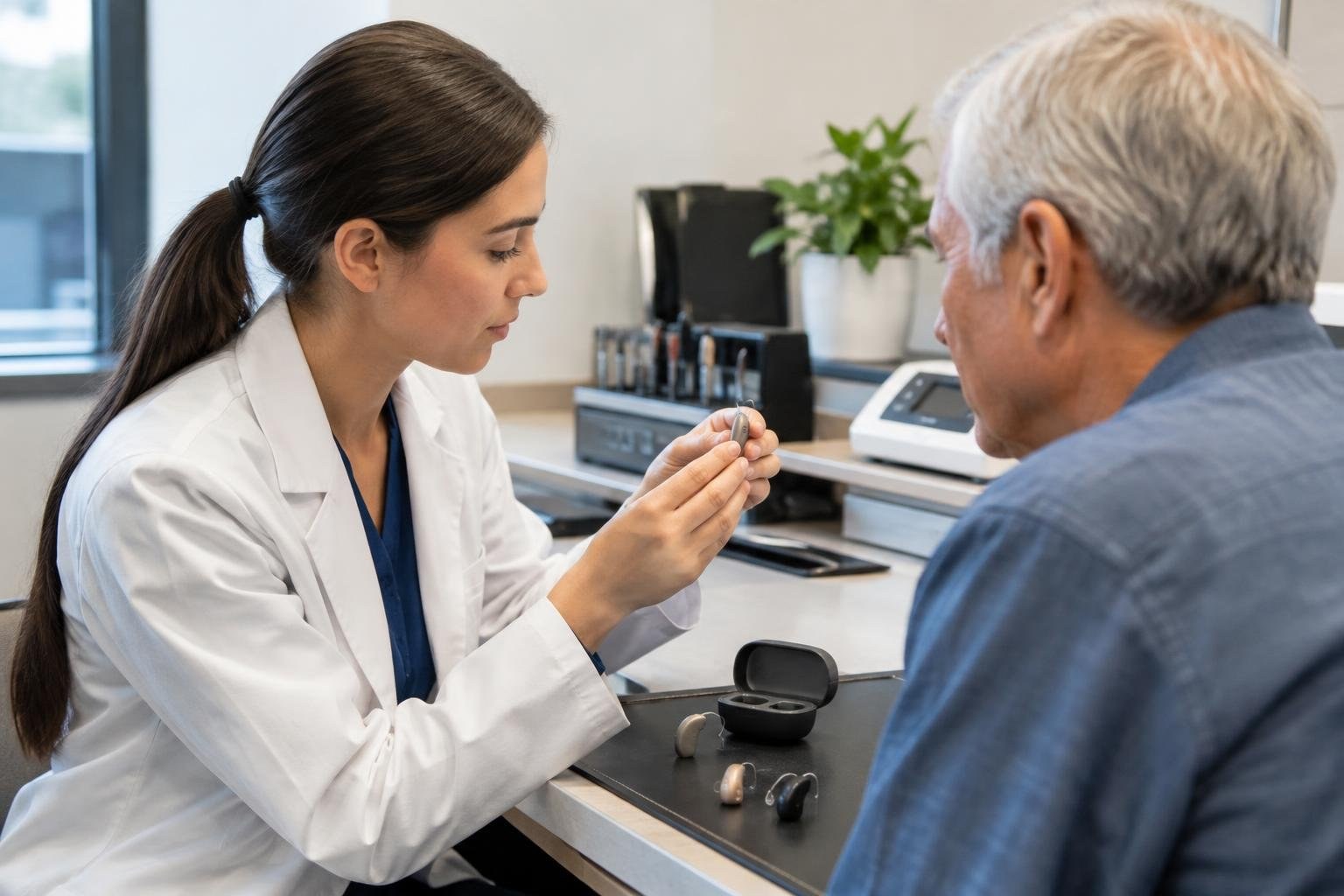
A supervised hearing instrument dispensing training session
What Is a Hearing Instrument Specialist Program?
A Hearing Instrument Specialist program is career-focused education in hearing assessment and hearing-aid selection, fitting, and dispensing. The field combines technical knowledge of sound and hearing instruments with communication and client support. The program description for this area includes acoustics, ear anatomy and physiology, hearing testing, hearing-aid fitting and technology, health promotion and rehabilitation, counseling and communication, business management, and professional ethics.
Program names and credentials differ. A school may use terms such as Hearing Instrument Specialist, Hearing Instrument Science, or Hearing Instrument Dispensary. Do not rely on a program title alone: check the actual curriculum, credential awarded, admission prerequisites, practical training, and state requirements. The federal Classification of Instructional Programs code associated with the subject is 51.0918, but a classification code does not prove that a specific program meets licensing rules.
For instance, Spokane Falls Community College describes an Associate in Applied Science program, while other institutions offer certificate routes. These are examples of differing formats, not a nationwide standard.
What You Study and How You Practice
Students build knowledge of how hearing works and how hearing instruments can be selected and adjusted for individual needs. Programs may connect anatomy and physiology to hearing tests, and acoustics to device performance. Technology and fitting coursework can help students understand how to evaluate options and work through adjustments. Counseling and communication instruction matters because explaining a device and responding to a client’s concerns are part of the work.
Course lists differ, so ask for the current catalog and syllabi rather than assuming every school covers the same material. Look for clear descriptions of hearing testing, instrument fitting, technology, ethics, and any business or rehabilitation topics. Ask how students practice skills before working with clients and whether faculty provide supervised feedback.
Practical training may be a significant part of the experience. The College of DuPage describes a clinical practicum offering 250 hours of clinical instruction. That figure applies to its program, not automatically to other schools. Ask each institution about the hours, setting, supervision, travel expectations, and whether placements are guaranteed or arranged by the student.
Who This Program Suits and What Admission May Require
This pathway may appeal to students who want healthcare-related work with a technical and interpersonal mix. A typical learning experience connects careful measurement and device use with explaining options in understandable language. Students should be ready to pay attention to detail, learn technical procedures, communicate patiently, and handle sensitive conversations about hearing needs.
No single personality profile is required. Some students are drawn to the technology; others are motivated by direct client support. Consider whether you want work that involves both following structured procedures and adapting communication to the person in front of you. If you are uncertain, talk with a program adviser and, where possible, learn about the day-to-day work before committing to a credential.
Admissions and prerequisites
Entry rules vary by program. Spokane Falls Community College identifies a two-year program, while Washington’s state licensing information describes a nine-month certificate route that requires an associate or baccalaureate degree and specified prior coursework. The latter is a particular route described by Washington, not a universal admission rule. Ask the school for required transcripts, prerequisite credits, application materials, and whether prior coursework can transfer.
Families should distinguish admission to a school from eligibility for a professional license. A student may meet a college’s admissions standards without yet meeting a state’s education, examination, experience, or application requirements. Confirm both before paying a deposit.
Credential Levels, Study Format, and Time to Complete
There is no single completion time for every Hearing Instrument Specialist pathway. Spokane Falls Community College describes its program as two years. Washington’s licensing page refers to a nine-month certificate option for applicants who already have a qualifying associate or bachelor’s degree and specified coursework. These examples show why it is important to compare the whole route, including any degree that must be earned before the certificate.
Ask whether the listed timeline assumes full-time enrollment, when clinical work happens, and how often required courses are offered. For a part-time student, adult learner, or student transferring credits, ask the institution for an individualized completion plan. Confirm that the plan still supports the licensing route you intend to pursue.
Online or hybrid availability should be verified directly. Even when lectures can be completed remotely, skills practice or a clinical practicum may require in-person attendance. The College of DuPage’s program information, for example, describes a clinical practicum; it does not establish that every program has the same format.
Tuition, Total Costs, and Financial Aid Planning
Program prices depend on the institution, residency, enrollment pace, credential, and additional requirements. The available information here does not support a reliable tuition estimate for a particular location or academic year. Request an itemized estimate from each school instead of comparing tuition alone.
Ask whether the estimate includes tuition, mandatory fees, books or course materials, equipment or technology, travel to clinical placements, and any additional costs related to exams or licensing. Compare the total expense through completion, not only the first term. If prerequisites or a prior degree are needed, include those costs and time in the calculation.
Ways to plan for affordability
Ask the institution’s financial-aid office for a written estimate based on your residency and enrollment plan.
Check eligibility for grants, scholarships, and other aid through official school and government channels.
Ask whether prior coursework can be evaluated for transfer credit before enrolling.
If employed, ask whether your employer offers education assistance and what conditions apply.
Compare lower-cost public options and certificate routes carefully, while verifying that each route fits your state’s licensing requirements.
Do not choose a shorter or cheaper program until you know whether it provides the instruction and supervised experience needed for your intended career path.
Careers, Employment, and Salary Questions
Hearing Instrument Specialist education most directly aligns with work as a Hearing Aid Specialist. O*NET describes this occupation as commonly involving one or two years of training that combines on-the-job experience with informal training from experienced workers; it also notes that a recognized apprenticeship program may be associated with the occupation. Education routes and job expectations can differ, so use the employer and state licensing authority as additional checks.
Career direction
How this program relates
What to verify
Hearing Aid Specialist
Directly related to hearing tests and the selection, fitting, and dispensing of hearing aids.
State license or registration rules, employer expectations, supervised training, and current local pay and employment information.
Hearing-care workplace roles
Training may be relevant to hearing health care establishments, depending on the role and employer.
Whether the position requires a license, a particular credential, or additional training.
Spokane Falls Community College describes its program as preparation for employment in hearing health care establishments. This does not mean every graduate is guaranteed a job. For a financial decision, consult current official labor-market data for Hearing Aid Specialists and compare local wages, openings, and employer requirements with your expected education costs.
Use Assessment.com’s Hearing Aid Specialists career guide to continue exploring this occupation. Ask employers how technology, client needs, and workplace responsibilities shape the role in your area rather than relying on a generic job title.
Accreditation, State Licensing, and Credentials
Completing a program and meeting the legal requirements to work are separate steps. Licensing and continuing-education rules vary by state. Wisconsin’s Department of Safety and Professional Services publishes statutes, administrative code, and continuing-education information for Hearing Instrument Specialists. Washington’s Department of Health describes a certificate route and its prerequisite education. These state examples should not be applied to other jurisdictions.
Before enrolling, identify the state where you expect to practice and consult that state’s official licensing authority. Ask whether the program’s credential, course content, supervised experience, and any examination preparation meet current requirements. Request a clear answer in writing from the school, then verify it with the state agency. If you may move, investigate the new state’s rules rather than assuming credentials transfer automatically.
Do not treat a school’s general career description as a licensing determination. Licensing may involve requirements beyond graduation, and rules can change. Keep copies of official guidance and revisit it near graduation and before applying for a license.
Official resources include Wisconsin’s Hearing Instrument Specialist licensing information and Washington’s Hearing Aid Specialist licensing requirements.
How to Choose a Program That Fits Your Goals
Compare programs by the details that affect completion and eligibility, not by name alone. Start with the credential awarded and the full course sequence. Check whether the program teaches hearing testing, anatomy and physiology, acoustics, hearing-aid fitting and technology, communication, and professional responsibilities. Then examine whether practical training is included and how it is supervised.
State alignment: Does the program explain the licensing route for the state where you plan to work?
Prerequisites: Are you eligible now, or do you need prior coursework or a degree?
Clinical experience: How many hours are included, what is the setting, and who arranges placements?
Schedule and format: Which courses are online, on campus, or in person, and how often are required courses offered?
Cost: What is the estimated full cost, including fees and clinical travel?
Student outcomes: What information can the school provide about completion, licensing preparation, and graduate employment?
Transfer: Which completed credits will the school accept, and will another institution accept them if you change plans?
Ask to speak with an adviser who can explain both the academic plan and the licensing pathway. A school’s description of a program is a starting point; confirm important professional rules with the state regulator.
Related Degrees and Career Alternatives
Related options can lead to different daily work, training commitments, and professional requirements. Before switching to an adjacent program, compare its actual curriculum and credential requirements. The sources reviewed here establish Hearing Instrument Specialist training and identify Hearing Aid Specialists as the closely related occupation; they do not establish entry requirements for other hearing-care professions.
Hearing Aid Specialist career pathway: Consider this if your interest is specifically hearing tests and selecting, fitting, and dispensing hearing aids. Check state licensing and employer requirements.
Another allied-health program: Consider this if you want healthcare work but are more interested in a different type of assessment or treatment. Compare its official curriculum and licensing rules rather than assuming courses transfer.
Audiology or another hearing-care profession: Consider this if you want a different scope of practice or educational route. Verify the profession’s requirements with official institutions and licensing bodies; this program should not be assumed to qualify you for it.
General healthcare exploration: If you are still deciding, browse related careers and compare work tasks before committing to a specialized credential.
Assessment.com’s healthcare practitioner career area can help you explore other roles. Use it to generate questions for further research, then verify education and license requirements through authoritative sources.
Clinical Practice, Experience, and Preparing for Employment
Students can strengthen their preparation by taking practical work seriously and asking for frequent feedback. When a program includes a clinical practicum, find out what skills students are expected to practice and how supervisors assess progress. The College of DuPage’s published description of its 250-hour practicum is one example of a structured experience, not a requirement that applies to every school.
Ask instructors whether the program offers opportunities to observe professional practice, complete supervised client work, or build familiarity with hearing instruments and testing procedures. Keep track of course projects and supervised experiences so you can describe what you learned to employers. If employers in your area expect on-the-job training, ask how that training is structured and whether the position provides mentorship.
How to stand out to employers
Explain how your training relates to the specific role and state requirements.
Give examples of careful, accurate work and clear communication.
Describe supervised practice honestly, including the tasks you performed and the level of oversight.
Ask about training, continuing education, and expectations before accepting a position.
O*NET notes that on-the-job and informal training with experienced workers are common for the occupation. Treat that as a reason to ask about employer training, not as a substitute for checking licensing or program requirements.
Questions to Ask Before Enrolling
Ask these questions before making a commitment:
What exact certificate or degree will I earn, and what prior education must I complete?
Does the program explain how its curriculum relates to current requirements in my state?
How much supervised practical or clinical experience is included, and where does it take place?
What is the estimated total cost through graduation, including fees, materials, and travel?
Which courses are online, hybrid, or in person, and what schedule should I expect?
Can the school explain its completion, licensing-preparation, and employment outcome information?
Will my prior credits transfer, and what happens if I change programs?
What financial aid or scholarships should I investigate through the institution?
Which employers recruit graduates, and what additional training do they expect?
Whom can I contact at the relevant state licensing agency to verify the route?
Keep the school’s answers and compare them side by side. If an answer about licensing, clinical placement, transfer credit, or cost is unclear, seek clarification before accepting an offer.
Is a Hearing Instrument Specialist Program Right for You?
Before choosing a degree, find out what fits you. Choosing a college program can shape years of study and influence the work you pursue afterward. Tuition, job possibilities, and a school’s reputation matter, but so do the subjects you want to learn, the tasks you want to do, and the kind of interaction you value in a workplace.
Assessment.com’s MAPP career assessment offers a way to explore career and degree options in light of your motivations and interests. Use the results as a conversation starter with family, advisers, and program representatives, alongside your review of course requirements, costs, hands-on training, and state licensing rules.
Explore guidance on choosing a college major and take the MAPP career assessment as you evaluate next steps.
Frequently asked questions
What does a Hearing Instrument Specialist program teach?
A Hearing Instrument Specialist program prepares students to assess hearing, select and fit hearing aids, and communicate with people about hearing-related needs. Depending on the program, study may include ear anatomy and physiology, acoustics, hearing tests, hearing aid technology, counseling, rehabilitation, professional ethics, and supervised clinical or practical training. Course requirements and the credential awarded vary by institution.
Is a Hearing Instrument Specialist program worth it?
It can be a practical route into hearing health care for students who want technical work alongside frequent client interaction. Whether it is worth the cost depends on your state’s licensing rules, program quality, clinical or workplace experience, total expenses, and local job options. Compare those details before deciding; the credential alone does not guarantee a particular job or salary.
How long does it take to become a Hearing Instrument Specialist?
Program length varies. One documented Washington community-college program is described as a two-year program. Other routes may be shorter, but some certificate programs require applicants to hold an associate or bachelor’s degree first. Check both the school’s completion timeline and the requirements of the state where you hope to work.
Can you study Hearing Instrument Specialist training online?
Some training includes supervised, in-person experience. For example, the College of DuPage describes a program with a 250-hour clinical practicum. That requirement is specific to that program, not a universal standard. Ask each school how clinical hours are arranged, where they take place, and whether students must travel or meet other in-person requirements.
Do Hearing Instrument Specialists need a license?
Requirements differ by state. Washington’s licensing information describes a nine-month certificate route for applicants who already have an associate or bachelor’s degree and specified prior coursework. Wisconsin publishes state statutes, administrative code, and continuing-education information for the profession. Contact the relevant state licensing authority and confirm that a program meets its current rules.
How much does a Hearing Instrument Specialist earn?
Earnings vary by location, employer, experience, and other job conditions. The research available for this guide does not establish a current national median wage or employment-growth figure, so it would be misleading to give one. For a decision, look up current wage and employment information for Hearing Aid Specialists from official labor-market sources and compare it with your likely costs and location.
Does this program require a lot of math?
The available program information emphasizes applied topics such as hearing testing, ear anatomy and physiology, acoustics, hearing-aid fitting, and technology. Students should expect careful technical work and some basic quantitative tasks, but the sources reviewed do not establish a standard math prerequisite for every program. Review the specific course list and admissions requirements at each school.
Do I need a graduate degree to work in hearing care?
Not necessarily for the hearing instrument specialist pathway described by these programs, but requirements depend on the career you want and the state where you plan to practice. First confirm whether a program prepares you for the relevant hearing-aid specialist credential or license. If considering a different hearing-care profession, compare its official education and licensing requirements separately.
People Also Ask
What classes do you take in a Hearing Instrument Specialist program?
Programs can cover acoustics, ear anatomy and physiology, hearing tests, hearing-aid technology and fitting, communication, counseling, and professional ethics. The exact course sequence varies by school.
Can you become a Hearing Instrument Specialist without a college degree?
Not every route has the same entry requirements. Some programs admit students for associate-level study, while a documented Washington certificate route requires an associate or bachelor’s degree and specified prior coursework. Confirm requirements with both the institution and your state licensing authority.
Do Hearing Instrument Specialist students complete clinical hours?
Some programs include hands-on training. The College of DuPage describes a clinical practicum with 250 hours of clinical instruction. This is a school-specific example, so ask other programs how they arrange practical experience and whether it is required in person.
How do I check whether a program meets my state’s requirements?
State rules and program routes differ. Review the relevant state licensing authority’s current rules, then ask a program to explain how its curriculum and supervised experience align with them. Do not assume a credential from one state automatically meets another state’s requirements.
What should I ask a school before enrolling?
Compare the credential awarded, prerequisites, course content, hands-on training, total estimated expenses, scheduling, and state licensing preparation. Ask for the written curriculum and verify key requirements with the state agency where you hope to work.
What is the difference between a Hearing Instrument Specialist and an audiologist?
Hearing Instrument Specialist training focuses on testing hearing and selecting, fitting, and dispensing hearing aids. Audiology is a related but distinct career area; do not assume the program prepares you for it. Compare official education, scope-of-practice, and licensing requirements for each path before choosing.
A Hearing Instrument Specialist program may be a good fit if you want practical training that combines hearing-related technology, careful testing, and one-on-one communication. Before enrolling, confirm that the program’s prerequisites, clinical or workplace training, credential, and licensing preparation fit the state where you plan to work. Compare total costs and likely work settings, then consider whether the day-to-day responsibilities match your interests as well as your career goals. Assessment.com’s MAPP assessment can help you reflect on career and degree options, but it is one input to a larger education decision.
Find out which Career or College Major is right for you!
We use cookies to offer you a better browsing experience, analyze site traffic and personalize content.
Read about how we use cookies and how you can control them in our
Privacy Policy.
If you continue to use this site, you consent to our use of cookies.
×
Exciting News!
Be one of the first to Beta Test the new AI-Powered Assessment.com Platform.