Forensic Anthropology Degree Guide: Courses, Careers, and Program Fit
Explore forensic anthropology courses, degree paths, practical training, career possibilities, costs, and questions to ask before choosing a program.
By Tome Fierre · Staff Writer Assessment.com · Published October 12, 2026 · Last updated November 5, 2026
Forensic anthropology applies biological anthropology and skeletal analysis to questions involving human remains in medical and legal settings. Students learn about human anatomy, osteology, identification, archaeological recovery, and scientific methods used to examine remains. Programs may be offered as a bachelor’s major, certificate, or graduate specialization, but offerings and course requirements vary by institution. The field can interest students who want to combine biological science, archaeology, careful analysis, and public-service-oriented work. A degree is an academic pathway, not a guarantee of a particular job or professional authority. Comparing the curriculum and practical learning opportunities with your career goals is essential.
Degree & Program Decision Insights
Explore your personal fit, education requirements, career potential and next steps.
01Motivational Fit
Discover whether this program fits you
Explore your preferences against the focus of Forensic Anthropology. These prompts are not personal MAPP results.
Understanding people and societies. Would you enjoy investigating biological anthropology theory, comparing perspectives rather than expecting a single simple explanation?
Breadth of interest. Consider the place of “crime scene investigation” in this field. Is this another part you would choose to explore, or mainly a requirement you would tolerate?
Work reality. Related work can involve this task: “Measure and sketch crime scenes to document evidence.” Would you want that activity to be a regular responsibility?
Interest in studying a field can differ from enjoying its related work.
Which part would you want to do repeatedly, and what would you try before deciding?
Discover Your Personal Program Fit
Before investing your time and money in your education, discover how this program aligns with your natural motivations, work preferences and career goals.
Typical occupational entry: doctoral or professional degree (BLS). Postsecondary teaching is a separate appointment and may require advanced study; this programme alone is not a promise of a teaching post.
U.S. occupational wages are not guaranteed graduate earnings; OEWS excludes self-employed workers.
Projected openings include replacements as well as growth.
U.S. national estimates. A crosswalk does not establish entry-level eligibility; advanced, management and teaching roles can require further qualifications.
Explore your motivations. Use MAPP as a starting point for reflecting on your interest in “biological anthropology theory”, then test that interest against a sample learning task.
Examine the work. Compare Forensic Science Technicians and Anthropology and Archeology Teachers, Postsecondary on daily work and entry qualifications, as well as pay. Explore Forensic Science Technicians.
Compare actual providers. Ask for the exact credential, course sequence and assessment methods. Compare how each provider teaches “crime scene investigation”, its entry criteria and its itemized costs.
Check the evidence before applying. Confirm prerequisites and any recognition or professional requirements for your intended route; ask for applicable rules and published outcome definitions in writing.
Verify the institution’s current offering, admissions requirements and outcomes; a search result does not establish your eligibility.
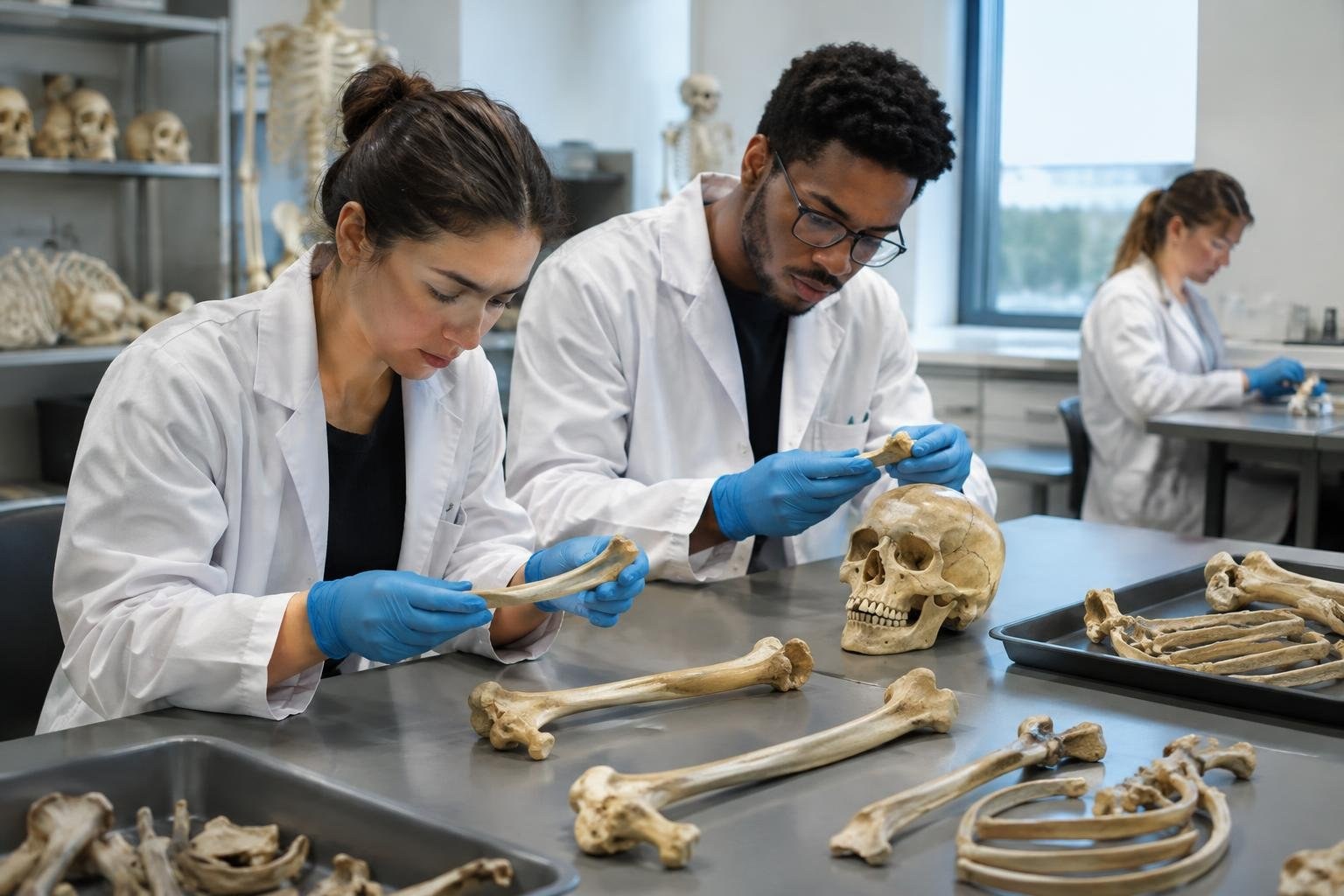
Forensic anthropology students studying skeletal anatomy in an academic lab
What Is a Forensic Anthropology Degree?
Forensic anthropology is the application of biological anthropology, anatomy, and osteology to the recovery, analysis, and identification of human remains in medical and legal contexts. It is an applied specialty rather than a synonym for all forensic science. The discipline draws on knowledge of human variation and skeletal biology to inform questions about remains.
Colleges use different program names and structures. Options in the supplied university program examples include an undergraduate forensic anthropology major, undergraduate and graduate certificates, and a graduate track in forensic and biological anthropology. For example, Ohio State describes its bachelor’s program as applying anatomy, biological anthropology, and osteology in medicolegal settings. This is a sample of available formats, not a guarantee that every credential level is offered at every college.
The program description associated with this field includes biological anthropology theory, human anatomy, osteology, taphonomy, human identification, mortuary archaeology, crime-scene investigation, and forensic field methods. Explore the Assessment.com education resources as you compare this specialized subject with broader majors.
What Do You Study in Forensic Anthropology?
Expect an interdisciplinary curriculum, but check the required courses at each school instead of relying on the degree title. The University of Florida’s description of forensic anthropology coursework includes evolutionary biology, biostatistics, human gross anatomy, forensic pathology, archaeology, biomechanics, and human development. These subjects illustrate how biological and archaeological perspectives can contribute to the study of medicolegal remains.
Other common topics in the field’s program description include osteology, methods of human identification, taphonomy, and forensic anthropology techniques. Coursework can teach students to examine skeletal material, consider how remains may have changed over time, and document observations systematically. The exact methods taught and amount of supervised practical work vary across programs.
Ask whether courses include lab or field components, research projects, internships, or a capstone. A catalog listing a subject does not tell you how much time students spend applying it. The University of Florida’s program description and Ohio State’s major overview offer examples of how institutions describe the field and its academic content.
Skills You Can Build
Students develop subject knowledge in human anatomy, biological anthropology, skeletal analysis, and archaeological approaches. They also practice the habits that make scientific work useful: observing carefully, recording methods, evaluating evidence, and explaining uncertainty clearly. These are academic and professional capabilities to look for in coursework and supervised projects, not a promise that every program teaches them to the same depth.
In a relevant job, technical knowledge may need to be communicated to colleagues from other disciplines. Ask programs how students practice written reports, presentations, research, and collaboration. A curriculum that pairs science courses with applied work can help you assess whether you enjoy both the detailed examination and the communication involved.
For a wider view of possible science-related directions, browse Assessment.com’s life, physical, and social science career resources.
Who Is This Program Best For?
This field may appeal to students who are curious about human biology, archaeology, and how scientific evidence can help answer complex questions. The work described by university programs draws on anatomy, biological anthropology, and osteology, so comfort with detailed scientific study is useful. You do not need to arrive with a fixed career identity, but you should be ready to evaluate whether the subject matter itself interests you.
Consider how you respond to careful, methodical work and emotionally serious subject matter. Do not make the decision based only on crime-show portrayals or a general interest in criminal investigations. Read course descriptions, attend an information session, and ask faculty what students actually do in class and in practical components.
Does forensic anthropology match you?
Salary, reputation, and job prospects are only part of a degree decision. Personal motivation, preferred work style, and willingness to pursue further education matter too. Assessment.com’s MAPP career assessment can help you reflect on career and degree options, while its college-major guidance can help you compare academic interests. Use an assessment as one input alongside course research and conversations with advisers.
Admissions and Entry Requirements
Admission requirements depend on the institution and credential. The provided program examples include undergraduate study, graduate study, and certificates, but do not establish one set of GPA, test, essay, or prerequisite rules for the entire field. Check the current official admissions page for each program you are considering.
For undergraduate entry, ask about required high-school preparation and whether introductory biology, chemistry, or mathematics is recommended. For a graduate track or certificate, verify the prior degree and subject background required, application materials, and whether relevant experience is expected. Do not assume that a certificate is open to students without a bachelor’s degree simply because the credential is shorter.
Prepare by requesting a degree audit or sample course plan, checking prerequisite sequences, and asking an adviser how transfer credits are evaluated. A program’s name alone does not confirm that your previous courses will count toward its requirements.
Credential Levels, Format, and Completion Time
Forensic anthropology study is available through more than one credential format, including the undergraduate and graduate examples described by universities in the supplied research. The time to completion depends on the specific credential, course load, transfer credit, and program structure. Do not infer a standard timeline from the field name; ask the school for a published plan of study and expected course sequence.
Some programs are campus-based. Mercyhurst describes its forensic and biological anthropology graduate certificate as a year-long, on-campus program. That is one institution’s format, not a universal completion time. The University of Nebraska–Lincoln also lists a forensic anthropology graduate certificate. Confirm whether any online coursework is available and whether required labs, field activities, or residencies take place in person.
When comparing online, hybrid, and campus options, focus on how students learn hands-on methods, access supervision, and complete research or field requirements. The Mercyhurst certificate page and Nebraska’s graduate certificate listing illustrate why you should verify each program’s delivery details directly.
Tuition, Costs, and Financial Aid
Tuition and total attendance costs depend on the institution, credential, residency classification, course load, and expenses beyond tuition. The program pages available for this guide do not establish a comparable current price across colleges. Build your own cost estimate from each school’s official tuition and fee schedule, and ask whether laboratory, field, technology, or other program expenses are additional.
Compare the full amount you may pay to finish, not just the per-credit or per-term headline. Include books, transportation or housing if relevant, and any costs associated with required in-person experiences. Ask the financial aid office about grants, scholarships, federal aid eligibility, payment plans, and employer tuition support if applicable.
For affordability, compare the net cost after aid and consider whether prior college credits can transfer. Request a written estimate and verify how long the quoted tuition rate applies. A shorter certificate is not automatically less expensive per credit or a better value; compare its total cost and relevance to your intended next step.
How to Choose the Right Program
Program names do not tell you how much practice, faculty supervision, or career preparation you will receive. Compare course requirements, lab and field opportunities, research access, and the way students learn applied forensic methods. Ask whether practical experiences are guaranteed, competitive, or dependent on a student finding a placement independently.
Request a current curriculum and sample semester plan.
Ask what practical or supervised learning is built into required courses.
Confirm course availability and whether prerequisites can delay completion.
Review total tuition and fees with the financial aid office.
Ask how the program supports research, internships, and career exploration.
Check the school’s current accreditation status and whether any relevant professional credential has separate requirements.
Official university pages are useful starting points, but confirm details with the department and registrar before making a decision. For a broader planning framework, see Assessment.com’s guide to choosing a college major.
Careers, Jobs, and Employment Outlook
Career options depend on education, experience, the employer, and the duties of the specific position. Forensic anthropology programs are designed around applying biological and skeletal anthropology in medicolegal contexts, but completing a degree does not by itself guarantee a job as a forensic anthropologist. Ask departments where students seek further study and what kinds of roles graduates pursue, and check real job announcements for required credentials.
Possible direction
How the study may connect
What to verify
Forensic anthropology specialization
Applied skeletal analysis and medicolegal study
Education, experience, and role-specific requirements
Anthropology research or related work
Biological anthropology, research, and human variation
Employer expectations and whether graduate study is needed
Forensic science support roles
Scientific methods and evidence-focused coursework
Specific lab, technical, and hiring requirements
Teaching or academic research
Disciplinary knowledge and research preparation
Required graduate credentials and teaching qualifications
Potential employers and settings can differ widely, so treat these as directions to investigate rather than guaranteed outcomes. For current salary and employment outlook, consult authoritative occupational data for the exact job title and year. A degree’s program page is not a labor-market forecast. Assessment.com’s anthropology career resource and forensic science technician resource can help you compare adjacent occupations.
AI and digital tools may support documentation or analysis in many scientific settings, but tools do not replace the need to evaluate evidence and communicate conclusions responsibly. Ask programs what current methods and technologies students use rather than assuming a particular tool is standard.
Find out which Career or College Major is right for you!
Distinguish an academic credential from permission to perform a regulated professional role. The supplied program descriptions identify courses and degrees, but do not establish a single nationwide forensic anthropology license or certification requirement. Requirements may depend on the job, employer, and jurisdiction, so verify them with the relevant agency or employer before choosing a program.
Ask the department whether it prepares students for any specific credential and whether that credential is required, optional, or simply useful for a particular role. If a program advertises certification preparation, request the name of the credentialing body and confirm the current rules directly with that organization. Do not assume that a certificate issued by a college confers professional certification.
Internships, Research, and Building Experience
Experience can help you test whether the subject fits before you commit to additional education. Ask about research assistant opportunities, faculty projects, field or lab learning, internships, and independent study. If placements are not part of the required curriculum, ask how students typically find them and what supervision is provided.
How to stand out to employers
Build a record of relevant coursework and supervised research, and practice presenting methods and findings clearly. Keep project descriptions accurate and specific about your contribution. Seek references from instructors who know your work, and use informational interviews to understand the requirements of roles that interest you. These steps strengthen your preparation but do not guarantee a position.
Graduate School and Advanced Study
Further study may be relevant for students who want more advanced specialization, research preparation, or academic work. The available university examples include a master’s track in forensic and biological anthropology and graduate certificates in the specialty. A post-bachelor’s certificate may also suit someone who already has relevant academic preparation and wants focused coursework, but eligibility and curriculum differ by school.
Before applying to graduate school, identify the role you want and check its education requirements. Compare the graduate program’s research opportunities, faculty expertise, practical training, costs, and admissions criteria. Do not pursue an advanced credential solely because the field sounds competitive; ask faculty and employers what additional study contributes for the roles you are considering.
Related Degrees and Alternatives
Forensic anthropology is narrower than a broad anthropology program because it emphasizes applied biological and skeletal analysis in medicolegal settings. A general anthropology major may offer wider disciplinary coverage; a forensic science program may focus on a different mix of evidence and laboratory methods. Compare actual course plans rather than assuming that similar names mean similar preparation.
Biological anthropology: consider this if you want to study human biology and variation more broadly.
General anthropology: consider this if you want broader exposure across anthropology subjects.
Forensic science: consider this if you want a wider or differently structured forensic-science curriculum.
Archaeology: consider this if material evidence, excavation, and past societies are your main interests.
Biology: consider this if you want a broader life-science foundation before selecting a specialty.
These are comparison directions, not claims that every college offers each major or that one pathway leads to a particular job. Review degree requirements and graduate-school implications with an academic adviser.
Is a Forensic Anthropology Degree Worth It?
Advantages: the subject connects biological science, archaeology, and applied questions; programs may offer focused study in skeletal analysis; and the specialty can provide a clear academic theme for research and further study.
Tradeoffs: the field is specialized, program formats differ, and the degree does not guarantee a forensic anthropology position. Some students may need further education or experience for their preferred roles. Practical opportunities and total costs also vary by institution.
Whether it is worth it depends on the price you will pay, the credential you need, the jobs you are pursuing, and whether the courses match your interests. Compare the program’s required learning experiences with alternative majors and ask graduates or faculty about realistic next steps. Avoid making a decision based only on a dramatic view of forensic work or on general claims about job growth.
Questions to Ask Before Enrolling
Use questions like these when speaking with an admissions adviser, department chair, or financial aid office:
What credential will I earn, and what courses are required?
What is the complete estimated cost, including fees and required in-person activities?
What are the current admissions prerequisites and application materials?
How much hands-on learning, research, or field experience is required?
Are placements guaranteed, competitive, or arranged by the student?
Can I complete the program online, and which activities require campus attendance?
How are transfer credits reviewed, and how might they affect my completion plan?
What career services and faculty advising are available to students?
What further education or credentials do graduates pursue for their intended roles?
What grants, scholarships, and other aid may apply to my circumstances?
Ask for answers in writing when they affect cost, time to completion, or eligibility. Recheck the details before enrolling because program requirements and institutional policies can change.
From Degree to Career: A Possible Pathway
A possible path could begin with a bachelor’s degree that includes forensic anthropology coursework, followed by research or supervised experience, then graduate study or a focused certificate if the student’s target role calls for it. With further education and experience, someone may pursue a more specialized role. This is an example of a planning sequence, not a standard route or a guaranteed career progression.
Other students may use an undergraduate program as preparation for broader anthropology or forensic-science-related opportunities. To evaluate a realistic path, compare entry-level job requirements with program content and ask faculty what next steps align with your interests. Assessment.com’s MAPP career assessment can support reflection on potential career and degree directions.
Frequently asked questions
What is forensic anthropology?
Forensic anthropology applies biological anthropology, anatomy, and skeletal analysis to questions about human remains in medical and legal settings. Students may study osteology, human identification, archaeological recovery methods, anatomy, and related sciences. The exact course mix and practical opportunities depend on the college and credential.
Is forensic anthropology hard to study?
It can be academically demanding because it combines detailed study of human biology and skeletal material with scientific reasoning and careful documentation. Students also need to interpret evidence cautiously and communicate what conclusions the evidence does and does not support. Reviewing course descriptions and speaking with faculty can help you gauge the workload at a particular school.
What jobs can I get with a forensic anthropology degree?
Possible directions include further study or work connected with anthropology, forensic science, research, and teaching. A forensic anthropology degree does not guarantee employment as a forensic anthropologist, and many specialized positions may require advanced education or substantial experience. Check specific job postings and ask programs about the preparation their graduates pursue.
How much can you make with a forensic anthropology degree?
There is no single salary figure that applies to everyone with this degree. Pay depends on the job, education level, employer, location, and experience. Compare earnings for specific occupations using current, authoritative labor-market data, and do not assume a degree title alone determines salary.
Can you study forensic anthropology online?
Some relevant lectures or coursework may be available online, but do not assume that an online program provides the same hands-on learning as an in-person option. Ask each school how it teaches anatomy, osteology, field methods, supervised research, and other practical material, and whether any in-person attendance is required.
Does forensic anthropology require math and science?
The subject is centered on biological and skeletal evidence, and some programs include biostatistics and other science coursework. The quantity and level of mathematics differ by curriculum. Review required course lists and ask an academic adviser whether prerequisite math or science courses are expected.
Do you need a graduate degree to become a forensic anthropologist?
A bachelor’s degree can provide foundational study, while some students pursue graduate education or a relevant graduate certificate for advanced specialization. The right level depends on the role you want and its stated requirements. Check job announcements and consult faculty before committing to additional years of study.
Is a forensic anthropology certificate enough to work in the field?
A certificate can add focused coursework, but it is not automatically equivalent to a degree or professional qualification. The University of Nebraska–Lincoln lists a forensic anthropology graduate certificate, and Mercyhurst describes a year-long, on-campus graduate certificate. Verify the program’s admission rules, curriculum, and relevance to your goals directly with the institution.
People Also Ask
What does a forensic anthropologist study?
Forensic anthropology applies anatomy, biological anthropology, and osteology to the recovery, analysis, and identification of human remains in medical and legal contexts. Programs may combine biological science, archaeology, and practical investigative methods.
What degree should I get for forensic anthropology?
Forensic anthropology programs are not all structured the same way. Some are undergraduate majors or certificates, while other options are graduate tracks or certificates. Compare the credential, course requirements, practical experiences, and admissions criteria on each institution’s official program page.
How is forensic anthropology different from anthropology?
Forensic anthropology is a focused area within biological anthropology. It applies biological and skeletal knowledge to medicolegal questions. A broader anthropology program may cover a wider range of human societies, cultures, and biological topics, while a forensic pathway emphasizes applied work with human remains.
Do forensic anthropology students do fieldwork?
Some programs include practical field methods, archaeology, anatomy, or osteology, but the learning format differs by school. Ask whether hands-on classes, supervised projects, internships, or other applied experiences are available and whether they are required or optional.
How do I choose a forensic anthropology program?
Start with the program’s official curriculum and identify required science, anatomy, statistics, archaeology, and forensic courses. Then compare the credential level, practical training, total cost, class format, and graduate or career pathways. Ask faculty how students gain relevant supervised experience.
Is forensic anthropology a good career choice?
Forensic anthropology is specialized, so the best preparation depends on the job you want. Compare actual job requirements with program curricula, and ask faculty or career advisers whether students typically pursue graduate study, certificates, research experience, or adjacent occupations.
Forensic anthropology may suit students drawn to human biology, skeletal analysis, archaeology, and careful evidence-based work in medicolegal settings. The field is specialized, and the degree alone does not promise a particular job, salary, or investigative role. Before enrolling, compare the actual curriculum, practical learning opportunities, total cost, and next-step education requirements. Talk with program faculty and explore related careers so you can judge whether the subject and likely work fit your goals.
Want to see your options? Try our comprehensive Degree, Program & College Search tool
We use cookies to offer you a better browsing experience, analyze site traffic and personalize content.
Read about how we use cookies and how you can control them in our
Privacy Policy.
If you continue to use this site, you consent to our use of cookies.
×
Exciting News!
Be one of the first to Beta Test the new AI-Powered Assessment.com Platform.