Plant Genetics Degree Guide: Courses, Careers, and How to Choose a Program
Explore what plant genetics programs teach, how to compare degrees, what careers they may support, and how to decide whether this field fits your interests and goals.
By David Slack · Staff Writer Assessment.com · Published October 7, 2026 · Last updated November 5, 2026
Plant genetics explores how genetic information and biological processes relate to plant traits, development, and diversity. Students may study genetics and genomics alongside plant physiology, biochemistry, morphology, and broader biological sciences. At some colleges, plant genetics is a focused track or combination of subjects rather than a degree with that exact name. The subject can connect to laboratory work, plant research, biotechnology, production settings, and environmental or agricultural questions. The opportunities that fit you depend on the program you choose, the experience you gain, and whether you continue to graduate study. Not sure whether plant genetics fits you? Take the Free MAPP Career Assessment to explore how your motivations, interests, and preferences may align with this field and related careers.
Degree & Program Decision Insights
Explore your personal fit, education requirements, career potential and next steps.
01Motivational Fit
Discover whether this program fits you
Explore your preferences against the focus of Plant Genetics. These prompts are not personal MAPP results.
Scientific investigation. Would you enjoy investigating molecular genetics and explaining your conclusions from evidence?
Breadth of interest. Consider the place of “gene expression” in this field. Is this another part you would choose to explore, or mainly a requirement you would tolerate?
Work reality. Related work can involve this task: “Conduct own research in field of expertise.” Would you want that activity to be a regular responsibility?
Interest in studying a field can differ from enjoying its related work.
Which part would you want to do repeatedly, and what would you try before deciding?
Discover Your Personal Program Fit
Before investing your time and money in your education, discover how this program aligns with your natural motivations, work preferences and career goals.
Typical occupational entry: bachelor's degree (BLS). BLS lists 5 years or more of related work experience as typical for this occupation; this programme is not a direct promise of entry.
Typical occupational entry: doctoral or professional degree (BLS). Postsecondary teaching is a separate appointment and may require advanced study; this programme alone is not a promise of a teaching post.
U.S. occupational wages are not guaranteed graduate earnings; OEWS excludes self-employed workers.
Projected openings include replacements as well as growth.
U.S. national estimates. A crosswalk does not establish entry-level eligibility; advanced, management and teaching roles can require further qualifications.
Explore your motivations. Use MAPP as a starting point for reflecting on your interest in “molecular genetics”, then test that interest against a sample learning task.
Examine the work. Compare Natural Sciences Managers and Biological Science Teachers, Postsecondary on daily work and entry qualifications, as well as pay. Explore Natural Sciences Managers.
Compare actual providers. Ask for the exact credential, course sequence and assessment methods. Compare how each provider teaches “gene expression”, its entry criteria and its itemized costs.
Check the evidence before applying. Confirm prerequisites and any recognition or professional requirements for your intended route; ask for applicable rules and published outcome definitions in writing.
Verify the institution’s current offering, admissions requirements and outcomes; a search result does not establish your eligibility.
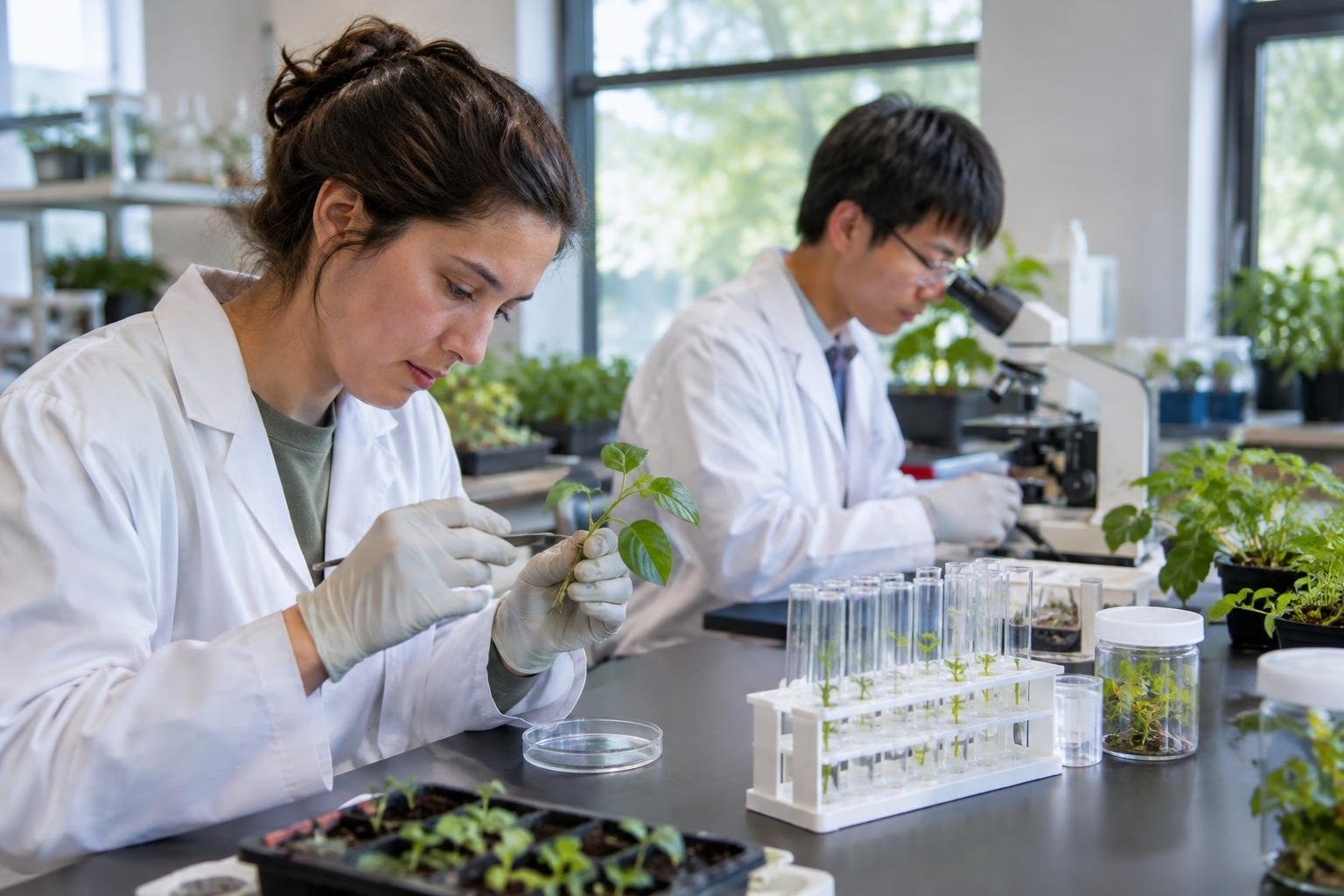
Plant genetics students working with plant specimens and laboratory materials
What Is a Plant Genetics Degree?
Plant genetics studies how genetic information and variation relate to plant traits and biological processes. It brings plant-focused questions together with genetics and other areas of biology. A college may offer the subject as a major, a concentration, or a research pathway inside a broader program.
Program names are not standardized across schools. Berkeley, for example, describes a Genetics and Plant Biology bachelor's program that combines traditional plant sciences, including physiology, biochemistry, and morphology, with molecular genetics and genomics. Yale describes a Plant Molecular Biology graduate track where specialized plant-science research is set within a broad biology education. These examples illustrate why students should inspect the curriculum and credential awarded, not infer the program's scope from its name.
Plant genetics is related to botany, plant biology, general genetics, and molecular biology. A plant-focused route emphasizes questions involving plants; a general genetics program may cover genetic principles across organisms; a broader plant-science program may devote more attention to whole-plant systems and their environments.
What Do You Study in Plant Genetics?
Expect a program to connect foundational biology with specialized study of plant genetics. The precise sequence varies by college. Berkeley's program description identifies plant physiology, biochemistry, morphology, molecular genetics, and genomics as components of its approach. Other biological-science programs may also introduce cell biology, microbiology, or laboratory techniques, but students should verify these subjects in the course catalog rather than assume every plant genetics path includes them.
From concepts to evidence
Foundational courses help students learn biological vocabulary and principles. More advanced work can ask how genetic information relates to plant traits and how scientists investigate those relationships. Laboratory or research components offer a way to practice following protocols, handling samples, documenting procedures, interpreting results, and communicating what the evidence does and does not show. The amount of hands-on work is school-specific.
At the graduate level, a plant-focused research track may involve more sustained scholarship. Yale describes its Plant Molecular Biology track as an opportunity for graduate students to pursue specialized plant-science research within a broad biology education. Before enrolling, ask whether undergraduates can join research projects, what facilities and supervision are available, and whether a capstone, thesis, internship, or field experience is required.
Build quantitative and communication skills alongside biology. Research depends on careful records, clear explanations, and the ability to examine data. Ask each program which statistics, computing, writing, and presentation courses are included or recommended.
Skills You Can Develop
Students in this field can develop scientific reading, experimental reasoning, observation, data interpretation, and technical communication. Practical laboratory learning can include sample analysis and specimen preparation in some biological-science programs. Those skills are useful to explore when comparing programs, but a course title alone does not guarantee a specific level of proficiency.
Scientific foundations: Connect genetics and molecular concepts with plant biology and related life sciences.
Research habits: Follow protocols, document work, assess evidence, and recognize uncertainty.
Communication: Explain findings in written reports, presentations, and discussions with colleagues.
Quantitative and digital practice: Ask whether students work with data analysis or computational tools and which courses teach them.
Teamwork: Research and production environments may require coordination, dependable records, and attention to safety procedures.
Review learning outcomes and examples of student work where available. If a career goal requires a particular technique or software tool, confirm that students receive instruction and practice rather than assuming it is part of every curriculum.
Who Is Plant Genetics Best For?
Plant genetics may suit students who are curious about plants and want to investigate how biology works, particularly at the genetic or molecular level. It can also appeal to people who enjoy detailed observation, lab-based questions, research, or the connection between plant science and the wider environment. You do not need to arrive with a fixed career plan, but you should be willing to test your interests through coursework and practical experience.
The field may be less satisfying if you want a program centered mainly on clinical patient care, or if you strongly prefer work with little science or data. That does not mean any particular personality type is required. Learning preferences, previous preparation, access to academic support, and the balance of laboratory, field, and classroom learning all matter.
Does plant genetics match you?
Do not choose only by a program's reputation, a broad salary claim, or a prediction about job growth. Ask whether you want to spend time studying plants, interpreting scientific evidence, and building skills step by step. Assessment.com's Free MAPP Career Assessment can help you reflect on work preferences; Degree Matching and Career Matching can help you investigate related options. Treat these tools as starting points for exploration, then compare program requirements and actual job descriptions.
Admissions, Program Length, and Academic Difficulty
Admissions standards are set by each institution and credential. Undergraduate applicants should check whether a program expects prior biology or chemistry, particular grades, essays, tests, or other materials. Transfer students should request an evaluation of previous coursework before relying on a projected graduation date. Graduate programs may ask for relevant academic preparation and a research fit; requirements are not uniform.
There is no single completion time for every plant genetics route. It depends on credential level, course load, transfer credit, research expectations, and full-time or part-time attendance. Certificates, bachelor's programs, graduate certificates, master's degrees, and doctoral study serve different purposes. Confirm the precise award and the total remaining courses with the registrar or academic adviser.
Coursework can be demanding because it links detailed biological concepts with laboratory or research practice. Prepare by strengthening foundational science, using tutoring or study groups early, and asking how lab sections are scheduled. If you are returning to school, ask about refresher courses, transfer policies, and support for balancing work or family responsibilities.
Online vs. On-Campus Plant Genetics Programs
Online, hybrid, and campus formats may all appear in the broader biological sciences, but the format of a specific plant genetics program must be confirmed with the school. Some academic content can be delivered remotely; hands-on research, lab work, or field experiences may require in-person participation. Ask whether required practical work takes place on campus, at an approved location, or through another arrangement.
Compare scheduling as carefully as course delivery. Find out whether classes are synchronous, how often students must attend in person, whether equipment or travel is needed, and how research supervision works for remote students. Do not assume that an online program removes all campus or experiential requirements.
Plant Genetics Tuition, Costs, and Financial Aid
Total cost depends on the college, residency status, credential, course load, fees, learning format, and any added expenses for laboratory materials, transportation, or living arrangements. Compare the full estimated cost of completing the program, not just a per-credit tuition figure. Ask whether required research or practical experiences create additional costs.
Review financial aid eligibility, scholarships, grants, work-study opportunities, payment plans, and employer education benefits with the college's financial aid office. Transfer credit may shorten the course plan only when the institution accepts the previous work. Get an official transfer evaluation and a written estimate of remaining tuition and fees before making a decision.
For affordability, compare several public and private institutions, include housing and travel when relevant, and consider whether you can keep working while enrolled. A less expensive route is not automatically the best if it lacks the courses or hands-on opportunities you need; weigh cost against program fit and the support available.
Plant Genetics Careers, Jobs, and Employment Outlook
Plant genetics can prepare students to explore laboratory, research, biotechnology, and production settings, but the role depends on the credential, experience, and employer. InnovATEBIO notes that biological sciences study can lead to laboratory or production technician work as well as field-based careers. A biological-science diploma overview also describes potential settings that include healthcare support, pharmaceutical production, environmental testing, and biomedical research assistance. These are broad examples, not a guarantee that a particular plant genetics graduate qualifies for each job.
Career direction
Possible starting point
What to verify
Laboratory technician or assistant
Biology coursework and supervised practical experience
Required degree, laboratory methods, and prior experience in job postings
Production technician
Biological-science preparation and familiarity with production procedures
Employer's technical, safety, and credential requirements
Research assistant
Research experience and clear documentation of practical skills
Whether the position requires a bachelor's degree or specific techniques
Plant or biotechnology-related work
Relevant plant-science courses, projects, or internships
Whether the role is research, production, field, or data focused
Advanced plant-science research
Further study may be relevant, depending on the position
Education and experience stated by employers and graduate programs
Salary and job outlook are tied to specific occupations, not to the major name. Compare current Bureau of Labor Statistics and O*NET profiles for each job title, using the appropriate year and location. Pay can vary by employer, sector, experience, and region. A degree alone does not guarantee a job or a particular salary.
Potential employers vary with specialization and experience. Investigate universities, research groups, biotechnology and production employers, and organizations involved in plant science. Automation and data tools may change laboratory workflows, but students should evaluate specific tools and employer expectations rather than relying on sweeping predictions.
Find out which Career or College Major is right for you!
Internships, Experience, Certifications, and Licensure
Experience can help make your education visible to employers. Ask about undergraduate research, internships, co-ops, lab projects, fieldwork, and opportunities to present or document your work. A portfolio need not reveal confidential data: it could describe a project question, your role, methods learned, and how you interpreted results, subject to your instructor's or employer's rules.
How to stand out to employers
Keep a clear record of courses, research responsibilities, and practical methods you have actually used.
Practice explaining a scientific project in plain language as well as technical terms.
Seek feedback from faculty and supervisors, and ask what additional training entry-level job postings request.
Join relevant academic or professional groups when useful, and build relationships through classes, research, and internships.
Do not assume that completing a degree grants a professional license or certification. Requirements depend on the specific occupation and jurisdiction. If an intended job lists a credential, verify the rule with the relevant licensing authority or certifying organization before paying for a program or exam.
Graduate School and Further Study
Graduate study may make sense if you want deeper specialization or research preparation. Potential paths include plant molecular biology, genetics, plant science, or a broader biological-science master's or doctoral program. Yale's plant molecular biology track illustrates one graduate route that combines specialized plant research with broad biology education. A graduate certificate may also provide focused coursework; the University of North Carolina at Charlotte describes its biomedical sciences certificate as preparation for professional biomedical schools, though that is not specifically a plant genetics credential.
Before committing, identify the role or subject you want graduate study to support. Compare prerequisites, research opportunities, funding, faculty interests, and the credential employers or further-study programs expect. Graduate school is an option to evaluate, not an automatic requirement for every plant-related career.
Related Degrees and Alternatives
Compare the plant genetics route with nearby fields according to what you want to study:
Plant biology or botany: Consider this if you want a wider focus on plants and their systems, not primarily genetic questions.
General genetics: Consider this if you want to study genetic principles across a wider range of organisms.
Biology: Consider this if you want a broad foundation before choosing a specialization.
Biotechnology: Consider this if you are drawn to applying biological methods in research or production settings.
Ecology and evolution: Consider this if your main interests are environmental relationships, populations, or biodiversity.
Biochemistry or molecular biology: Consider this if you prefer molecular processes that may extend beyond plants.
These are broad comparisons, not fixed curriculum rules. For instance, Berkeley's Genetics and Plant Biology program combines plant sciences with genetics and genomics. Compare required courses, lab access, research options, and the preparation needed for your next step at each institution.
Is a Plant Genetics Degree Worth It? Pros and Cons
Advantages: Plant genetics can bring together plant-focused science and molecular or genetic questions. A well-chosen program may let you test your interests through coursework and research while building skills relevant to laboratory or production environments.
Tradeoffs: Program titles and requirements vary, and a narrowly focused degree may not fit students who want a broad biology curriculum. Some career paths may call for more education or experience than an undergraduate degree alone. Hands-on components can also affect scheduling and total cost.
Whether the degree is worth it depends on your goals, the program's quality and cost, opportunities to gain experience, and the jobs or further study you plan to pursue. Compare actual course plans and outcomes, and use current occupational data for specific careers rather than assuming the major itself determines earnings.
How to Choose the Right Plant Genetics Program
Use these questions when comparing programs:
What credential will I earn, and is plant genetics a major, concentration, track, or research area?
Which courses are required in genetics, genomics, plant physiology, biochemistry, and related sciences?
How much laboratory, field, internship, or research experience is available and required?
What are the total tuition, fees, equipment, travel, and living costs for my likely course plan?
Which financial aid and transfer-credit options can the school confirm in writing?
How are online or hybrid courses delivered, and where must practical requirements take place?
What accreditation applies to the institution or program, and does it matter for my intended next step?
Do graduates pursue the kinds of jobs or further study I am considering?
What career services, research mentors, and employer connections can students access?
Does the program meet any prerequisite requirements for graduate or professional study I may consider?
Check institutional accreditation in recognized U.S. Department of Education resources, and verify any occupation-specific licensing or certification requirements with the relevant authority. Do not treat accreditation, internship access, or job outcomes as interchangeable: ask for specific details about the program you are considering. Assessment.com's education-matching resources can help you compare directions, but use college catalogs and direct conversations to verify program facts.
From Degree to Career: Possible Pathways
Career paths are not automatic, but a student might plan a route such as: plant genetics coursework → supervised laboratory or research experience → an entry-level laboratory or research-support role → deeper experience in a plant-science or biotechnology setting → specialized graduate study or advanced responsibilities if required by the chosen path.
Another student might begin with a broad biology or plant-science degree, add plant genetics electives and a research project, then apply to relevant employers or graduate programs. In either case, compare the qualifications named in real job postings and keep building skills that match the work you want.
Frequently asked questions
What is plant genetics?
Plant genetics studies how genes and genetic variation relate to plant traits and biological processes. A program may combine genetics and molecular biology with plant-focused subjects such as physiology, biochemistry, morphology, and genomics. Programs differ: plant genetics may be a named major, a concentration, or a research track within a broader biology or plant-science degree.
Is plant genetics a hard major?
It can be challenging because students may need to connect concepts across genetics, biology, chemistry, and quantitative analysis, then apply them in laboratory or research settings. The level of difficulty depends on the program and the student's preparation. Reviewing course requirements and asking about tutoring, lab instruction, and research support can help you judge the fit before enrolling.
What jobs can you get with a plant genetics degree?
Possible directions include laboratory or research support, biotechnology or production work, and plant-focused research. The exact roles available depend on the degree level, experience, location, and employer. A bachelor's degree does not automatically qualify someone for independent research or regulated professional work, so check job descriptions and program outcomes for the roles you have in mind.
How much do plant genetics graduates make?
Pay depends on the occupation, degree level, experience, employer, and location, not just the name of the major. Compare current U.S. Bureau of Labor Statistics or O*NET data for specific job titles you may pursue, and distinguish entry-level roles from positions requiring graduate education or substantial experience. Avoid using one salary figure as a promise of what graduates will earn.
Can you study plant genetics online?
Some biology coursework may be available online, but plant genetics programs can include practical laboratory, research, or field components that require in-person participation. Online availability and requirements vary by school. Ask whether any hands-on requirements can be completed near you, how they are assessed, and whether travel or scheduled campus visits are necessary.
Is plant genetics the same as plant biology?
Plant genetics is not necessarily a standalone degree at every college. One possible route is a biology, genetics, or plant-science degree with relevant electives, research, or a specialization. For example, Berkeley describes a Genetics and Plant Biology bachelor's program combining plant sciences with genetics and genomics. Compare the actual curriculum rather than relying on the program title alone.
Do you need a graduate degree to work in plant genetics?
Graduate school is not automatically required for every plant-related position. It may be important for advanced research roles or for developing specialized expertise. Look at job postings for your intended career and note their education and experience requirements. If you are considering graduate study, investigate whether undergraduate programs offer research preparation and relevant faculty mentorship.
What experience helps plant genetics students stand out?
Useful experience depends on your intended direction. Look for supervised research, laboratory practice, plant-focused projects, internships, or work with relevant employers. Ask programs what opportunities students can access and whether they are available to undergraduates. Build evidence of skills through documented projects and learn to explain your methods, results, and limits clearly.
People Also Ask
What does a plant geneticist study?
Plant genetics examines genetic information and variation in plants and how these relate to plant traits and biological processes. College programs may combine genetics, genomics, and molecular biology with plant-focused study.
Do colleges offer plant genetics as a degree?
A plant genetics program may be offered as a major, concentration, track, or combination of courses within a broader biology or plant-science degree. Check the official catalog to confirm how each college structures it.
What classes are in a plant genetics major?
Students may encounter genetics, molecular biology, plant physiology, biochemistry, morphology, and genomics, depending on the curriculum. Lab, research, and project requirements differ among programs.
What can you do with a plant genetics bachelor's degree?
Possible starting points include laboratory or research support and roles in biotechnology or production settings. Job titles and requirements vary, so check current employer postings and occupational profiles.
How is plant genetics different from botany?
Plant genetics has overlap with plant biology, botany, and general genetics. It is more specifically centered on genetic questions in plants, while related degrees may cover wider groups of organisms or plant systems.
How long does it take to study plant genetics?
There is no single timeline for all plant genetics programs. Completion time depends on the credential, course load, transfer credits, and whether the student studies full time or part time. Check each college's degree plan.
Can I earn a plant genetics degree fully online?
Some coursework may be online, but any required lab, research, or field experience may require in-person participation. Ask the school exactly how practical requirements are delivered.
Plant genetics may be a strong fit if you want to understand how genes and other biological processes shape plants, and you are willing to build both scientific knowledge and practical research skills. Before enrolling, compare actual course plans, hands-on opportunities, total cost, and the pathways graduates pursue. The label alone does not tell you whether a program is broad, research-intensive, or focused on a particular application. Choose a program that supports your goals and the kind of work you want to explore.
Want to see your options? Try our comprehensive Degree, Program & College Search tool
We use cookies to offer you a better browsing experience, analyze site traffic and personalize content.
Read about how we use cookies and how you can control them in our
Privacy Policy.
If you continue to use this site, you consent to our use of cookies.
×
Exciting News!
Be one of the first to Beta Test the new AI-Powered Assessment.com Platform.