Solar Energy System Installation and Repair Technology/Technician: Program Guide
Learn what Solar Energy System Installation and Repair Technology/Technician programs teach, which credentials colleges may offer, and how to compare cost, hands-on learning, and career fit.
By Tome Fierre · Staff Writer Assessment.com · Published October 12, 2026 · Last updated November 5, 2026
Solar Energy System Installation and Repair Technology/Technician is a technical field of study focused on the equipment and practical work involved in installing, operating, maintaining, testing, and repairing solar energy systems. The U.S. education classification for the field is CIP code 47.0703. Colleges may use related program names, and the actual credential and curriculum depend on the institution. Students considering this path are often interested in applied electrical or mechanical work and want to learn how solar equipment functions in real settings. A school’s program description, labs, and field-learning arrangements are more useful than the title alone when judging what you will learn. Not sure whether this field fits you? Take the Free MAPP Assessment to explore career and degree options.
Degree & Program Decision Insights
Explore your personal fit, education requirements, career potential and next steps.
01Motivational Fit
Discover whether this program fits you
Explore your preferences against the focus of Solar Energy System Installation and Repair Technology/Technician. These prompts are not personal MAPP results.
Subject curiosity. Would you choose to explore “installing” in depth? Ask for a sample learning activity to test that interest.
Breadth of interest. Consider the place of “maintaining and testing various types of equipment” in this field. Is this another part you would choose to explore, or mainly a requirement you would tolerate?
Work reality. What would an actual workday connected with Solar Energy System Installation and Repair Technology/Technician involve? Investigate the setting and entry requirements separately from your interest in studying the field.
Interest in studying a field can differ from enjoying its related work.
Which part would you want to do repeatedly, and what would you try before deciding?
Discover Your Personal Program Fit
Before investing your time and money in your education, discover how this program aligns with your natural motivations, work preferences and career goals.
Typical occupational entry: high school diploma or equivalent (BLS). BLS lists moderate-term on-the-job training as typical occupational training.
Solar Photovoltaic InstallersSOC 47-2231 · O*NET 47-2231.00$53,140/year median (May 2025); +36.5% projected change (2025–2035); 4,200 projected openings/year.
Typical occupational entry: high school diploma or equivalent (BLS). BLS lists moderate-term on-the-job training as typical occupational training.
U.S. occupational wages are not guaranteed graduate earnings; OEWS excludes self-employed workers.
Projected openings include replacements as well as growth.
U.S. national estimates. A crosswalk does not establish entry-level eligibility; advanced, management and teaching roles can require further qualifications.
Compare the focus and route of these distinct instructional fields; their credentials and admission requirements are not interchangeable.
Solar Energy Technology/TechnicianCIP 15.1703. Compare its emphasis on solar energy principles and energy storage and transfer technologies with this program’s focus.
Explore your motivations. Use MAPP as a starting point for reflecting on your interest in “installing”, then test that interest against a sample learning task.
Compare actual providers. Ask for the exact credential, course sequence and assessment methods. Compare how each provider teaches “maintaining and testing various types of equipment”, its entry criteria and its itemized costs.
Check the evidence before applying. Confirm prerequisites and any recognition or professional requirements for your intended route; ask for applicable rules and published outcome definitions in writing.
Verify the institution’s current offering, admissions requirements and outcomes; a search result does not establish your eligibility.
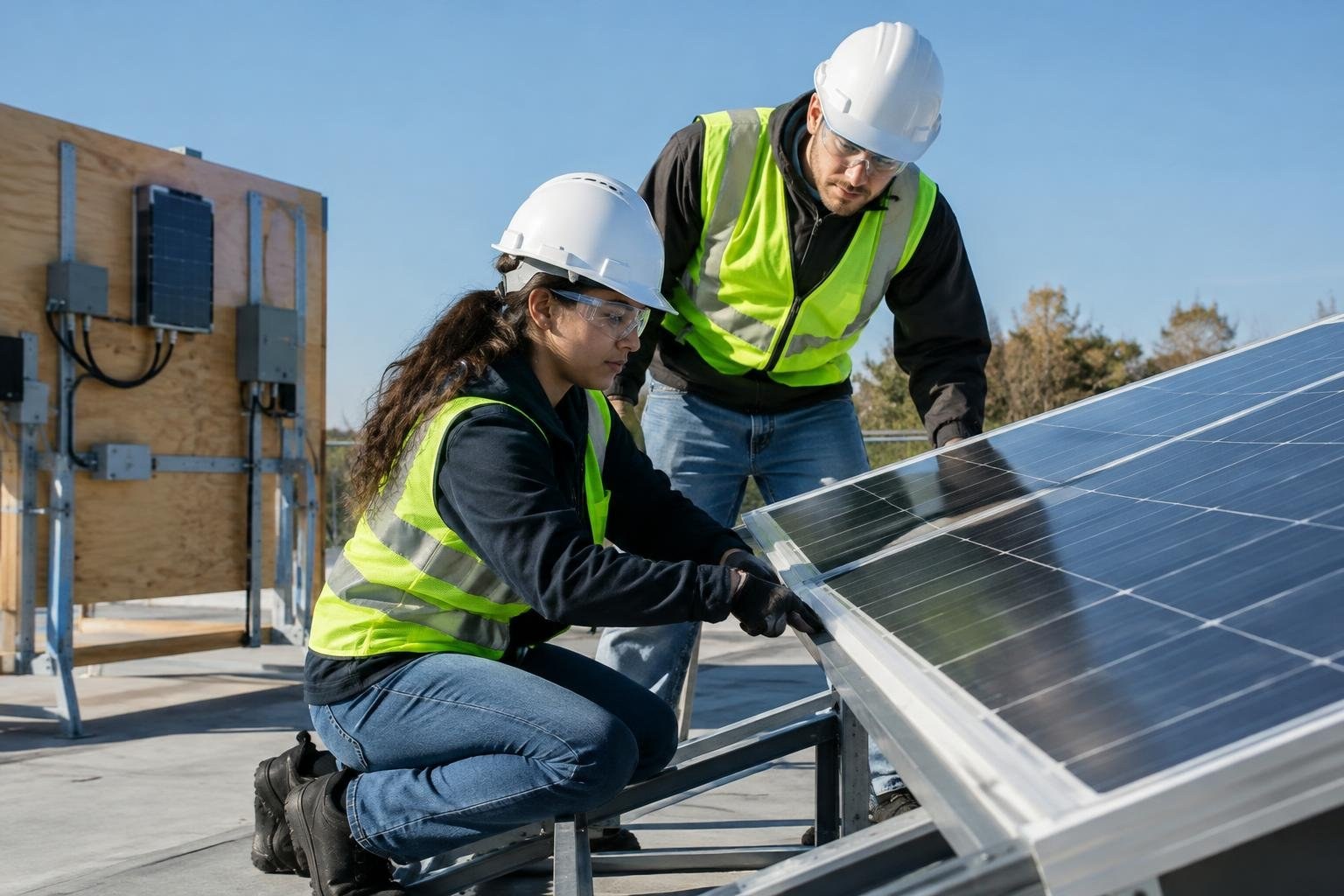
Solar installation training equipment and supervised practice
What Is Solar Energy System Installation and Repair Technology?
Solar Energy System Installation and Repair Technology/Technician is the formal name used for an instructional field identified by the National Center for Education Statistics under CIP code 47.0703. The field centers on applying technical knowledge and skills to solar equipment, including assembling, installing, operating, maintaining, and repairing systems. NCES lists the program classification.
The classification describes a field, not one universal degree. Schools may use shorter names such as solar installation, solar photovoltaic installation, renewable energy technician, or solar energy technology. Treat those names as starting points, then check the award and course content. College pages in Wisconsin, Texas, California, and Arizona describe distinct solar training offerings, which is a reminder to compare institutions directly rather than assume identical curricula.
Solar photovoltaic systems convert sunlight into electricity; solar thermal systems use solar energy for heat. Programs can differ in which equipment and system types they emphasize. Arizona Western College, for example, describes technical assistance related to solar electric, solar thermal, electrical, or mechanical systems. That example is not a promise that every program covers all those areas.
What Do You Study in a Solar Technician Program?
Students learn how solar equipment is assembled, installed, operated, maintained, tested, and repaired. Ask each school for current syllabi or course descriptions, not just a short program summary.
Pay particular attention to how much of the learning involves equipment and supervised practice. Arizona Western College describes technical assistance in solar electric, solar thermal, electrical, and mechanical systems. Los Angeles Trade-Technical College’s program is titled Renewable Energy Technician - Solar PV Installation and Maintenance, while Texas State Technical College describes solar energy technology. These titles and descriptions provide examples of how closely related programs can be presented differently.
When reviewing the curriculum, check whether learners practice installation, testing, troubleshooting, routine maintenance, and safe work procedures. Ask how practical skills are assessed and whether projects, labs, internships, or other field experience are required. Do not assume a lab or placement is included unless the college confirms it.
Skills You Can Build
The central skill set is applied technical work with solar equipment. Learners may build familiarity with system installation and maintenance, and the program field encompasses testing and repair. The precise tools, software, equipment, and methods depend on the school’s curriculum, so ask for examples of the equipment students use and the tasks they complete.
Solar work also calls for careful communication: technicians may need to explain a system issue, coordinate work, or document a task for coworkers or customers. Ask a program adviser how students practice technical documentation, teamwork, and customer-facing explanations. These are reasonable preparation questions, not a guarantee that every course teaches them explicitly.
O*NET provides occupational descriptions and training information for solar photovoltaic installers. Use that resource to compare the occupation’s work profile with what a specific college teaches, rather than treating a degree label as proof that you have mastered every employer-requested skill.
Who Is This Program Best For?
This program may appeal to students who want applied technical learning and are curious about how solar equipment works. It is worth exploring if you enjoy hands-on tasks, methodical troubleshooting, and seeing a physical system come together. You do not need to arrive with a fixed career identity; the point of comparing programs is to find out whether the work and learning style make sense for you.
Consider your comfort with practical problem-solving, equipment, and potentially variable work settings. Ask a college what the physical and safety demands are, since the available sources do not specify them for every program. Students who prefer a mostly classroom-based or purely theoretical course of study may want to compare other fields as well.
Does this program match you?
Salary, job growth, and a school’s reputation matter, but they cannot tell you whether you will like the everyday tasks. Compare your interests and motivations with the work itself. The MAPP career assessment can be one reflection tool as you consider careers and education options; use it alongside program visits, course descriptions, and conversations with advisers or people in the field.
Admissions, Program Length, and Academic Demands
Admissions rules are set by the institution, not by the CIP code. Before applying, ask whether you need a high school diploma or equivalent, particular math or science preparation, placement testing, an application essay, or prior technical experience. The available program pages do not establish one common GPA, test, portfolio, or work-experience requirement for this field.
Program length also varies with the award, required credits, course schedule, and any transfer credit accepted. One Virginia Community College System listing describes a Career Studies Option Certificate as 9 to 29 credit hours. That is a specific credential definition in that system, not a national rule or a timeline for all solar certificates. Ask the school how many credits its program requires and how many terms students typically need at full-time and part-time enrollment.
Technical subjects may feel challenging if you have not recently studied electrical or mechanical concepts. Review prerequisites early, ask about tutoring or introductory coursework, and look for a chance to see the lab before committing. If you work or have family responsibilities, request a sample schedule and confirm whether required practical sessions are offered at times you can attend.
Online Versus On-Campus Study
Online, hybrid, and campus availability is school-specific. Some course material may be taught remotely, but training that involves equipment may require an in-person lab or supervised field activity. The sources provided do not establish that this program can always be completed fully online.
Before enrolling in an online or hybrid option, ask which courses require campus attendance, whether students must find their own work-site placement, where practical assessments happen, and what equipment access is available. Include travel and scheduling in your decision, especially if a school is not nearby. Get confirmation in writing if an advertised online format is a deciding factor.
Tuition, Costs, and Financial Aid
There is no single tuition figure for this field in the supplied sources. The price depends on the college, residency status, credential length, and fees. Ask for the full estimated cost, including tuition, books, tools, lab or equipment charges, transportation, and any required safety items. For an online option, ask about technology costs and any campus visits.
Compare the net cost after grants and scholarships, not just the published tuition rate. Contact the financial aid office about federal and state aid eligibility, institutional scholarships, payment plans, and whether the program qualifies for employer tuition assistance. If you already have college credits, ask how transfer evaluation works before you register. Do not assume that a short program is automatically low-cost or that credits will transfer to another institution.
For families helping a student choose, compare the expected borrowing with the credential and job goals, and ask for the school’s written cost estimate. A program’s price should be considered alongside the practical training and support it actually provides.
Careers, Jobs, and Employment Outlook
Solar installation training can connect to technician work involving solar photovoltaic systems and related technical support. Arizona Western College describes assistance to installers, technicians, and other solar professionals in solar electric, solar thermal, electrical, and mechanical systems. Employers may include private solar companies and utility suppliers; Western Technical College describes its certificate as addressing needs across utility suppliers and private companies serving residential, commercial, nonprofit, and government sectors.
Potentially relevant job titles include solar photovoltaic installer and solar thermal installer or technician. A program does not guarantee access to either job; employers set their own experience and qualification expectations.
This guide does not provide current median pay or employment projections for these occupations. Avoid using an undated salary estimate to judge a program. Compare current local job postings and note the date and geography for any pay or outlook figure you consult. O*NET provides occupational information for solar photovoltaic installers, but specific local hiring conditions require separate verification.
With experience, some workers may pursue coordination or supervisory responsibilities, but that is not an automatic promotion path. Ask employers and program staff what additional experience or training is commonly expected for roles beyond entry-level installation.
Find out which Career or College Major is right for you!
A program award and permission to perform regulated work are not necessarily the same thing. Requirements may vary according to the work, location, and employer. Check with the relevant state or local authority and ask employers what credentials they require for the jobs you are considering.
One Pennsylvania document classifies CIP 47.0703 within an occupational competency framework that references required certification. That state document should not be read as a universal rule for all students or all U.S. jurisdictions. Ask the college which certification or competency assessment, if any, is connected to its curriculum, whether testing is included, and what additional steps a student must complete.
Confirm the institution’s accreditation status through the appropriate recognized accreditor and determine whether the program itself has a specialized approval relevant to your goal. The sources provided do not verify accreditation for any particular school. Request the accreditor’s name and check it independently before paying an enrollment deposit.
Related Programs and Alternatives
Compare related programs by reading their course lists rather than relying on broad labels. Solar photovoltaic installation is the closest named pathway in the supplied occupational information. Solar thermal installation and technician training is another related direction. Broader electrical technology, renewable energy technology, and general installation or repair programs may also be worth comparing, but course content and credentials differ by college.
Solar photovoltaic installation: Consider this if your main interest is installing and maintaining solar electric systems.
Solar thermal installation and technician work: Consider this if you want to compare training related to solar heat systems.
Electrical technology: Consider this if you want a broader electrical curriculum, and verify whether it includes solar equipment.
Renewable energy technology: Consider this if you want to compare solar with other energy topics offered by the school.
General installation and repair: Consider this if you prefer transferable equipment-maintenance skills beyond solar.
These are comparison prompts, not standardized degree definitions. For adjacent career ideas, browse installation, maintenance, and repair careers. If an associate degree or future transfer is a goal, ask whether the credits apply to a named next program before choosing a short certificate. Assessment.com’s degree directory can help you explore related education options.
Experience, Credentials, and Preparing for Employers
Hands-on evidence can help you explain what you have learned. Ask whether the program includes supervised equipment practice, projects, internships, cooperative education, or a portfolio of completed tasks. If those opportunities are not part of the curriculum, seek advice from the program about appropriate ways to gain experience without compromising safety or violating workplace rules.
How to stand out to employers
Keep a clear record of the systems, equipment, and tasks covered in your training.
Be ready to describe how you approached a technical problem and checked your work.
Ask instructors about references, employer connections, and relevant professional groups.
Read job postings in your target area and identify requested skills that the program does not cover.
Verify whether a named certification is required or preferred by employers where you plan to work.
Do not treat a certificate as proof of a license or a guarantee of employment. A college can explain its own curriculum and student opportunities; employers and public authorities determine job-specific qualifications.
Further Study and Career Development
Some students may continue from a short credential into additional technical education, while others may prefer to begin work and build experience. If a college lists higher-level credentials in the broader field, verify that those programs actually exist at the institution and match your intended work.
Ask whether a certificate can count toward an associate degree or another program, what grades are required for transfer, and whether the receiving school has a written articulation agreement. If your long-term goal is system design, engineering, project management, or another adjacent occupation, compare its education requirements separately instead of assuming technician training alone qualifies you.
How to Choose the Right Program
A program is more likely to serve your goals when its curriculum, schedule, and practical learning match the kind of work you want to explore. Use this checklist when comparing colleges:
What exact certificate or degree will I earn, and how many credits does it require?
Which solar systems and equipment are covered, and what will students do hands-on?
Are labs, projects, internships, or site-based activities included or optional?
What are the total tuition, fee, equipment, book, and travel costs?
Which aid, scholarships, payment arrangements, or employer support may apply?
What are the admission prerequisites, schedule, and expected completion time?
Is the program online, hybrid, or campus-based, and what in-person attendance is required?
What accreditation applies, and what licensing or certification preparation is included?
Can credits transfer to a specific next program? Ask for the policy in writing.
What career services, employer connections, and graduate outcome information can the school provide?
Ask for data with a stated time period and a clear description of how outcomes were measured. Compare the answers across institutions and talk with an adviser before making a deposit. Assessment.com’s college-major guidance and career assessment can help organize your questions, but the school must verify its program details.
From Training to a Career: A Possible Path
Think through a plausible route without treating it as a promised outcome. One possible sequence is:
Solar installation certificate or technical program → entry-level solar photovoltaic installation role → additional supervised work experience → specialization in equipment, testing, maintenance, or system type → possible lead or coordination duties.
Actual progression depends on the credential, employer, local requirements, available work, and the skills a worker develops. Before enrolling, compare the program’s stated learning outcomes with the responsibilities in current job postings. Ask instructors and employers what experience is commonly expected for later roles.
Use college guidance resources and the MAPP assessment to think about education and career fit, then verify program facts directly with the institution.
Frequently asked questions
What does a Solar Energy System Installation and Repair Technology/Technician program teach?
This program focuses on technical knowledge and skills for assembling, installing, operating, maintaining, and repairing solar energy systems. A specific college may emphasize solar photovoltaic equipment, solar thermal systems, or related electrical and mechanical work. Review the institution’s course list and lab or field requirements to see exactly what its program covers.
Is solar installation technician training worth it?
It can be a fit if you enjoy hands-on technical tasks, working through equipment problems, and learning how electrical or mechanical systems operate. The credential does not guarantee a job, and program content varies. Compare the training with the specific work you want to do, then ask prospective schools about equipment practice, internships, and graduate outcomes.
What jobs can I get with solar energy system installation training?
The CIP field is associated with solar photovoltaic installer training, and a program may prepare students for installation, testing, maintenance, or repair work. The exact job options depend on coursework, practical experience, employer requirements, and local rules. Check current job descriptions in your area and compare them with the skills taught by the program.
Can I earn a solar installation technician certificate online?
Some colleges offer solar training online or in a hybrid format, but the available evidence here does not establish that every program can be completed fully online. Ask whether equipment practice, labs, internships, or assessments require campus or job-site attendance. Confirm the format and any travel or placement requirements before enrolling.
How long does a solar installation technician program take?
There is no single completion time for this field across institutions. A certificate, career-studies option, and associate degree can involve different credit requirements and schedules. One Virginia Community College System listing describes a Career Studies Option Certificate as 9 to 29 credit hours, but that range should not be applied to every credential or college.
Do solar photovoltaic installers need a license or certification?
Requirements can depend on the state, employer, specific work, and credential. Ask the college what certifications its curriculum prepares students to pursue, and verify any legal or occupational requirements with the relevant state or local authority before relying on them.
People Also Ask
What is CIP code 47.0703?
CIP 47.0703 is the education classification for Solar Energy System Installation and Repair Technology/Technician. It identifies a field of study, not one standard degree or a guarantee that each college offers the same credential. Compare each school’s award, course sequence, practical training, and entry requirements.
Is solar energy system installation a degree or a certificate?
Not necessarily. Program names and awards vary by institution. The field may be offered as a certificate or another credential, but the CIP code does not prove that every listed level is commonly available. Ask the college for the exact credential title, credit total, and whether it can be applied toward further study.
What should I look for in a solar technician program?
Look for program details that explain what equipment students install, operate, test, and maintain. Ask whether learning includes supervised practice, access to working equipment, field experience, and safety procedures. Check the published curriculum against the tasks in job postings for the occupations that interest you.
How much does solar installation training cost?
Tuition depends on the college, location, residency rules, credential length, and fees. Additional expenses may include books, tools, safety items, transportation, and equipment-related charges, but amounts are institution-specific. Request a written estimate of total attendance costs and compare it with grants, scholarships, employer support, and payment options.
How does solar technician training differ from electrical technology?
Solar programs focus on applying technical skills to solar systems. Electrical technology may cover a broader range of electrical equipment, while renewable energy programs can include a wider set of energy topics. Program labels are not standardized enough to decide by name alone; compare course descriptions, lab content, and the occupations each curriculum is intended to support.
Does solar installation technician training require math?
Review prerequisites and course descriptions, then ask an adviser which math, electrical, or technical concepts students use. If you are unsure about preparation, ask whether the school offers foundational support before starting.
Solar Energy System Installation and Repair Technology/Technician may suit students who want practical training in assembling, installing, testing, maintaining, and repairing solar equipment. The program title alone does not tell you how much hands-on work a particular college includes, what it costs, or which credential it awards. Compare the actual curriculum, equipment access, field experience, total price, and job pathways before enrolling. If you are weighing solar work against other technical careers, consider how the daily tasks fit your interests and preferences as well as your education plans.
Want to see your options? Try our comprehensive Degree, Program & College Search tool
We use cookies to offer you a better browsing experience, analyze site traffic and personalize content.
Read about how we use cookies and how you can control them in our
Privacy Policy.
If you continue to use this site, you consent to our use of cookies.
×
Exciting News!
Be one of the first to Beta Test the new AI-Powered Assessment.com Platform.