Universal access
Every student receives structured self-discovery and pathway exploration, not only students with access to private coaching.
A practical framework for turning student motivation into career discovery, college and major planning, CTE pathways, live job research and measurable next steps—without treating one assessment as a verdict.
No-cost account creation. Explore available school tools before planning a pilot.
MAPP stands for Motivational Appraisal of Personal Potential. It is a 71-item career and motivation assessment that helps students identify the kinds of activities, environments and work patterns that may naturally engage them. High schools can use MAPP to begin informed exploration—not to assign a student a permanent label or predetermined future.
Review the MAPP assessment overview and the published MAPP validity study.
High school students make decisions with long consequences while their knowledge of occupations, postsecondary options and themselves is still developing. They may default to familiar professions, family expectations, perceived status or salary—or postpone decisions because the landscape feels too large.
At the same time, school counselors balance academic advising, graduation requirements, mental health needs, college applications, financial aid, career readiness and family communication. ASCA recommends a 250:1 student-to-school-counselor ratio; its reported national average for 2024–2025 was 372:1. Technology cannot replace counselors, but a well-designed platform can make structured exploration available to more students and reduce repetitive preparation.
Every student receives structured self-discovery and pathway exploration, not only students with access to private coaching.
Results create hypotheses and better questions. They do not assign a destiny.
College, CTE, apprenticeships, certificates, military routes and direct employment receive equal visibility.
Counselors and educators retain professional judgment while reports and AI support the work.
Students test fit against occupational, salary, outlook, education and live-job information.
Schools track meaningful exploration and next steps—not assessment completion alone.
MAPP supplies a foundational motivational profile. The broader Assessment.com platform helps schools convert that insight into career research, education planning, counselor conversations, family engagement, student action and schoolwide visibility.
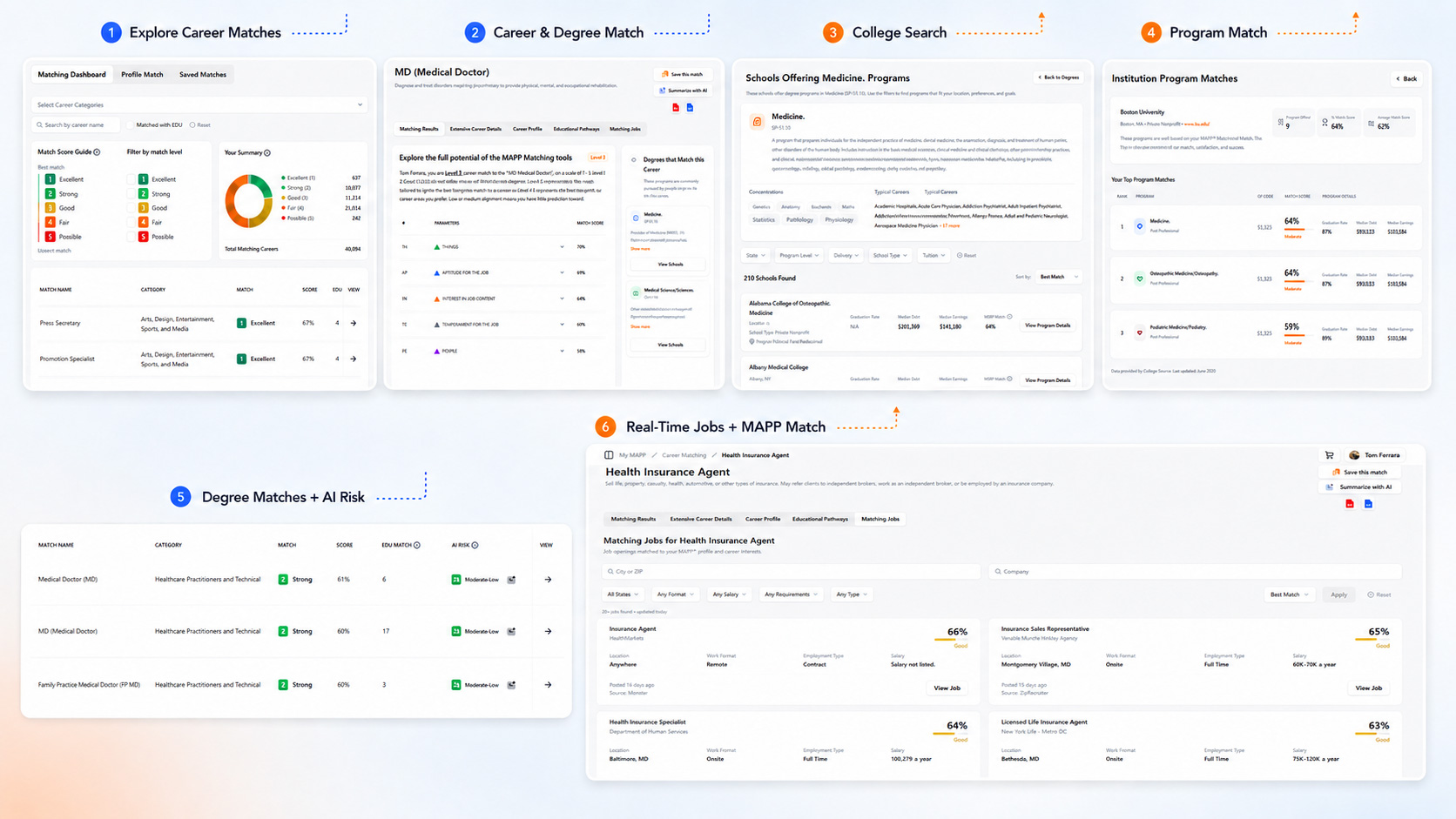
Illustrative student Career Dashboard experience. Available features may vary by package and school configuration.
Give students a shared language for motivations, work preferences and career-fit patterns.
Compare career matches, responsibilities, education, skills, salary, outlook and AI-related task change.
Use current openings to identify employer language, recurring skills, credentials, locations and work conditions.
Connect careers to majors, degrees and institutions, then compare tuition, graduation rates, school type and delivery.
Explore community colleges, trade schools, certificates, apprenticeships, military pathways and workforce programs.
Explain results, compare options and build next steps from student, parent, counselor or educator perspectives.
Review participation, completion, saved pathways and cohort activity according to role and configuration.
Extend MAPP with skills, interests, personality, leadership, wellness, study habits and role-specific assessments.
Create school-specific surveys, intake forms, reflections, knowledge checks and readiness tools.
Support shared reports, cohorts, access codes, branding, languages and integration options as configured.
MAPP begins the conversation. A strong school program deliberately builds what comes next.
Complete MAPP, reflect on motivations and name three to five patterns.
Compare career areas and occupations, including at least one unfamiliar option.
Link promising careers to majors, programs, training routes and prerequisites.
Create an academic, experience and decision plan with dates and support people.
Complete interviews, visits, projects, applications, credentials or work-based learning.
Review participation, equity, learning and completed next steps; improve the program.
Introduce MAPP at the school’s chosen entry point, then return to the results while students add academic, experiential, education and labor-market evidence. Review annually; retest selectively when there is a clear purpose.
Motivation can make college and career research more purposeful, but a responsible decision combines motivational fit with academic, admissions, financial, environmental and outcomes evidence.
| Lens | Question | Evidence |
|---|---|---|
| Motivational fit | Do likely activities, environments and outcomes align with the student’s preferences? | MAPP, reflection and experiences |
| Academic fit | Is the student prepared for the coursework and prerequisites? | Transcript, rigor, grades, skills and teacher input |
| Admissions likelihood | How does the student compare with published entry expectations? | Institution data and current counseling analysis—not MAPP |
| Affordability | What is the probable net cost, aid picture and debt burden? | Net-price tools, aid offers and family resources |
| Environment and support | Will the setting, size, delivery, culture and services support success? | Visits, program details, support services and student needs |
| Outcomes and flexibility | Do completion, transfer, licensing and career outcomes support the goal? | Graduation, retention, accreditation and pathway evidence |
Begin with promising careers and activities. Identify related fields of study, compare actual curriculum and prerequisites, then build alternatives such as minors, certificates, transfers or apprenticeships.
Compare multiple listings for the same occupation. Identify recurring skills and credentials, then translate them into courses, software practice, club roles, projects, portfolios and work-based learning.
Treat an AI Risk Score as a prompt to examine task exposure and resilient skills—not a forecast that an occupation will disappear or a reason to close a student’s path.
Let the student explain the results first. Families can contribute context about finances, geography, culture, caregiving and practical constraints without treating the report as a verdict.
Better question:“What is the next small step we can support?”
Use AI to explain language, summarize themes, generate research questions and draft human-reviewed plans. Do not use it to diagnose, rank or exclude students, make final decisions, invent accomplishments or treat unverified facts as current.
Simple habit:Ask → Check → Act
Define the educational purpose, minimum data, role-based access, retention, deletion, exports and incident response. Involve district leadership, counseling, IT, privacy, legal and special-education teams before launch.
Equity standard:School time and support for every student.
A focused pilot lets a school align the platform to its students, existing readiness initiatives, staff capacity and privacy requirements before expanding.
Start with a Free High School AccountChoose the cohort, purpose, student outputs, equity goal and success measures.
Name an executive sponsor, operating lead and clear counselor, CTE, IT and family roles.
Set cohorts, permissions, result visibility, AI access, languages, branding and support.
Practice interpretation, exploratory language, platform navigation, privacy and escalation.
Explain purpose, provide suitable conditions, capture reflection and schedule follow-through.
Review participation, learning, pathway actions, counselor workload, feedback and equity gaps.
Define cohort, outcomes, owners and privacy requirements
Configure roles, tools and the student experience
Train counselors and facilitators with sample reports
Communicate, administer MAPP and capture first reflection
Teach responsible interpretation and career exploration
Connect careers to majors, programs and training routes
Conduct targeted meetings and action planning
Review data, feedback, equity and expansion decisions
A sound evaluation combines reach, student understanding, exploration, action, equity, family engagement and operating quality. Avoid claiming MAPP caused graduation or enrollment outcomes without an appropriate evaluation design.
Invitations, registration, completion and participation by cohort
Students can explain key themes and separate preference from ability
Careers, majors, colleges, pathways and live jobs meaningfully reviewed
Interviews, visits, experiences, applications, résumés or credential steps
A primary route, alternative route, deadlines and support person
Gaps in access, completion, follow-through and opportunity
Preparation time, meeting quality and follow-up completion
Student-reported usefulness, agency, clarity and absence of labeling
| Failure mode | Why it happens | Correction |
|---|---|---|
| Assessment without follow-up | Completion is treated as the program. | Schedule reflection and pathway activities before launch. |
| Deterministic interpretation | Adults want one simple answer. | Train on preference versus ability and require multiple options. |
| Too many tools at once | The platform’s breadth overwhelms users. | Sequence features by grade and purpose. |
| Unequal access | Home completion and opt-in counseling favor advantaged students. | Provide universal school time and targeted follow-up. |
| Unverified AI output | Drafts are treated as facts. | Require official-source verification and human review. |
| No ownership | Teams assume another department leads. | Name an executive sponsor and operating lead. |
Get the printable 26-page guide with counselor prompts, student reflection tools, parent discussion questions, an AI prompt bank and a launch checklist.
Clear answers for school leaders, counselors, CTE teams, teachers and families evaluating the assessment and platform.
View the complete high school platformMAPP stands for Motivational Appraisal of Personal Potential. It is a career and motivation assessment that helps students describe the activities, environments and patterns of work that may naturally engage them. Schools can use the results as a starting point for career exploration, college and major research, CTE planning and student counseling.
Most students complete MAPP in approximately 15 to 22 minutes. A school should reserve additional time for instructions and an immediate student reflection so the assessment becomes the beginning of a learning process rather than an isolated event.
MAPP identifies motivations, preferences and recurring patterns related to job content, temperament, people, things, data, reasoning, mathematics, language, learning and vocational interests. It does not prove academic ability, skill mastery, mental health status, admissions likelihood or future job performance.
Yes, when used as one source of evidence. Students can connect promising careers to majors and degree programs, then compare curriculum, prerequisites, cost, graduation outcomes, learning environment and admissions evidence. MAPP should not be used by itself to rank colleges or determine whether a student will be admitted.
Yes. A comprehensive program should give college, community college, certificates, trade schools, apprenticeships, military pathways, workforce training, entrepreneurship and direct employment equal visibility. The goal is to identify several realistic routes to a meaningful outcome.
Yes. Students can examine live listings connected to careers they are considering. In high school, the strongest use is often to identify recurring skills, credentials, tools, locations and work conditions, then translate employer language into courses, projects, certifications and work-based learning experiences.
Counselors can review motivational themes, career matches, saved pathways and unfinished next steps before a meeting. During the conversation, they can test the results against the student’s lived experience, compare multiple options and document one concrete next action with a date and support person.
No. AI can explain result language, summarize themes, suggest research questions and draft action plans or parent-ready summaries. Counselors retain responsibility for context, ethics, student welfare, confidentiality, professional judgment and consequential decisions.
Schools can review the results annually without requiring automatic annual retesting. Retesting is most useful when the original administration was compromised, the student reports meaningful change, or a new administration has a clear counseling purpose.
Yes. Schools can sequence the experience from Grade 9 self-discovery, to Grade 10 career experimentation, Grade 11 education and pathway comparison, and Grade 12 applications, credentials, live opportunities and transition planning.
Yes. The Assessment Marketplace includes more than 100 free and premium assessments covering interests, skills, personality, leadership, communication, emotional intelligence, wellness, study habits and student-success topics. Schools can also use the AI Assessment Builder for local surveys, reflections, knowledge checks and readiness tools.
Begin with one clearly defined cohort, purpose and follow-up experience. Create a free high school account to review available tools, then define roles, privacy requirements, counselor training, student communications and the evidence your pilot will collect before expanding.
Create a free high school account to review Assessment.com’s MAPP-powered career, education, AI and assessment tools.
Platform features, languages, integrations, reporting, AI access, security controls and data practices may vary by package and configuration and can change over time. Schools should confirm current functionality and contractual requirements directly with Assessment.com. This resource provides educational and operational guidance, not legal advice.
We use cookies to offer you a better browsing experience, analyze site traffic and personalize content. Read about how we use cookies and how you can control them in our Privacy Policy. If you continue to use this site, you consent to our use of cookies.
Be one of the first to Beta Test the new
AI-Powered Assessment.com Platform.