Costume Design Degree Guide: Courses, Careers, Costs & Program Fit
A practical guide to costume design study: compare program emphases, production experience, portfolios, costs, and related career directions before choosing a college.
By David Slack · Staff Writer Assessment.com · Published October 26, 2026 · Last updated November 5, 2026
A costume design degree can lead you into a distinctive mix of storytelling, clothing research, visual design, and practical production work. But programs bearing similar names may prepare students in different ways: one may focus on design concepts, another on making, and another on work across a theatre production. If you are a student or parent comparing colleges, begin with the actual courses and student responsibilities, then weigh schedule, cost, and the kind of work you hope to practice. This guide offers a decision framework for making that comparison.
Degree & Program Decision Insights
Explore your personal fit, education requirements, career potential and next steps.
01Motivational Fit
Discover whether this program fits you
Explore your preferences against the focus of Costume Design. These prompts are not personal MAPP results.
Subject curiosity. Would you choose to explore “costume design” in depth? Ask for a sample learning activity to test that interest.
Breadth of interest. Consider the place of “script analysis” in this field. Is this another part you would choose to explore, or mainly a requirement you would tolerate?
Work reality. Related work can involve this task: “Select materials and production techniques to be used for products.” Would you want that activity to be a regular responsibility?
Interest in studying a field can differ from enjoying its related work.
Which part would you want to do repeatedly, and what would you try before deciding?
Discover Your Personal Program Fit
Before investing your time and money in your education, discover how this program aligns with your natural motivations, work preferences and career goals.
Typical occupational entry: master's degree (BLS). Postsecondary teaching is a separate appointment and may require advanced study; this programme alone is not a promise of a teaching post.
U.S. occupational wages are not guaranteed graduate earnings; OEWS excludes self-employed workers.
Projected openings include replacements as well as growth.
U.S. national estimates. A crosswalk does not establish entry-level eligibility; advanced, management and teaching roles can require further qualifications.
Explore your motivations. Use MAPP as a starting point for reflecting on your interest in “costume design”, then test that interest against a sample learning task.
Examine the work. Compare Fashion Designers and Art, Drama, and Music Teachers, Postsecondary on daily work and entry qualifications, as well as pay. Explore Fashion Designers.
Compare actual providers. Ask for the exact credential, course sequence and assessment methods. Compare how each provider teaches “script analysis”, its entry criteria and its itemized costs.
Check the evidence before applying. Confirm prerequisites and any recognition or professional requirements for your intended route; ask for applicable rules and published outcome definitions in writing.
Verify the institution’s current offering, admissions requirements and outcomes; a search result does not establish your eligibility.
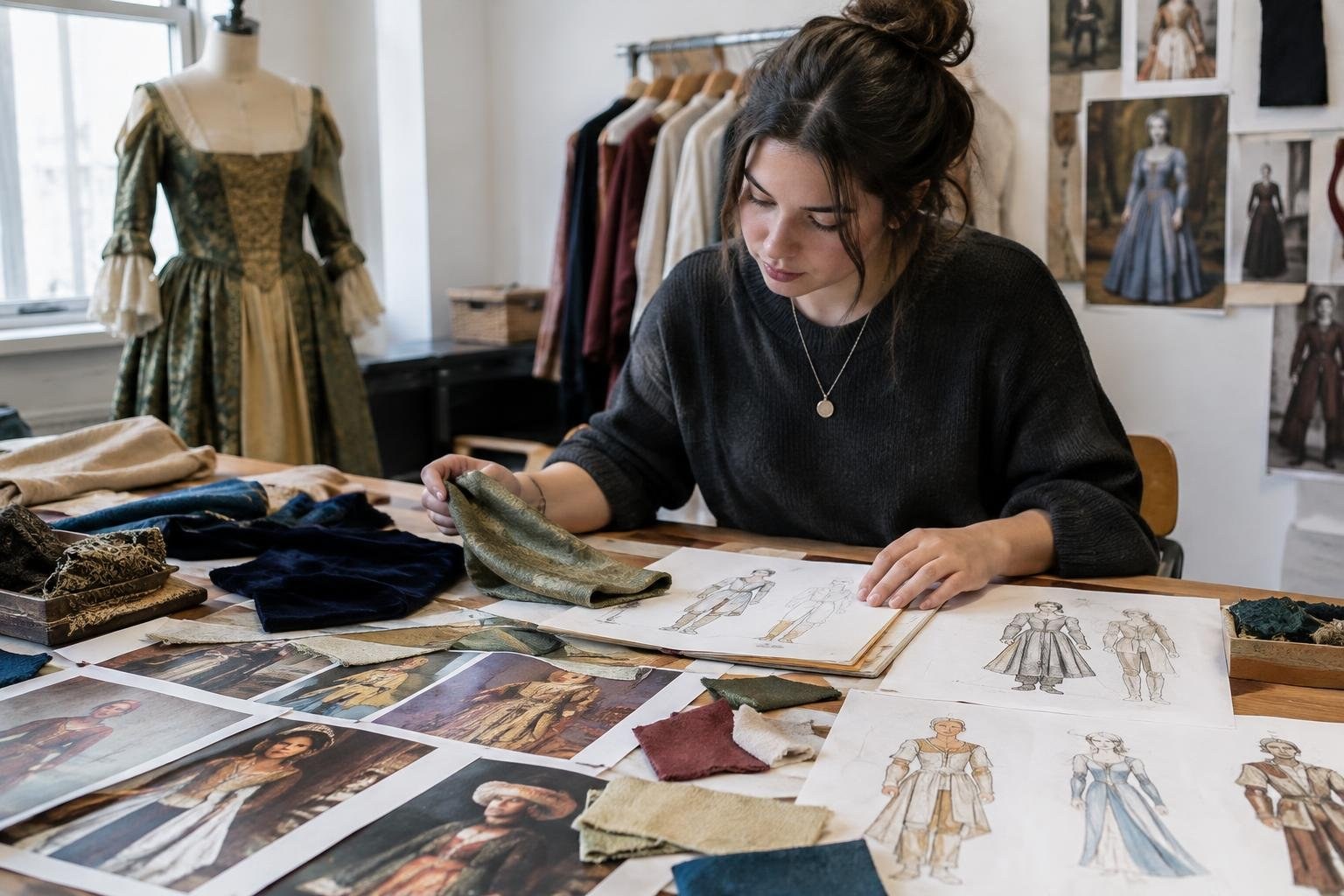
A student’s costume research and design process, showing sketches, fabric samples, and period references
Start With the Work, Not the Degree Title
Costume design is where character interpretation meets the practical work of clothing a performer. A costume choice can help make a role’s identity, relationships, or place in a story legible to an audience. The designer’s task is therefore not simply to create an attractive outfit: it is to make visual decisions that belong to the production and can function in performance.
Program labels can obscure important differences. Costume design may sit inside a theatre design and production degree, or be combined with costume making. One university frames the discipline through dress, identity, and narrative; another describes a curriculum that connects design and technology with staged performance. Compare the work a student will do, not only the title on the diploma.
For an initial comparison, ask whether you want to concentrate on designing concepts, learning to construct garments, or participating in a broader production program. Those interests can overlap, but the curriculum may emphasize one more than the others. Review course lists and project descriptions before deciding what the word “costume” means at a particular school.
Explore how to compare college majors alongside a program’s official requirements. The aim is to find a learning environment that matches the work you want to practice, rather than choosing from a title alone.
What You May Learn and Make
Costume study asks students to turn a story into a visual plan. That process can begin with a script and questions about a character’s circumstances, identity, or change through the performance. Students may investigate historical styles, collect reference material, develop renderings, and consider how a design will be made and worn.
The supplied program description for this field includes script analysis, theory and criticism, period styles, costume history, stage makeup, rendering, and costume construction. Not every school will give each subject equal time. Phoenix College, for example, describes a certificate and associate pathway focused on designing and making costumes for theatre, film, opera, dance, and period reproductions. A separate BFA example emphasizes design and technology through staged theatre, opera, and dance work.
Use these topics as a checklist, not a promise about every curriculum. Look for required courses and sample assignments. Ask how much time is devoted to visual research, drawing, construction, fittings, and collaboration, and whether students can choose projects aligned with their interests.
A useful exercise before applying is to select a character from a play or film and assemble a short design proposal: a written interpretation, visual references, and a few sketches. This is not an admissions requirement. It is a way to see whether you enjoy the thinking and communication involved in the work.
Compare Three Kinds of Learning Experience
Costume programs can differ in how much they emphasize design concepts, making, or experience within a production. A student interested in building garments should check for construction and technology training. Someone drawn to visual interpretation should examine the design process, critique, research, and opportunities to develop a body of work. A student who wants a broad production education should ask whether costumes are taught alongside other theatre disciplines.
Program examples illustrate this variety rather than establish a universal standard. Phoenix College describes costume design and production training across several performance and screen contexts. Shenandoah University describes hands-on experience and work realized in staged productions. DePaul presents its BFA as combining artistic development with practical experience. These are distinct descriptions; they do not prove that one format is better for every student.
Ask a department to describe a recent student production from start to finish. Who proposes the design? Who researches, sources or makes garments, attends fittings, and responds to changes? What parts are assigned to students, and what parts are handled by faculty or staff? Answers to these questions make “hands-on” more meaningful.
If a program offers an online or hybrid option, verify how any studio, fitting, workshop, or production work is completed. The available program descriptions do not establish a general online standard. Request the actual course delivery plan and clarify whether in-person participation or travel is necessary before making a schedule or budget.
Check Whether the Daily Work Appeals to You
This field may suit students who like both interpretation and execution. The work can move between reading a story, researching clothing, communicating a visual idea, and adapting that idea to practical production needs. Collaboration is also part of the picture: costume work contributes to a shared performance rather than standing apart from it.
Try a small self-check. Do you enjoy making choices from incomplete information? Are you interested in how clothing can signal identity or help tell a story? Do you like refining an idea after feedback? Are you willing to balance creative intent with the realities of materials, construction, and use? A “yes” to some of these questions may justify exploring the major further, not prove that it is the right choice.
Consider the opposite signals too. If your main interest is clothing as a product or collection, a fashion-focused program may be a closer academic fit. If you prefer designing the visual environment rather than garments, compare theatre production or set design. If you want to explore visual arts more broadly, a general art program may be worth investigating, with production experience pursued separately.
Assessment.com’s MAPP career assessment can be one tool for reflecting on interests and preferences. Use it as a conversation starter, then compare its themes with actual course plans, sample work, and discussions with a counselor or people familiar with theatre production.
Choose a Credential and Map the Route Through It
Credential names tell only part of the story. The field includes certificate and associate pathways, undergraduate BFA study, and graduate costume-design programs among the supplied examples. The level, length, prerequisites, and completion rules belong to each institution, so confirm them in its current catalog and program materials.
For each option, build a simple comparison sheet with the credential, required courses, expected completion sequence, production commitments, and portfolio opportunities. Ask whether credits can transfer, how part-time enrollment affects the schedule, and whether courses are offered every term. A published degree map can help reveal if a missed course could delay progress.
Admission rules also vary. Do not assume that a portfolio, sewing experience, audition, interview, or particular high-school course is required. Ask admissions staff for the exact requirements and what they consider useful evidence of creative potential. If a portfolio is requested, confirm format, number of pieces, and whether collaborative work must identify your contribution.
Graduate study is a different decision from choosing an undergraduate major. UConn describes its MFA in costume design as adaptable to student interests, while UNCSA describes in-depth preparation in collaborative theatrical storytelling. Those examples show that graduate study can be specialized; they do not mean an advanced degree is a prerequisite for every costume-related role. Before applying, identify what training or experience you want the degree to add.
Build a Realistic Cost Comparison
There is no reliable single price for a costume design degree based on the information available here. Costs depend on the school, enrollment plan, and expenses beyond tuition. Request a current estimate from each institution and compare the same period of study rather than comparing one school’s annual tuition with another school’s total program estimate.
Ask the financial aid office to identify tuition, mandatory fees, and any expected materials or production expenses. Clarify whether students should budget for tools, supplies, transportation, housing, or travel tied to participation. Ask whether a listed estimate includes those items, and whether the amount is based on a particular number of credits or a particular living arrangement.
Review aid terms directly with the institution. Ask about grants, scholarships, work opportunities, and payment plans, then check eligibility and renewal conditions. If you are comparing transfer routes, ask whether credits will apply to required courses or only count as electives. The amount of transferred credit can affect both time and total cost.
Do not weigh a school’s cost against assumed future earnings. The degree is not one job category, and the available program descriptions do not provide a salary or employment guarantee. Compare what each program makes possible for your learning goals, then decide whether the financial commitment is workable for you and your family.
Think in Career Directions, Not Guaranteed Outcomes
Costume study can support preparation for design and production work in theatre and other performing-arts settings. The named program examples connect training with theatre, film, opera, dance, costume technology, and staged productions. The exact job title, responsibilities, and qualifications depend on the employer and project, so treat a degree as education rather than a promise of a specific position.
Related fields may also be worth exploring. The supplied degree examples distinguish costume design from fashion and textile study, while the program description identifies fashion designers and postsecondary arts teaching among related paths to investigate. For context, Assessment.com has pages on fashion designers, set designers, and postsecondary art, drama, and music teachers. These are related possibilities, not automatic outcomes of a costume degree.
When researching pay or employment outlook, identify the specific occupation, location, and date of the data. A field of study can connect to different roles, so a single degree-wide salary figure would be misleading. Compare job descriptions and requirements for the particular work you may want to pursue, and consider how a portfolio or production experience appears in those requirements.
Ask each department what students have been able to do after graduation and how the school tracks those outcomes. Clarify whether reported outcomes cover all graduates, a subset of respondents, or a particular year. Those details help you interpret career information without treating anecdotes as a forecast.
Use Projects to Test the Field and Build a Portfolio
A portfolio can help communicate how you think, not just what a finished design looks like. Depending on the work you have permission to share, it might include references, sketches, revisions, material explorations, and a brief explanation of the production question you were solving. Include your role clearly when a project involved a team.
Experience does not have to begin with a professional production. School or community projects may offer a chance to learn how people coordinate around a performance. Before volunteering or accepting a role, understand what is expected, who supervises the work, the schedule, and whether you can document the contribution. The goal is meaningful learning, not collecting credits without understanding what you did.
Ask instructors or collaborators to review a portfolio for clarity. A viewer should be able to understand the concept, the decisions you made, and how the work relates to the production. Be careful with photographs, sketches, and production materials: check permission before sharing work that includes other people’s contributions or belongs to a school or company.
The program information supplied here does not establish a universal costume-design license or certification. Requirements for a specific position may differ, so ask employers or institutions about that role directly. If teaching is a goal, investigate the qualifications requested by the schools where you might want to work.
A Practical Program-Comparison Checklist
Compare programs by the evidence they can show you. Review required courses, examples of student work, the production calendar, access to facilities, and the way students receive feedback. A claim that a program is practical matters most when the school can explain the tasks students perform and how those tasks fit into the curriculum.
Learning: Which courses cover research, design, history, construction, and technology? Which are required?
Production: How often do students work on productions, and what decisions or tasks are assigned to them?
Support: Who gives design feedback, and how are portfolios developed?
Schedule: What is the expected course sequence, and how do production periods affect workload?
Format: Which activities are in person, and what is required of online or hybrid students?
Cost: What is the complete estimate, including fees and expected supplies?
Outcomes: How are graduate outcomes collected and defined?
Ask the department, admissions office, and financial aid office separate questions so you receive the right detail. If possible, speak with current students and look at a range of projects rather than one showcase example. Take notes and compare answers using the same questions at each school.
Assessment.com also provides a college guidance resource for students and supporters preparing to discuss education choices. For career exploration beyond this major, browse arts and design careers and the entertainment and sports career area.
Questions to Resolve Before You Commit
Before enrolling, ask for details that can be checked and compared. What credential will I earn, and what must I complete to graduate? Which classes are required, and when are they offered? What do students actually do on productions? What supplies or other costs should I include in my budget? Which parts of the program require in-person participation?
Then ask questions about fit. Can students explore both designing and making, or must they choose a focus early? How are projects critiqued? What can a student include in a portfolio? Can I see examples from students at different stages, not only the final showcase? What support is available if I need to change course or transfer credits?
Finally, check how the program connects to your next step. Ask how the department defines graduate outcomes, whether it can describe the roles graduates pursue, and what additional training employers may expect. If you are considering graduate study, ask what experience and portfolio preparation applicants should have. If you are considering fashion design instead, compare its course plan and project emphasis with costume study.
Write down answers from each school and verify important points in official catalogs, cost estimates, and admissions materials. A clear comparison can prevent a common mistake: choosing by reputation or an appealing program name before understanding the curriculum, costs, and day-to-day commitment.
Frequently asked questions
What do students study in a costume design program?
It connects visual interpretation with practical clothing decisions for a production. Program descriptions may include script analysis, costume history, period styles, rendering, makeup, construction, and technology, but the balance differs by school. Check required courses and student project examples.
How can I tell whether a costume design program is hands-on?
Programs differ. Some emphasize design and production training, while other descriptions highlight hands-on work realized in staged performances. Ask the department what students do on productions and how often those assignments occur before choosing a program.
What costs should I compare for a costume design degree?
There is no single cost for the field. Compare each school’s current tuition and fees with expected materials, supplies, housing, transportation, and production-related expenses. Ask the financial aid office to explain aid eligibility and renewal terms.
Do I need an MFA to work in costume design?
Not necessarily. The supplied examples include certificate and associate pathways, undergraduate BFA study, and graduate costume-design options. The right level depends on the particular role and your learning goals. Verify the requirements of schools or employers related to your plan.
How is costume design different from fashion design?
Fashion design focuses on clothing as a fashion discipline, while costume design connects clothing to character and performance storytelling. The fields may share visual and garment-related skills. Compare actual courses and projects at the schools you are considering.
People Also Ask
What does costume design mean as a college major?
Costume design study links clothing choices to a character and the story being performed. Depending on the program, students may research styles, develop renderings, learn construction, and take part in production work.
What degree levels are available in costume design?
The supplied examples range from certificate and associate pathways to BFA and graduate study. A specific program’s completion time depends on its catalog, credit requirements, and your enrollment plan, so confirm the degree map with the school.
Do costume design applicants need a portfolio?
No universal rule is established by the program descriptions. Check each school’s admission materials for portfolio requirements and ask what work or creative experience can demonstrate your interests.
Will I work on productions as a costume design student?
Some program descriptions explicitly include practical training or staged production work, but opportunities and student duties vary. Ask what students do, how often they participate, and whether their work can be documented for a portfolio.
How should I compare costume design colleges?
Compare course plans, projects, facilities, production responsibilities, schedule, and total expenses. Ask the department to explain what students actually design or make and review work from students at different stages.
What careers can costume design study lead toward?
The field can connect to design and production in performing arts, while fashion design and postsecondary arts teaching are other directions to investigate. A degree alone does not guarantee a particular job; check role-specific experience and education requirements.
Costume design is worth exploring if you want to connect clothing, character, and performance through both visual decisions and practical work. Your best next step is to compare actual courses, student responsibilities in productions, portfolio opportunities, and the full cost of each program. If you are weighing costume design against fashion or another arts path, examine the daily work behind each choice and reflect on what motivates you. Assessment.com’s MAPP assessment can help you explore career and degree options, then use what you learn to guide conversations with family, counselors, and colleges.
Find out which Career or College Major is right for you!
We use cookies to offer you a better browsing experience, analyze site traffic and personalize content.
Read about how we use cookies and how you can control them in our
Privacy Policy.
If you continue to use this site, you consent to our use of cookies.
×
Exciting News!
Be one of the first to Beta Test the new AI-Powered Assessment.com Platform.