Behavioral Neuroscience Degree Guide: Courses, Careers and Program Fit
Behavioral neuroscience connects brain science with behavior and psychology. Learn what students study, where the degree can lead, and how to compare programs and pathways.
By Kieth Nelson · Staff Writer Assessment.com · Published October 26, 2026 · Last updated November 5, 2026
Behavioral neuroscience is the scientific study of how the brain and nervous system relate to behavior and psychological functioning. Students examine connections among biology, cognition, perception, memory, and behavior, often learning how researchers investigate these relationships through experiments and evidence. Depending on the institution and degree level, a program may be an undergraduate major, a graduate concentration, or a research-focused graduate program. The best fit is usually a student curious about both psychology and life science, and willing to build research and analytical skills. If you are weighing this major, compare the courses and research opportunities at specific schools with the education required for the work you may want to do.
Degree & Program Decision Insights
Explore your personal fit, education requirements, career potential and next steps.
01Motivational Fit
Discover whether this program fits you
Explore your preferences against the focus of Behavioral Neuroscience. These prompts are not personal MAPP results.
Subject curiosity. Would you choose to explore “functional neuroanatomy” in depth? Ask for a sample learning activity to test that interest.
Breadth of interest. Consider the place of “neural system development” in this field. Is this another part you would choose to explore, or mainly a requirement you would tolerate?
Work reality. What would an actual workday connected with Behavioral Neuroscience involve? Investigate the setting and entry requirements separately from your interest in studying the field.
Interest in studying a field can differ from enjoying its related work.
Which part would you want to do repeatedly, and what would you try before deciding?
Discover Your Personal Program Fit
Before investing your time and money in your education, discover how this program aligns with your natural motivations, work preferences and career goals.
Explore these official instructional-field associations. They describe possible occupational routes, not measured outcomes of this program.
Psychologists, All OtherSOC 19-3039 · O*NET 19-3039.00$110,840/year median (May 2025); +2.3% projected change (2025–2035); 3,500 projected openings/year.
Typical occupational entry: master's degree (BLS). BLS lists internship/residency as typical occupational training. Check the exact professional credential and jurisdiction requirements for this occupation; the classification association alone does not establish eligibility.
Life Scientists, All OtherSOC 19-1099 · O*NET 19-1099.00$93,750/year median (May 2025); +6.3% projected change (2025–2035); 400 projected openings/year.
U.S. occupational wages are not guaranteed graduate earnings; OEWS excludes self-employed workers.
Projected openings include replacements as well as growth.
U.S. national estimates. A crosswalk does not establish entry-level eligibility; advanced, management and teaching roles can require further qualifications.
Compare the focus and route of these distinct instructional fields; their credentials and admission requirements are not interchangeable.
NeuroscienceCIP 26.1501. Compare its emphasis on molecular and biochemical bases of information processing and behavioral neuroscience with this program’s focus.
Behavioral SciencesCIP 30.1701. A program with a combined or undifferentiated focus on the social sciences, psychology, and biomedical sciences to study complex problems of human individual and social growth and behavior.
BiopsychologyCIP 30.1001. A program that focuses on biological and psychological linkages, especially the linkages between biochemical and biophysical activity and the functioning of the central nervous system.
Explore your motivations. Use MAPP as a starting point for reflecting on your interest in “functional neuroanatomy”, then test that interest against a sample learning task.
Examine the work. Compare Psychologists, All Other and Life Scientists, All Other on daily work and entry qualifications, as well as pay. Explore Psychologists, All Other.
Compare actual providers. Ask for the exact credential, course sequence and assessment methods. Compare how each provider teaches “neural system development”, its entry criteria and its itemized costs.
Check the evidence before applying. Confirm prerequisites and any recognition or professional requirements for your intended route; ask for applicable rules and published outcome definitions in writing.
Verify the institution’s current offering, admissions requirements and outcomes; a search result does not establish your eligibility.
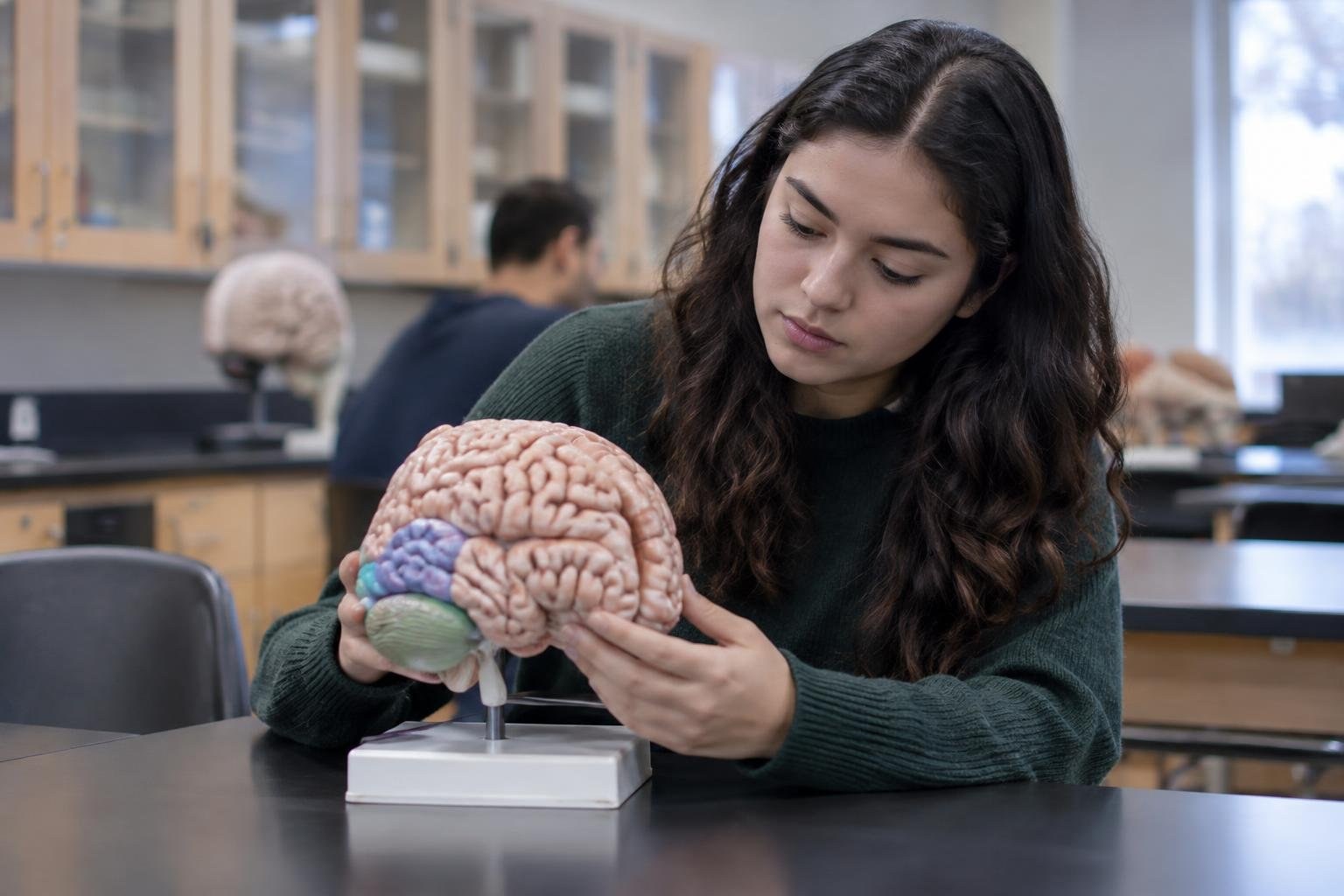
Undergraduate student exploring a brain model in an academic setting
What Is a Behavioral Neuroscience Degree?
Behavioral neuroscience examines biological processes that help explain behavior and psychological functioning. It connects questions traditionally studied in psychology with the brain, nervous system, and other biological systems. The University of Kansas offers a Bachelor of Science in Behavioral Neuroscience within its psychology department; other universities describe behavioral neuroscience as a graduate research area or concentration. The name and academic home are not identical everywhere, so compare the actual courses and program structure rather than judging by title alone.
At the undergraduate level, students may encounter it as a major or concentration. At graduate level, it can be a research specialization or part of a master’s or doctoral pathway. Programs and credential availability vary by institution; a field-level list of credential types does not mean a particular school offers each one.
How it differs from related fields
Behavioral neuroscience focuses on the biological and neural foundations of behavior. General psychology can cover a wider range of topics, while neuroscience programs may place greater emphasis on nervous-system science. Biology programs usually have a broader life-science scope. These distinctions are not universal: inspect course requirements, research options, and faculty interests at each school.
What Do Behavioral Neuroscience Students Study?
Behavioral neuroscience coursework typically combines foundational science with psychology and research. The field’s subject matter may include functional neuroanatomy, neural development, biochemical regulation, memory, cognition and perception, psychopharmacology, and the biological aspects of psychological disorders. Individual programs choose their own sequence and depth, so these areas should be treated as a map of the discipline, not a promise that every school teaches every topic.
From foundations to focused study
Early coursework may establish a base in psychology and biological science. More advanced classes can connect neural systems to questions about learning, motivation, cognition, and behavior. Research methods matter because students need to distinguish a supported finding from an assumption and understand how evidence is collected and interpreted.
Depending on the program, learning may include laboratory classes, independent research, a thesis, or a capstone. Graduate programs described by UNC-Chapel Hill, Ohio State, and the University at Albany emphasize research into biological bases of behavior, experimental work, or examining the brain at multiple levels. Ask departments which experiences are required, how students find mentors, and what equipment or research settings are accessible.
Skills students can build
Scientific reasoning: framing a research question, evaluating evidence, and identifying limits in an interpretation.
Biological literacy: understanding how nervous-system structures and processes relate to behavior.
Research communication: explaining methods and results in writing and conversation.
Data and technology familiarity: using the tools and procedures taught by a specific lab or course. Software and technical methods differ by institution.
Collaboration and care: following research procedures, coordinating with a team, and handling scientific information responsibly.
These skills are relevant to research and scientific work, but the degree alone does not substitute for job-specific experience or qualifications.
Who Is Behavioral Neuroscience Best For?
This major may appeal to students who keep asking how biological processes shape thought and action. It can suit learners who enjoy both people-centered questions and scientific explanations, and who are willing to work through detailed evidence rather than rely on intuition alone. Interest in experiments, reading research, and revising an explanation when results do not support it can be helpful.
No single personality type is required. Some students prefer hands-on laboratory tasks; others are drawn to theory, data, or the meaning of findings for human behavior. The key is to be comfortable learning biological concepts and research methods, even if those subjects are initially challenging.
Typical preparation and admissions
Entry requirements vary by school and credential. Undergraduate applicants should check general admission rules as well as prerequisite courses, transfer-credit policies, and any requirements for declaring the major. Graduate applicants may need prior study in a related area and a record of research preparation; requirements, application materials, and faculty-fit expectations differ. Ohio State directs prospective graduate students to its program handbook for requirements and expectations. Confirm details with the department rather than assuming that requirements at one school apply elsewhere.
Does behavioral neuroscience match you?
Salary, reputation, and career growth are only part of a degree decision. Consider whether you would enjoy the day-to-day work of reading studies, studying biological systems, and learning how researchers test ideas. Assessment.com’s MAPP career assessment can help you reflect on motivations and preferences. Use that reflection alongside degree matching, career matching, conversations with advisers, and direct review of program requirements; an assessment is a prompt for exploration, not an admissions or career guarantee.
Credential Levels, Format, Time, and Academic Demands
How long a behavioral neuroscience degree takes depends on the credential, transfer credit, study load, and school requirements. A bachelor’s program generally follows the institution’s standard undergraduate schedule; part-time and transfer pathways can take longer or shorter depending on credits accepted and course availability. Master’s and doctoral timelines are program-specific, especially when research and thesis or dissertation work are involved. Do not assume every credential level listed for the field is offered in this specialization.
Online, hybrid, and campus options also vary. Online coursework may be available in a broader psychology program, but a research-intensive behavioral neuroscience path may include in-person laboratory work, supervised research, or campus resources. UAB describes undergraduate psychology options in traditional and online formats and also lists graduate behavioral neuroscience study; that does not establish that every course or research requirement is fully online.
Workload and common challenges
Students may find it demanding to combine biological concepts with psychological theories and research methods. Keeping up with readings, interpreting data carefully, and fitting research activity into a schedule can also take planning. Before enrolling, review sample syllabi, ask about lab scheduling, and find out whether required courses are offered each term. If you are returning to school, identify support for science coursework, writing, and time management early.
Tuition, Costs, and Financial Aid
The total cost depends on the institution, residency status, credential, enrollment pace, and whether you study on campus or online. Tuition is only one part of the budget. Include mandatory fees, books, lab or research expenses, technology, housing and transportation where relevant, and the cost of any additional education needed for your intended occupation. The sources for this guide do not establish a comparable current price across programs, so request a current cost-of-attendance estimate directly from each institution.
Ways to manage the expense
Compare total degree costs, not just the advertised per-credit rate.
Ask the financial aid office about grants, scholarships, work-study, and eligibility requirements.
Check whether transfer credits can reduce repeated coursework, and get the decision in writing before relying on it.
Ask whether paid research or campus employment is available, without assuming a position is guaranteed.
For graduate study, ask whether funding, assistantships, or tuition support exist for the specific program and cohort.
Review the likely education beyond the first degree before estimating return on investment.
Compare borrowing with realistic career plans and the possibility that you may need graduate training. A low initial price is not the only measure of value if the program lacks the research access or preparation needed for your goal.
Careers, Jobs, and Employment Outlook
Behavioral neuroscience can prepare students to explore several research and science-related directions, but available jobs depend on education, experience, and the employer. The university sources describe research-scientist preparation and graduate work on relationships between brain and behavior. They do not provide comparable salary or occupational-outlook figures, so use current occupation-specific data when evaluating earnings and demand.
Career direction
How the study may apply
Preparation to verify
Research assistant or laboratory research support
Research methods and knowledge of behavior and biological systems can support supervised research tasks.
Employers may specify laboratory skills, prior experience, or a relevant degree level.
Behavioral or neuroscience research scientist
Advanced research training can prepare graduates to investigate brain-behavior relationships.
Research positions commonly depend on specialized training and demonstrated research experience; check each posting.
Biological or life-science research roles
Relevant coursework may support work in a related scientific team, depending on the research subject.
Specific laboratory methods and subject knowledge vary by role.
Postsecondary psychology teacher
Behavioral neuroscience research can inform teaching in a related academic area.
Confirm the institution’s degree expectations; a doctorate may be needed for many faculty roles.
Scientific data or research coordination support
Careful documentation, analysis, and communication can be useful in research settings.
Requirements depend on the employer, tools, and responsibilities.
Potential employers include universities and research settings, but opportunities and job titles differ. The career paths supplied for this field also name bioinformatics, biology, genetics, molecular and cellular biology, and psychology teaching. These are adjacent possibilities, not automatic outcomes of the degree. A bioinformatics role, for example, may require computational preparation beyond a behavioral neuroscience curriculum.
Some entry-level opportunities may be accessible after undergraduate study, while independent research and postsecondary teaching typically call for further preparation. Check current postings in your region and distinguish required qualifications from preferred ones. Artificial intelligence and other research technologies may change how some data are processed, but students still need sound methods, careful interpretation, and the ability to explain limitations. No specific employment effect is established by the program information cited here.
Find out which Career or College Major is right for you!
Look beyond classes to the experience that helps translate a degree into evidence of readiness. Ask faculty about joining a research group, assisting with a supervised project, presenting work, or completing a thesis or capstone. A research poster, careful lab documentation, a writing sample, or a project summary can help you explain what you learned, provided the work is shareable and follows research rules.
How to stand out to employers or graduate programs
Seek research experience early and ask what skills a lab expects before applying.
Keep a clear record of methods, responsibilities, and results you are permitted to discuss.
Practice explaining a scientific question and its limitations to people outside your specialty.
Build complementary skills in statistics, data handling, or coding if they fit your chosen path.
Talk with faculty, advisers, and professional groups about opportunities and realistic next steps.
A degree is not the same as professional licensure. Behavioral neuroscience study alone should not be treated as authorization to diagnose or provide clinical care. If your goal involves patient treatment, identify the relevant profession and check current state licensing rules and approved education requirements with the appropriate authority. The sources cited here describe research-oriented programs, not clinical licensure routes.
Graduate School and Advanced Study
Graduate study can deepen research ability and open paths that require advanced subject knowledge. Options may include a master’s degree, a research doctorate, or another specialized graduate program. The right route depends on whether you want to support research, lead independent studies, teach at the postsecondary level, or move into a different professional field.
Examples show that program structures differ. Binghamton describes a combined MA and PhD in behavioral neuroscience, while the University at Albany describes a PhD that approaches the brain from molecular analysis through psychological effects of neurological conditions. UConn describes graduates trained as research scientists studying brain and behavior. These are examples of institutional offerings, not a guarantee that all schools follow the same model or that a specific credential is required for every research job.
Before applying, ask about prerequisites, faculty research areas, mentorship, funding, time to completion, and the milestones required for a thesis or dissertation. A doctorate is a substantial commitment; pursue it because the work and career requirements fit your goals, not simply because the major sounds specialized.
Related Degrees and Alternatives
Related subjects can lead to different course mixes and career preparation. Compare required courses and the work you expect to do, rather than choosing based on a similar-sounding title.
General psychology: consider this if you want broader exposure to psychological topics rather than a strong biological emphasis.
Neuroscience: consider this if you want a wider or more explicitly nervous-system-centered science curriculum; compare biology, chemistry, and laboratory requirements.
Biology: consider this if you prefer a broad study of living systems and do not want behavior to be the central theme.
Biochemistry or molecular biology: consider these if your interests center on chemical or molecular processes rather than behavior and cognition.
Cognitive science: consider this if you are drawn to cognition and want to compare psychological, computational, linguistic, or philosophical approaches offered by schools.
Psychology research methods or experimental psychology: consider these if research design and evidence are your main interests, while checking how much biological coursework is included.
Bioinformatics or computational biology: consider these if you want a stronger computational and data-analysis direction; verify prerequisites in mathematics and computing.
For a student comparing behavioral neuroscience with general psychology, the central question is how much biology and research training each program requires. For comparison with a neuroscience major, inspect whether the program emphasizes behavior and psychology or a broader range of neural science. Graduate-school prerequisites can differ, so consult the departments and programs you may later apply to.
How to Choose a Behavioral Neuroscience Program
Program titles alone do not establish academic quality, research access, or professional recognition. Start by checking the institution’s accreditation status through authoritative education resources, then ask whether any specialized recognition is relevant to your intended path. The sources available for this guide do not identify a behavioral-neuroscience-specific accreditor, so do not assume that a program has one.
Compare the details that shape your experience
Curriculum: Are biology, psychology, statistics, and research methods balanced in a way that supports your goals?
Research access: Can undergraduates participate? How are mentors assigned, and what is the process for joining a lab?
Faculty and facilities: Do research interests align with yours, and are students able to use the facilities required for their work?
Format and logistics: Which classes, labs, and research activities require campus attendance?
Cost and aid: What is the full estimated cost after aid, fees, housing, and likely time to completion?
Outcomes and support: Ask the department for recent information about graduate study, research placements, advising, and career services. Clarify how outcomes are defined.
Transfer and progression: Confirm which credits count and whether required courses are available on a schedule you can manage.
Compare more than one program and speak with students or advisers when possible. Assessment.com’s education resources and MAPP assessment can support exploration, while school catalogs and department advisers should answer program-specific questions. Use career matching to test possible directions against real job requirements rather than treating a major as a guaranteed career route.
Questions to Ask and Next Steps
Use this checklist before accepting an offer or paying a deposit:
What credential and major will appear on my transcript, and which courses are required?
What is the complete estimated cost for my expected time to graduation?
Which prior courses or transfer credits will the school accept?
Can I access research or laboratory experience, and what are the selection steps?
Which parts of the program require campus attendance or supervised in-person work?
What preparation do graduates typically pursue next, and how does the department define those outcomes?
What financial aid, scholarships, assistantships, or work opportunities may apply to me?
If I want a clinical career, what separate degree and licensing route does that profession require?
How will advisers help me connect courses and experience with realistic career options?
Map a possible route, without assuming a guarantee
A research-oriented path might look like: behavioral neuroscience bachelor’s degree → supervised research assistant work → graduate study or specialized research experience → a focused research role. Another might be: undergraduate behavioral neuroscience → additional training in a related scientific area → work on a research team. A postsecondary teaching direction may involve doctoral study and a research record. Each step depends on available positions, further education, performance, and employer requirements; none is an automatic promotion sequence.
For a practical next step, compare the program curriculum with two or three job descriptions you find appealing. Note the education, tools, and experience they request, then ask an adviser how the program can help you build those qualifications. Explore Assessment.com’s degree and career resources as you refine the possibilities and use the MAPP assessment as one input in considering fit.
Frequently asked questions
What is behavioral neuroscience?
Behavioral neuroscience studies the biological processes related to behavior and psychological functioning. Courses and research may explore the nervous system, brain development, cognition, memory, and experimental methods. The balance between psychology and biology differs by institution, so review the specific curriculum before choosing a program.
Is behavioral neuroscience hard?
It can be challenging for students who are new to biology, chemistry, statistics, or research methods, because programs may combine these subjects with psychology. The workload also depends on the course sequence and research expectations. Check prerequisites and talk with a department adviser to understand the demands of a particular program.
What jobs can I get with a behavioral neuroscience degree?
Possible directions include research support, laboratory work, and further study toward research scientist or postsecondary teaching roles. The degree may also provide a foundation for related scientific or behavioral fields, but many specialized positions require graduate education or additional training. A major alone does not guarantee a specific job.
How much can you make with a behavioral neuroscience degree?
Behavioral neuroscience salary depends on the job, education level, experience, employer, and location, not just the major. The university program information available for this guide does not provide comparable salary data. For a useful estimate, first identify a specific occupation and then consult current U.S. labor-market information for that occupation and region.
Can I earn a behavioral neuroscience degree online?
Some institutions offer online or hybrid psychology courses, but the format and availability of a behavioral neuroscience degree vary. Research-intensive study may involve laboratory or other supervised research experiences that cannot be completed entirely online. Ask each department which requirements require campus attendance or in-person work.
Does behavioral neuroscience require math and science?
Many programs include biology and may require chemistry, statistics, or other quantitative coursework, but requirements vary. Behavioral neuroscience is not only reading and discussion: students may need to understand scientific evidence, research design, and data. Review the program’s required courses and prerequisites before enrolling.
Do you need graduate school for behavioral neuroscience careers?
Graduate school is often relevant to research careers and to postsecondary teaching, but not every job connected to a behavioral neuroscience background requires a doctorate. The right level depends on the role. Compare actual job postings and the preparation expected for your intended work before committing to graduate study.
How is behavioral neuroscience different from psychology?
Behavioral neuroscience emphasizes biological and neural explanations of behavior, while general psychology can cover a broader range of psychological topics. The exact distinction depends on each school’s courses and options. Compare required classes, laboratory work, research opportunities, and graduate-school goals rather than relying on the major title alone.
People Also Ask
Is behavioral neuroscience a psychology major or a neuroscience degree?
Behavioral neuroscience is offered under different academic structures. The University of Kansas lists a behavioral neuroscience Bachelor of Science within psychology, while the graduate programs described by several universities focus on research training. Verify current availability and credential level in each institution’s official catalog.
What does a behavioral neuroscience student study?
The discipline examines biological bases of behavior and psychological functioning, including areas such as neural systems, cognition, memory, and brain-related processes. A student’s actual course of study depends on the program’s requirements and specialization.
What can I do after a behavioral neuroscience bachelor’s degree?
Start with the jobs you might pursue, then identify the degree level and experience employers request. Research-focused careers and university teaching may involve graduate training, while other positions may value laboratory, data, or communication experience. Verify requirements with employers and official program advisers.
What should I look for in a behavioral neuroscience program?
Some programs emphasize a broad undergraduate foundation, while research-oriented graduate programs may expect focused research experience. Look at prerequisites, faculty research areas, lab access, mentorship, and how students progress into advanced study.
Do behavioral neuroscience programs require laboratory research?
A behavioral neuroscience program may include laboratory research or other supervised experiences, but whether they are required and how they are delivered varies by school. Ask about research placements, campus attendance, equipment access, and expectations for online students.
Does a behavioral neuroscience degree qualify you to treat patients?
A behavioral neuroscience degree is not automatically a clinical license. Students interested in treating patients should identify the specific profession they intend to enter and verify its current education, supervised practice, and licensing requirements with the relevant state authority.
Behavioral neuroscience may suit students who want to investigate how the brain and nervous system relate to behavior, cognition, and psychological functioning. The major can be a strong foundation for research-focused graduate study, but it does not by itself guarantee a particular job, salary, or license. Compare course plans, research access, total cost, and the education required for your intended career. Assessment.com’s MAPP career assessment can help you reflect on how your interests and motivations align with possible careers and degree paths.
Want to see your options? Try our comprehensive Degree, Program & College Search tool
We use cookies to offer you a better browsing experience, analyze site traffic and personalize content.
Read about how we use cookies and how you can control them in our
Privacy Policy.
If you continue to use this site, you consent to our use of cookies.
×
Exciting News!
Be one of the first to Beta Test the new AI-Powered Assessment.com Platform.