Degree Library
Forestry Degree Guide: Courses, Careers, Costs, and How to Choose a Program
A guide to Forestry, General degrees: what students learn, program formats, admissions, costs, career pathways, and how to compare schools for fit.
A Forestry, General degree prepares students to understand and manage forest resources, with possible emphasis on conservation, forest ecology, silviculture, wildlife, or public and private land management. Programs vary: some combine professional coursework with substantial hands-on learning, while others focus more on research or a specialized topic. Credentials range from certificates and associate degrees to bachelor’s and graduate degrees. If you are comparing options as a student or parent, look past the program name and examine the courses, field experience, cost, and jobs graduates aim to pursue. Not sure whether forestry fits you? Take the Free MAPP Career Assessment to explore how your motivations, interests, and preferences may align with this field and related careers.
Millions of people Take the MAPP Career assessment to see which Degrees are the best Match!
You can too,
What Is a Forestry, General Degree?
Forestry, General is a broad area of study concerned with forests and the stewardship, conservation, and management of forest resources. Programs may connect forest ecology and silviculture with wildlife or broader natural-resource management. The University of Florida’s Forest Resources and Conservation bachelor’s curriculum, for example, identifies forest ecology, silviculture, and wildlife among its areas of study and prepares students for managing public or private land.
“Forestry” may appear in program titles alongside forest resources, conservation, wildlife, or natural resources. That does not mean programs with similar labels have identical content. Compare the required courses and options: a student seeking forest management preparation should check that the program actually includes relevant professional coursework and practical opportunities.
Forestry is related to environmental science, wildlife management, and natural-resource policy, but those programs can emphasize different systems or decisions. Use the course catalog, not just the title, to see what a particular degree teaches.
For context, see the University of Florida Forest Resources and Conservation catalog and the University of Arkansas at Monticello natural resources program options.
What Do Forestry Students Study?
Expect a mix of general education and courses connected to forests and natural resources, though the precise plan depends on the college and credential. Examples in the supplied university program descriptions include forest ecology, silviculture, wildlife, and professional preparation for forest-resource management. These subjects help students examine how forest systems function and how management decisions relate to land, conservation, and resource use.
At the intermediate and advanced levels, a program may let students focus more closely on a resource area or career direction. Look for electives and concentrations in the catalog, then ask how they fit into the required sequence. A course list alone does not show how much applied learning students receive.
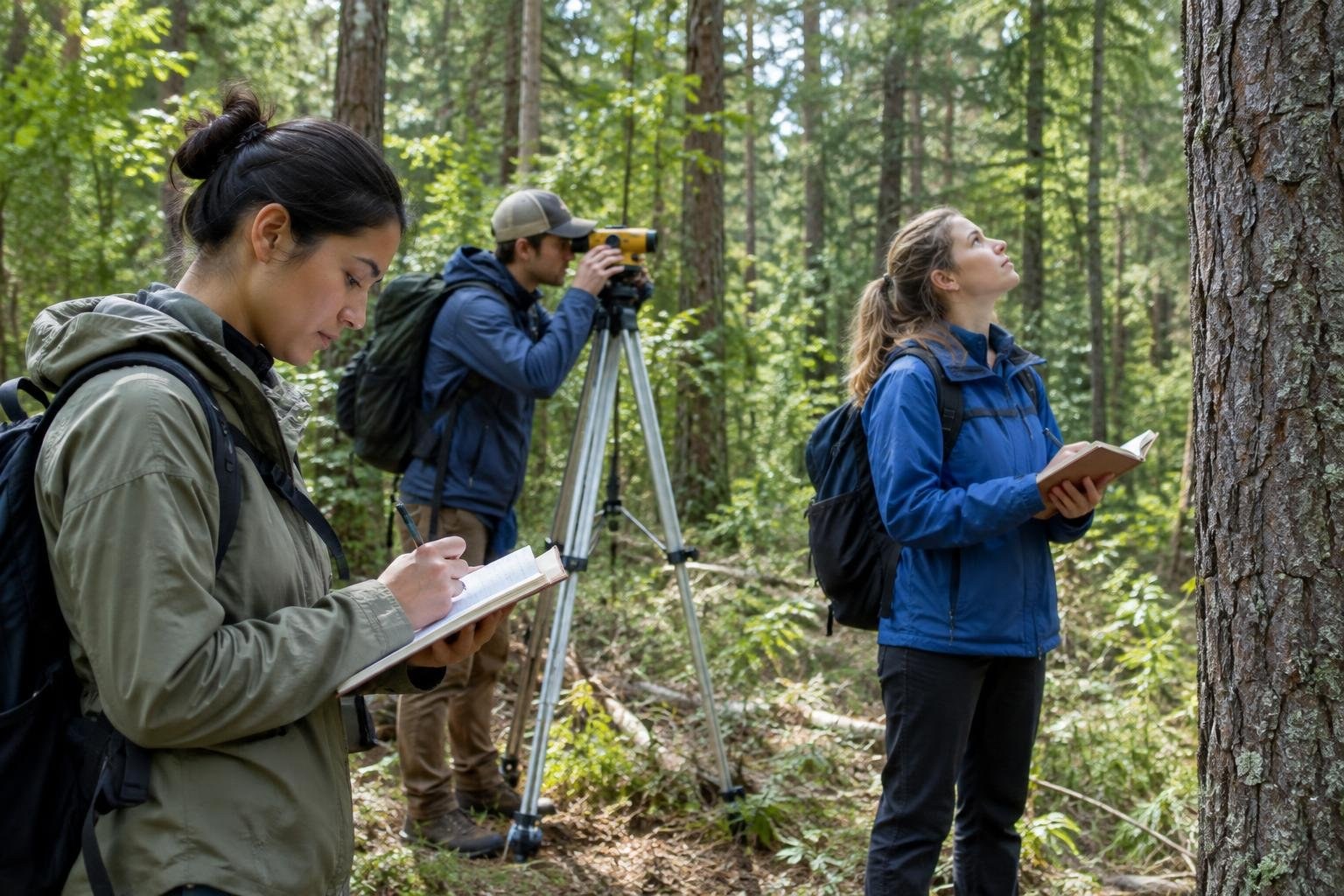
Ask whether the curriculum includes field exercises, laboratories, research, internships, or a capstone. Forestry colleges describe hands-on learning as part of their academic offerings, but the format and availability are school-specific. Find out whether experiences are required, how students secure placements, and whether travel or equipment creates extra costs.
Programs may balance general learning and professional coursework differently. The Monticello natural resources major, for example, describes a balance of general and professional coursework and identifies separate forestry and wildlife-management options. Treat this as an illustration, not a template every college follows.
Skills You Can Develop
Coursework in forestry can help students build subject knowledge in forest resources, ecology, silviculture, wildlife, and conservation. The skills most relevant to a student’s career plan depend on the courses, projects, and experience they complete. A degree title by itself does not show proficiency in particular methods or software.
When assessing a program, ask how students practice applying what they learn. Look for project work, field activities, research opportunities, and chances to communicate findings or management recommendations. These experiences can help a student demonstrate readiness for a role, but the program should be able to explain what is offered and whether participation is guaranteed.
For each prospective job, read several current employer postings and note recurring qualifications. Use that list to check whether the degree provides relevant coursework and whether you may need additional experience, a credential, or graduate study. This makes skill planning more specific than relying on a generic list of “forestry skills.”
Who Is a Forestry Degree Best For?
Forestry may be worth exploring if you are interested in forests, natural resources, conservation, land management, or how people make decisions about forest use. Programs can include both broad academic learning and professional coursework, and some colleges highlight practical learning. That mix may appeal to students who want to connect classroom study with resource-management questions.
You do not need to arrive with a fixed career plan. But it helps to ask yourself what draws you to the field: working with natural systems, learning about forest management, studying wildlife, or preparing for conservation work. Also consider whether you prefer field-based, research-oriented, or policy-related work. A college adviser can help map those interests to actual course options.
Does Forestry Match You?
Salary, job growth, and a school’s reputation are only part of a decision. A program should also match your interests, preferred learning environment, and willingness to complete its academic and practical requirements. Use the Free MAPP Career Assessment to reflect on motivations and preferences, then compare its results with Degree Matching and Career Matching options. Treat assessment results as a prompt for further research, not as a guarantee that a particular career or major will suit you.
Admissions and Preparation
Admission standards are set by each college and can differ between undergraduate, certificate, and graduate programs. Before applying, check the current admissions page for prerequisites, application materials, deadlines, and any required academic background. Do not assume that a requirement at one forestry school applies at another.
Ask how the program evaluates transfer coursework and whether prior learning can count toward the degree. If you are considering graduate study, confirm the expected undergraduate preparation with the specific department. A graduate forestry certificate designed for working professionals may have a different purpose and admissions process from an undergraduate major.
Students should prepare by reviewing the degree plan, identifying any science or math courses they may need, and discussing concerns with an adviser. Request an official transfer evaluation before relying on an estimate of how many credits will apply.
Credential Levels, Formats, and Time to Finish
Forestry education is available at several credential levels. The sources consulted describe programs at certificate, associate, bachelor’s, and master’s levels, as well as graduate certificates and doctoral study. One forest-resources department lists a Master of Forest Resources, a Master of Science, and a PhD. These credentials serve different purposes, so confirm what each one prepares students to do.
Completion time is determined by credit requirements, course sequencing, attendance pattern, transfer credits, and whether the student studies full time. Ask each school for its typical timeline for your circumstances instead of assuming that a credential takes a fixed number of years.
Campus, hybrid, and online options exist across forestry education, but availability varies by program and level. An online silviculture graduate certificate, for example, uses online coursework, while forestry colleges also describe hands-on learning opportunities. Before enrolling online, ask how the program handles any fieldwork, labs, or applied activities relevant to your goals.
Sources describing forestry formats and credentials include the Colorado State University online silviculture certificate, the forestry program overview, and Oregon State University College of Forestry academics.
Tuition, Total Cost, and Financial Aid
There is no single cost for a forestry degree. Your total depends on the school, credential, residency classification, study format, transfer credits, fees, and how long you take to complete the program. Include books, supplies, equipment, field activities, travel, housing, and other living expenses where applicable. Ask the college for a complete estimate covering the whole program, not just one term’s tuition.
Compare net cost after grants and scholarships, not only the advertised tuition rate. Ask the financial-aid office about grants, scholarships, loans, work opportunities, and payment arrangements for which you may be eligible. Adult learners can also check whether an employer offers education assistance, but should verify coverage and any conditions directly.
Potential ways to manage cost include comparing public and private options, asking how transfer credits affect the time to completion, and considering a suitable lower-cost starting credential only after checking whether credits transfer to a later program. A less expensive route is not a saving if credits do not apply to your intended degree.
Request written answers about tuition, mandatory fees, field expenses, financial aid, refund policies, and transferability before making a commitment. These figures and policies can change, so use current estimates from the institution.
Careers, Jobs, and Employment Outlook
A forestry degree can connect to conservation, wildlife management, agriculture, natural resources, environmental science, and forest-resource management. One program source also describes two-year associate degrees as a route toward forestry technician positions. These are examples of directions to investigate, not promises of employment or a complete list of job requirements.
| Career direction | Education to investigate | How forestry study may apply | Pay and outlook research |
|---|---|---|---|
| Forestry technician | Associate degree or relevant credential may be a starting point; check each employer’s requirements. | Applied forestry and natural-resource coursework may be relevant. | Compare current local and national data for the precise job title. |
| Forest-resource management | Review bachelor’s-level program preparation and employer expectations. | Forest ecology and silviculture appear in some forest-resources curricula. | Pay varies by position, location, experience, and employer. |
| Conservation or natural-resource work | Requirements depend on the role and hiring organization. | Forestry programs may provide a foundation in forest and resource management. | Check current occupational data and job postings. |
| Wildlife or land-management work | Compare forestry with programs offering a wildlife or natural-resource option. | Some curricula include wildlife or wildlife-management study. | Verify the qualifications and pay range for the specific occupation. |
| Research or teaching | Graduate education may be relevant; confirm requirements for each position. | Graduate forest-resources programs include research-oriented options such as an MS or PhD. | Use occupation-specific, current sources rather than degree averages. |
Salary and employment outlook are properties of occupations and labor markets, not of a degree in isolation. Research job titles that match your goals using current U.S. Bureau of Labor Statistics and O*NET information, and check the date, geography, and occupational definition behind any figure. The supplied forestry-program information does not establish a salary or job-growth estimate, so do not treat a degree-level average as a reliable forecast.
Job duties and hiring needs can change as employers adopt new tools and methods. Rather than assuming technology will eliminate or create a particular role, ask programs how students learn current technical methods and how they keep course content relevant to employers.
Find out which Career or College Major is right for you!
Take the MAPP free today!Accreditation, Certification, and Licensure
Before enrolling, verify whether a program’s accreditation claim applies to the specific degree you intend to earn. Accreditation is not interchangeable with a college’s general reputation or an individual course’s quality. Confirm current status and scope directly with the institution and accrediting organization.
Do not assume that earning a forestry degree automatically grants a professional license or certification. Requirements can depend on the occupation, state, employer, and credential. Ask the program whether graduates commonly pursue a relevant certification, what preparation is included, and whether the credential is required for your target job. Verify rules with the organization or agency responsible for the specific credential.
Ask for details in writing if a program advertises certification preparation, professional recognition, or eligibility for a regulated role. Check that the claim applies to the location where you expect to work.
Related Degrees and Alternative Pathways
Compare forestry with related programs based on the questions you want to study and the work you hope to pursue. Program labels are not standardized enough to replace a course-by-course review.
- Environmental science: Consider this if you want to investigate environmental systems beyond forests; compare required courses and career preparation.
- Wildlife management and conservation: Consider this if wildlife is your main focus. Some natural-resource programs offer a distinct wildlife-management option.
- Natural-resource management: Consider this if you want a broader resource-management framework rather than a forestry-centered curriculum.
- Fisheries or water-resource study: Consider this if aquatic systems are a closer match to your interests than forest management.
- Forestry technician or associate pathway: Consider this if you want to investigate a shorter, applied route before committing to a bachelor’s degree.
- Graduate forest resources: Consider an MFR, MS, or PhD if you have a defined advanced or research goal and have confirmed the preparation those roles require.
For a fair comparison, examine the required courses, field learning, transfer arrangements, time to completion, and the types of entry-level jobs graduates seek. Do not assume that a program with a broader title will automatically qualify you for every related occupation.
Experience, Projects, and Preparing for Employment
Internships, field projects, research, volunteering, and relevant work can help you test your interests and explain your preparation to employers. Availability is not guaranteed by a program’s existence, so ask what placements are offered, whether they are paid, how students apply, and whether they fit into the academic schedule.
Build a record of completed work: describe the question or task, your contribution, methods learned, and outcome. Keep examples of reports, presentations, or project work that you are permitted to share. Join relevant student or professional organizations if they provide useful learning or connections, and ask faculty about research or field opportunities.
How to Stand Out to Employers
Start with job postings for roles you want. Identify recurring education and experience requirements, then plan coursework and practical experience around them. Be ready to discuss specific projects and what you learned instead of relying only on the degree name. If a position calls for a license or certification, verify the requirement and plan for it separately from degree completion.
Graduate School Options
Graduate study may be useful for a student seeking advanced forest-resource preparation, research, or academic work, but it is not automatically the best next step. Clemson’s forest-resources program lists a Master of Forest Resources, a Master of Science, and a PhD. These are distinct routes, and the purpose, research expectations, admissions standards, and funding options must be checked with the department.
Before applying, identify the role or capability you want graduate school to support. Ask prospective departments about prerequisites, advisor fit, research opportunities, total cost, funding, and the outcomes graduates pursue. Compare this with gaining work experience or a specialized certificate. The right choice depends on the goal, not simply on the availability of another credential.
Advantages, Drawbacks, and Is a Forestry Degree Worth It?
Forestry can be a worthwhile investment when the curriculum, cost, practical experience, and career preparation align with your goals. Potential benefits include studying forest resources through a dedicated program and choosing among multiple credential levels. Some colleges also offer hands-on learning, while certificate and online options may suit learners seeking focused study.
Tradeoffs include the time and cost of education, variation between programs, and the fact that a degree does not guarantee a job or salary. Some intended careers may require additional experience or education. A program with an appealing title may not offer the courses, field access, or transfer path you need.
To judge value, estimate total out-of-pocket cost, compare financial-aid offers, identify realistic entry-level roles, and check what those employers ask for. Consider location, format, and whether you enjoy the subjects and work settings the program prepares you to explore. There is no universal return on investment for every student.
How to Choose the Right Forestry Program
Compare colleges using evidence you can verify, not a program’s marketing language alone. Use this checklist:
- Is the specific program accredited, and can you confirm the accreditor and current status?
- Which courses are required, and what concentrations or electives are available?
- How much field, laboratory, research, or internship learning is included?
- What is the full estimated cost, including fees and practical-learning expenses?
- Can the school explain transfer credit and expected completion time for your circumstances?
- Does the online or hybrid format include any required in-person activities?
- What career services, employer connections, or placement support can the school document?
- What jobs do graduates pursue, and how does the school define and measure outcomes?
- Does the curriculum prepare you for any certification or licensure requirements relevant to your intended work?
- What financial aid, scholarships, and payment options may apply to you?
Ask for answers from the relevant department and offices, then compare them side by side. Assessment.com’s education-matching tools can help you explore degree and career directions; use them as a starting point for checking program details with colleges.
From Degree to Career: Realistic Pathways and Next Steps
Career paths are not guaranteed ladders, but planning can clarify the next decision. Possible examples include:
- Associate degree or relevant certificate → forestry technician role to investigate → build experience and applied skills → pursue a specialized role or further education if it supports your goal.
- Bachelor’s in forest resources → entry-level forest or natural-resource position to investigate → gain field or project experience → consider a management, conservation, or specialized pathway.
- Bachelor’s degree → graduate forest-resources study → research or academic roles to investigate → develop expertise in a defined topic.
These examples are starting points, not promised outcomes. Confirm entry requirements with employers and graduate departments. A student’s experience, location, coursework, and hiring conditions all affect the options available.
Questions to Ask Before Enrolling
- What is the total cost after my expected aid?
- Which credits will transfer, and can I get that evaluation in writing?
- What field or internship opportunities are guaranteed, optional, or self-arranged?
- What accreditation or professional preparation applies to this exact program?
- How will online students complete any practical requirements?
- What career support and graduate or employment outcomes can the school document?
- What are the likely next steps if I change my concentration or transfer?
Frequently asked questions
What is a Forestry, General degree?
A Forestry, General degree focuses on managing, conserving, and protecting forest resources. Depending on the program, students may study forest ecology, silviculture, wildlife, land management, and related natural-resource topics. The exact curriculum and balance of classroom, laboratory, and field learning vary by college.
How long does it take to earn a forestry degree?
It depends on the credential and the school. Forestry programs are offered at associate, bachelor’s, and graduate levels, while certificates and graduate certificates are also available. Ask each college for its credit requirements and expected completion time, especially if you plan to study part time or transfer credits.
Can I earn a forestry degree online?
Some forestry courses may be available online, and online certificates exist. However, a fully online option may not provide the same field experience as a campus or hybrid program. Check whether required fieldwork, labs, internships, or other in-person activities are part of the specific curriculum.
Does a forestry degree require a lot of math?
Forestry programs can include science and quantitative coursework, but the requirements differ by school and specialization. Review the course plan for subjects such as biology, ecology, statistics, or other sciences, and ask an adviser how much math and lab work the program requires before applying.
What jobs can I get with a forestry degree?
Possible directions include forest management, conservation, natural-resource work, and forestry technician roles. The job you qualify for depends on your credential, experience, the employer, and any role-specific requirements. A bachelor’s degree is not automatically required for every forestry-related position, and further study may help with some research or academic paths.
How much can you make with a forestry degree?
There is no single salary for a forestry degree. Pay depends on the occupation, location, employer, experience, and education level. Compare current wage information for the specific job titles you are considering rather than relying on a degree-wide salary estimate, and check whether the figures are national or local.
Do you need a graduate degree for a forestry career?
Not necessarily. Some forestry careers may be accessible with an associate degree or relevant certificate, while research, teaching, or specialized roles may call for graduate education. Check job postings and professional expectations in your intended field before deciding whether a master’s or doctorate is worth the additional time and cost.
What is the difference between forestry and environmental science?
Forestry and environmental science can overlap, but programs may emphasize different questions and methods. Forestry often focuses on forest resources and their management; environmental science can take a broader approach to environmental systems and problems. Compare required courses and the jobs each program prepares students to pursue.
People Also Ask
What does Forestry, General mean as a college major?
The Forestry, General field covers education focused on forests and related natural-resource management. Depending on the program, coursework may include forest ecology, silviculture, wildlife, and managing public or private lands. Colleges use different program names and course plans, so check the curriculum rather than relying on the title alone.
Is forestry a good major for conservation work?
Yes, forestry degrees can lead toward conservation and natural-resource work, and some programs prepare students for forest management. The available roles depend on the credential, experience, and employer expectations. Review job postings for the positions you want and compare those requirements with each program’s coursework and field opportunities.
Do forestry students work outdoors as part of their degree?
Forestry programs can include field learning, but the amount and structure vary by school. Some programs emphasize hands-on learning, while online coursework may require students to arrange or attend in-person activities. Ask whether field exercises, internships, or other practical experiences are required and how students complete them.
How can I pay for a forestry degree?
Potential funding sources include federal or state aid for eligible students, institutional scholarships, private scholarships, and employer assistance where available. Eligibility and award amounts vary. Before enrolling, request a full cost estimate from the college and compare aid offers, fees, books, field-related expenses, and any travel or housing costs.
How do I choose a forestry program?
Compare the actual course requirements, total cost, field and internship options, delivery format, and the program’s connection to your intended career. Verify any accreditation or professional preparation claims directly with the school and relevant accrediting or licensing organization. Ask for written details about transfer credit and student support before committing.
Are online forestry programs available?
Forestry programs may be offered on campus or online, and some schools offer both formats. An online program can be convenient, but convenience alone does not establish that it includes appropriate practical learning for your goals. Confirm how the program handles labs, field experience, internships, and any in-person requirements.
Forestry, General can be a practical path into work involving forests, conservation, and land management, but the best route depends on the kind of work you want and the credentials it requires. Compare actual curricula, field opportunities, total cost, and graduate outcomes, then consider whether the day-to-day work matches your interests. A degree can open pathways; it does not guarantee a particular job, salary, or career progression.
Want to see your options? Try our comprehensive Degree, Program & College Search tool
College Search ToolSources & Official Resources
- Online Forestry & Silviculture Graduate Certificate | CSU Online
- Forest Resources (MFR, MS, PHD)
- Forest Resources and Conservation | University of Florida Catalog
- Academics | College of Forestry - Oregon State University
- Forestry Degree Programs - Monticello
- Earn a two-year degree in Forestry, Wildlife, and Natural Resources