Court Reporting and Captioning: Programs, Skills, Careers, and How to Choose
Explore court reporting and captioning programs, the work reporters and captioners do, common training considerations, costs to investigate, and questions to ask before enrolling.
By Tome Fierre · Staff Writer Assessment.com · Published October 7, 2026 · Last updated November 5, 2026
Court reporting and captioning programs teach students to capture spoken words and produce accurate written records or captions. The field includes reporting on legal proceedings and providing simultaneous captions for broadcasts or events. Students considering this path should look closely at the practice involved, the technology a program uses, its credential and format, and the work settings it prepares them to explore. Program names and offerings differ by college, so compare the curriculum and outcomes rather than relying on the title alone.
Degree & Program Decision Insights
Explore your personal fit, education requirements, career potential and next steps.
01Motivational Fit
Discover whether this program fits you
Explore your preferences against the focus of Court Reporting and Captioning/Court Reporter. These prompts are not personal MAPP results.
Practical problem solving. Does learning equipment operation and procedures appeal to you, with patient practice and careful checks of the result?
Reasoning and public responsibility. Does studying legal terminology interest you enough to examine competing interpretations and explain a careful conclusion?
Work reality. Related work can involve this task: “Record depositions and other proceedings for attorneys.” Would you want that activity to be a regular responsibility?
Interest in studying a field can differ from enjoying its related work.
Which part would you want to do repeatedly, and what would you try before deciding?
Discover Your Personal Program Fit
Before investing your time and money in your education, discover how this program aligns with your natural motivations, work preferences and career goals.
Typical occupational entry: postsecondary nondegree award (BLS). BLS lists short-term on-the-job training as typical occupational training.
U.S. occupational wages are not guaranteed graduate earnings; OEWS excludes self-employed workers.
Projected openings include replacements as well as growth.
U.S. national estimates. A crosswalk does not establish entry-level eligibility; advanced, management and teaching roles can require further qualifications.
Medical Transcription/TranscriptionistCIP 51.0708. Compare its emphasis on dictation and simultaneous recording and analysis of notes and visual evidence with this program’s focus.
Court InterpreterCIP 22.0304. Compare its emphasis on courtroom standards and procedures and court interpreting with this program’s focus.
Explore your motivations. Use MAPP as a starting point for reflecting on your interest in “legal terminology”, then test that interest against a sample learning task.
Compare actual providers. Ask for the exact credential, course sequence and assessment methods. Compare how each provider teaches “legal transcription”, its entry criteria and its itemized costs.
Check the evidence before applying. Confirm prerequisites and any recognition or professional requirements for your intended route; ask for applicable rules and published outcome definitions in writing.
Verify the institution’s current offering, admissions requirements and outcomes; a search result does not establish your eligibility.
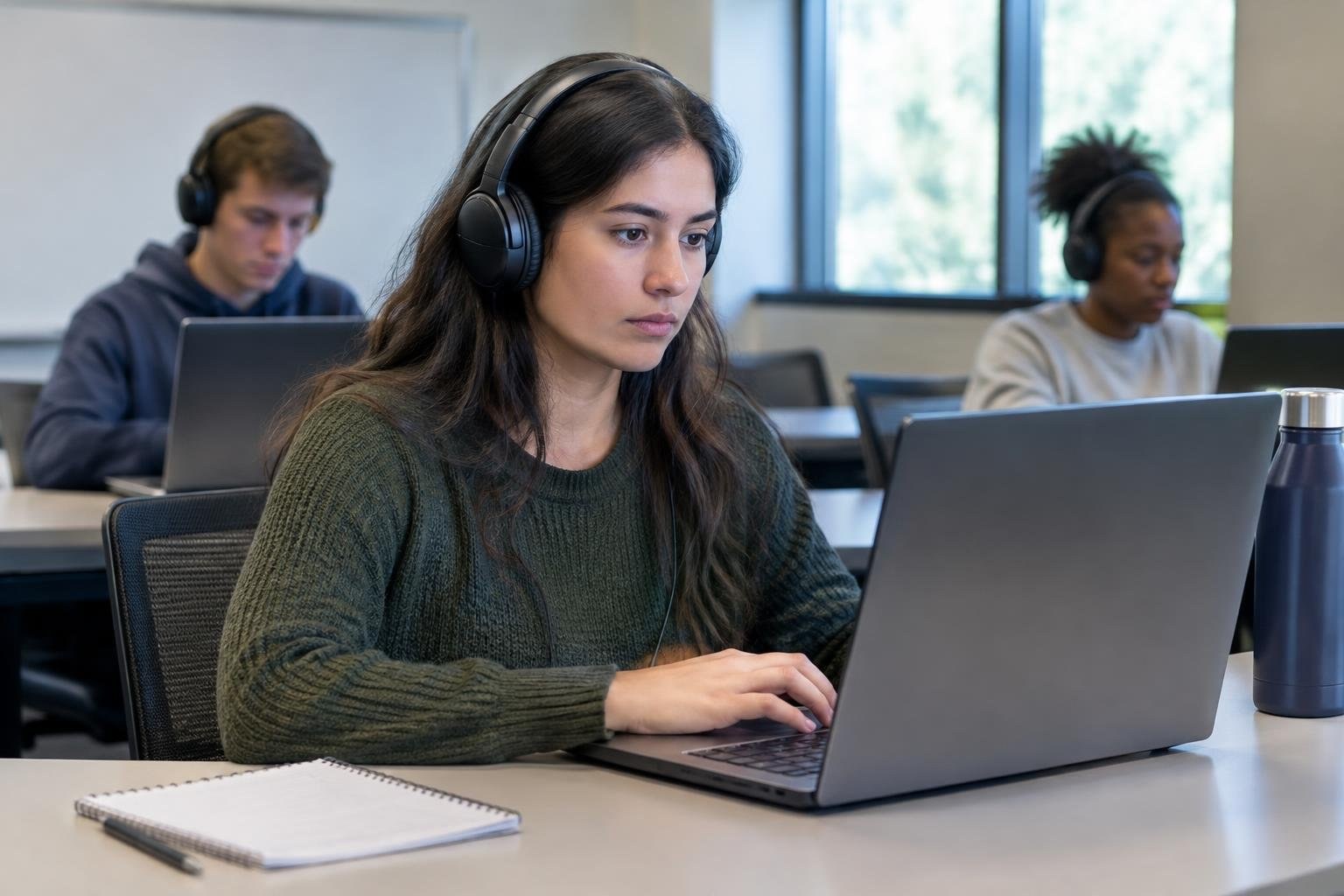
A college student practicing transcription skills in a classroom or lab
What Is Court Reporting and Captioning?
Court reporting and captioning is a field focused on capturing spoken words and producing a written record or captions. Court reporters create word-for-word transcripts at trials, depositions, and other legal proceedings. Simultaneous captioners provide similar transcription for television and presentations, such as press conferences.
The work is not limited to a single setting or tool. The U.S. Bureau of Labor Statistics describes both courtroom and captioning work, while O*NET includes court reporters and simultaneous captioners in the same occupational profile. Federal court guidance discusses court reporting and electronic sound recording as methods used to keep the record. These descriptions are useful context, but they do not mean every college program teaches every method or prepares students for every setting.
Programs may use titles such as court reporting, court reporting and captioning, or court reporter. Read the course list and credential description to understand what a particular college means by its program name.
What Students Learn
Training is intended to build the ability to capture speech and produce an accurate record. O*NET describes the occupation in terms of methods and equipment used to capture, store, retrieve, and transcribe proceedings or other information. That makes hands-on practice an important point to investigate when comparing programs.
Ask each college to explain how students learn the work, not just which subjects appear in the catalog. Useful questions include:
What equipment, software, or other tools do students practice with?
How do instructors give feedback on accuracy and skill development?
Does practice focus on legal proceedings, live or recorded captioning, or both?
Are students expected to complete supervised practice, projects, or other applied work?
How does the program assess whether students can produce a clear and dependable record?
Course names and hands-on requirements vary. A program description or old curriculum document should not substitute for the current catalog and a direct conversation with an adviser. Ask for a sample course sequence and the current requirements for graduation.
Who May Enjoy This Program, and What Are the Entry Requirements?
This field may appeal to students who like focused listening, careful language work, and using technology to create a reliable record. It can involve sustained attention to speech and the responsibility of accurately capturing what is said. You do not need to arrive knowing the equipment, but you should be willing to practice and ask for feedback.
There is no single personality profile that determines who will succeed. Consider whether you enjoy detailed work, can stay engaged with spoken information, and feel interested in learning a specialized process. If you are unsure, ask a program whether prospective students can observe a class, attend an information session, or try an introductory exercise.
Admissions requirements are set by individual colleges. Before applying, confirm prerequisites, application materials, placement or assessment steps, and any technology expectations. Ask whether prior coursework can transfer and whether applicants need access to particular equipment or software. Do not assume that the same entry rules apply at every institution.
Parents and counselors can help by looking beyond program names. Review the catalog with the student, discuss whether the practice demands sound engaging, and compare the program’s stated requirements with the student’s schedule, resources, and longer-term goals.
Credentials, Format, and Time to Completion
Court reporting and captioning may be offered through different program structures. The credential and course sequence are specific to the college, so check whether the option is a certificate, associate degree, or another award. Do not infer the credential from a program’s marketing name.
Completion time depends on the credential, course load, schedule, and the student’s prior learning. Ask for a term-by-term plan showing the courses required and the expected pace for both full-time and part-time study. If you plan to transfer credits, get a written evaluation before relying on them to shorten the program.
Online, hybrid, and campus options also vary. A remote class does not necessarily mean every part of the training can be completed remotely. Ask whether equipment practice, assessments, or other activities require campus attendance, and how students obtain technical support. The college’s current catalog and program adviser are the best sources for these details.
Tuition, Other Costs, and Financial Aid
Compare the full cost of attendance for the specific program and enrollment plan you are considering. Ask the college for current tuition and required fees, then check whether books, equipment, software, and other course materials are additional expenses. For online study, ask whether students must purchase or maintain particular technology.
Request an estimate based on your residency status, course load, and expected completion schedule. A tuition figure without fees or required materials may not show the full amount you will need. Also ask whether costs can change if you take longer than the standard schedule.
Contact the financial-aid office before making a deposit. Ask which grants, scholarships, loans, work-study options, or payment plans may apply to your situation, and whether aid is available for the credential you want. If you are already employed, find out whether your employer offers education assistance. Transferable credits may help avoid repeating coursework, but confirm acceptance in writing before building a budget around them.
Compare net cost, not only the published price. Keep estimates and aid terms together so you can weigh programs using the same assumptions.
Careers, Work Settings, and Employment Questions
Two clearly described occupational directions are court reporting and simultaneous captioning. Court reporters create word-for-word transcripts of trials, depositions, and other legal proceedings. Simultaneous captioners provide transcription for television or presentations and other settings. These roles share an emphasis on capturing spoken information, but their work environments can differ.
Career direction
Work described in occupational sources
What to ask a program
Court reporter
Creating a word-for-word transcript of trials, depositions, and other legal proceedings.
Does training address reporting in legal proceedings, and what practice or employer connections can the college describe?
Simultaneous captioner
Providing transcription for television, presentations, or other events.
Does the curriculum include captioning practice and instruction relevant to the settings you are considering?
Federal court guidance addresses the use of court reporting and electronic sound recording methods in keeping the record. A separate judiciary guide outlines responsibilities of the court reporter and the court. This is a reminder to distinguish a career description from a particular employer’s process or position requirements.
For current salary and employment outlook information, consult the latest occupational data and confirm that the occupation and location are relevant to your plans. Pay and hiring prospects can depend on the job, employer, location, and experience. Do not treat a program’s general career list as a promise of a particular salary or job.
As you research, compare job postings in the areas where you may want to work. Record the stated education, skills, tools, and experience, then ask program staff how students develop the abilities employers request. Technology is part of the occupational picture: O*NET describes the use of equipment to capture, store, retrieve, and transcribe information. Ask how a program teaches students to work with its tools and maintain accuracy.
Accreditation, Professional Requirements, and Credentials
Do not assume that a program’s completion certificate automatically satisfies every employer, professional association, or jurisdiction. Ask the college what the credential represents and whether it prepares students for any exams or other requirements relevant to their intended work. If a job posting or local authority lists a specific requirement, confirm it directly with that organization.
For work connected with federal courts, consult official federal court reporting guidance rather than relying on a college summary alone. The guidance discusses court reporting and electronic sound recording methods used to keep the federal record, while the judiciary guide addresses responsibilities of the court and reporter. Those materials describe federal court practice; they should not be read as universal rules for every employer or location.
Verify institutional accreditation through the appropriate recognized accrediting body, and ask how credits or credentials transfer to other colleges. Request written answers about program approval, any certification preparation, and the outcomes the institution can substantiate.
How to Choose a Court Reporting Program
Compare programs using evidence you can verify. A strong fit is not simply the nearest option or the one with the most appealing title. Use the following questions to structure campus visits and conversations with advisers:
Credential: What award will you earn, and what courses are required?
Curriculum: How much instruction and practice addresses reporting, captioning, or both?
Tools: What equipment and software will you learn to use, and are there additional costs?
Teaching and feedback: How is student work evaluated, and how can students get help when they struggle?
Experience: Are there applied projects, observations, or other opportunities to connect study with the work?
Format: Which activities require in-person attendance, and how does online instruction work?
Cost: What is the estimated total for your schedule, including fees and materials?
Outcomes: What completion and career information can the college provide, and how is it defined?
Transfer: Will other institutions accept the credits or credential? Confirm with the receiving institution.
Career support: What advising, job-search support, or employer connections are available?
Ask for current documentation instead of relying on verbal assurances. A school profile for a particular college can offer context, but compare it with the institution’s own catalog and recent information. Assessment.com’s education and career matching tools can help you reflect on fit alongside these practical checks.
Related Degrees, Pathways, and Alternatives
Compare court reporting and captioning with other programs by the daily work they prepare you to do, rather than assuming that similar names lead to interchangeable careers. If your main interest is producing accurate transcripts from spoken proceedings, look for training that clearly explains its practice focus and equipment. If you are more interested in the legal process, research other legal-support or legal-studies programs and compare their course plans and occupational outcomes separately.
Consider these broad alternatives as starting points for research, not as equivalent credentials:
Legal studies: Explore this if your interest is understanding legal systems and concepts more broadly than capturing speech.
Paralegal studies: Consider this if you are more interested in supporting legal work through research, documents, or case organization.
Medical transcription or documentation: Investigate this if your interest is transcription in a health-care context; verify the curriculum and current job requirements.
Communications or media studies: Consider this if your primary interest is broadcast or event production rather than creating captions as a specialized skill.
General office or administrative training: Explore this if you want broader workplace preparation and are still deciding on a specialized occupation.
These are comparison prompts, not claims that the programs share the same curriculum or employment outcomes. Review official program information and job descriptions before choosing a direction.
Common Mistakes to Avoid
Choosing by title alone. Similar program names can describe different credentials or emphasis. Compare required courses and hands-on practice.
Assuming online means fully remote. Ask which activities require campus access, equipment, or scheduled participation before enrolling.
Budgeting only for tuition. Check fees, books, tools, software, and technology requirements as well as tuition.
Treating a credential as a job guarantee. A college’s program description is not a promise of employment, pay, or eligibility for every role. Compare current job postings and ask for clearly defined outcomes.
Skipping a fit check. The work involves turning spoken information into a dependable record. If that kind of detailed listening does not interest you, compare other pathways before committing time and money.
Questions to Ask Before Enrolling
What credential does the program award, and what are the graduation requirements?
What is the estimated total cost for my enrollment plan, including fees and equipment?
How much practice is included, and how is accuracy assessed?
Does the curriculum address the work setting I want to explore?
Which activities are online, on campus, or scheduled in person?
What transfer-credit decisions can the college make in writing?
What information is available about completion, employment, and how those outcomes are measured?
What support is available for financial aid, career planning, and job searches?
Are there certification, employer, or jurisdiction-specific requirements I should verify independently?
Take notes and ask the same questions at each college. If a response affects your budget, completion plan, or job eligibility, request a written answer and confirm it with the responsible office or organization.
Frequently asked questions
What does a court reporting and captioning program teach?
Court reporting and captioning programs prepare students to capture spoken proceedings or events and produce accurate written records or captions. Training can involve specialized equipment and repeated skills practice. Course offerings, credentials, formats, and program requirements vary, so review each college’s current catalog and ask how its training relates to the roles you want to pursue.
Is court reporting a good career for me?
The work can suit people who enjoy focused listening, precise language, sustained concentration, and learning specialized technology. Those qualities are helpful interests, not a formal personality test or guarantee of success. Before enrolling, try a beginner lesson or demonstration if available, and ask programs how students practice accuracy and build speed over time.
Can you study court reporting online?
Some colleges offer court reporting and captioning training, but delivery formats and in-person requirements differ. Ask whether equipment practice, assessments, or other parts of the program must be completed on campus. Also ask how online students access the required software or tools and whether the program’s format fits your schedule and learning preferences.
How long does it take to become a court reporter?
There is no single completion time that applies to every court reporting and captioning program. The credential, course load, prior credits, and program schedule affect how long an individual path takes. Ask colleges for a written sequence showing required courses, the typical pace for part-time and full-time students, and any prerequisites.
What is the difference between a court reporter and a captioner?
Court reporters create word-for-word transcripts of proceedings such as trials and depositions. Simultaneous captioners provide similar transcription for broadcasts and events such as presentations. The work settings and equipment can differ, so compare role descriptions and ask programs which kinds of practice and career preparation they provide.
How much does court reporting school cost?
Tuition depends on the institution and the particular program. Compare the full estimated cost, not just tuition: ask about fees, books, required equipment or software, and whether costs change by delivery format. Request current financial-aid information and ask how transfer credits, scholarships, grants, or employer assistance could affect your own total.
People Also Ask
What does a court reporter do?
Court reporters capture and transcribe proceedings such as trials and depositions. Simultaneous captioners produce captions for broadcasts and events, including presentations. Both roles require careful attention to spoken language, but the settings and work processes may differ. Review occupational descriptions and program course plans to understand which work a course of study emphasizes.
What skills do court reporters need?
The relevant skills include accurate listening, careful transcription, concentration, and the ability to use specialized reporting or captioning equipment. The exact tools and training differ by program and job setting. Ask colleges what equipment students use and how often they practice converting speech into a reliable written record or captions.
What degree do you need for court reporting?
Court reporting and captioning can be taught through different credential types and program formats. The supplied college examples include a court reporting and captioning program, while program offerings can vary by institution. Confirm the credential awarded, course sequence, and delivery format directly with each college before applying.
Where can court reporters and captioners work?
Court reporters may work at trials, depositions, and other legal proceedings. Simultaneous captioners may provide captions for television, presentations, and other settings. Compare the responsibilities and typical environments described for each role before choosing a program focus.
How do I choose a court reporting program?
Ask whether the curriculum includes structured practice with the equipment and methods used for reporting or captioning. Find out what credential the program awards, what is included in the total cost, whether courses are available online or on campus, and what information the college can share about student outcomes and career preparation.
Is court reporting the same as captioning?
Court reporting creates a word-for-word record of proceedings, while simultaneous captioning provides text for broadcasts or live events. The skills overlap, but the setting and timing of the work can differ. Program applicants should ask whether a course emphasizes legal proceedings, broadcast captioning, other events, or a combination.
Court reporting and captioning combines language accuracy, concentration, specialized technology, and the responsibility of creating a dependable record. It may appeal to students who enjoy precise listening and structured work, but the right education path depends on the skills they want to build, the roles they are considering, and the requirements of employers or jurisdictions they may pursue. Compare programs carefully, ask for clear information about cost and outcomes, and consider whether the day-to-day work matches your preferences.
Find out which Career or College Major is right for you!
We use cookies to offer you a better browsing experience, analyze site traffic and personalize content.
Read about how we use cookies and how you can control them in our
Privacy Policy.
If you continue to use this site, you consent to our use of cookies.
×
Exciting News!
Be one of the first to Beta Test the new AI-Powered Assessment.com Platform.