Tropical Medicine Degree Guide: Programs, Careers, Costs, and Fit
Explore what tropical medicine programs teach, who they suit, typical study formats, career directions, costs to compare, and questions to ask before enrolling.
By David Slack · Staff Writer Assessment.com · Published October 25, 2026 · Last updated November 5, 2026
Tropical medicine is the study and practice of preventing, diagnosing, and controlling infectious diseases that are especially important in tropical and subtropical settings, as well as related health concerns such as travel-associated illness. Programs can connect microbiology, parasites, viruses, vectors, epidemiology, laboratory diagnosis, and clinical or public health work. The name can refer to several different educational routes, from a focused graduate certificate to a master’s or doctoral program. Many options are designed for people who already have college, health-profession, or research experience, so prospective students should check entry rules rather than assume it is an undergraduate major at every school. Graduates and trained professionals may pursue research, teaching, health policy, global health, or clinical and travel-health work, depending on their prior qualifications and the role. Not sure whether tropical medicine fits you? Take the Free MAPP Career Assessment to explore how your motivations and interests may align with related careers and education options.
Degree & Program Decision Insights
Explore your personal fit, education requirements, career potential and next steps.
01Motivational Fit
Discover whether this program fits you
Explore your preferences against the focus of Tropical Medicine. These prompts are not personal MAPP results.
Scientific investigation. Would you enjoy investigating microbiology and explaining your conclusions from evidence?
Breadth of interest. Consider the place of “parasitology” in this field. Is this another part you would choose to explore, or mainly a requirement you would tolerate?
Work reality. Related work can involve this task: “Plan and direct studies to investigate human or animal disease, preventive methods, and treatments for disease.” Would you want that activity to be a regular responsibility?
Interest in studying a field can differ from enjoying its related work.
Which part would you want to do repeatedly, and what would you try before deciding?
Discover Your Personal Program Fit
Before investing your time and money in your education, discover how this program aligns with your natural motivations, work preferences and career goals.
Explore these official instructional-field associations. They describe possible occupational routes, not measured outcomes of this program.
Medical Scientists, Except EpidemiologistsSOC 19-1042 · O*NET 19-1042.00$103,410/year median (May 2025); +12.6% projected change (2025–2035); 10,500 projected openings/year.
Typical occupational entry: doctoral or professional degree (BLS).
Health Specialties Teachers, PostsecondarySOC 25-1071 · O*NET 25-1071.00$107,310/year median (May 2025); +17.9% projected change (2025–2035); 24,900 projected openings/year.
Typical occupational entry: doctoral or professional degree (BLS). BLS lists less than 5 years of related work experience as typical for this occupation; this programme is not a direct promise of entry. Postsecondary teaching is a separate appointment and may require advanced study; this programme alone is not a promise of a teaching post.
U.S. occupational wages are not guaranteed graduate earnings; OEWS excludes self-employed workers.
Projected openings include replacements as well as growth.
U.S. national estimates. A crosswalk does not establish entry-level eligibility; advanced, management and teaching roles can require further qualifications.
Compare the focus and route of these distinct instructional fields; their credentials and admission requirements are not interchangeable.
Clinical and Translational ScienceCIP 51.1402. Compare its emphasis on bioinformatics and Information technology with this program’s focus.
Medical Science/ScientistCIP 51.1401. An undifferentiated clinical science program that prepares clinicians to conduct clinical and translational research in various areas.
Explore your motivations. Use MAPP as a starting point for reflecting on your interest in “microbiology”, then test that interest against a sample learning task.
Examine the work. Compare Medical Scientists, Except Epidemiologists and Health Specialties Teachers, Postsecondary on daily work and entry qualifications, as well as pay. Explore Medical Scientists, Except Epidemiologists.
Compare actual providers. Ask for the exact credential, course sequence and assessment methods. Compare how each provider teaches “parasitology”, its entry criteria and its itemized costs.
Check the evidence before applying. Confirm prerequisites and any recognition or professional requirements for your intended route; ask for applicable rules and published outcome definitions in writing.
Verify the institution’s current offering, admissions requirements and outcomes; a search result does not establish your eligibility.
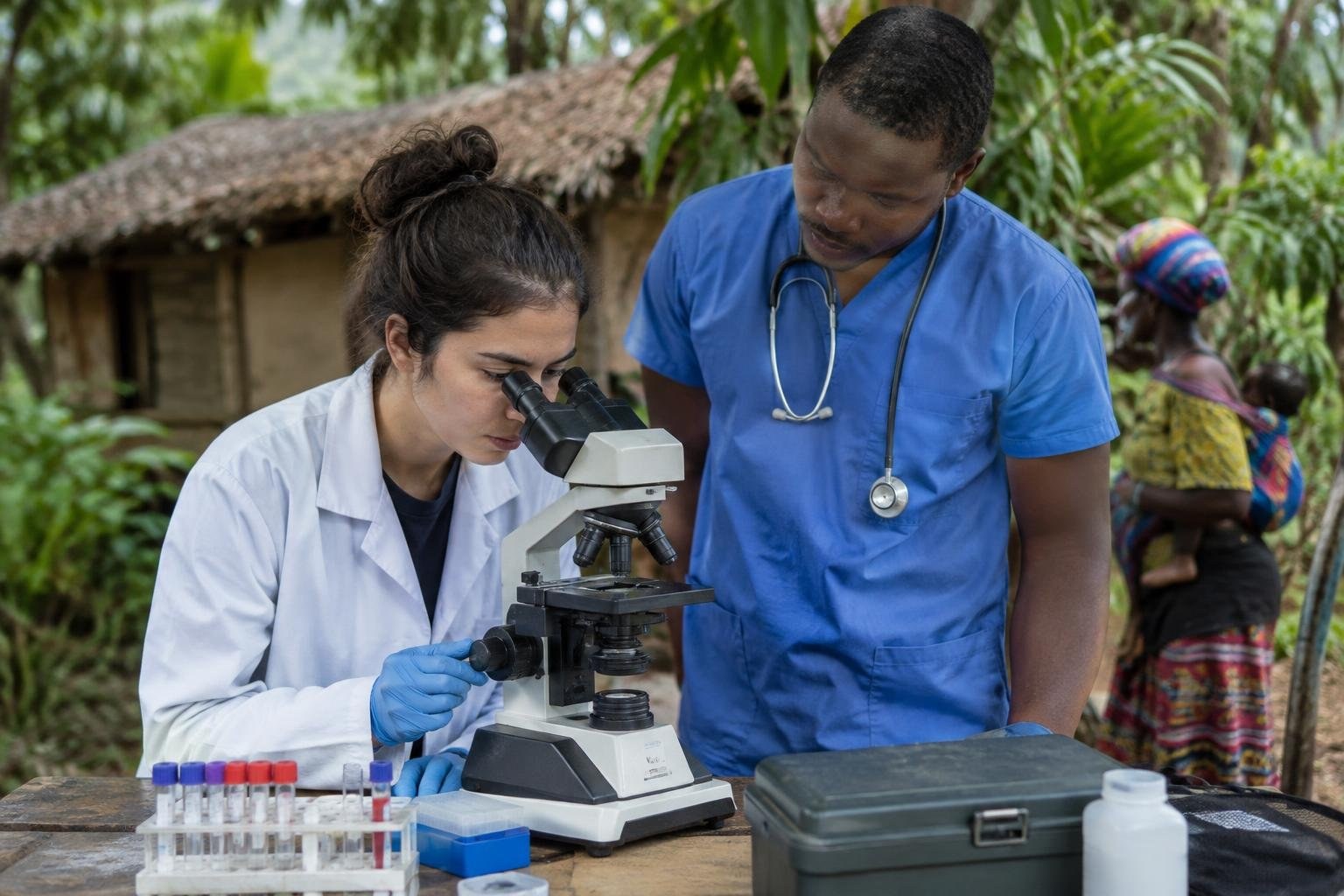
A learning environment illustrating the relationship between infectious disease study and global health
What Is a Tropical Medicine Degree?
Tropical medicine is an interdisciplinary area focused on infectious diseases and health problems associated with tropical settings and travel. Depending on the program, training may connect disease biology with prevention, diagnosis, clinical care, research, or public health practice. The academic field includes topics such as microbiology, parasitology, mycology, virology, vector biology, vaccinology, laboratory diagnosis, travelers’ health, epidemiology, and disease management.
It is not one standardized degree title. A school might offer a graduate certificate, a master’s or doctoral program, or advanced training for clinicians. The University of Hawaiʻi at Mānoa, for example, describes MS, PhD, and graduate certificate offerings in tropical medicine. Johns Hopkins describes a certificate with a multidisciplinary approach to tropical medicine and related public health issues. Those examples show why students should compare the actual curriculum and credential, not just the subject name.
Tropical medicine overlaps with infectious disease, microbiology, epidemiology, and global health, but each has a different emphasis. A tropical medicine curriculum may bring several of these lenses together around diseases, vectors, travelers’ health, and disease management. Use the University of Hawaiʻi at Mānoa program overview and the Johns Hopkins certificate catalog entry to see examples of how institutions describe their programs.
What Do You Study in Tropical Medicine?
Coursework depends on credential level and institutional focus, but students may encounter several connected areas:
Infectious disease foundations: Microbiology, parasitology, mycology, and virology build understanding of pathogens and the illnesses they cause.
Vectors and prevention: Vector biology and vaccinology address how some diseases spread and how prevention strategies are studied.
Diagnosis and disease management: Laboratory diagnosis and disease management connect scientific knowledge with identifying and responding to health problems.
Population and travel health: Epidemiology and travelers’ health examine patterns of illness and health questions related to travel and place.
Some programs add research or translational work. Hawaiʻi describes students conducting clinical and translational research on infectious diseases, with an Asia-Pacific focus. The precise balance between laboratory science, clinical work, public health, and research is not uniform. Before applying, examine required courses and ask whether the program includes supervised research, practical training, a capstone, or other applied work. Do not assume a component is included because it is common in another school’s program.
The Johns Hopkins certificate catalog describes a multidisciplinary approach and preparation for work with current and emerging health problems. That description is useful as an example, not a guarantee that every program has the same aims or learning activities.
Skills You Can Develop
Training can develop a combined skill set: scientific reading, attention to diagnostic detail, evidence-based reasoning, and the ability to connect disease questions with clinical or population-health contexts. Research-focused study may also involve planning or interpreting studies, while clinical or public-health-oriented work may call for clear communication across professional and community settings. The specific skills depend on program design and prior education.
For example, understanding microbiology and laboratory diagnosis supports scientific interpretation; epidemiology helps frame patterns of illness; and travelers’ health coursework can inform work in settings that advise people preparing for travel. Hawaiʻi describes clinical and translational infectious-disease research and identifies science, policy, and global health as career directions associated with its program. These are broad directions, not guaranteed job placements.
When comparing programs, look beyond course titles. Ask what students produce or practice: research work, laboratory exercises, written analysis, presentations, or applied projects. Find out what equipment, methods, and digital tools are used if those capabilities matter to your planned career. The institution should be able to explain what graduates are prepared to do and which skills require additional training or prior credentials.
Who Is Tropical Medicine Best For?
Tropical medicine may appeal to students who want to understand infectious disease and how scientific evidence can guide prevention, diagnosis, research, or health policy. It can suit people who enjoy detailed science, asking why disease patterns differ, and working across disciplines. It may also interest clinicians who want additional training relevant to tropical settings or travel health.
There is no single personality type required. Some students may prefer hands-on laboratory or clinical learning; others may be more interested in research, teaching, or policy. The important question is whether the daily work behind your intended role fits your interests and strengths, not whether the field sounds impressive.
Does tropical medicine match you?
Consider the work you want to do after graduation, the amount of science and research you want in your studies, and whether you already have the professional background many advanced programs expect. A credential cannot substitute for unrelated prerequisites or automatically qualify you for a regulated occupation. Salary, prestige, or a compelling mission should be weighed alongside fit, the cost of study, and the actual job requirements.
Assessment.com’s MAPP assessment can be one tool for reflecting on career and education preferences. Use it alongside conversations with faculty, advisers, and professionals, and compare the specific career and degree options that interest you.
Admissions, Program Length, and Academic Demands
Admission requirements are institution-specific and differ by credential. Hawaiʻi’s graduate certificate application page states that applicants need a bachelor’s degree from an accredited U.S. college or university, or an equivalent degree from a recognized non-U.S. institution. Tulane describes its tropical medicine diploma course as a non-degree graduate certificate for doctors holding an MD, DO, DVM, or equivalent. These examples are not interchangeable rules; verify the current requirements of each program.
Before applying, check the required prior degree, relevant professional background, prerequisite courses, application materials, and any academic or language requirements. Ask whether your existing coursework or experience meets the entry criteria. Do not assume that a certificate is an entry-level option simply because it is shorter than a degree.
Time to completion depends on the course load, credential, and schedule. Johns Hopkins lists its certificate as onsite and part-time, with a one-to-three-year timeframe. Other programs may follow different calendars and requirements. Ask for a written plan showing typical course sequencing and what happens if a student needs to study part-time or pause enrollment.
Online, Hybrid, and On-Campus Options
Program format cannot be inferred from the subject. Johns Hopkins lists its tropical medicine certificate as onsite and part-time. Other institutions describe different offerings, so ask directly whether lectures, laboratories, research meetings, clinical instruction, or other components must be completed in person.
Online study can be convenient for students balancing work, family, or relocation, but convenience is not the same as full remote completion. Request a clear explanation of the location, attendance expectations, required practical components, and whether any travel is necessary. If the program is advertised as hybrid, ask which parts are online and which require campus attendance.
For clinicians or students considering work in travel-health settings, ask how the program’s training relates to those settings. The Uniformed Services University describes an advanced master’s-level course in tropical medicine and travelers’ health that addresses practice in tropical settings and in a U.S. travel clinic. That example does not establish that all programs include clinical placements or that completion alone qualifies a graduate to practice.
Tuition, Costs, and Financial Aid
There is no single tuition figure for tropical medicine. Total cost depends on the institution, credential, residency and tuition classification where applicable, study pace, and required fees. A certificate and a graduate degree should not be compared by tuition per term alone: compare the full amount needed to finish, including course fees, books, technology, travel for onsite instruction, and living expenses if relocation is involved.
Request an itemized cost estimate from each school. Ask whether tuition is charged by credit, course, or term; whether fees differ for online or in-person study; and whether the published estimate includes required course materials. The program pages cited here describe credential and format examples, not a common price across schools, so use each institution’s current official cost information.
For financial aid, contact the institution’s financial aid office and ask which forms of aid may apply to your program and student status. Also investigate scholarships, employer education benefits, and whether prior coursework can transfer, but confirm terms in writing before treating any support or transfer credit as certain. A lower advertised price may not mean a lower total cost if the program takes longer or adds required expenses.
Careers, Jobs, Salary, and Employment Outlook
Tropical medicine training can connect with several career directions, but the degree title alone does not determine job eligibility, salary, or employment outlook. Hawaiʻi identifies science, policy, and global health as potential career areas associated with its program and describes infectious-disease research. The Uniformed Services University describes training relevant to tropical practice and travel clinics. These examples illustrate possible settings, not guaranteed outcomes.
Career direction
How tropical medicine may apply
Important qualification to check
Medical or infectious-disease research
Study of pathogens, diagnosis, epidemiology, or clinical and translational research
Research roles may require additional research training, experience, or a higher degree, depending on the position.
Postsecondary health-sciences teaching
Subject-matter knowledge may support teaching in a related academic area
Check the employer’s required degree level and teaching experience.
Health policy or global health work
Scientific understanding can inform analysis of infectious-disease issues
Job requirements depend on the employer and may call for additional policy or public-health experience.
Clinical or travel-health settings
Advanced tropical medicine and travelers’ health training may complement existing clinical work
Confirm the professional qualification and jurisdictional requirements for the clinical role.
No single median salary or job-growth rate applies to a field of study that leads to different occupations. Compare occupation-specific pay and outlook using current authoritative labor-market information once you have identified a target role. Do not assume a program’s career examples represent placement rates or a promise of employment.
Employers and organizations may include universities, research settings, health organizations, and clinical services, but hiring criteria vary. When evaluating a career path, look at real job descriptions and note the required degree, professional license, experience, and research or technical skills.
Find out which Career or College Major is right for you!
Before enrolling, determine whether the institution and the specific program meet the standards relevant to your goal. Accreditation questions matter especially when a program’s eligibility rules refer to an accredited prior degree. Hawaiʻi’s graduate certificate application page, for example, specifies an accredited U.S. bachelor’s degree or recognized equivalent as an entry requirement; that is not a claim that every tropical medicine program has the same admissions rules or accreditation status.
Ask the school to identify the accrediting body and explain whether the credential is a degree, a graduate certificate, or a non-degree course. Then verify that the credential is appropriate for the next step you intend to take, such as doctoral study, a research position, or work in a clinical setting.
Separate academic training from professional authorization. A tropical medicine degree or certificate should not be assumed to replace the license, certification, or base professional qualification required for a particular job. Ask the program and the relevant employer or licensing authority what additional qualifications apply in your intended location. The supplied program examples describe training and eligibility, not a universal license to practice.
Credential Levels and Graduate-School Pathways
Certificates, master’s programs, and doctoral study serve different purposes. A certificate may offer focused study for a student or professional who already meets its prerequisites. Tulane identifies its course as a non-degree graduate certificate for doctors with specified professional degrees or equivalents. Johns Hopkins describes an onsite, part-time certificate, while Hawaiʻi lists MS, PhD, and graduate certificate programs in tropical medicine.
A master’s-level route may be relevant for students seeking deeper study or research preparation, depending on program design. Doctoral study is a more extensive research pathway and should be considered in relation to the work you want to do, not simply as a higher credential. Training for a clinician may differ from training for a student aiming at research, policy, or teaching.
Ask each school what credential appears on the transcript, whether credits can apply to another program, and whether the curriculum is designed for entry-level students or professionals who already work in health or research. A program’s name alone cannot answer those questions.
Related Degrees and Alternatives
Related fields can be a better fit if you want a different emphasis. Use these alternatives as starting points for comparing curricula and outcomes, not as interchangeable credentials:
Infectious disease: Consider this if you want to focus more narrowly on infectious illness and its diagnosis or management.
Microbiology: Consider this if your strongest interest is microorganisms, laboratory methods, or pathogen biology.
Epidemiology: Consider this if you are most interested in patterns, causes, and prevention of disease across populations.
Public health: Consider this if you want a broader focus on population health, prevention, and health systems.
Global health: Consider this if you want to examine health challenges across countries and health systems, including but not limited to tropical infections.
Immunology or virology: Consider these if you want deeper study of specific biological systems or pathogen groups.
Clinical medicine: Consider this if your main goal is direct patient care and you need the professional degree and license associated with your intended role.
Tropical medicine may combine elements of several of these subjects. Compare required courses, research or practical work, credential level, and career preparation. Students who are uncertain can also review Assessment.com’s college major decision guidance and browse the degree guide collection.
Internships, Experience, and Credentials
Practical experience can help you test whether the day-to-day work suits you and make your preparation more concrete. Depending on your program and background, explore supervised research, laboratory projects, public-health work, clinical experience within your existing qualifications, or a capstone. Ask whether the school helps students find these opportunities and whether participation is required or optional.
Build evidence of your skills in ways appropriate to your target path: a research poster or project summary, a clear explanation of data or laboratory work, or a written analysis of a health issue. Seek feedback from instructors and professionals, and join relevant academic or professional groups when available. Do not treat a certificate alone as a substitute for practical experience if employers ask for it.
How to stand out to employers
Match your experience to the job description. For research roles, highlight methods and contributions you can explain accurately. For policy or global health roles, show how you analyze evidence and communicate clearly. For clinical work, make your base professional qualification and any applicable authorization clear. Specific certifications are not universal across tropical medicine careers; verify whether a credential is required or merely preferred for each position.
How to Choose a Tropical Medicine Program
A program’s fit depends on more than its title. Compare the curriculum, faculty interests, access to laboratories or research, and the type of applied learning available. Ask what students actually do in required courses and whether the program’s geographic or disease focus aligns with your interests. Hawaiʻi’s program, for instance, identifies an Asia-Pacific focus; other programs may have different areas of emphasis.
Confirm the credential and entry requirements in the current official catalog.
Ask for the full program plan, including required and elective courses.
Clarify online, onsite, and part-time expectations before making a schedule.
Request an itemized estimate of tuition, fees, materials, and travel or living costs.
Ask how the curriculum connects with your intended role and what additional qualifications that role may require.
Seek information about research, practical experience, advising, and career support.
Ask how transfer credit, employer assistance, and financial aid are handled for your student status.
Review outcome information carefully and distinguish documented outcomes from illustrative career examples.
Use the same questions with each school so you can compare programs fairly. Assessment.com’s education resources can help you reflect on your preferences, while the final decision should be grounded in the institution’s current written requirements and your career plan.
Questions to Ask Before Enrolling
Ask admissions and program staff questions that connect the course of study to the work you hope to do. Save written answers and compare schools using the same checklist:
What exact credential will I earn, and is the course degree-bearing or non-degree?
What prior degree, professional background, and prerequisites are required?
What is the full estimated cost through completion, including fees and required materials?
Which courses are required, and are research or practical experiences included?
Is the program online, hybrid, or onsite, and what attendance is expected?
What is the typical part-time or full-time completion plan?
What accreditation applies, and will the credential support my intended next step?
Does my target occupation require a separate license, certification, or professional degree?
What career advising, research connections, or employer relationships are available?
Can prior credits transfer, and what financial aid or employer support may apply?
These questions help parents and students move from a broad interest in tropical medicine to a more realistic comparison of programs, obligations, and outcomes.
From Tropical Medicine Study to Career
Career steps are not automatic, but a few examples show how tropical medicine training could connect with further education or work:
Prior clinical qualification → tropical medicine training → clinical or travel-health setting → added experience or specialization. The program may complement prior clinical education; confirm the qualifications and authorization required for the role.
Life-science education → graduate tropical medicine study → research assistant or related research work → advanced research training or specialization. The actual entry role depends on the employer’s requirements and the student’s experience.
Health-sciences graduate study → subject expertise → teaching or academic work → advanced teaching or research responsibilities. Review hiring requirements for each institution and position.
Public-health or health-policy preparation → tropical disease focus → policy or global health work → program or subject specialization. Experience and relevant analytical skills may matter alongside the degree.
These pathways are examples, not promises. Match a specific job title to current job descriptions, required education, and local professional rules before choosing a program.
Frequently asked questions
Is tropical medicine hard to study?
Tropical medicine can be academically demanding because it brings together infectious disease, microbiology, epidemiology, laboratory diagnosis, and clinical or public health questions. How challenging it feels depends on your prior preparation, the program level, and whether the curriculum emphasizes research, clinical practice, or public health. Review course expectations and ask about prerequisites before applying.
Is a tropical medicine degree worth it?
The value depends on the career you want, the program’s total cost, and whether the credential adds relevant training to your existing education. A graduate certificate may be a focused option for someone already qualified in a related field, while a research degree requires a different level of time and commitment. Compare each program’s curriculum and format with your specific goals.
What jobs can you get with tropical medicine training?
Potential directions include infectious-disease research, global health or health policy work, academic teaching, and clinical or travel-health settings. The program alone does not establish eligibility for every role. Requirements depend on the position and on your prior professional education, experience, and any applicable credential or license.
How much can you make with a tropical medicine degree?
There is no single salary for tropical medicine because it is a field of study, not one occupation. Earnings and job outlook depend on the specific role, employer, location, and required prior qualifications. Compare occupation-specific information for the positions you are considering rather than treating a degree title as a salary category.
Can you study tropical medicine online?
Some learning may be delivered online, but formats vary by school and credential. For example, Johns Hopkins describes its certificate as onsite and part-time, while program formats elsewhere must be checked individually. Ask whether laboratory, clinical, research, or other in-person components are required before enrolling.
Does tropical medicine require math or science?
Expect science-focused coursework, with topics that can include microbiology, parasitology, virology, vector biology, laboratory diagnosis, and epidemiology. How much mathematics or statistics a program requires depends on its research and public health content. Review the course list and ask admissions staff about prerequisites and quantitative expectations.
Do you need a medical degree to study tropical medicine?
Some tropical medicine certificates are designed for people who already hold a professional or graduate qualification. Tulane describes its certificate as a non-degree graduate certificate for doctors with an MD, DO, DVM, or equivalent, and Hawaiʻi lists a bachelor’s degree as an application eligibility requirement for its graduate certificate. Confirm the exact rules for each program.
Does tropical medicine training qualify you to practice medicine?
A tropical medicine certificate or degree is not, by itself, proof that you meet the requirements for a regulated clinical role. Those requirements depend on the profession and jurisdiction. Ask the institution what the program prepares you to do, and separately confirm any professional license or certification rules that apply to your intended job.
People Also Ask
What do you learn in tropical medicine?
Tropical medicine programs study infectious diseases and related health issues, including topics such as microbiology, parasitology, virology, vectors, epidemiology, laboratory diagnosis, and disease management. The exact mix depends on the credential and institution.
How long does a tropical medicine program take?
There is no universal duration. One Johns Hopkins certificate is listed as onsite, part-time, and one to three years; other programs and degree levels have different requirements. Check the official program plan and expected course load.
Is tropical medicine a bachelor's degree?
Not necessarily. Tropical medicine appears in different credential formats. Some offerings are graduate certificates for people who already hold a degree or professional qualification, while universities also describe master’s and doctoral programs. Availability and admission rules vary by school.
What can you do after studying tropical medicine?
Possible directions include infectious-disease research, academic teaching, health policy, global health, and clinical or travel-health settings. Which positions are realistic depends on your previous education, experience, and any additional professional qualifications required.
Is tropical medicine the same as public health?
No. Tropical medicine focuses on infectious diseases and related health practice, while public health is a broader field. Some tropical medicine programs explicitly include public health issues, so compare course lists and intended career outcomes rather than relying on program titles alone.
Are tropical medicine certificates online or in person?
Some programs are onsite or part-time, and formats differ across institutions. Do not assume a program can be completed fully online. Confirm where instruction takes place and whether in-person coursework or other requirements apply.
Should I choose a tropical medicine certificate or master's degree?
A graduate certificate can be a focused credential for people who already meet its entry requirements. Whether it is the better choice than a master’s depends on the depth of training and career goal you need. Compare the courses, admission rules, format, and total cost.
Tropical medicine may suit students drawn to infectious disease, laboratory and clinical questions, and health challenges across different regions. The right route depends on your starting education and whether you want to practice medicine, conduct research, teach, or work in policy or global health. Compare specific curricula, delivery formats, total costs, and eligibility before committing. If you are still weighing possible directions, Assessment.com’s MAPP assessment can help you explore career and degree options that may fit your motivations and interests.
Want to see your options? Try our comprehensive Degree, Program & College Search tool
We use cookies to offer you a better browsing experience, analyze site traffic and personalize content.
Read about how we use cookies and how you can control them in our
Privacy Policy.
If you continue to use this site, you consent to our use of cookies.
×
Exciting News!
Be one of the first to Beta Test the new AI-Powered Assessment.com Platform.