Medical Illustration Degree Guide: Courses, Careers, Cost & Fit
Medical illustration combines art, visual communication, and biomedical knowledge. Learn what students study, how to compare programs, and which career paths may use these skills.
By Tome Fierre · Staff Writer Assessment.com · Published October 31, 2026 · Last updated November 5, 2026
A medical illustration degree prepares students to communicate information about medicine, biology, and health through images and other visual media. Students combine art and design practice with biomedical subjects such as anatomy and physiology, then apply those skills to illustrations, digital images, animation, or three-dimensional models. The field may lead toward work for educational, research, and clinical audiences, although the right degree and career route depend on the student’s goals and portfolio. Some students explore the field as undergraduates; others pursue specialized graduate study after developing both art and science experience. Not sure whether medical illustration fits you? Take the Free MAPP Career Assessment to explore how your motivations, interests, and preferences may align with this field and related careers.
Degree & Program Decision Insights
Explore your personal fit, education requirements, career potential and next steps.
01Motivational Fit
Discover whether this program fits you
Explore your preferences against the focus of Medical Illustration/Medical Illustrator. These prompts are not personal MAPP results.
Subject curiosity. Would you choose to explore “anatomy” in depth? Ask for a sample learning activity to test that interest.
Breadth of interest. Consider the place of “physiology” in this field. Is this another part you would choose to explore, or mainly a requirement you would tolerate?
Work reality. Related work can involve this task: “Photograph objects, places, or scenes for reference material.” Would you want that activity to be a regular responsibility?
Interest in studying a field can differ from enjoying its related work.
Which part would you want to do repeatedly, and what would you try before deciding?
Discover Your Personal Program Fit
Before investing your time and money in your education, discover how this program aligns with your natural motivations, work preferences and career goals.
Typical occupational entry: bachelor's degree (BLS). BLS lists long-term on-the-job training as typical occupational training.
U.S. occupational wages are not guaranteed graduate earnings; OEWS excludes self-employed workers.
Projected openings include replacements as well as growth.
U.S. national estimates. A crosswalk does not establish entry-level eligibility; advanced, management and teaching roles can require further qualifications.
Compare the focus and route of these distinct instructional fields; their credentials and admission requirements are not interchangeable.
IllustrationCIP 50.0410. Compare its emphasis on book illustration and fashion illustration with this program’s focus.
Medical InformaticsCIP 51.2706. Compare its emphasis on computer science and health information systems architecture with this program’s focus.
Digital DentistryCIP 51.0512. Compare its emphasis on digital diagnostic and treatment planning techniques and CAD/CAM restoration with this program’s focus.
Explore your motivations. Use MAPP as a starting point for reflecting on your interest in “anatomy”, then test that interest against a sample learning task.
Compare actual providers. Ask for the exact credential, course sequence and assessment methods. Compare how each provider teaches “physiology”, its entry criteria and its itemized costs.
Check the evidence before applying. Confirm prerequisites and any recognition or professional requirements for your intended route; ask for applicable rules and published outcome definitions in writing.
Verify the institution’s current offering, admissions requirements and outcomes; a search result does not establish your eligibility.
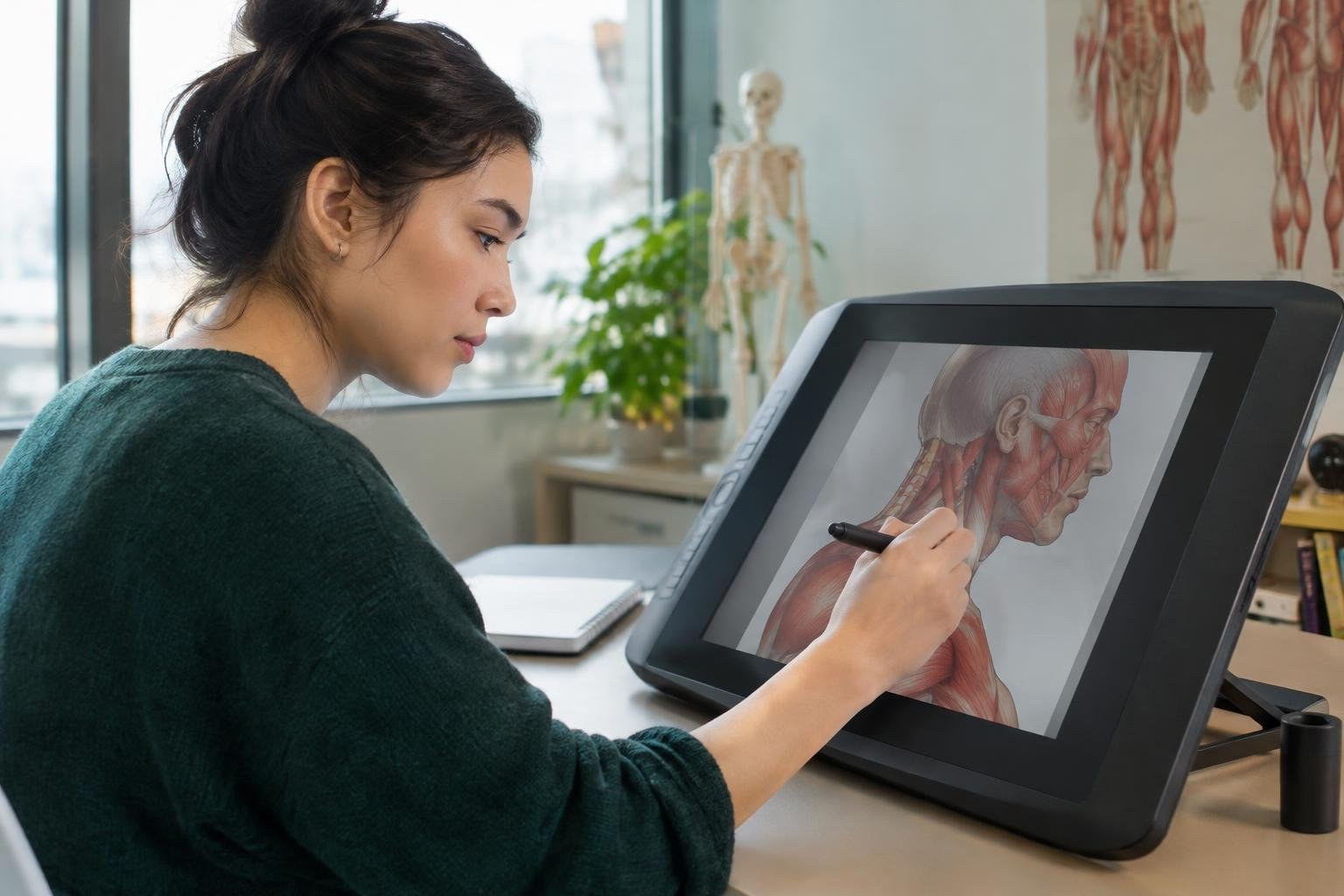
A medical illustration student working on a digital anatomy image
What Is a Medical Illustration Degree?
Medical illustration is the creation of visual materials that help record, explain, or share biomedical knowledge for educational, research, or clinical purposes. The federal Classification of Instructional Programs (CIP) describes the field under code 51.2703. Its definition connects artistic methods with computer-assisted imaging, graphics, and animation. The NCES CIP description lists topics such as anatomy, physiology, pathology, histology, embryology, neuroanatomy, medical terminology, digital imaging, and instructional design.
Schools may use names such as medical illustration, medical and biological illustration, or medical and scientific illustration. These labels can signal related work, but they do not guarantee the same curriculum or credential. Medical illustration differs from general illustration because its visual choices must serve a biomedical subject; it differs from clinical practice because the illustrator creates communication materials rather than diagnosing or treating patients.
Use the CIP code as a way to identify the academic field, not as proof that a particular college offers a specific degree. Confirm the current program name and credential in the institution’s catalog.
What Do You Study in Medical Illustration?
Students learn to make complex biomedical subjects understandable through deliberate visual choices. That requires more than drawing skill: an illustrator needs enough scientific knowledge to represent structures and processes responsibly, and enough design judgment to guide a viewer’s attention.
Science and visual communication
The CIP description includes anatomy, physiology, pathology, histology, embryology, neuroanatomy, and medical terminology. It also includes artistic media, illustration techniques, data display, exhibit design, medical photography, and instructional design. This mix helps students connect scientific content with audience, purpose, and visual form. Johns Hopkins’ program catalogue describes graduate-level science alongside visual communication of medicine and life sciences.
Digital production and portfolio work
Digital imaging, computer graphics, animation, multimedia, and three-dimensional modeling appear in the field’s CIP description. Augusta University also notes that digital techniques support images for print, projection, animation, and multimedia, alongside anatomy and health-science knowledge. A student may develop a portfolio through projects that combine research, visual planning, drafts, revisions, and finished work. Review actual course sequences: a program’s emphasis on illustration, animation, photography, or other formats may differ.
Skills You Can Develop
Students develop several kinds of capability at once. In science, they learn terminology and subject matter that help them understand what an image represents. In art and design, they practice composition, drawing, color, visual hierarchy, and storytelling. Digital coursework can build experience with raster and vector images, animation, multimedia, and 3D modeling, depending on the program.
Research and analysis: interpret biomedical information and identify the details an image needs to convey.
Visual communication: turn complex information into images that a defined audience can follow.
Technical production: work with digital imaging and other tools taught in the curriculum.
Communication and collaboration: discuss goals, review feedback, and refine work for educational, research, or clinical use.
Portfolio development: present finished work and explain the decisions behind it.
These abilities may apply to medical illustration, biomedical visualization, or adjacent scientific communication work. A course list alone cannot show how well a program develops them. Look at student projects and ask how frequently students receive critique and practice explaining their visual decisions.
Who Is Medical Illustration Best For?
Medical illustration may appeal to students who enjoy both making images and learning how living systems work. It can be a good area to investigate if you like visual storytelling, detailed observation, and the challenge of explaining complicated subjects. Augusta University describes the field as requiring an interest in graphic arts and visual storytelling along with an affinity for science.
No single personality type is required. Some students prefer careful anatomical drawing; others are more interested in digital visualization, animation, or communication design. The common thread is willingness to revise work and learn scientific content that may be outside a student’s original comfort zone.
Entry requirements are program-specific
Admissions requirements cannot be assumed from the field name. Check each school’s application page for academic prerequisites, science preparation, portfolio instructions, interview requirements, and any expectations about prior art coursework. A prospective student can prepare by building a varied portfolio, strengthening foundational science knowledge, and asking admissions staff how applicants from different educational backgrounds are reviewed. Parents and counselors can help compare requirements without deciding fit on a student’s behalf.
To consider personal fit, weigh the daily work and education commitment alongside salary or prestige. Assessment.com’s college-major guidance and MAPP assessment can support reflection, but they should complement conversations with faculty and a review of the work itself.
Degree Levels, Time to Completion, and Admissions
Medical illustration is taught at more than one credential level, but availability depends on the institution. The CIP code identifies a field that may appear across certificate, associate, bachelor’s, post-bachelor’s, graduate certificate, master’s, first-professional, or doctoral classifications. That list does not mean every type is commonly offered or available at a specific college. Confirm the exact award and entry requirements in the current catalog.
One possible route is an undergraduate foundation in art and science followed by specialized graduate study. Oglethorpe describes its medical and scientific illustration program as building art-and-science skills and a portfolio for graduate study as a medical artist. Augusta University and Johns Hopkins describe graduate-level medical illustration programs. These examples show different points in a pathway, not a rule that all students must follow the same sequence.
Ask schools for the number of credits, full-time and part-time completion plans, transfer-credit rules, and prerequisites. Those details determine how long an individual route takes. Do not rely on a general estimate when an institution can provide the degree map for your situation.
Tuition, Costs, and Financial Aid
The sources available for this guide do not establish a standard tuition amount or a single delivery format for medical illustration programs. Rather than compare schools using a broad estimate, build a program-specific budget from the official cost information for the year you would enroll.
Ask for the full cost of attendance, not tuition alone. Check whether program fees, art supplies, a suitable computer, required software, printing, travel, and housing apply. A program with studio or specialized equipment requirements may have expenses beyond ordinary course materials; confirm what students must supply and what the school provides.
Ways to make a plan affordable
Complete the institution’s financial-aid process and ask about grants, scholarships, and work-study eligibility.
Compare net price after aid, not just published tuition.
Ask whether transfer credits or prior learning can reduce required coursework.
Check whether an employer offers education assistance if you are studying while working.
Compare local living and transportation costs if programs require campus attendance.
Request cost details in writing and compare the same items across schools. Do not assume online study is automatically less expensive; verify fees, equipment needs, and any in-person requirements with the program.
Online, Hybrid, and On-Campus Options
Online availability, hybrid scheduling, and campus requirements can differ by institution and credential. The program descriptions cited here do not confirm that a complete online medical illustration degree is available. A student considering distance study should ask whether courses are fully remote, whether critique sessions happen live, and whether any studios, labs, or other learning activities require travel.
Because the field may include traditional media as well as digital image-making, ask how students access software, equipment, and faculty feedback. Request examples of how a remote student submits work and receives detailed critique. If an internship, clinical collaboration, residency, or in-person project is part of the curriculum, ask when it occurs, where it takes place, and whether the student must arrange transportation or housing.
Choose a format based on the learning experience and total cost, not convenience alone. For a portfolio-focused program, the quality and frequency of feedback may be as important as the location of lectures.
Careers, Jobs, and Employment Considerations
Medical illustration graduates may pursue work creating biomedical images, animation, or other visual materials for health and science audiences. Potential employment settings described by Augusta University include medical, dental, and veterinary schools; hospitals; health-science research institutes; government agencies; and pharmaceutical companies. The type of work and qualifications sought can vary across employers.
Possible direction
How the training may apply
What to verify
Medical or biological illustrator
Combines illustration skills with anatomy and life-science knowledge.
Portfolio expectations and requested credential.
Biomedical visualizer or medical animator
Uses digital imaging, graphics, animation, or 3D modeling.
Software, production, and science requirements in job postings.
Scientific visual communication
Turns research or clinical information into understandable visuals.
Audience, subject expertise, and writing or design responsibilities.
Medical photography or multimedia
Applies visual production skills to health-related media.
Employer-specific technical and photography requirements.
Exhibit or instructional media design
Connects visual explanation with exhibit or learning design.
Whether the role requires additional design or instructional experience.
These are possible directions, not guaranteed job placements. No salary or employment-growth estimate is included here because a current official figure specific to medical illustrators is not established by the cited research. The related Assessment.com painters and illustrators career resource can help explore a broader creative occupational category, but it is not a substitute for medical-illustration-specific labor data. Review current postings, employer requirements, and alumni outcomes before making financial decisions.
Accreditation, Licensure, and Professional Credentials
Medical illustration programs are not licenses to practice medicine, and completing a degree should not be confused with earning a healthcare professional license. The materials cited here describe academic curricula and program credentials; they do not establish a universal state license or a single mandatory certification for medical illustrators.
Accreditation needs careful checking. Johns Hopkins’ academic catalogue states that its Medical and Biological Illustration program has been accredited since 1970. That claim applies to the program described there, not to every program using a similar title. Ask each school which accrediting body reviews the program, what the accreditation covers, and where to verify current status. Also confirm institutional accreditation and whether the credential will meet your future education or employment requirements.
If a prospective employer requests a credential or specific experience, check the requirement directly with that employer or the relevant professional organization. Do not assume one school’s status or a program’s marketing language applies to another institution.
Experience, Portfolio, and Employer Preparation
For a portfolio-based field, coursework is only part of the preparation. Students can use class assignments, independent projects, research collaborations, internships where available, and volunteer communication work to show how they approach scientific subjects. These activities should be accurate and clearly labeled; never present speculative or practice work as commissioned clinical material.
How to stand out to employers
Build a portfolio that shows more than one visual format, such as illustration, digital imaging, or animation where appropriate.
Include process examples that explain how you researched, planned, and revised a visual piece.
Practice describing the intended audience and purpose of each project.
Ask science faculty, illustrators, and program advisers for specific critique.
Review job postings to identify the tools and subject knowledge employers actually request.
Augusta’s program information emphasizes the combination of artistic capability, anatomy, health sciences, and digital methods. Students can use that combination as a checklist when assessing their own work and identifying gaps. A polished portfolio is valuable evidence of preparation, but it does not guarantee an interview or job offer.
Graduate School and Further Study
Graduate school may be part of the route for students seeking specialized preparation in medical illustration. Options may include a master’s degree or an MFA, depending on the institution and program. Johns Hopkins describes a graduate program in Medical and Biological Illustration, while Augusta University offers a master’s in medical illustration and RIT has an MFA program page. These program examples do not establish a universal admissions standard or show that one credential is best for every student.
Before applying, check prerequisites, required science coursework, portfolio standards, application timing, and the program’s current degree requirements. Ask how the curriculum balances graduate-level science, visual communication, and production practice. If your undergraduate major is art, biology, or another field, speak with admissions staff about courses you may need before entering.
For students who want broader creative work rather than biomedical specialization, a general illustration, graphic design, scientific communication, or biology pathway may be a more direct match. Compare the work you hope to do, not just the degree title.
Related Degrees and Alternatives
Related programs can develop useful skills but differ in subject emphasis and career aims. Consider these alternatives if they better match the work you want to do:
Illustration: consider this instead if you want broad image-making work without a primary biomedical focus.
Graphic design: consider this instead if you prefer layout, branding, and broader visual communication projects.
Biology or biological sciences: consider this instead if scientific study matters more to you than creating visual media.
Biomedical visualization: consider this instead if you are especially drawn to digital, animated, or three-dimensional representations of science.
Scientific communication: consider this instead if you prefer explaining research through writing, media, or broader communication methods.
Medical photography: consider this instead if photography and image capture interest you more than illustration and constructed imagery.
These are comparison points, not interchangeable qualifications. Medical illustration is distinguished by its blend of art and biomedical knowledge. The NCES CIP description covers illustration, anatomy, imaging, animation, medical photography, and instructional design, while program pages show that undergraduate and graduate routes may differ. Compare required courses, the finished portfolio, and further-study expectations before choosing.
How to Choose the Right Program
A program can look appealing by title and still be a poor match for a student’s learning goals or budget. Compare schools using the same questions and request details from the people responsible for the curriculum.
Accreditation: Which body accredits the institution and, where applicable, the program? What exactly does that status cover?
Curriculum: How much study is devoted to biomedical science, illustration, digital imaging, animation, and 3D work?
Portfolio: What work do students produce, and what are the application portfolio requirements?
Faculty and facilities: Who teaches the science and art components, and what tools can students access?
Experience: Are internships, research, clinical collaborations, or external projects available? Are they required?
Cost and format: What is the full cost, and which courses or activities require campus attendance?
Outcomes and support: Can the school explain graduate pathways, career services, employer connections, and transfer-credit rules?
Ask for written answers and compare them side by side. Assessment.com’s education resources and college guidance information can support exploration. Use career matching and degree exploration as starting points, then verify program facts with the institution.
Questions to Ask Before Enrolling
Before submitting an application or paying a deposit, use this checklist with a parent, counselor, or adviser:
What exact credential will I earn, and is the program currently available in my intended format?
What are the admissions prerequisites and portfolio requirements?
How many credits and semesters are required for my situation, including transfer credits?
What is the estimated total cost, including fees, materials, equipment, and living expenses?
Which grants, scholarships, employer benefits, or other aid options can I pursue?
How much anatomy and other science will I study, and what art and digital production courses are required?
What student work can I review, and how much direct feedback do students receive?
Does the program include internships, research, or clinical or educational collaborations?
What accreditation applies, and does it cover the program I plan to enter?
What careers have graduates pursued, and what additional education or experience did those roles require?
Then test your assumptions: review a class project, speak with faculty or current students, and compare the program’s demands with the work you want to do. The Assessment.com guide to choosing a college major can help structure a family discussion about interests and options.
From Degree to Career: Possible Pathways
Several realistic pathways can connect study to work, but none is automatic. One example is an undergraduate art-and-science foundation, then a specialized medical illustration graduate program, followed by an entry-level portfolio-based role. With experience, a person may focus on medical animation, research visualization, educational media, or another specialty. A different student may build a related portfolio during undergraduate study and pursue adjacent scientific communication work.
Compare the pathway you have in mind with actual requirements. Augusta identifies several potential work settings, including schools, hospitals, research institutes, government agencies, and pharmaceutical companies. Specific openings may ask for different combinations of science knowledge, software ability, portfolio quality, and experience. Use current job postings to check what is requested rather than assuming a degree title guarantees a particular progression.
Frequently asked questions
Is medical illustration a difficult major?
Medical illustration can be challenging because students must develop visual craft while learning detailed anatomy and health-science concepts. Programs may also expect students to use digital imaging, animation, or 3D modeling tools. The mix varies by curriculum, so ask to see course requirements and examples of student work before applying.
Is a medical illustration degree worth it?
Medical illustration may be worth considering if you want to communicate biomedical information through images and are ready to build both science knowledge and a strong portfolio. Value depends on your program cost, career goals, and the time needed for specialized study. Compare several curricula and likely work settings before deciding.
What jobs can I get with a medical illustration degree?
Potential directions include medical or scientific illustration, biomedical visualization, medical animation, and visual communication work for health or science audiences. Some paths may require advanced training or a graduate degree. A program’s coursework and portfolio can help prepare you, but neither guarantees a particular job.
How much do medical illustrators make?
There is no single salary figure that represents all medical illustrators. Earnings can differ across salaried positions and freelance work, and by experience, employer, location, and specialty. Compare current labor-market data for the closest occupational categories, then review job postings and alumni outcomes from programs you are considering.
Can you earn a medical illustration degree online?
Some programs may offer individual online or hybrid courses, but the sources referenced here do not establish that a complete medical illustration degree is available online. Ask each institution whether studio, lab, portfolio, or other in-person requirements apply, and how students access specialized software and faculty feedback.
Does medical illustration require a lot of math or science?
Science coursework is central to medical illustration, especially anatomy and other biomedical subjects. The program description also includes subjects such as physiology, pathology, and medical terminology. Quantitative requirements vary by school; review the required science and math courses in each official catalog rather than assuming every program has the same prerequisites.
Do medical illustrators need a master’s degree?
Graduate study is a common route into the specialized profession, but pathways vary. Some students first build art and science foundations in an undergraduate program and develop a portfolio before applying to a graduate program. Review specific admissions requirements, including science preparation and portfolio expectations, with each school.
What is the difference between medical illustration and graphic design?
Medical illustration combines biomedical subject matter with visual communication. Graphic design usually emphasizes broader visual problem-solving, while illustration focuses more on creating images. Medical illustration adds a specialized expectation: visual work must accurately communicate health or life-science information. Program curricula differ, so compare the actual courses and portfolio outcomes.
People Also Ask
What do you learn in medical illustration?
Medical illustration programs teach students to combine visual communication with biomedical knowledge. Coursework may include anatomy, physiology, pathology, medical terminology, illustration, digital imaging, animation, and 3D modeling. Exact requirements vary by school and degree level.
How long does it take to become a medical illustrator?
The time required depends on the credential, transfer credits, enrollment pace, and whether a student pursues graduate study. Check the published credit and completion requirements for each program. A bachelor’s degree followed by a specialized graduate program is one possible pathway, not a universal requirement.
Are there many medical illustration programs?
It can be difficult to find a program that matches your intended credential and learning needs. Check the current catalog, curriculum, portfolio requirements, and delivery format directly with each institution. The CIP classification identifies a field of study but does not confirm that every listed credential is available at a particular school.
Where do medical illustrators work?
Medical illustrators may create visual materials for educational, research, or clinical purposes. Possible settings include medical, dental, and veterinary schools, hospitals, research institutes, government agencies, and pharmaceutical companies, according to Augusta University’s program information.
What should be in a medical illustration portfolio?
A medical illustration portfolio should show careful observation, visual problem-solving, and the ability to explain complex subjects clearly. Include work that reflects both artistic technique and scientific understanding. Follow the application instructions for each program because portfolio formats and required subjects vary.
Do medical illustrators use 3D modeling and animation?
The CIP description includes digital imaging, computer graphics, animation, multimedia, and three-dimensional modeling. Digital tools are therefore a meaningful part of the field. The software and production methods emphasized will vary by institution and by the kind of work a student wants to pursue.
Medical illustration can suit students who want to combine visual storytelling with serious study of anatomy and health science. The route may involve a bachelor’s degree followed by specialized graduate study, though program structure and career preparation vary. Before enrolling, compare the curriculum, portfolio expectations, total cost, program accreditation, and opportunities to make work for real audiences. Also consider whether the day-to-day work of translating complex scientific information into clear images fits your interests. Explore Assessment.com’s education and career resources, and use the MAPP assessment as one tool for thinking through career and degree fit.
Find out which Career or College Major is right for you!
We use cookies to offer you a better browsing experience, analyze site traffic and personalize content.
Read about how we use cookies and how you can control them in our
Privacy Policy.
If you continue to use this site, you consent to our use of cookies.
×
Exciting News!
Be one of the first to Beta Test the new AI-Powered Assessment.com Platform.