Audiology Degree Guide: Courses, Careers, Requirements, and Program Fit
Audiology programs explore hearing science, assessment, rehabilitation, and assistive technology. Learn how the path to becoming an audiologist works, what programs teach, how to compare costs and clinical training, and which careers may follow.
By Kieth Nelson · Staff Writer Assessment.com · Published October 26, 2026 · Last updated November 5, 2026
Audiology is the health and science field concerned with hearing, hearing loss, and related disorders of the ear. Audiology programs teach students to understand hearing systems, measure hearing, interpret assessment results, and help people use hearing technology and rehabilitation services. Coursework may include acoustics, anatomy and physiology, auditory pathology, assistive technology, and pediatric applications, with clinical experience in professional programs. For students who want to practice as audiologists, the pathway commonly includes a bachelor’s degree followed by a clinical Doctor of Audiology (Au.D.), then the licensing or certification steps applicable to the state and role. Other audiology credentials may support academic preparation or related work, but they do not automatically qualify a graduate for independent practice. Not sure whether audiology fits you? Take the Free MAPP Career Assessment to explore how your motivations, interests, and natural preferences may align with this field and related careers.
Degree & Program Decision Insights
Explore your personal fit, education requirements, career potential and next steps.
01Motivational Fit
Discover whether this program fits you
Explore your preferences against the focus of Audiology/Audiologist. These prompts are not personal MAPP results.
Subject curiosity. Would you choose to explore “acoustics” in depth? Ask for a sample learning activity to test that interest.
Breadth of interest. Consider the place of “anatomy and physiology of hearing” in this field. Is this another part you would choose to explore, or mainly a requirement you would tolerate?
Work reality. Related work can involve this task: “Examine and clean patients' ear canals.” Would you want that activity to be a regular responsibility?
Interest in studying a field can differ from enjoying its related work.
Which part would you want to do repeatedly, and what would you try before deciding?
Discover Your Personal Program Fit
Before investing your time and money in your education, discover how this program aligns with your natural motivations, work preferences and career goals.
Typical occupational entry: doctoral or professional degree (BLS). Check the exact professional credential and jurisdiction requirements for this occupation; the classification association alone does not establish eligibility.
Health Specialties Teachers, PostsecondarySOC 25-1071 · O*NET 25-1071.00$107,310/year median (May 2025); +17.9% projected change (2025–2035); 24,900 projected openings/year.
Typical occupational entry: doctoral or professional degree (BLS). BLS lists less than 5 years of related work experience as typical for this occupation; this programme is not a direct promise of entry. Postsecondary teaching is a separate appointment and may require advanced study; this programme alone is not a promise of a teaching post.
U.S. occupational wages are not guaranteed graduate earnings; OEWS excludes self-employed workers.
Projected openings include replacements as well as growth.
U.S. national estimates. A crosswalk does not establish entry-level eligibility; advanced, management and teaching roles can require further qualifications.
Explore your motivations. Use MAPP as a starting point for reflecting on your interest in “acoustics”, then test that interest against a sample learning task.
Examine the work. Compare Audiologists and Health Specialties Teachers, Postsecondary on daily work and entry qualifications, as well as pay. Explore Audiologists.
Compare actual providers. Ask for the exact credential, course sequence and assessment methods. Compare how each provider teaches “anatomy and physiology of hearing”, its entry criteria and its itemized costs.
Check the evidence before applying. Confirm prerequisites and any recognition or professional requirements for your intended route; ask for applicable rules and published outcome definitions in writing.
Verify the institution’s current offering, admissions requirements and outcomes; a search result does not establish your eligibility.
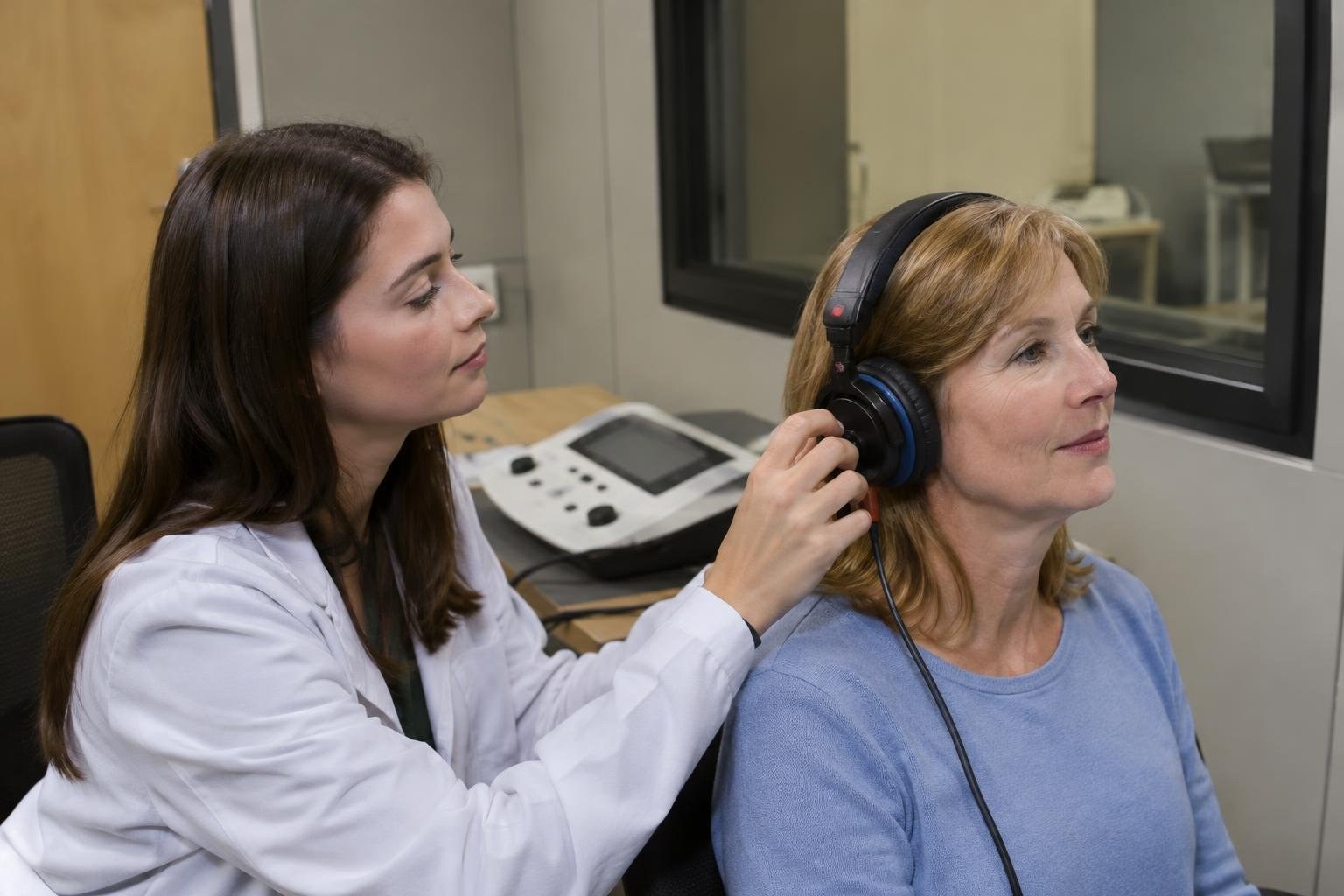
Audiology student practicing a hearing assessment with a supervisor
What Is an Audiology Degree?
Audiology is a field focused on the scientific study of hearing and the assessment and care of hearing loss and related ear disorders. The U.S. Department of Education’s CIP description for code 51.0202 connects the field with hearing measurement, auditory pathology, rehabilitation, assistive technologies, and patient advice about hearing devices.
Program names may include audiology, audiology and hearing sciences, or audiologist preparation. The credential categories associated with a field of study do not mean that every college offers every award, or that every award qualifies a graduate to practice. A short certificate, undergraduate degree, graduate certificate, master’s, or doctorate can have different purposes. Clinical independent practice is a separate question from the name of a major.
Audiology is distinct from speech-language pathology, which centers on communication and swallowing disorders, and from hearing-aid specialist training, which may follow different state rules and education pathways. Compare actual duties and required credentials when deciding between fields.
See the NCES program description for Audiology/Audiologist and Hearing Sciences.
What Do You Study in Audiology?
Audiology coursework builds knowledge of hearing systems and develops the ability to assess hearing and plan appropriate support. The field’s curriculum description includes acoustics, anatomy and physiology of hearing, hearing measurement, auditory pathology, analysis of the middle and inner ear, rehabilitation therapies, assistive technologies, and pediatric and other applications.
Those subjects connect theory to decisions made in practice. Students learn why hearing works as it does, how hearing problems may appear in assessment, and how rehabilitation or technology can help a patient make use of remaining hearing. Programs may also teach students to communicate findings and recommendations clearly to patients and other professionals.
Clinical professional programs combine academic study with practical training. The University of Illinois describes its Au.D. as including courses and real-world clinical experience, including work in its clinic. Clinical education is especially important to evaluate: ask which patient populations, settings, and supervised experiences a program provides. Course titles and sequence vary by school.
Read an example of clinical and academic training in an Au.D. program.
Skills You Can Develop
Audiology education can help students develop scientific reasoning, careful measurement, patient communication, and familiarity with hearing-related technology. These abilities support tasks such as evaluating hearing, explaining results, discussing rehabilitation, and selecting or fitting devices, as described in the NCES program definition.
Scientific and technical: understanding acoustics, hearing anatomy and physiology, auditory pathology, and assistive technologies.
Analytical: connecting test observations with a patient’s concerns and deciding what further evaluation or support may be appropriate.
Communication: explaining assessments, options, and device use in language patients and families can understand.
Interpersonal: listening to people with different communication needs and supporting them through assessment and rehabilitation.
Professional: documenting work, collaborating with care teams, and using clinical judgment within training and legal scope.
These are capabilities to develop, not traits a student must already possess. Ask programs how they teach and assess them through coursework, supervised practice, and feedback.
Who Is an Audiology Program Best For?
Audiology may suit students who are curious about hearing science and want a role that combines testing, technology, problem-solving, and direct work with patients. The field can involve carefully gathering measurements and also listening to how a hearing concern affects a person’s everyday life. Students need not arrive with a single personality type; patience, curiosity, and willingness to practice communication and technical skills can matter more than a fixed profile.
Consider whether you are interested in biology and physical science, comfortable learning detailed procedures, and willing to work with people who may have varied ages, communication preferences, and needs. The clinical route involves advanced study and practical training. If you prefer a shorter route into a patient-facing support role, compare related occupations and their exact credentials rather than assuming an undergraduate audiology degree is enough for independent practice.
Does Audiology Match You?
Salary, reputation, and broad career demand cannot tell you whether daily work will feel meaningful to you. Think about your interest in patient care, science, precise assessment, technology, and ongoing clinical learning. The MAPP assessment can help you reflect on career and degree alignment; use it as one input alongside conversations with practitioners, program visits, and verified admissions requirements.
Admissions, Program Length, and Academic Demands
Admissions rules are set by individual institutions and can differ between undergraduate audiology study and clinical Au.D. programs. The University of Illinois describes its four-year Au.D. as building on a bachelor’s degree. That example is not a universal admissions checklist; confirm each school’s current prerequisites and application process directly.
Before applying, ask whether the program expects a completed bachelor’s degree, particular science or communication courses, a minimum GPA, standardized tests, recommendations, an essay, an interview, or relevant experience. Also ask how the program evaluates applicants whose previous degree is outside communication sciences or who are changing careers.
The University of Illinois describes the Au.D. as a four-year program after the bachelor’s degree. The total time from starting college can therefore be longer, and transfer credit or part-time study may change an individual timeline. Ask for a term-by-term plan and the likely time needed to complete clinical requirements.
Students often find it helpful to strengthen study habits in science courses, practice explaining technical ideas clearly, and seek an informational conversation or observation opportunity where permitted. Do not rely on an informal estimate when planning your application calendar.
Online vs. On-Campus Audiology Programs
Online, hybrid, and campus formats vary by program and by the student’s prior professional preparation. For example, A.T. Still University lists an online post-professional Au.D. option. A post-professional program is not automatically the same pathway as an entry-level clinical doctorate, so confirm who may apply and what the credential is designed to accomplish.
Clinical preparation requires more than watching lectures. Ask whether any in-person labs, local clinical placements, supervised patient contact, or campus visits are required; who arranges placements; and whether the program can accommodate a student’s location. Get the answers in writing before comparing an online option with a campus program.
On-campus study may make it easier to access a university clinic and interact in person with faculty and classmates, while distance study may offer flexibility for students who already have relevant professional training. Neither format is automatically better. Match the delivery model to your eligibility, schedule, learning needs, and ability to complete the required practical components.
Review the A.T. Still University catalog entry for its online post-professional Au.D. and ask the institution for current program details.
Audiology Degree Costs and Financial Aid
There is no single tuition figure that applies to audiology programs nationwide. Your total expense depends on the institution, residency classification, credential and program length, delivery format, and individual living situation. A clinical program may also have costs associated with equipment, clinical requirements, travel, books, technology, and fees; request an itemized estimate rather than comparing tuition alone.
Ask each school for the total cost of attendance for the expected time to completion, including tuition increases, fees, required supplies, insurance if applicable, and travel to clinical placements. Compare the net price after grants and scholarships, not just the published tuition rate. Check whether aid is available for the program and for each year of study.
Potential funding routes may include federal student aid for eligible students, institutional scholarships, assistantships where offered, employer tuition assistance, and payment plans. Eligibility and availability vary. For current federal aid rules and options, use official government information and complete the required aid application; ask the financial aid office how aid interacts with clinical placements and enrollment intensity.
Make a conservative budget that includes borrowing and living expenses. Avoid assuming future salary will make any amount of debt manageable.
Affordability and Ways to Fund Your Education
To decide whether audiology education is worth the investment, compare the full cost and time commitment with your intended role. The relevant question is not simply whether a degree has value in general, but whether the credential qualifies you for the work you want and whether the financial plan is manageable.
Compare total tuition and mandatory fees across the full program, not one semester.
Ask whether clinical placements require travel, relocation, or schedule flexibility.
Check scholarship, grant, employer-support, and federal aid eligibility before borrowing.
Compare the clinical doctorate route with related professions that have different training requirements.
Consider the opportunity cost of years in school and any income you may give up.
Funding may come from grants, scholarships, eligible student aid, employer benefits, or savings, but do not count on an award until it is confirmed. Keep a written estimate of expected borrowing and repayment obligations. If the program’s cost is difficult to reconcile with your goals, talk with its financial aid office and compare other accredited or appropriately recognized options before enrolling.
Audiology Careers, Jobs, and Employment Considerations
Clinical audiologists may work in hospitals, physicians’ offices, audiology clinics, school districts, and industry, according to the supplied university program and career descriptions. The precise duties and qualifications depend on the role and employer. Audiology study can also lead toward teaching or other hearing-science work, but a postsecondary teaching position may require additional graduate education or relevant professional experience.
Career direction
Typical education or preparation
How audiology applies
Audiologist
Clinical Au.D. and applicable state credentials
Assesses hearing, supports rehabilitation, and works with hearing technology.
Postsecondary health specialties teacher
Advanced education and relevant experience may be expected; check each job posting
May teach health or audiology-related subjects, depending on qualifications and institution.
Hearing-science research or industry role
Requirements vary by position; specialized research roles may require further study
Applies knowledge of hearing processes, measurement, and assistive technology.
Related hearing-care support role
Depends on the occupation and state requirements
May use a narrower set of hearing-care or device skills than an audiologist.
Check the current U.S. Bureau of Labor Statistics audiologist profile for dated national wage and outlook data, and compare it with local job postings. Pay and openings differ by location, experience, and work setting.
See the Bureau of Labor Statistics overview of audiologists and Assessment.com’s audiologist career guide.
Accreditation, Licensure, and Certification
Graduating from a degree program and being legally qualified to practice are not the same thing. Audiologists may need state licensure, and the requirements can differ by state. A New York program describes its academic and clinical training as preparing students for New York State licensure and national certification; that statement should not be treated as a rule for another state.
The Bureau of Labor Statistics notes that audiologists may earn credentials such as certificates or certifications, usually requiring an accredited Doctor of Audiology program and an exam. Some employers may require or prefer a credential, and in some states it may help meet licensure requirements. Confirm which qualifications apply to the exact role and state where you plan to work.
Before enrolling, ask the program to identify the states for which it is designed to prepare students, how it supports licensing applications, and whether its curriculum meets the applicable educational requirements. Then verify the answer with the relevant state licensing authority. Do not assume national certification automatically grants a state license or that a program’s marketing language guarantees eligibility.
See the CUNY Graduate Center’s description of its academic and clinical preparation and the BLS discussion of audiologist credentials.
Clinical Experience, Credentials, and Preparing for Employment
Experience can help students understand the realities of hearing care and connect classroom learning with patient needs. Depending on program rules, useful preparation may include observation, volunteering, research, student projects, or employment in a related health setting. Ask before arranging clinical observation: patient privacy and site policies may limit access.
Once enrolled, take clinical placements seriously. Seek feedback on assessment technique, documentation, patient communication, and device-related work. Keep a record of completed projects and experiences that demonstrate what you learned, while respecting patient confidentiality.
How to Stand Out to Employers
Build evidence of reliable clinical learning, clear communication, thoughtful collaboration, and a strong understanding of the patient populations or settings that interest you. Ask faculty and supervisors for specific feedback. Join relevant student or professional organizations if appropriate, and use informational interviews to learn how employers describe the qualifications they need. A certificate or certification may help in some situations, but it does not replace a required degree or state license.
Graduate School and Further Study
A clinical Au.D. is the central advanced education path for many students who want to become practicing audiologists. Other graduate options may support different goals, including hearing-science research, teaching, leadership, or further specialization. The right next degree depends on the job: an academic research role and a clinical practitioner role may not ask for the same preparation.
Before applying to another program, identify the work you want to do and review job postings from employers in that setting. Ask faculty and program advisors which credentials are typically expected, whether a research thesis or clinical placement is part of the program, and what graduates actually do. Avoid adding a degree simply because it sounds more advanced; assess whether it provides skills or eligibility tied to a specific goal.
University program examples describe Au.D. graduates entering clinics, hospitals, physician offices, school districts, and industry. These are possible settings, not guaranteed outcomes. The next credential should be chosen to strengthen a specific direction and fit a realistic financial and time plan.
Related Degrees and Alternatives
Related pathways can share an interest in health, communication, or hearing, but they differ in daily work and required education. Use this short list to decide what to research next:
Speech-language pathology: consider this instead if communication or swallowing assessment and therapy interest you more than hearing assessment.
Hearing-aid specialist preparation: consider this instead if your main interest is hearing-device services and you want to investigate a distinct occupation-specific route.
Communication sciences and disorders: consider this instead if you want a broad undergraduate foundation before deciding between audiology and related graduate professions.
Biology or neuroscience: consider this instead if your main interest is the science of hearing and the nervous system, rather than direct clinical care.
Public health: consider this instead if you are drawn to population-level health education and prevention more than individual assessment.
Health administration: consider this instead if you prefer organizing or managing health services over patient testing and rehabilitation.
These alternatives are broad decision prompts, not claims that a specific degree qualifies someone for a regulated occupation. Compare curricula, clinical requirements, and the credentials listed in real job postings. Explore Assessment.com degree guides and related healthcare career areas.
Advantages, Drawbacks, and Is an Audiology Degree Worth It?
Audiology can offer the satisfaction of combining science, careful assessment, technology, and direct patient support. Professional preparation includes academic and clinical learning, and a degree can connect to several settings, including clinics, hospitals, physician offices, schools, or industry. Those features may appeal to students who want to use technical knowledge in a people-centered field.
The tradeoffs are significant: the clinical pathway requires advanced study after a bachelor’s degree, practical training, time, and careful attention to state-specific credentials. Tuition and living costs can vary widely, and a degree does not guarantee a particular job or income. Students who want a quicker route into work, less patient contact, or a research-only focus may prefer to compare other pathways.
Assess value against your goals, likely borrowing, location, program quality, and the work you actually want to do. A program may be worthwhile for one student and a poor fit for another. Ask schools for transparent cost and outcome information, and speak with current students or practicing audiologists before deciding.
How to Choose an Audiology Program
Program quality cannot be judged by a title or a brochure alone. Compare the curriculum, supervised learning, eligibility for the career you want, and the full cost. Ask each institution to document important answers and verify licensing claims with the relevant state authority.
Accreditation and recognition: ask which recognized accreditation applies to the institution and specific professional program, and verify its current status with the accreditor.
Curriculum: compare hearing science, assessment, rehabilitation, assistive technology, and any areas of focus.
Clinical learning: ask where placements take place, who supervises students, and which experiences are required.
Cost and aid: request a complete cost estimate and a written explanation of aid eligibility.
Format and timing: clarify campus attendance, online components, clinical logistics, and expected completion time.
Career preparation: ask about licensure eligibility, certification preparation, career services, and graduate destinations.
Transferability: get written confirmation about how prior coursework will apply.
Use Assessment.com’s major-selection guidance to reflect on fit, then verify each program’s facts directly with the school.
From Audiology Degree to Career
Career development is not a guaranteed ladder, but it can help to picture possible steps before choosing a degree. For example, a student interested in clinical practice might complete undergraduate study, enter an Au.D. program, gain supervised clinical experience, and then pursue a role in a clinic, hospital, school setting, or another employer. Experience may lead to a focused patient population, additional responsibilities, or teaching and leadership work, depending on qualifications and opportunity.
A different student might use undergraduate hearing-science preparation to explore research or industry, then decide whether graduate education is necessary for a particular position. In every case, confirm the education and credentials in the relevant job descriptions. A credential or degree can expand options, but it cannot promise hiring, advancement, or a specific salary.
Use career matching to compare what a job involves with the study and training it requires. Assessment.com’s career resources can help you explore occupational areas alongside program research.
Frequently asked questions
What is an audiology degree?
Audiology is the study and clinical care of hearing and related ear disorders. Programs cover hearing science, measurement, auditory pathology, rehabilitation, and assistive technology. To become an independent practicing audiologist in the United States, students commonly pursue a Doctor of Audiology (Au.D.) after a bachelor’s degree, complete clinical education, and meet the licensing requirements where they plan to work.
Is audiology a hard major?
Audiology can be academically challenging because it combines scientific concepts with detailed measurement, clinical reasoning, and hands-on work. Students need to learn how hearing systems function, interpret test results, and communicate findings to people with different needs. The clinical doctorate also requires sustained supervised practice. Preparation in biology, physical science, statistics, and communication may help, but program prerequisites differ.
How long does it take to become an audiologist?
A bachelor’s degree in a related area is a common foundation for a clinical Doctor of Audiology program. The University of Illinois describes its Au.D. as a four-year program building on a bachelor’s degree. Requirements vary by school, so review prerequisites, transcripts, recommendations, essays, interviews, and any required experience directly with each admissions office.
Do audiologists need a doctorate?
A clinical audiologist typically needs an Au.D., supervised clinical preparation, and any license required by the state of practice. A bachelor’s degree alone does not generally prepare someone to practice independently as an audiologist. Some programs also prepare students for certification, but certification and state licensure are separate credentials; check the rules and employer expectations where you plan to work.
Can you earn an audiology degree online?
Some audiology education is offered online, but online availability depends on the student’s prior education and the program’s purpose. A.T. Still University lists an online post-professional Au.D. option. Clinical training for professional practice involves practical experience, so prospective students should confirm exactly how a program arranges and assesses required clinical work.
What do you study in an audiology program?
Audiology programs may teach acoustics, hearing anatomy and physiology, hearing measurement, auditory pathology, middle- and inner-ear analysis, rehabilitation, assistive technologies, and pediatric applications. A clinical program also integrates academic study with patient-facing training. Course names and sequencing vary by institution, so compare the curriculum and clinical experience rather than relying on a program title alone.
What jobs can you get with an audiology degree?
Audiologists work in settings that can include hospitals, physician offices, audiology clinics, school districts, and industry. The work may involve assessing hearing, counseling patients, supporting rehabilitation, and selecting or fitting hearing devices. Actual duties depend on the job, employer, patient population, and any applicable state scope-of-practice rules.
How much do audiologists make?
The evidence available here does not support a current salary estimate or employment-growth percentage. Pay can depend on factors such as location, employer, experience, and role. For a current estimate, review the U.S. Bureau of Labor Statistics’ audiologist profile and compare the date, geographic area, and occupation definition before using a figure in a personal budget.
Can you become an audiologist with a bachelor’s degree?
A bachelor’s degree in communication sciences, biology, or a related field may help prepare a student for Au.D. admissions, but a bachelor’s degree is not the clinical doctorate. A bachelor’s program may offer useful academic preparation or related opportunities, while independent clinical audiology practice generally requires advanced professional education and state-specific credentials.
What is the difference between audiology and speech-language pathology?
Speech-language pathology focuses on communication and swallowing disorders, while audiology focuses on hearing and related ear disorders. Both involve health care, assessment, and patient communication, but their coursework, clinical tasks, and professional qualifications differ. Compare the day-to-day work and education requirements for both fields before choosing a major or graduate pathway.
People Also Ask
What does audiology study?
Audiology is the study and clinical care of hearing and disorders involving hearing and the ear. Programs cover hearing science, assessment, rehabilitation, and assistive technologies; clinical professional education prepares students for patient care.
How many years is an audiology degree?
Many students complete a bachelor’s degree before entering an Au.D. program. One university describes its clinical doctorate as a four-year program built on the bachelor’s degree. The full timeline varies with prior coursework, transfer credit, and a student’s enrollment pace.
Are audiology programs available online?
Some online options are designed for audiologists who already have professional education. A.T. Still University lists an online post-professional Au.D. option. Students seeking initial clinical preparation should ask programs how they deliver required supervised practice and whether distance study is suitable for their situation.
What are the admission requirements for an Au.D. program?
Requirements vary by institution. For an Au.D., ask whether applicants need a completed bachelor’s degree, specific prerequisite courses, minimum academic standards, recommendations, personal statements, interviews, or clinical exposure. Confirm the current requirements with each program’s admissions office.
Where can audiologists work?
Audiologists may work in hospitals, physician offices, audiology clinics, school districts, and industry. The work setting influences the patient population and daily tasks, so students should seek clinical exposure and ask programs about the range of placement settings available.
Does an audiology degree include clinical training?
A clinical audiologist’s education includes both academic coursework and clinical learning. Program examples describe real-world clinical experience as part of Au.D. preparation. The length, placement structure, and settings differ, so ask for details before enrolling.
What certification or license does an audiologist need?
Audiologists may earn certification in addition to completing a professional degree, and some employers may require or prefer credentials. Certification does not automatically replace state licensure. Confirm the specific license and credential rules for the state and work setting you are considering.
What can I do with a bachelor’s in audiology?
A bachelor’s program can build a foundation in hearing science and related subjects, but the clinical doctorate is the professional pathway described by universities for independent audiology practice. Check job requirements carefully before assuming an undergraduate credential leads to clinical practice.
Audiology may be a strong fit if you want to combine science, precise testing, communication, and patient care, and you are prepared for advanced clinical education before practicing independently. It may be less suitable if you want to enter a licensed clinical career after a short undergraduate program or prefer work with little patient interaction. Compare program requirements, total cost, clinical training, and your state’s licensing rules before committing. Your interests and preferred work style matter alongside career possibilities. Explore education and career resources on Assessment.com, and use the MAPP assessment to reflect on how this path may fit you.
Find out which Career or College Major is right for you!
We use cookies to offer you a better browsing experience, analyze site traffic and personalize content.
Read about how we use cookies and how you can control them in our
Privacy Policy.
If you continue to use this site, you consent to our use of cookies.
×
Exciting News!
Be one of the first to Beta Test the new AI-Powered Assessment.com Platform.