Visual Impairment and Blindness Education Degree Guide
Learn what visual impairment and blindness education programs teach, which credentials may lead to teaching roles, and what to compare before choosing a program.
By Tome Fierre · Staff Writer Assessment.com · Published October 7, 2026 · Last updated November 5, 2026
Education and teaching programs focused on visual impairments and blindness prepare educators to support students who are blind or have low vision. Depending on the program, students may learn to assess educational needs, adapt instruction, teach skills such as Braille and independent living, and use assistive technology. Graduates may pursue roles in public schools, specialized schools, or other education settings, subject to the credentials required by their state and employer. Programs use different names and credential structures. Some are graduate certificates, while others combine graduate study with teacher certification options. Before applying, check the state requirements for the job you want and confirm that a program’s coursework and supervised experience fit those requirements. Not sure whether this field fits you? The Free MAPP Career Assessment can help you reflect on your motivations, interests, and work preferences alongside the practical demands of a specialized education career.
Degree & Program Decision Insights
Explore your personal fit, education requirements, career potential and next steps.
01Motivational Fit
Discover whether this program fits you
Explore your preferences against the focus of Education/Teaching of Individuals with Vision Impairments Including Blindness. These prompts are not personal MAPP results.
Care and responsibility. Would you want to develop the skills involved in counseling, while taking the other person’s needs and professional boundaries seriously?
Supporting learning. Are you interested in teaching and supervising blind or visually handicapped students and in adjusting your approach when another person needs a different explanation?
Work reality. Related work can involve this task: “Prepare, administer, or grade assignments to evaluate students' progress.” Would you want that activity to be a regular responsibility?
Interest in studying a field can differ from enjoying its related work.
Which part would you want to do repeatedly, and what would you try before deciding?
Discover Your Personal Program Fit
Before investing your time and money in your education, discover how this program aligns with your natural motivations, work preferences and career goals.
Check the exact professional credential and jurisdiction requirements for this occupation; the classification association alone does not establish eligibility.
Special Education Teachers, PreschoolSOC 25-2051 · O*NET 25-2051.00$64,830/year median (May 2025); +2.4% projected change (2025–2035); 2,000 projected openings/year.
Typical occupational entry: bachelor's degree (BLS). Check the exact professional credential and jurisdiction requirements for this occupation; the classification association alone does not establish eligibility.
U.S. occupational wages are not guaranteed graduate earnings; OEWS excludes self-employed workers.
Projected openings include replacements as well as growth.
Some wage or projection fields are unavailable; no missing values are inferred.
U.S. national estimates. A crosswalk does not establish entry-level eligibility; advanced, management and teaching roles can require further qualifications.
Compare the focus and route of these distinct instructional fields; their credentials and admission requirements are not interchangeable.
Education/Teaching of Individuals with AutismCIP 13.1013. Compare its emphasis on identifying students with autism and teaching and supervising autistic students with this program’s focus.
Explore your motivations. Use MAPP as a starting point for reflecting on your interest in “identifying students with visual impairments”, then test that interest against a sample learning task.
Examine the work. Compare Special Education Teachers, Kindergarten and Special Education Teachers, Preschool on daily work and entry qualifications, as well as pay. Explore Special Education Teachers, Kindergarten.
Compare actual providers. Ask for the exact credential, course sequence and assessment methods. Compare how each provider teaches “developing individual education plans”, its entry criteria and its itemized costs.
Check the evidence before applying. Confirm prerequisites and any recognition or professional requirements for your intended route; ask for applicable rules and published outcome definitions in writing.
Verify the institution’s current offering, admissions requirements and outcomes; a search result does not establish your eligibility.
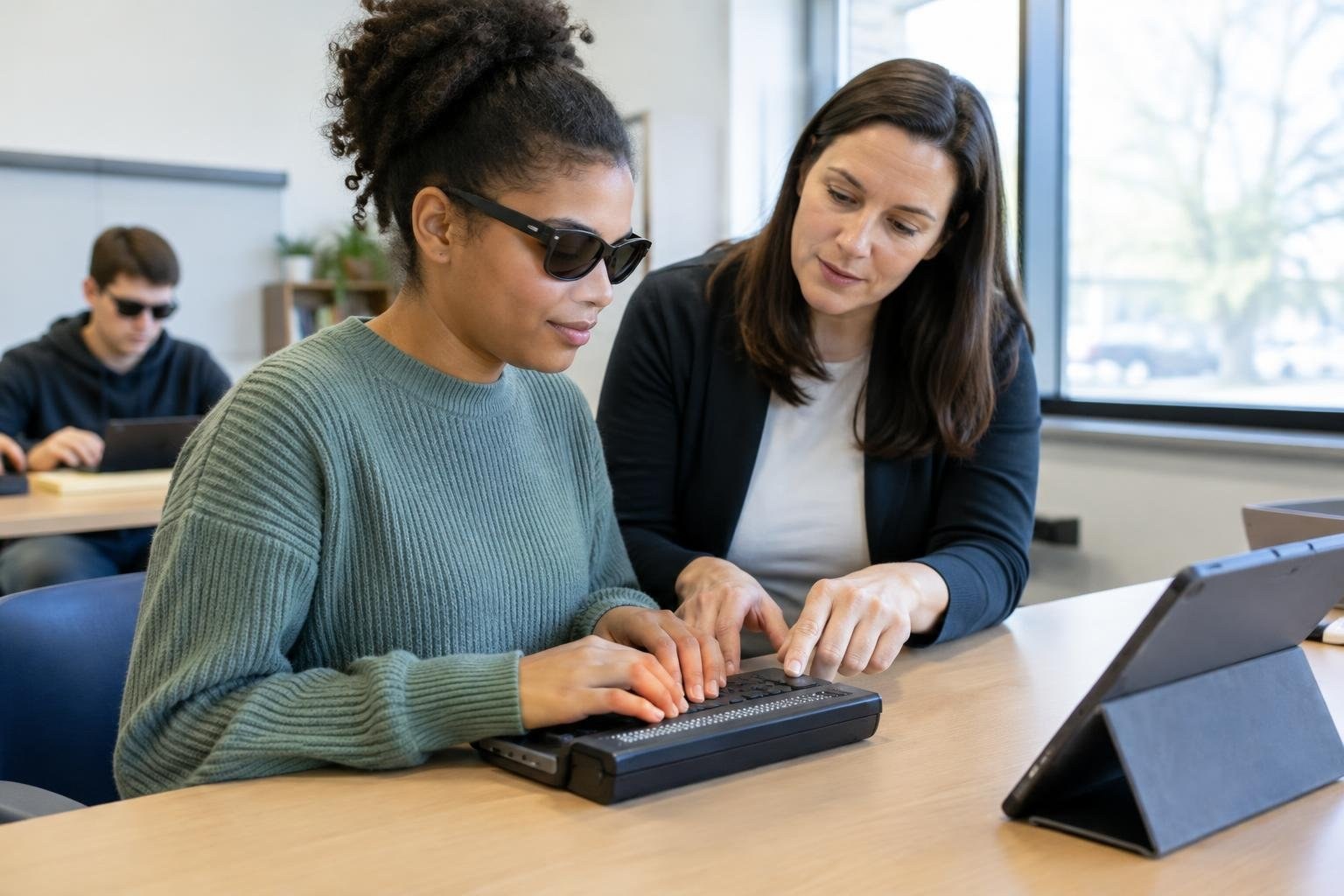
Accessible classroom instruction and assistive technology
What Is a Visual Impairment and Blindness Education Program?
This specialized area of education prepares teachers to support students who are blind or have visual impairments. The work can include identifying educational needs, developing individualized education plans, adapting instruction, counseling students, and understanding laws and policies that affect their education.
Programs may be listed under names such as visual impairment education, blindness education, or teacher of students with visual impairments. The credential may be a post-baccalaureate certificate, graduate certificate, master’s degree, or a combination of graduate study and certification. Similar programs can have different names, so compare course content and the credential each one leads to rather than searching only one phrase.
This field is distinct from general special education because it focuses on learning access and teaching needs related to blindness and visual impairment. It may overlap with broader special education preparation, particularly when students have multiple disabilities.
What Do Students Study?
Coursework is intended to help educators make learning accessible and build students’ skills for school and daily life. Depending on the program, a student may study assessment and educational planning, instructional methods, blindness and low-vision supports, assistive technology, and the needs of learners with additional disabilities.
Some programs emphasize independent living, low-vision efficiency, recreation, social skills, vocational preparation, and transition planning. These topics connect classroom teaching with practical tasks students may need in other settings.
Expect the curriculum to vary by credential and school. Review course descriptions and ask how students practice adapting instruction, work with learners, and receive feedback. A degree title does not tell you by itself which skills or experiences are included.
California State University, Los Angeles describes coursework and preparation centered on independent living, low-vision efficiency, assistive technology, recreation, vocational transition, and social skills. Its program page also lists itinerant, resource-room, special-classroom, and specialized-school roles among possible settings.
Skills and Work the Program Can Prepare You For
Preparation in this field combines teaching with individualized planning. Depending on the curriculum, students may develop skills in accessible instruction, education-plan development, assistive technology, and teaching practical independence skills. They also learn to consider how a student’s learning needs and circumstances affect the way instruction is delivered.
These skills can apply to itinerant teaching, resource-room teaching, and special-classroom teaching. Itinerant roles involve working across settings, while classroom and resource roles provide other ways to deliver specialized instruction. Programs also identify specialized schools for blind and visually impaired children and youth as potential workplaces.
These are possible career directions, not a promise of employment or eligibility. Employers may require a state credential, prior teaching preparation, or other qualifications. Ask program advisers which positions recent graduates are prepared to pursue and which requirements remain your responsibility.
Who Is This Program For?
This path may appeal to people interested in teaching, accessibility, individualized learning, and helping students build academic and practical skills. It can suit prospective educators who want to work closely with learners and adapt instruction to different needs. The work also calls for interest in specialized teaching methods and in coordinating learning supports.
It is not necessary to assume there is one personality type for this work. Consider whether you are comfortable learning about visual access, teaching skills in different ways, and working toward student goals over time. If you are comparing fields, think about whether you prefer direct teaching and student support or another education role with a different focus.
Entry requirements are program-specific
Do not assume that every option is open to applicants with the same background. The sources show graduate programs and a graduate certificate option for experienced educators, but do not establish universal admission rules. Ask each school whether you need a prior degree, a teaching credential, relevant experience, or other prerequisites. Have an adviser review your transcripts before you make a financial commitment.
Use career and degree matching tools to examine how this pathway relates to your interests and other options. A personal-fit assessment can support reflection, but it cannot replace an admissions decision or a state credential review.
Credential Levels, Program Format, and Time to Completion
Options in this specialty include graduate certificates and master’s pathways. At the University of Kentucky, a hybrid Master of Science program offers graduate-level certification options in visual impairments, which candidates may combine with the degree. George Mason describes a master’s program as well as a graduate certificate option for experienced educators. The University of Pittsburgh describes a certificate and MEd pathway, with the MEd portion optional.
Those examples show that a certificate may be pursued on its own or alongside graduate study, depending on the institution. They do not establish a standard program length. Ask each school for its current credit total, course sequence, expected time to finish, part-time options, and rules for transferring prior coursework.
Online and hybrid formats may make some coursework more flexible, but verify how the program handles supervised practice. A page describing a hybrid format does not mean every activity can be completed remotely.
The University of Kentucky program page describes its hybrid MS and certification options. The University of Pittsburgh page explains its certificate and MEd structure.
Admissions, Academic Demands, and Preparation
Admission criteria depend on the school and the credential. Before applying, ask whether the program is intended for new teachers, practicing educators, or both. Find out whether prior teacher preparation or a valid teaching credential is expected, and request a written list of application materials and deadlines.
The academic work may require students to connect education policy, individualized planning, and specialized teaching approaches. Field-based learning may also be part of a preparation route. A useful way to prepare is to read the program sequence, discuss expectations with an adviser, and ask how field placements are arranged and assessed.
Prior experience can affect some requirements. New York’s published rules describe conditions under which certain candidates in graduate programs leading to certification may be exempt from clinical experience requirements, including specified prior preparation, National Board certification, or qualifying teaching experience. That rule is specific to New York; do not apply it to another state or assume it is current without checking with the state education agency.
Tuition, Costs, and Financial Aid
There is no single price for this specialty. Tuition and total expenses depend on the school, credential, study format, and your individual circumstances. Request a written estimate from each institution that separates tuition from required fees and materials. Ask whether fieldwork or travel creates additional expenses.
Compare the full cost of a certificate with the cost of a degree pathway, especially if one option includes graduate coursework you do not need for your career goal. Ask the financial aid office about grants, scholarships, federal aid eligibility, payment plans, and employer education benefits. Availability depends on your circumstances and the school’s policies.
Before borrowing, confirm that the credential aligns with the role and state where you want to work. A less expensive program may not be good value if it does not meet the certification requirements you need. Conversely, avoid paying for an additional credential without confirming that it advances your intended path.
Careers, Work Settings, Pay, and Employment Outlook
Potential roles include teacher of students with visual impairments, itinerant teacher, resource-room teacher, and special-classroom teacher. Public schools, specialized schools for students who are blind, and virtual providers are among the settings described in the available program and career materials. Each employer sets its own qualification requirements.
Teacher preparation may be part of the pathway, but the degree or certificate does not by itself guarantee a position or satisfy every state’s licensing rules. Check job postings in the location where you plan to work and compare their required credentials with each program’s outcomes.
No current national wage or job-growth estimate specific to this specialization is established by the sources cited here, so this guide does not give a salary figure or outlook percentage. Pay and openings can differ by employer, location, and role. Use current Bureau of Labor Statistics data for the relevant broader teaching occupation and local public-sector salary schedules when assessing earnings; verify that the job category is a close match rather than treating a general teacher statistic as a specialty-specific salary.
To understand demand in your area, review recent postings and speak with school districts, specialized schools, and program faculty. A university’s description of substantial demand among its own service area or graduates is informative about that program’s context, not a guarantee of national employment.
Find out which Career or College Major is right for you!
Certification, Licensure, and Supervised Experience
Completing a degree or certificate is not necessarily the same as earning permission to teach. Teaching credentials are governed by state requirements, and a program’s certification option should be checked against the state where you intend to work. Ask the institution for a clear explanation of the credential its program is designed to support, and ask the state agency whether the program and your prior qualifications meet current rules.
New York publishes program-specific standards for teaching students who are blind or visually impaired, including limited circumstances that can affect clinical experience requirements. Other states may set different rules. Get confirmation directly from the relevant certification authority before enrolling.
Internships, Field Experience, and Ways to Stand Out
Ask how a program helps you practice the work, not just study it. Find out how students apply course concepts, how instructional skills are assessed, and whether learning opportunities span different age groups or educational settings. Program emphasis varies, so compare the curriculum and ask faculty how it connects to teaching practice.
Build a record of the skills you develop through coursework and practice. Keep examples of accessible lesson planning, assistive-technology use, and ways you adapted instruction, while protecting student privacy and following placement rules. Ask faculty or mentors which professional learning opportunities are relevant to your goals.
These steps can help you discuss your preparation with employers, but no portfolio, placement, or credential guarantees a job. Confirm each employer’s requirements and follow applicable privacy and professional standards.
Related Degrees and Alternative Pathways
Compare this specialization with other routes based on the students you want to serve and the type of work you want to do.
General special education: Consider this if you want broader preparation for learners with varied disabilities rather than a specific focus on blindness and visual impairment.
Deaf and hard-of-hearing education: Consider this if your intended specialization is accessible teaching for students with hearing differences.
Physical and health impairment education: Consider this if you are more interested in instructional supports associated with physical or health-related needs.
Intellectual disability education: Consider this if you want a specialization centered on intellectual disabilities.
Educational assessment or learning sciences: Consider these areas if you prefer assessment, research, or the study of how people learn over a direct specialized teaching pathway.
These are broad comparison points, not interchangeable credentials. Review course requirements and state certification rules for each option. A candidate who wants to teach students with visual impairments should verify that an alternative program actually prepares them for the required specialty credential.
How to Choose a Program: A Practical Checklist
Use these questions to compare schools before applying:
Credential fit: Which certificate or degree will you earn, and what teaching credential is the program designed to support?
State alignment: Has the state agency where you plan to work confirmed that the program meets relevant requirements?
Curriculum: Does the course sequence cover the student needs and teaching skills relevant to your goals?
Supervised practice: What field experience is included, where does it take place, and who arranges it?
Format: Which coursework is online, hybrid, or in person? Are placements or other activities location-dependent?
Time and transfer: What is the expected completion schedule, and can previous coursework or experience count?
Total cost: What are tuition, required fees, materials, and potential fieldwork expenses? What aid may be available to you?
Outcomes: What roles have graduates pursued, and how does the school define and document those outcomes?
Support: Who advises students about certification, placements, and career planning?
Request answers in writing when possible. Confirm state requirements with the state agency rather than relying only on a recruiter or general program page.
Questions to Ask Before Enrolling
Does this program match the specific role and state credential I am pursuing?
Do I need prior teacher preparation, a current license, or relevant work experience?
What is the complete cost, and which financial aid options can I apply for?
How are supervised field placements arranged, and what will I be expected to complete?
What portion of the program is online, hybrid, or in person?
How long do students typically take to finish, and what happens if I study part time?
Can any previous study or qualifying experience satisfy program requirements?
What career advising and certification guidance can I access?
How will the program help me evaluate whether this student-focused teaching work is a good personal fit?
Take these questions to admissions, an academic adviser, and the relevant certification office. Comparing their answers can reveal differences that program titles and marketing summaries do not show.
Is a Visual Impairment and Blindness Education Program Worth It?
The value depends on your career goal, existing qualifications, local certification rules, and the cost of the pathway. A focused program may be relevant if you want to teach students who are blind or visually impaired and it meets the requirements for the roles you are targeting. Graduate programs and certificates offer different combinations of study, so compare what each includes rather than assuming the longer or more advanced credential is automatically preferable.
Potential drawbacks include the time and expense of additional study and the need to verify state-specific requirements. Do not use an unverified salary claim to justify tuition. Compare current local job postings and pay information for the role, ask programs for documented graduate outcomes, and assess whether the day-to-day work aligns with your interests.
For a realistic pathway, ask a program adviser to map your current education to its entry requirements, field experience, credential outcomes, and expected completion plan. Then compare that map with the state rules for your intended workplace.
Frequently asked questions
What do you learn in a visual impairment and blindness education program?
Programs prepare educators to teach students who are blind or have visual impairments. Topics may include identifying student needs, developing individualized education plans, teaching Braille and independent living skills, using assistive technology, and understanding relevant laws. Coursework and field experiences vary by program and credential.
Do you need a master’s degree to teach students with visual impairments?
It depends on the credential and the state where you plan to teach. Some university pathways combine graduate study with a visual impairment certification option. Check whether the program meets the requirements for the specific teaching certificate you need, and whether you must already hold a teaching credential or complete supervised experience.
Can you earn a visual impairment education credential online?
Some programs offer hybrid or online coursework, but the exact format varies. For example, the University of Kentucky describes a hybrid MS program with graduate-level visual impairment certification options. Ask how the program arranges supervised field experience and whether any activities require in-person attendance.
How much do teachers of students with visual impairments earn?
The sources available here do not establish a reliable national salary figure for teachers specializing in visual impairments. Pay can depend on role, employer, location, experience, and other qualifications. For a useful estimate, check current wage data for the relevant teaching occupation and local school system rather than relying on a degree-specific figure.
Does a visual impairment teacher need a state license or certificate?
Requirements vary by state and credential. New York’s published rules describe program requirements for teaching students who are blind or visually impaired and list circumstances under which certain candidates may be exempt from clinical experience requirements. Confirm current rules with the state agency where you plan to work.
How should I choose a program in blindness and visual impairment education?
Compare the program’s required coursework, certification alignment, supervised practice, delivery format, and total cost. Ask the institution and the relevant state certification office to confirm that the program leads toward the credential you need. A program title alone does not establish that it meets state requirements.
People Also Ask
What does a teacher of students with visual impairments study?
Programs may cover identifying students’ educational needs, individualized education plans, instruction for blind and visually impaired learners, counseling, and relevant laws. Some curricula also emphasize assistive technology, low-vision efficiency, independent living, social skills, and transition to work or adult life. Course details differ by institution and credential.
Where can teachers of students with visual impairments work?
Potential settings include public schools, specialized schools for students who are blind, and virtual providers. Roles described by programs include itinerant teacher, resource-room teacher, and special-classroom teacher. A candidate’s eligibility for a particular position depends on the required license or certificate and the employer’s expectations.
Are there hybrid graduate programs in visual impairment education?
Yes, some universities offer hybrid graduate pathways. The University of Kentucky describes a hybrid MS program with graduate-level certification options in visual impairments. Ask each school how coursework, field experience, and any in-person requirements are delivered.
What other names are used for blindness and visual impairment education programs?
Program names and credential structures differ. Search terms may include visual impairment education, blindness education, teacher of students with visual impairments, and visual impairments certification. Compare the actual curriculum and state certification alignment rather than relying only on a program title.
How much does a visual impairment education program cost?
Request a school-specific estimate that includes tuition, fees, required materials, and fieldwork-related expenses. Then compare grants, scholarships, employer assistance, and other aid you may qualify for before deciding.
Can an experienced teacher complete a graduate certificate instead of a degree?
It may be an option for experienced educators, but eligibility depends on the institution and credential. George Mason describes a graduate certificate option for experienced educators, while other programs pair graduate study with certification. Ask schools to assess your prior education and confirm state eligibility.
A degree or credential in teaching students with visual impairments can prepare educators to teach practical skills, support learning, and adapt instruction for students who are blind or have low vision. The right path depends on your existing education, the credential required where you plan to work, the program’s supervised experience, and whether its cost and format fit your circumstances. Compare state requirements and program outcomes before enrolling, and consider whether this specialized work matches your interests and goals.
Want to see your options? Try our comprehensive Degree, Program & College Search tool
We use cookies to offer you a better browsing experience, analyze site traffic and personalize content.
Read about how we use cookies and how you can control them in our
Privacy Policy.
If you continue to use this site, you consent to our use of cookies.
×
Exciting News!
Be one of the first to Beta Test the new AI-Powered Assessment.com Platform.