Sports Communication Degree Guide: Courses, Careers, Costs, and Fit
Explore sports communication courses, program formats, career paths, costs, and ways to compare degree options before enrolling.
By Tome Fierre · Staff Writer Assessment.com · Published October 6, 2026 · Last updated November 5, 2026
A sports communication degree prepares students to communicate about sports and support communication work within sports organizations. Programs may combine journalism, broadcasting, video production, public relations, and topics related to the business of sports. The exact mix depends on the college and credential. Students may use this study as a starting point for sports media, communications, and public relations work. A degree alone does not guarantee a job, so experience, portfolio pieces, and a clear understanding of the work matter when comparing programs. Not sure whether sports communication fits you? Take the Free MAPP Career Assessment to explore how your motivations, interests, and natural preferences may align with this degree and related careers.
Degree & Program Decision Insights
Explore your personal fit, education requirements, career potential and next steps.
01Motivational Fit
Discover whether this program fits you
Explore your preferences against the focus of Sports Communication. These prompts are not personal MAPP results.
Language and interpretation. How interested are you in the close attention to meaning and expression involved in sports writing?
Breadth of interest. Consider the place of “photography” in this field. Is this another part you would choose to explore, or mainly a requirement you would tolerate?
Work reality. What would an actual workday connected with Sports Communication involve? Investigate the setting and entry requirements separately from your interest in studying the field.
Interest in studying a field can differ from enjoying its related work.
Which part would you want to do repeatedly, and what would you try before deciding?
Discover Your Personal Program Fit
Before investing your time and money in your education, discover how this program aligns with your natural motivations, work preferences and career goals.
U.S. occupational wages are not guaranteed graduate earnings; OEWS excludes self-employed workers.
Projected openings include replacements as well as growth.
U.S. national estimates. A crosswalk does not establish entry-level eligibility; advanced, management and teaching roles can require further qualifications.
Compare the focus and route of these distinct instructional fields; their credentials and admission requirements are not interchangeable.
Sports StudiesCIP 31.0508. Compare its emphasis on theory of sport and sport psychology with this program’s focus.
Sport and Fitness Administration/ManagementCIP 31.0504. Compare its emphasis on program planning and development and business and financial management principles with this program’s focus.
Political CommunicationCIP 09.0904. Compare its emphasis on media effects and political speaking and debating with this program’s focus.
Explore your motivations. Use MAPP as a starting point for reflecting on your interest in “sports writing”, then test that interest against a sample learning task.
Compare actual providers. Ask for the exact credential, course sequence and assessment methods. Compare how each provider teaches “photography”, its entry criteria and its itemized costs.
Check the evidence before applying. Confirm prerequisites and any recognition or professional requirements for your intended route; ask for applicable rules and published outcome definitions in writing.
Verify the institution’s current offering, admissions requirements and outcomes; a search result does not establish your eligibility.
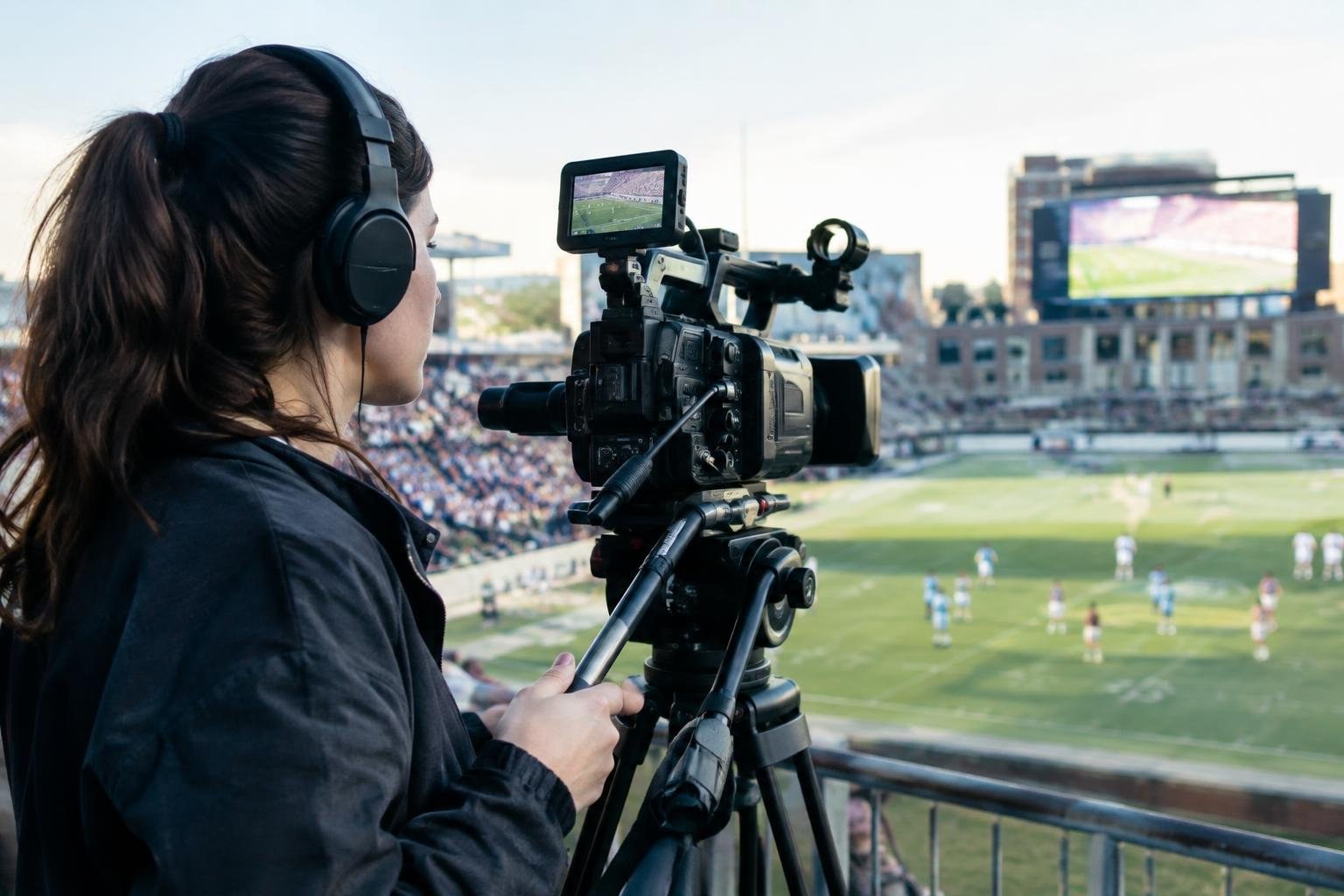
Sports media production in an educational or event setting
What Is a Sports Communication Degree?
Sports communication is an academic field focused on creating and sharing information about sports and communicating for sports-related organizations. It can connect journalism and media production with public relations and strategic communication. Program names vary: a college may offer a sports communication major, a sports media degree, a concentration within a broader communication program, or a certificate.
The label alone does not tell you what you will learn. One curriculum may put more weight on broadcast journalism and video; another may focus on public relations or sports business. For example, Hofstra describes its sports media bachelor’s program as drawing on multiple disciplines and combining professional experience with coursework in journalism, television, public relations, and strategic communication. (Source: Hofstra University.)
Sports communication also differs from studying sports management alone. Communication programs center on messages, media, and audiences, while sports business content may be part of some curricula. Read the course list and project requirements instead of assuming programs with similar names have the same emphasis.
What Do Sports Communication Students Study?
What You Study and What You Learn
Sports communication programs may include courses in broadcast journalism, sports entertainment, video production, public relations, and the business of sports. The program descriptions in the research show that the mix varies. A certificate at SUNY Buffalo State, for example, is described as a set of courses intended to strengthen credentials for sports-related journalism, public relations, and media production careers.
In practical terms, journalism and broadcasting courses can help students learn to prepare information for an audience; production coursework can introduce the creation of video or other media; and public relations study can address communication for an organization. The specific assignments and tools depend on the program, so ask to see sample course descriptions and examples of student projects.
Some programs bring together several departments or connect coursework with professional settings. Hofstra describes a curriculum spanning journalism, television, public relations, and strategic communication alongside professional experience. That is one example, not a promise that every sports communication program includes an internship or the same kind of production work.
Before applying, find out whether students write, record, edit, plan campaigns, or complete other work relevant to their interests. A list of course titles is useful, but the actual projects can help you judge whether you will graduate with evidence of your skills.
Skills Sports Communication Students Can Build
Skills You Can Develop
The potential skills depend on the curriculum and the effort a student puts into projects and experience. Coursework and practice in journalism, broadcasting, and video production can help students develop media and content skills. Public relations and strategic communication study can build experience in shaping messages for an organization or audience.
Students should also pay attention to transferable abilities: writing clearly, speaking to different audiences, meeting deadlines, working with feedback, and collaborating on a production or communication project. These are practical goals to look for in assignments, rather than abilities that a degree automatically guarantees.
Connect each skill to an example of work. A student interested in journalism might seek reporting or broadcast samples; someone drawn to public relations could build examples of written communication or campaign planning; a student interested in production could ask about opportunities to create video. Confirm that the program has the equipment, instruction, or experience opportunities needed for the work you want to practice.
Who Is a Sports Communication Degree Best For?
Who May Find This Field a Good Fit?
Sports communication may appeal to students who enjoy sports and also want to explain, report on, produce, or promote information about them. Interest in sports by itself is not enough to establish fit: the day-to-day work may involve writing, production, public-facing communication, or organizational messaging, depending on the career and program.
Think about what you like doing, not only what subject you like following. Do you prefer interviewing and reporting, creating video, communicating on behalf of an organization, or exploring how sports organizations work? Are you willing to revise work after feedback and build examples of your abilities? These questions can help distinguish interest in sports from interest in communication work.
There is no single personality type required. Compare your preferences with real course assignments and entry-level job descriptions. Students who are unsure can use Assessment.com’s MAPP Career Assessment, Degree Matching, and Career Matching resources to explore related directions, then verify program and career requirements independently.
Admissions, Time, and Academic Demands
Admission rules are set by individual colleges, not by the general field. Requirements may differ by credential and institution. Check the school’s official admissions information for prerequisites, application materials, transfer-credit policies, and any portfolio, interview, or experience requirements. Do not assume that one college’s rules apply to another.
The research identifies multiple credential levels, from certificates and associate’s degrees through bachelor’s, graduate, and doctoral study, but does not establish a standard number of credits or completion time for each. Ask for the published degree plan and a completion estimate based on your enrollment pace and transfer credits. If you are an adult learner or changing careers, confirm whether previous coursework can count toward the program.
Academic demands depend on emphasis. Journalism and media production involve different kinds of assignments from public relations or sports business coursework. Before committing, review course descriptions and ask current students or advisers about the amount of writing, production practice, group work, and scheduled attendance. Planning around work, family, and course deadlines can make a program more manageable.
Can You Study Sports Communication Online?
Online, Hybrid, and Campus Programs
Sports communication study may be available in different formats. The University of North Dakota describes a sports communication certificate offered online or on campus. A separate sports journalism program listing describes online study that includes live classes and an in-person training week in Madrid. These examples show why the word “online” is not enough to determine whether a program fits your schedule.
Ask whether online classes are live or self-paced, whether any course or training requires travel, and whether you need access to specific production equipment or facilities. Check the calendar for required attendance and find out whether an internship or professional experience is optional, arranged by the school, or something students must secure themselves. Include equipment, travel, and time away from work in your comparison.
For campus-based study, look at access to relevant facilities and opportunities to participate in media projects. For any format, get the details in writing before enrolling, especially if you are choosing online study to balance education with work or family responsibilities.
Sports Communication Degree Costs and Financial Aid
Cost, Financial Aid, and Affordability
The available program descriptions do not provide a common tuition figure that would apply across colleges. Your total cost depends on the school and program, how many credits you need, your enrollment pace, and any expenses tied to technology, production, travel, or campus attendance. Request an itemized estimate for the full program rather than comparing tuition alone.
Ask the financial aid office about grants, scholarships, loans, work-study eligibility, payment plans, and whether aid applies to the specific credential you are considering. Students who already hold college credits should ask for a transfer evaluation before paying a deposit. If you are working, check whether your employer offers education assistance and whether the program’s schedule makes it practical to keep earning income.
For a realistic comparison, calculate the amount you would pay after confirmed aid, include required fees and equipment, and consider the cost of travel or reduced work hours. Do not base a borrowing decision on a broad promise about career outcomes. Compare the program’s actual requirements and the jobs you intend to pursue.
Sports Communication Careers and Job Outlook
Find out which Career or College Major is right for you!
Sports communication can relate to work in sports journalism, broadcast journalism, video production, public relations, and communications for sports organizations. The available career overview also identifies sports entertainment and sports management as areas connected with the subject. These are broad directions, not guaranteed outcomes of completing a particular credential.
Career direction
How study may apply
What to investigate
Sports journalism
Journalism study can help prepare students to report and communicate sports information.
Review writing, reporting, and broadcast opportunities and compare current job requirements.
Broadcast or sports media
Broadcast journalism and television coursework may relate to media roles.
Ask what production assignments, facilities, and work samples students can build.
Video production
Video production coursework can support media-making skills.
Check the equipment and software students use and how projects are assessed.
Sports public relations
Public relations study can relate to communication work for sports organizations.
Look for applied writing, strategic communication, and professional experience.
Sports organization communications
A combination of media, public relations, and sports-business study may be relevant.
Compare the actual duties and education expectations of specific employers.
Sports media and communications roles can differ substantially in duties and hiring expectations. Search current postings in the geographic areas where you may work. Check the required experience, portfolio, software knowledge, and education for each role. For salary and outlook, use current occupation-specific U.S. Bureau of Labor Statistics or O*NET information rather than treating one figure as the expected pay for every sports communication graduate.
A University of North Dakota program page reports a 24.5% increase in sports communication bachelor’s programs from 2019 to 2023, citing IPEDS data. This describes reported program growth, not employment growth, job openings, or an individual graduate’s chance of finding work. Interpret it accordingly.
Experience, Portfolios, and Certifications
Experience, Portfolios, and Credentials
Practical experience can help you show what you can do beyond listing a degree. Ask whether a program includes professional experience, internships, student media, production assignments, or other opportunities. Hofstra describes professional experience as part of its sports media degree, but that does not mean every program offers the same placement or structure.
Build work samples that match your direction. Depending on the program and your goals, these might include reporting, broadcast, video, or public relations work. Keep track of your role on group projects and be prepared to explain how you contributed. Seek feedback from instructors and professionals, and revise samples before sharing them with employers.
Do not assume that a certificate, degree, or course automatically provides a professional license. The sources describe academic credentials and career preparation, not a universal sports communication license. If an employer or role asks for a specific credential, verify the requirement with that employer or the relevant organization.
How to Stand Out to Employers
Choose projects that demonstrate the kind of communication work you want to do.
Ask how your program connects students with professional settings or applied work.
Keep a clear, current portfolio and describe your contribution to each project.
Compare job postings regularly so you can target experience to real requirements.
Graduate School and Alternatives to Sports Communication
Graduate Study and Related Degrees
Further study can make sense when it serves a clear academic or career goal. The available research includes graduate-level sports journalism study, including an online format with live classes and an in-person training week described by the program listing. That is one example of a specialized graduate route, not a requirement for every career in sports communication.
Related undergraduate paths can include communication, journalism, public relations, media production, and sports management. Consider communication or public relations if you want broader study of organizational messaging; journalism if reporting is your central interest; media production if you want to concentrate on creating media; or sports management if business and organizational topics are more appealing. Program content varies, so compare course plans rather than relying on degree titles.
A certificate may be useful for focused coursework or as an added credential alongside another area of study. SUNY Buffalo State describes its sports communication certificate as supporting careers involving sports-related journalism, public relations, and media production. Ask employers and advisers whether a certificate, full degree, or portfolio is most relevant for your intended role before investing in another credential.
How to Choose a Sports Communication Program
Start with the work you hope to do, then test whether the curriculum supports it. Compare course requirements, project types, access to equipment, practical experience, and the balance of journalism, production, public relations, and sports-business content. A program title is not a substitute for a course-by-course review.
Curriculum: Which courses are required, and do they match your preferred direction?
Applied learning: What projects or professional experiences can students complete?
Format: Are classes online, in person, or hybrid, and are there live sessions or required travel?
Cost: What is the full estimated cost, including fees, equipment, and travel?
Transfer: Will previous credits count, and can you get a written evaluation?
Career support: What portfolio guidance, advising, and employer connections are available?
Accreditation: What institutional or program accreditation applies, and can you verify it with the accreditor?
Outcomes: What information does the school share about completion and graduates’ work?
Do not treat a school’s marketing claims as a substitute for documented information. Ask for answers in writing, speak with an adviser who understands the program, and contact the financial aid office about your specific circumstances. Assessment.com’s education-matching resources can help you explore options, but confirm every program detail directly with the college.
Questions to Ask Before Enrolling
Questions to Ask Before You Enroll
Use these questions when comparing schools with your family or an adviser:
What credential will I earn, and what courses are required?
What is the total estimated cost after confirmed financial aid?
Are equipment, travel, or in-person sessions required?
What kinds of media, journalism, or public relations work will I complete?
Are internships or professional experiences available, and who arranges them?
How are transfer credits evaluated?
What accreditation applies to the institution or program, and where can I verify it?
What career advising, portfolio review, or employer connections are offered?
What do local job postings require for the roles I hope to pursue?
Can I manage the format and schedule alongside work and family responsibilities?
Write down the answers and compare programs on the same criteria. A low advertised price may not represent total cost, and a broad career claim may not tell you what graduates actually do. Verify both the academic details and the practical conditions before making a decision.
Is a Sports Communication Degree Worth It?
Whether the degree is worth the investment depends on your goals, the program’s total cost, and the opportunities it gives you to develop and demonstrate relevant skills. Its value may be clearer for a student who wants structured study in sports media or communications and has a plan to build practical work samples. It may be less compelling if the curriculum does not match the intended career or if the cost cannot be justified by the student’s broader education and career plan.
Before deciding, compare the degree with a certificate or a broader program in communication, journalism, public relations, or media production. Check current job postings for the roles you are targeting, including their education and experience expectations. Consider whether a part-time or online option would make completion more manageable, and verify any in-person requirements.
Do not choose only for the promise of working in sports. Choose a program because its real curriculum, cost, and learning opportunities fit your plans, and because you are interested in the communication work itself.
Frequently asked questions
What is a sports communication degree?
Sports communication is the study and practice of communicating about sports and within sports organizations. Programs may combine journalism, broadcasting, video production, public relations, and sports business topics. Depending on the school, it may be offered as a major, concentration, or certificate.
Is sports communication a hard major?
It can be challenging for students who are uncomfortable with writing, deadlines, production work, or frequent feedback. The specific workload varies by program. Before enrolling, review sample assignments and ask whether the curriculum includes reporting, video, public relations, or other areas that match your interests.
What jobs can I get with a sports communication degree?
Possible directions include sports journalism, broadcast or video production, public relations, and communications work for sports organizations. A degree does not guarantee a particular job. Relevant experience, work samples, communication skills, and the roles available in a student’s preferred location can affect their options.
How much can you make with a sports communication degree?
Pay depends on the occupation, employer, experience, and location. Sports communication covers several kinds of work, so a single degree-wide salary figure would not describe every graduate’s prospects. Compare current pay data for specific occupations you are considering and check whether the figures refer to entry-level or experienced workers.
Can you earn a sports communication degree online?
Some sports communication learning can be delivered online, but formats differ by program. Ask whether courses require studio access, equipment, scheduled live sessions, in-person activities, internships, or other campus visits. Get any required travel and equipment costs in writing before you enroll.
Does sports communication require a lot of math?
Writing and clear communication are central to many paths in this field. The sources reviewed for this guide do not establish one math requirement for all programs. Check each school’s degree plan and admissions requirements for general education, statistics, business, or other quantitative courses.
Do you need a master’s degree for sports communication jobs?
Graduate school is not automatically required for every sports communication career. Whether it makes sense depends on the role you want, your existing education, and whether advanced study provides a specific skill or credential you need. Compare job requirements before taking on the additional cost and time.
What is the difference between a sports communication certificate and a degree?
A certificate can supplement another degree or provide focused study in sports-related journalism, public relations, and media production. A bachelor’s program may offer broader study and more time for coursework and practical projects. Compare the curriculum, total cost, and employer expectations for your intended roles.
How is sports communication different from sports management?
Sports communication may emphasize journalism, broadcasting, video, public relations, and communication in sports settings. Sports management generally points toward business and management topics, though programs may overlap. Compare course lists and likely work tasks rather than relying on the program name alone.
How should I choose a sports communication program?
Prioritize programs with relevant coursework, opportunities to produce work samples, clear costs, and a format you can complete. Ask how students gain experience, what career support is offered, and whether the program’s curriculum matches the roles you are targeting. Verify accreditation and transfer policies directly with the institution.
People Also Ask
What do you study in sports communication?
Sports communication programs may cover sports journalism, broadcast journalism, video production, public relations, and sports business topics. Some programs emphasize media production, while others combine communication with sports management or strategic communication. Review the required courses and project work at each school to see the actual balance.
What degree levels are available in sports communication?
The credential options in the research include certificates, associate’s and bachelor’s degrees, post-bachelor’s and graduate certificates, master’s degrees, and doctoral or first-professional study. Availability and purpose vary by institution. Many students should begin by identifying a target role, then checking what education employers expect for that work.
How long does a sports communication degree take?
Program length depends on the credential, enrollment pace, transfer credits, and school requirements. Ask each college for its credit requirements and a realistic completion plan for full-time, part-time, and transfer students.
Does sports communication require a license?
A sports communication credential is not itself evidence of professional licensure. The programs described in the available sources focus on journalism, public relations, media production, and communication. If a particular job asks for a license or certification, confirm that requirement with the relevant employer or credentialing organization.
How can I gain experience while studying sports communication?
Look for classes and projects that develop the work you want to do, along with practical experience in professional settings where available. For example, a program that combines journalism, television, public relations, and strategic communication may offer several kinds of preparation. Ask how students access equipment, internships, and career guidance.
Is sports communication a growing major?
A University of North Dakota program page reports that sports communication ranked among the fastest-growing bachelor’s degree programs, citing IPEDS degree data and a 24.5% increase from 2019 to 2023. That statistic concerns degree-program growth, not a job-growth forecast or a guarantee of employment for graduates.
Sports communication can suit students who want to tell sports stories, produce media, or support sports organizations through public relations and strategic communication. The degree’s practical value depends on the experience and work samples students build, the program’s cost and format, and the roles they want to pursue. Compare several programs, ask what students actually produce, and consider whether the day-to-day work fits your interests before enrolling.
Want to see your options? Try our comprehensive Degree, Program & College Search tool
We use cookies to offer you a better browsing experience, analyze site traffic and personalize content.
Read about how we use cookies and how you can control them in our
Privacy Policy.
If you continue to use this site, you consent to our use of cookies.
×
Exciting News!
Be one of the first to Beta Test the new AI-Powered Assessment.com Platform.