Degree Library
Veterinary Physiology Degree Guide: Courses, Careers, Requirements & Fit
A veterinary physiology degree explores how animal bodies function, including their systems, health, and responses to disease. Learn what students study, possible career paths, program choices, costs, and how to assess whether this science-focused field fits your goals.
Veterinary physiology is the study of how animal bodies work: how organs and biological systems function, interact, and respond to health challenges. Colleges may offer it as a focus within veterinary science, animal science, or veterinary and biomedical sciences rather than as a degree with the exact title “veterinary physiology.” Students typically build a foundation in biology and chemistry before studying topics such as physiology, nutrition, genetics, animal health, and disease. Depending on the program, hands-on learning may include laboratory, farm, or research experience. Graduates may pursue animal-related science and agricultural work or continue into veterinary or graduate education. A bachelor’s degree by itself does not make someone a veterinarian. Not sure whether this subject fits you? Take the Free MAPP Career Assessment to explore how your motivations, interests, and preferences align with this area of study and related careers.
Millions of people Take the MAPP Career assessment to see which Degrees are the best Match!
You can too,
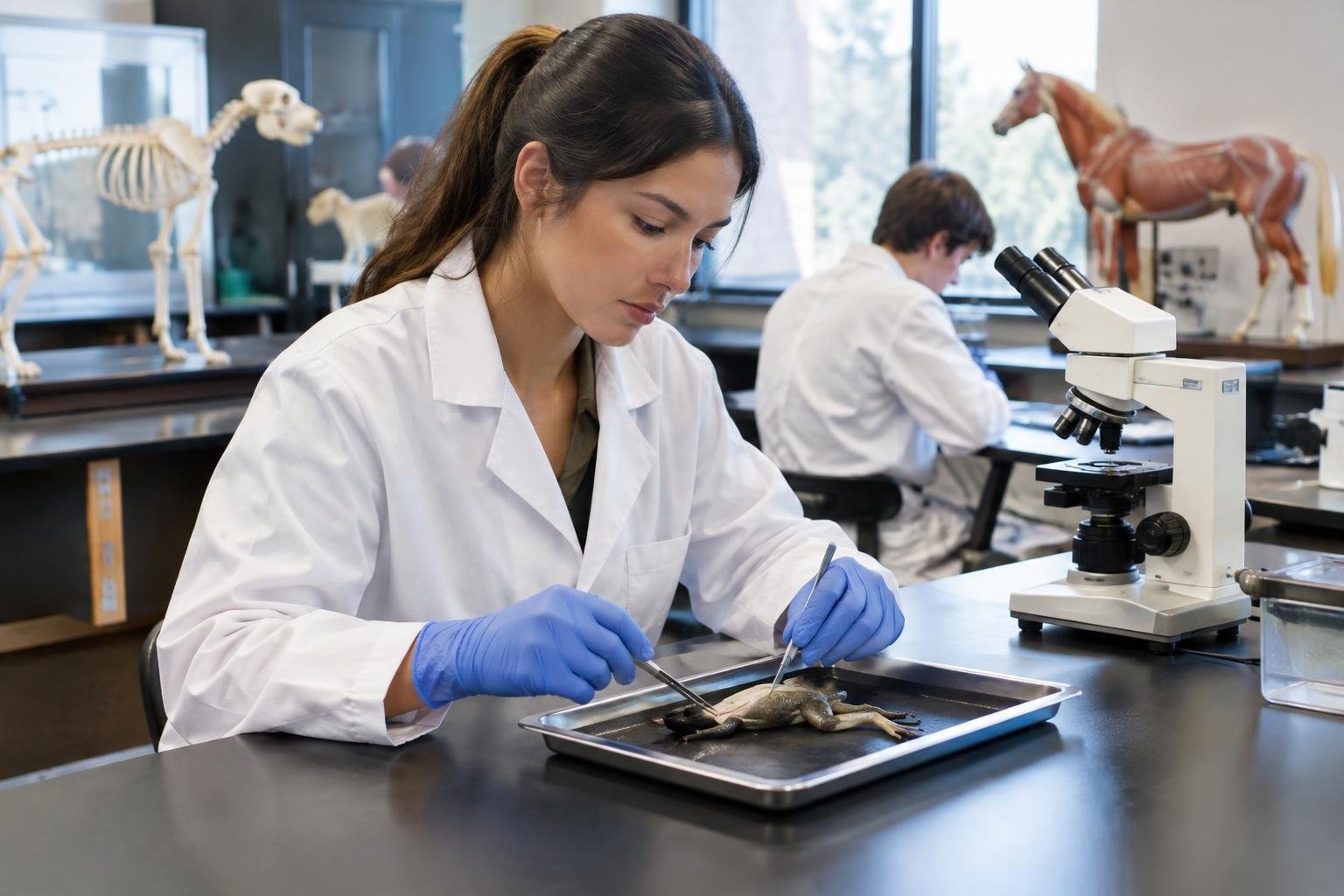
What Is a Veterinary Physiology Degree?
Veterinary physiology examines how animal bodies work, from individual organs and tissues to the interactions among body systems. It applies biological and chemical principles to understanding normal function, health, and responses to disease.
The exact credential can be called veterinary science, veterinary and biomedical sciences, animal science, or a related title. Veterinary physiology may appear as a course sequence, specialization, or research focus inside one of these programs. Before applying, look beyond the title and compare the required courses and hands-on opportunities.
Related areas have different emphases. Animal science can include nutrition, genetics, reproduction, animal production, and management. Veterinary science may prepare students for animal-health careers or veterinary school prerequisites. Biomedical sciences may emphasize laboratory and disease research. These boundaries are not identical at every college.
What the program includes: typically a science foundation followed by increasingly specialized study. For example, the University of Kentucky describes animal sciences coursework spanning animal biology, nutrition, genetics, physiology, and health, with laboratory and farm learning opportunities.
What Do You Study? Courses and Practical Learning
Course plans differ by school, but students commonly start with foundational biology and chemistry before taking more specialized courses. Relevant subjects may include animal physiology, nutrition, genetics, reproduction, animal health, microbiology, and animal production. Some programs include biochemistry, immunology, pathology, or toxicology, especially at the graduate level.
The goal is not simply to memorize anatomy. Students learn to explain how systems function, interpret scientific evidence, connect biological processes with health, and communicate results. Depending on the program, learning may include laboratory activities, supervised farm experience, faculty research, or a capstone project.
What to check: ask whether lab courses are required, how animal-related activities are supervised, whether internships or research are available, and how practical work is assessed. A university catalog and current degree plan are more reliable than a broad program description because requirements can change.
For example, Utah State describes foundational study in nutrition, genetics, reproduction, physiology, animal health, and production, while the University of Arizona lists topics including anatomy, physiology, microbiology, disease ecology, and pathology in its veterinary science program.
Skills You Can Develop
Students develop scientific reading, observation, data interpretation, and clear writing skills. Laboratory courses can build familiarity with research methods and careful recordkeeping. Courses in animal biology, physiology, and health help students understand how living systems work; genetics and nutrition can support work related to animal populations and care.
Practical animal experience may help students learn safe, attentive handling and how to work within established care procedures. Group projects and research can build collaboration, planning, and communication. These skills may be useful in research teams, animal-related industries, agriculture, and preparation for professional or graduate education.
Ask colleges what equipment, research settings, animal facilities, and software students actually use. Do not assume a program includes a specific technique or technology unless it appears in the curriculum or the department confirms it.
Who Is This Degree Best For?
This field may appeal to students who are curious about animal biology and enjoy asking why a body system behaves as it does. You may like close observation, evidence-based problem-solving, and learning through both concepts and practical activities. Patience with detailed science coursework is helpful.
There is no single personality type required. Some students are drawn to research; others are interested in animal health, agriculture, or veterinary school preparation. Consider whether you enjoy biology and chemistry, how you feel about laboratory work, and whether you are comfortable with the responsibilities and realities of working around animals.
Does Veterinary Physiology Match You?
Salary, reputation, and employment projections are only part of a degree decision. Your interests, preferred work environment, tolerance for additional education, and motivation to study life sciences matter too. The Free MAPP Assessment can help you reflect on personal fit; Degree Matching and Career Matching can help you explore related educational and occupational directions. Treat these tools as inputs, not guarantees.
Admissions, Length, and Academic Difficulty
Admissions requirements are set by each college. For undergraduate study, review high-school preparation, application materials, transfer-credit rules, and any required introductory science courses. Some programs admit students to a general major first and have separate requirements for a concentration or professional-school pathway. Do not assume that a pre-veterinary emphasis guarantees admission to veterinary school.
Time to completion depends on credential level, credits accepted, course availability, full- or part-time enrollment, and whether required lab or research courses are offered on a particular schedule. Ask for a degree map that reflects your transfer credits and intended course load instead of relying on a generic estimate.
Students often find sequential science courses, lab reports, and balancing practical experience with coursework challenging. Prepare by strengthening study habits, checking prerequisite sequences early, meeting an academic advisor, and seeking tutoring or faculty help before you fall behind.
Online, Hybrid, or On Campus?
Online availability depends on the institution and on what the program requires. Lecture courses may be offered remotely in some programs, while laboratories, research, animal handling, or farm-based learning may involve in-person attendance. Hybrid programs combine formats, but the label does not tell you which activities can be completed remotely.
Before enrolling, request a written list of required campus visits, lab sessions, research experiences, internships, and any location restrictions. If you are balancing college with work or family responsibilities, ask how often in-person activities occur and whether they are offered at times you can attend.
Cost, Financial Aid, and Budget Planning
There is no single reliable tuition figure for veterinary physiology because programs differ by institution, residency classification, credential, and enrollment format. Compare the full estimated cost, not just the advertised per-credit rate. Include tuition, mandatory fees, books, laboratory costs, equipment, travel to campus or a practical placement, and living expenses.
Ask each college for a term-by-term cost estimate and find out whether fees change for lab courses or distance learners. Check eligibility for federal student aid, institutional scholarships, grants, and employer tuition support. Transfer credits can reduce repeated coursework, but confirm how they apply to the major before making a decision.
For families considering veterinary school after an undergraduate degree, plan for the additional education costs as a separate part of the budget. Financial planning guidance for veterinary education recommends reviewing federal aid options, scholarships, budgeting, and borrowing before making decisions. Compare the full pathway cost with realistic career plans rather than considering only the first credential.
Careers, Pay, and Employment Outlook
A degree title does not lead to one fixed occupation, and earnings depend on the actual job, region, employer, experience, and education level. Use the U.S. Bureau of Labor Statistics Occupational Outlook Handbook and O*NET to check current pay and outlook for a specific occupation. Do not treat a major’s name as a salary estimate.
| Career direction | Typical preparation to investigate | How the degree may apply |
|---|---|---|
| Animal or agricultural research support | Relevant science coursework and practical or laboratory experience; requirements differ by employer | Physiology and research skills can provide a useful foundation |
| Animal production or related industry roles | Degree focus and hands-on experience vary by position | Animal health, nutrition, genetics, and production knowledge may be relevant |
| Veterinary school applicant | Completion of each veterinary school’s prerequisite and admissions requirements | Some veterinary science and animal science programs are designed to support preparation for professional study |
| Veterinarian | Professional veterinary education and applicable state licensure | An undergraduate degree may be preparatory but is not sufficient by itself |
| Graduate researcher or academic | Advanced study may be required, depending on the role | Physiology and biomedical science can support further specialization |
Higher-responsibility research, teaching, and professional roles may require advanced credentials or substantial experience. The precise pathway varies; verify requirements with employers and professional programs.
Animal-health and agricultural work can involve laboratory, farm, government, business, or academic settings. Technology and automation may change data collection and routine processes, but students still benefit from sound scientific judgment, careful observation, and communication. Avoid assuming that any degree guarantees a job or a particular salary.
Find out which Career or College Major is right for you!
Take the MAPP free today!Experience, Credentials, and Professional Requirements
Relevant experience can help connect coursework with an intended career. Ask about undergraduate research, supervised work with animals, internships, farm experience, and projects that produce evidence of your skills. Student organizations and faculty relationships can also help you learn about fields and opportunities.
How to Stand Out to Employers
- Keep a clear record of research, lab, farm, or animal-related experience.
- Describe your role, methods, responsibilities, and what you learned in concrete terms.
- Build reliable communication, teamwork, and data-handling habits.
- Ask employers which experience or credentials they value for a particular opening.
A degree is not the same as professional licensure. If you want to become a veterinarian, check veterinary school prerequisites and state licensing requirements; do not assume an undergraduate program provides either automatically. For other work, ask the employer or relevant professional organization whether a credential is necessary or merely helpful.
Graduate School and Further Education
Graduate study can make sense for students who want deeper research training or a specialized career in physiology, nutrition, microbiology, pathology, toxicology, or a related area. A master’s or doctoral program may be relevant for some research or academic roles, but requirements vary by employer and position. Veterinary school is a separate professional path, not simply another name for a veterinary physiology graduate degree.
Before applying, identify the work you want to do and look at the education of people currently doing it. Then compare program prerequisites, research fit, funding, expected time, and career outcomes. Penn State’s veterinary and biomedical sciences graduate programs, for example, include areas such as immunology, microbiology, nutrition, biochemistry, pathology, physiology, and toxicology.
Related Degrees and How to Compare Them
Compare veterinary physiology-related study with alternatives based on course requirements and your destination, not titles alone:
- Animal science: consider this if you want a broader focus that may include animal production, nutrition, genetics, and management.
- Veterinary science: consider this if you want animal-health coursework and possible preparation for veterinary school or related science work.
- Veterinary and biomedical sciences: consider this if human and animal health, disease, or laboratory science interest you.
- Biology: consider this if you want a broad study of living organisms beyond animal-focused applications.
- Biochemistry: consider this if you want a more chemistry-centered study of biological processes.
- Animal behavior or zoology: consider these if animal behavior, ecology, or species-focused study attracts you more than body-system function.
Veterinary physiology versus animal science is not a uniform comparison: one college may place physiology at the center of a program, while another offers it as a course within a wider major. Review course lists, hands-on learning, graduate-school prerequisites, and employment preparation side by side.
Advantages, Drawbacks, and Is It Worth It?
Potential advantages: the subject combines animal biology with applied science; programs may offer practical or research experience; and the coursework can support different next steps, including animal-related work and further education.
Potential drawbacks: science sequences can be demanding; not every college offers a stand-alone veterinary physiology degree; hands-on components may limit fully remote study; and some desired careers require more education or specific credentials. Career outcomes can also differ significantly by specialization and location.
Whether it is worth it depends on the total cost, the program’s quality and practical opportunities, your intended occupation, and whether additional education is part of your plan. Ask a college for outcome information and speak with professionals in roles you are considering. Compare those answers with current occupation data before deciding.
How to Choose a Veterinary Physiology Program
Compare programs using a consistent checklist rather than choosing by name or location alone:
- Curriculum: Do required courses match your interests and career plans?
- Practical learning: Are labs, supervised animal experience, research, or internships available?
- Faculty and facilities: Can students learn from instructors working in relevant subjects, and are facilities appropriate for the program?
- Cost and aid: What is the estimated total cost after grants and scholarships?
- Format: Which activities require campus or off-campus attendance?
- Outcomes: What information does the college provide about completion, further study, and employment?
- Transfer and prerequisites: Will previous credits count, and are science courses sequenced?
- Career support: What advising, internship connections, and job-search resources are available?
Ask for answers in writing when they affect your budget or timeline. Assessment.com’s Degree Matching and Career Matching tools can be one way to explore options, alongside direct research with schools and employers.
Signs This Field May Be Worth Exploring
Some practical signs that this subject deserves a closer look: you repeatedly choose animal biology or health topics; you enjoy understanding mechanisms rather than only memorizing facts; or you want to investigate science pathways connected to animals. These are reasons to explore, not proof that a major is right for you.
Warning signs to investigate include disliking required biology and chemistry, expecting an undergraduate degree to qualify you as a veterinarian, or choosing a program without checking its actual courses and hands-on requirements. If you are uncertain, compare introductory course descriptions, speak with an academic advisor, and interview people working in your target occupations.
Parents and students can use the same checklist: What does the student want to learn? What jobs or next degrees are realistic? What will the full pathway cost? Which parts of the work sound motivating, and which may be difficult to sustain?
What Affects the Program Experience?
Program factors that can change a student’s experience include whether physiology is a major focus or one part of a broader degree, availability of laboratory and research opportunities, required in-person participation, course sequencing, and access to faculty advising. Your transfer credits and part-time or full-time schedule also affect the time and cost of completion.
Ask how students obtain practical experience, whether opportunities are open to undergraduates, and what prerequisites apply. Do not infer that a school has a particular farm, laboratory, internship placement, or employer partnership unless the department confirms it. Compare what is guaranteed in the curriculum with opportunities that are optional or competitive.
What to Expect: Planning and Timing
After admission, expect to map prerequisites and required courses with an advisor, then plan for a mix of lectures, science coursework, and any program-specific laboratory or practical learning. Research, internships, and animal experience may be optional, limited by availability, or scheduled outside ordinary class hours, so clarify expectations early.
Ask for a course sequence and likely completion timeline that accounts for your starting credits. Find out how missed or full courses affect progress, when practical requirements take place, and what support is available if a science course proves difficult. A clear plan makes it easier to coordinate study, work, family commitments, and costs.
Permits, Credentials, Warranties, and Safety
Before enrolling, confirm the exact credential the college awards and whether its curriculum is intended to cover prerequisites for your next step. Cal Poly Pomona describes its pre-veterinary option as designed to help students meet veterinary-school admission requirements, but students should check the requirements of each school they may apply to.
Programs may include hands-on work in laboratories, on farms, or with animals. Ask the department what safety training, supervision, and procedures apply before participating. The University of Kentucky describes laboratory and farm learning, while Utah State describes hands-on livestock experience.
Ask the college about requirements for any off-campus placement or animal-related activity before committing. A degree program is not a warranty of admission to veterinary school or a particular career outcome; compare the curriculum and stated requirements with your own goals.
Frequently asked questions
What is veterinary physiology?
Veterinary physiology focuses on how animal bodies function, including their organs, biological systems, and responses to health conditions. It is often studied within a veterinary science, animal science, or biomedical sciences program rather than as a stand-alone undergraduate major. The exact program name and curriculum vary by college.
Is veterinary physiology hard?
It can be challenging because students may take courses in biology, chemistry, physiology, microbiology, and other sciences. Laboratory work and detailed study of biological systems can require sustained effort. Difficulty depends on your preparation, the program’s expectations, and the support and study habits you develop.
What jobs can I get with a veterinary physiology degree?
Possible paths include research support, animal health and production roles, laboratory work, and preparation for veterinary or graduate school. The degree title alone does not qualify someone to practice as a veterinarian. Check the education, experience, and credentials required for each specific job.
How much can you make with a veterinary physiology degree?
There is no single salary for this field because veterinary physiology is offered under different program names and graduates enter varied occupations. Pay depends on the job, education level, experience, employer, and location. Compare current wage data for specific occupations through the U.S. Bureau of Labor Statistics and O*NET.
Can I earn a veterinary physiology degree online?
Some coursework may be online, but the format depends on the college and program. Science degrees can include laboratory, research, or animal-related experiences that may require in-person participation. Ask the program which courses and practical requirements can be completed remotely before enrolling.
Does veterinary physiology require math?
Many programs require substantial biology and chemistry, and some include statistics, biochemistry, or other quantitative coursework. Requirements vary by institution and curriculum. Review the published degree plan and ask an academic advisor which math and science courses are required before you commit.
Do I need graduate school after veterinary physiology?
A bachelor’s degree may prepare you for some animal-related, agricultural, or science roles, but advanced research and academic positions may require graduate study. Becoming a veterinarian requires further professional veterinary education and applicable state licensure. Research the exact requirements for your intended career.
How is veterinary physiology different from animal science?
Veterinary physiology and animal science overlap in subjects such as animal biology, nutrition, health, and production. Veterinary physiology typically emphasizes how biological systems function, while animal science programs may cover a wider range of production, management, and agricultural topics. Compare course lists and career preparation at each school.
What certifications help with veterinary physiology careers?
There is no single credential required for every job associated with this subject. Some roles may value laboratory skills, animal-handling experience, or job-specific training; regulated professions have their own requirements. Confirm any credential with the relevant employer, licensing authority, or professional organization before paying for it.
People Also Ask
What does a veterinary physiology major study?
Veterinary physiology examines how animal bodies and biological systems function. Colleges often offer it within veterinary science, animal science, or biomedical sciences programs rather than as a stand-alone major.
What can you do with a veterinary physiology degree?
A veterinary physiology degree can help prepare students for science, animal-health, agricultural, and research-related work. Specific jobs may require added education, experience, or credentials.
How long does a veterinary physiology degree take?
The length depends on credential, course load, transfer credits, and program design. Ask colleges for the total required credits and a realistic completion plan for your circumstances.
Is veterinary physiology a lot of science?
Yes, programs can include substantial biology and chemistry, and some require statistics or other quantitative coursework. Check each college’s degree plan for exact requirements.
Can veterinary physiology be studied remotely?
Some programs may offer online classes, but labs, research, or animal-related learning may require in-person participation. Confirm the format of every required component.
Does a veterinary physiology degree make you a vet?
A veterinary physiology or veterinary science bachelor’s degree can be preparation for veterinary school, but it is not the professional veterinary degree. Veterinary practice requires further education and applicable licensure.
How do I choose a veterinary physiology program?
Compare curricula, faculty, practical learning, costs, transfer policies, and career preparation. Make sure the program’s courses align with your intended next step, such as employment, veterinary school, or graduate research.
What is the difference between veterinary physiology and animal science?
Animal science commonly covers a broader set of subjects, potentially including production and management. Veterinary physiology places particular emphasis on how animal biological systems function. Program names and course content differ by college.
Veterinary physiology may be a strong fit if you want to understand how animal bodies function and are prepared for demanding science coursework, lab work, and possibly further education. It can support paths in animal health, research, agriculture, and preparation for veterinary or graduate school, but a degree alone does not qualify you to practice as a veterinarian. Compare actual curricula, costs, practical experience, and career requirements before enrolling. Most importantly, consider whether the subject matter and the work it leads to fit your interests and goals.
Want to see your options? Try our comprehensive Degree, Program & College Search tool
College Search ToolSources & Official Resources
- Bachelor's Degree in Animal Sciences | University of Kentucky'
- Graduate Programs — Department of Veterinary and Biomedical Sciences
- Department of Animal & Veterinary Sciences
- Veterinary and Biomedical Sciences — Academics — Penn State College of Agricultural Sciences
- Animal Science, B.S. - Pre-Veterinary Science/Graduate School
- Veterinary Science - BS
- Veterinary Science < University of Nebraska–Lincoln
- Veterinary Science | School of Animal and Comparative Biomedical Sciences
- Academic Preparation & Prerequisite Courses | Weill School of Veterinary Medicine