Radio and Television Broadcasting Technology/Technician Degree Guide
Explore what Radio and Television Broadcasting Technology/Technician programs may teach, which credentials to compare, related career paths, and how to assess program fit and cost.
By David Slack · Staff Writer Assessment.com · Published October 6, 2026 · Last updated November 5, 2026
Radio and Television Broadcasting Technology/Technician is a college program area for students interested in the technical work behind producing and delivering audio and video content. Depending on the school, coursework may connect broadcast equipment, production workflows, and technical problem-solving. The name alone does not tell you exactly what you will study, so compare course lists and practical requirements before applying. Programs in this area may be offered at different credential levels, from certificates to graduate credentials. That range does not mean every college offers every level or that each credential leads to the same work. The College Instructional Programs classification places Radio and Television Broadcasting Technology/Technician under CIP code 10.0202; one source notes that the program is reported under that code. Compare the exact credential, curriculum, and intended outcomes at each institution. Students often consider this field because they enjoy technology, audio or video production, and practical problem-solving. Related career directions include broadcast technician, camera operator, and film or video editor roles, but a program title is not a guarantee of eligibility or employment. Not sure whether this field fits you? The Free MAPP Career Assessment can help you explore how your motivations, interests, and preferences relate to education and career possibilities.
Degree & Program Decision Insights
Explore your personal fit, education requirements, career potential and next steps.
01Motivational Fit
Discover whether this program fits you
Explore your preferences against the focus of Radio and Television Broadcasting Technology/Technician. These prompts are not personal MAPP results.
Subject curiosity. Would you choose to explore “sound, lighting, and camera operation and maintenance” in depth? Ask for a sample learning activity to test that interest.
Breadth of interest. Consider the place of “power and feed control” in this field. Is this another part you would choose to explore, or mainly a requirement you would tolerate?
Work reality. Related work can involve this task: “Edit broadcast material electronically, using computers.” Would you want that activity to be a regular responsibility?
Interest in studying a field can differ from enjoying its related work.
Which part would you want to do repeatedly, and what would you try before deciding?
Discover Your Personal Program Fit
Before investing your time and money in your education, discover how this program aligns with your natural motivations, work preferences and career goals.
Typical occupational entry: postsecondary nondegree award (BLS). BLS lists short-term on-the-job training as typical occupational training.
U.S. occupational wages are not guaranteed graduate earnings; OEWS excludes self-employed workers.
Projected openings include replacements as well as growth.
U.S. national estimates. A crosswalk does not establish entry-level eligibility; advanced, management and teaching roles can require further qualifications.
Compare the actual offering and credential before committing your time or money.
Request the itemized fees, materials and equipment associated with “sound, lighting, and camera operation and maintenance”; confirm what tuition includes.
Compare the full attendance budget, course availability and time away from paid work, rather than tuition alone.
No institution- and credential-matched cost, debt or graduate-earnings amount is reported here; occupational pay is not program ROI.
Financial aid depends on the school, program and student’s eligibility.
Recording Arts Technology/TechnicianCIP 10.0203. Compare its emphasis on sound equipment operation and maintenance and music, dialogue, and sound effects recording with this program’s focus.
Explore your motivations. Use MAPP as a starting point for reflecting on your interest in “sound, lighting, and camera operation and maintenance”, then test that interest against a sample learning task.
Examine the work. Compare Broadcast Technicians and Lighting Technicians on daily work and entry qualifications, as well as pay. Explore Broadcast Technicians.
Compare actual providers. Ask for the exact credential, course sequence and assessment methods. Compare how each provider teaches “power and feed control”, its entry criteria and its itemized costs.
Check the evidence before applying. Confirm prerequisites and any recognition or professional requirements for your intended route; ask for applicable rules and published outcome definitions in writing.
Verify the institution’s current offering, admissions requirements and outcomes; a search result does not establish your eligibility.
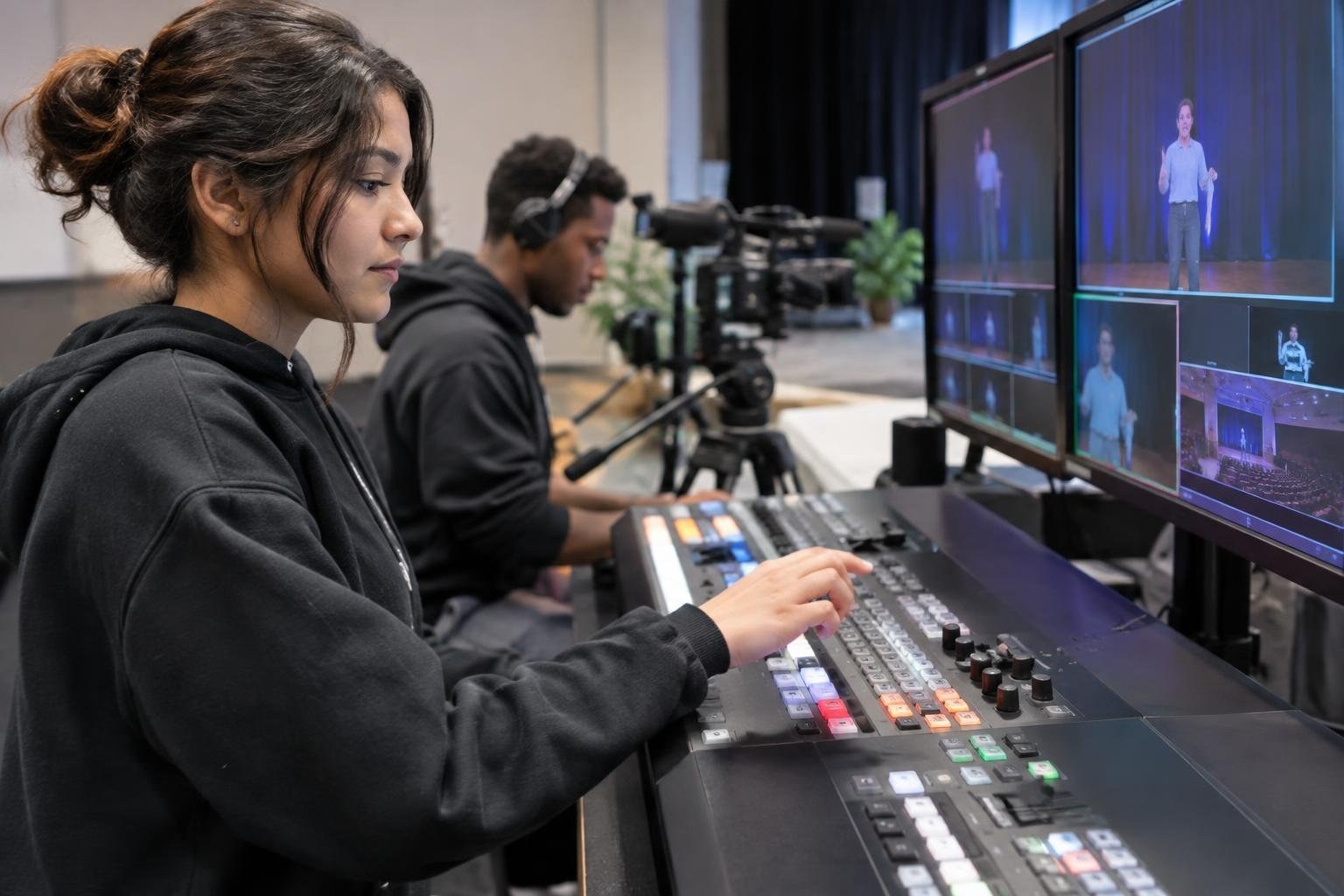
Broadcast production equipment and hands-on student learning
What Is Radio and Television Broadcasting Technology/Technician?
Radio and Television Broadcasting Technology/Technician is a program area focused on technical work associated with radio and television broadcasting. It belongs to the broader Communications Technologies/Technicians and Support Services grouping. The federal Classification of Instructional Programs, or CIP, identifies Radio and Television Broadcasting Technology/Technician as code 10.0202. A source also identifies the program as moved and reported under that code.
Colleges may use different names for programs in this area, and similar-sounding titles do not guarantee identical course content. Read the catalog description and required courses, rather than relying on a title or category label alone. The credential may be a certificate, associate degree, bachelor’s degree, post-bachelor’s certificate, graduate certificate, or master’s, depending on what a college offers. These are possible credential levels in the broader program context, not a promise that one school provides all of them.
When comparing programs, look for the intended level of study, the balance of technical and production learning, and the work students are expected to complete. Ask how the program’s curriculum connects to the roles you are considering.
What Do You Study in Broadcasting Technology?
What You May Study
Course content varies by college, so review the current catalog and required courses for each program you are considering. One published Radio and TV Broadcasting course description, for example, covers basic audio techniques for film, radio, and television, audio production and post-production, and radio history. Treat this as an example, not a standard curriculum for every school.
Compare what students do in each course, not just the course title. Ask whether practical assignments involve equipment, production planning, troubleshooting, or projects, and how students access any facilities or tools they need.
Ask whether internships, studio work, or final projects are required, optional, or dependent on placement availability. Request examples of student work when the college can share them, and make a simple list of required courses and practical experiences to compare programs.
Skills You May Build and Who the Program May Suit
Skills and Work Styles to Consider
Because specific course requirements vary, evaluate the skills a particular program teaches directly. Potentially relevant areas to investigate include operating production equipment, understanding technical instructions, troubleshooting, communicating with a production team, and completing work to a schedule. Treat these as questions for the program, not guaranteed outcomes of every credential.
This field may appeal to students who like practical tasks, technology, audio or video, and solving problems when equipment or workflows do not go as planned. It can also involve collaboration: production work may require people to coordinate roles and communicate clearly. A student who enjoys creative content but prefers not to operate equipment should compare production, media studies, and other programs to see which better matches the daily work they want.
No single personality profile is required. Consider whether you prefer hands-on tasks, technical detail, creative collaboration, or a mix. Think, too, about what kind of assignments keep your attention. Reviewing a sample course, visiting a campus facility, or asking a current student about a typical project can make the choice more concrete.
Does this program match you? Pay, prestige, or broad claims about opportunity do not show whether you will enjoy the tasks involved. Use career and degree matching tools, including the MAPP assessment, as prompts for reflection. Then compare those results with actual course plans and job descriptions.
Admissions, Length, and Difficulty
Admissions, Program Length, and Academic Demands
Admissions standards are set by each college and can differ by credential and program. Before applying, confirm required prior education, application materials, prerequisites, and any portfolio, interview, or experience expectations directly with the institution. Do not assume that requirements for one college apply to another.
There is no one completion time for this program area. The credential you pursue, whether you attend full or part time, the schedule of required courses, and any transfer credit decisions can all affect your plan. Request a sample term-by-term schedule and ask whether required classes are offered often enough to follow that sequence. If you are transferring, get a written evaluation of credits before relying on an estimated graduation date.
To assess academic fit, inspect the course descriptions and ask about technical prerequisites and support services. Students returning to school or changing fields can ask whether introductory courses assume previous experience. Find out how practical assignments are scheduled and whether students need access to equipment or software outside class time.
Prepare by comparing admissions pages, talking with an advisor, and identifying questions about workload, course availability, and support. A realistic schedule should account for class time, practical assignments, work, family responsibilities, and commuting or equipment access.
Can You Study Broadcasting Technology Online?
Online, Hybrid, and Campus Options
Do not assume that every program in this area is available in every format. Ask each college whether the credential can be completed online, on campus, or in a hybrid format, and verify which courses and activities are actually offered in that mode.
For online study, ask how students complete work that involves equipment, production facilities, or collaboration. Find out whether you must attend scheduled campus sessions, use a partner location, arrange access to equipment independently, or complete practical work in another way. Get the requirements in writing before enrolling.
For campus programs, compare facility access, the hours equipment is available, class schedules, and any limits on student use. For hybrid programs, clarify which activities require travel and how often. Include transportation, lodging if relevant, and time away from work or family in your comparison.
The best format is not simply the most convenient one. It is the format that gives you a workable route to complete required learning and practical assignments without creating costs or scheduling demands you did not anticipate.
Cost, Tuition, and Financial Aid
Tuition, Total Cost, and Financial Aid
Costs depend on the college, credential, enrollment pace, residency classification where applicable, and delivery format. Tuition is only one part of the budget. Ask for an itemized estimate that includes mandatory fees, equipment or technology expenses, course materials, transportation, and any costs tied to required practical work.
Compare total cost to completion, not just the advertised price per credit or term. A longer completion timeline can change the amount you pay, and transfer credits may affect how many courses remain. Before making a decision, confirm which credits the college will accept and whether financial aid can be applied to the program and your enrollment pattern.
Ask the financial aid office about grants, scholarships, federal or state aid eligibility, payment plans, and work-study options where available. Parents and students should review the terms of any borrowing, including the amount needed across the full program. If an employer may offer education assistance, confirm the benefit, eligibility rules, and any obligation to remain employed.
Affordability checklist: Request a written cost estimate; compare aid offers on the same basis; ask about additional practical-course expenses; check transfer-credit decisions; and leave room in your budget for changes in course availability or enrollment pace.
Careers, Jobs, and Employment Outlook
Find out which Career or College Major is right for you!
Broadcast technician work can involve controlling and adjusting broadcast signals to regulate sound volume, signal strength, and clarity, as well as operating transmitter equipment. Occupational descriptions also include recording sound for radio or television and checking its quality. These examples describe job tasks, not guaranteed outcomes of a particular college credential.
The U.S. Bureau of Labor Statistics says broadcast technicians typically need an associate degree. Employers may also prefer candidates with skills related to audio and video equipment and related technologies. Check current job postings for the specific roles and locations that interest you, and compare their stated education and experience requirements with the courses and practical projects offered by each college.
Use current occupational information and job listings when comparing opportunities. Requirements differ by position and location, so do not treat a degree title as a promise of eligibility, employment, pay, or career progression.
Accreditation, Certification, and Licensure
Accreditation, Certification, and Professional Requirements
Confirm that the institution is appropriately accredited and that the specific credential will meet your education goals. Institutional accreditation and program-level recognition are not interchangeable. Check the college’s current accreditation information with the accreditor and relevant official sources, rather than relying solely on a marketing page.
The information available for this program category does not establish one universal occupational license or certification requirement. Requirements can depend on the job, employer, and jurisdiction. If a particular role lists a license, certification, or other qualification, verify it with the organization responsible for that requirement and ask the college whether its curriculum prepares students for it.
Ask what the credential represents and what it does not. Completing a college program is not automatically the same as earning an industry credential, qualifying for a regulated occupation, or meeting an employer’s experience requirements. Request written details about any exam preparation or certification-related claims before paying additional fees.
For students comparing schools, ask whether credits can transfer to another institution and whether the program’s accreditation status affects financial aid or your next education step. Confirm these details with the receiving school or relevant agency.
Related Degrees and Alternatives
Related Degrees and Alternative Paths
Compare programs by the work and learning they emphasize, not just by subject labels. Related options may include broadcasting, audiovisual production, film and video production, audio production, media studies, communications, or digital media. These are comparison directions, not a claim that every college offers a program under those exact names.
Broadcasting or audiovisual production: Consider this if you want to compare technical operation with a broader range of production activities.
Film and video production: Consider this if your main interest is creating video projects and you want to compare the production curriculum with broadcast-focused study.
Audio production: Consider this if you are especially interested in sound and want to examine a more focused course plan.
Media studies or communications: Consider this if you want to compare technical training with coursework that may emphasize media, messages, or audiences.
Digital media: Consider this if you want to compare broadcast equipment work with programs centered on digital content and tools.
Short-term training or entry-level work: Consider whether a shorter learning route or supervised experience fits your goals, but check employer expectations before deciding that a degree is unnecessary.
For each alternative, compare actual courses, practical assignments, transfer options, cost, and the kinds of entry-level openings you find in your target area. Similar labels can hide substantial differences in emphasis.
How to Choose the Right College Program
How to Choose a Program
Use a short list of programs and investigate each one with the same questions. Start with the college catalog and confirm the exact credential, required classes, available formats, and published admissions requirements. Then speak with an advisor who can explain course sequencing and transfer evaluation.
Curriculum: Which required classes and projects connect to the roles you are considering?
Practical access: What equipment, facilities, software, or production experience can students use, and when?
Format and schedule: Which activities happen in person, and are required courses offered on a schedule you can manage?
Total cost: What will tuition, fees, materials, equipment, transportation, and other requirements add up to?
Outcomes and support: What career services, employer connections, internship information, and graduate outcome data can the school provide?
Accreditation and transfer: Is the institution accredited, and will other schools accept credits if you continue your education?
Ask for specific, current information rather than relying on general promises. If a college presents employment outcomes, ask how they were calculated, which graduates were counted, and whether the figures apply to this program and credential. Compare like with like, and keep a record of answers so your decision is based on verifiable details.
Assessment.com education-matching tools, including Degree Matching and Career Matching, can help you explore options. Use them as a starting point, then verify program details with colleges and compare your interests with real job descriptions.
Experience and How to Stand Out to Employers
Experience, Work Samples, and Career Preparation
Ask colleges how students can gain experience beyond coursework. Depending on the program, useful opportunities might include supervised projects, campus production activities, internships, volunteering, or work with community organizations. Confirm what is available, whether it is required, and whether students must arrange placements themselves.
Keep examples of completed work when you are permitted to do so. A portfolio or organized record of projects can help you discuss your contribution, the tools you used, the challenge you addressed, and what you learned. Follow privacy, copyright, and employer rules when sharing work publicly.
Build relationships with instructors, classmates, and local organizations in ways that feel appropriate and professional. Join relevant student or industry groups if they offer useful learning and connections. Focus on demonstrating reliable teamwork, clear communication, preparation, and the ability to learn unfamiliar tools rather than collecting credentials without a clear purpose.
How to stand out: Tailor work samples to the roles you want; describe your own responsibilities accurately; practice explaining a project from planning through completion; and ask employers what practical skills matter in entry-level roles. This preparation supports job searching but does not guarantee employment.
Do You Need Graduate School?
Graduate Study and Further Education
Graduate study is not automatically required for every career direction associated with broadcasting technology. Whether it makes sense depends on the role you want, the preparation you already have, and whether a specific employer or education pathway values an advanced credential.
Before applying to a graduate certificate or master’s program, identify the knowledge or career opportunity you hope to gain. Compare prerequisites, total cost, course content, and the experience expected by the programs you are considering. Ask whether your undergraduate coursework meets admission requirements and whether the advanced program is designed for technical, creative, management, or research goals.
For many prospective students, the more useful next step may be gaining practical experience, strengthening work samples, or adding targeted training. Compare those options against graduate tuition and time commitments. Let job requirements and your own career plan guide the decision instead of assuming that more education always improves employment prospects.
Questions to Ask Before You Enroll
Questions to Ask Before Enrolling
What exact credential and program title will appear on my record?
What are the current admissions requirements and prerequisites?
Which courses and practical assignments are required?
How do students gain access to equipment, software, and facilities?
Can the credential be completed online, on campus, or in a hybrid format, and what must happen in person?
What is my estimated total cost, including fees, materials, and practical-course expenses?
Which transfer credits will be accepted, and can I receive a written evaluation?
What accreditation applies to the institution, and are any program-specific requirements relevant to my goals?
Does the program prepare students for a specific certification or license, if one matters for my target role?
What internships, projects, career services, and employer connections can students actually access?
How does the college calculate any job-placement or graduate-outcome figures it shares?
What financial aid, scholarships, employer assistance, and payment options may be available to me?
Keep the answers and compare them across schools. If important details are unclear, ask for clarification before you commit or pay a nonrefundable fee.
Realistic Education-to-Career Pathways
From Education to Career: Possible Directions
Broadcast technician roles include work such as adjusting incoming and outgoing broadcast signals and operating transmitter equipment. Other described tasks include recording sound for radio or television and checking its quality. These occupational descriptions can help you compare job duties with course content, but they do not establish a required education-to-career sequence.
Check current postings for the roles and locations you are considering. Compare the listed education, technical skills, and experience with a program's curriculum, then ask college staff what practical projects students can complete. Employment and career progression depend on the qualifications requested for each opening and the experience a candidate brings.
Frequently asked questions
What is a Radio and Television Broadcasting Technology/Technician program?
Radio and Television Broadcasting Technology/Technician is a technical program area focused on skills and equipment used in radio and television production or broadcasting. The exact curriculum depends on the college and credential. Review course descriptions and hands-on requirements to see whether a particular program matches your interests.
Is Radio and Television Broadcasting Technology/Technician hard?
It depends on the course mix and your strengths. Programs may combine technical concepts with equipment-based practice, production projects, and troubleshooting. Ask colleges for sample assignments and prerequisites, and check whether you can get help with any math, computing, or technical topics that feel unfamiliar.
What jobs can I get with this degree?
Potential directions include broadcast technician work and related production roles, such as camera or video work. The specific jobs available to you depend on your training, experience, portfolio, location, and employer requirements. Check current job postings in the places where you might work before choosing a program.
How long does the program take?
There is no single completion time for this program area. The credential you choose, transfer credits, course availability, and whether you study full time or part time all affect the timeline. Ask each college for a written degree plan based on your likely enrollment pace.
Can I study broadcasting technology online?
Some programs may offer online or hybrid coursework, but the amount of practical equipment use varies. Ask whether production assignments, labs, or other hands-on activities must be completed on campus or at a designated site, and include travel and equipment access in your comparison.
Is a broadcasting technology program worth it?
Compare total tuition and fees, the amount of hands-on training, equipment access, career support, and the credential awarded. A program may be worth considering when its learning opportunities and costs support your specific career goal. Compare actual course plans and outcomes rather than relying on a program title alone.
People Also Ask
What is the CIP code for Radio and Television Broadcasting Technology/Technician?
This program area is associated with CIP code 10.0202. Check the school’s catalog to confirm the code and the exact program name it uses.
What should I look for in a broadcasting technology curriculum?
Start with the required courses and ask how much time students spend using production or broadcast equipment. Compare hands-on assignments, equipment access, and opportunities to build work samples.
Should I choose a certificate or a degree in broadcasting technology?
The credential level is one factor. Compare the curriculum, practical experience, total cost, and career support, then check local job postings for the roles you hope to pursue.
Are there online broadcasting technician programs?
Potentially. Availability and format vary by school, and practical work may have in-person or equipment-access requirements. Ask for details about how online students complete any hands-on components.
How does broadcasting technology differ from a general media program?
Compare broadcasting technology with related production or media programs by looking at the work emphasized, the equipment or software taught, the practical projects, and the roles graduates pursue.
What questions should I ask a college about this program?
Ask about course planning, equipment access, practical projects, career services, and where graduates seek work. Request details for the specific credential and delivery format you are considering.
Radio and Television Broadcasting Technology/Technician programs are designed for students interested in the technical side of creating and delivering audio and video content. The right choice depends on the work you want to do, the practical experience a program offers, and how its total cost and credential level fit your plans. Compare curricula and career outcomes carefully, and consider whether the day-to-day tasks appeal to you before enrolling.
Want to see your options? Try our comprehensive Degree, Program & College Search tool
We use cookies to offer you a better browsing experience, analyze site traffic and personalize content.
Read about how we use cookies and how you can control them in our
Privacy Policy.
If you continue to use this site, you consent to our use of cookies.
×
Exciting News!
Be one of the first to Beta Test the new AI-Powered Assessment.com Platform.