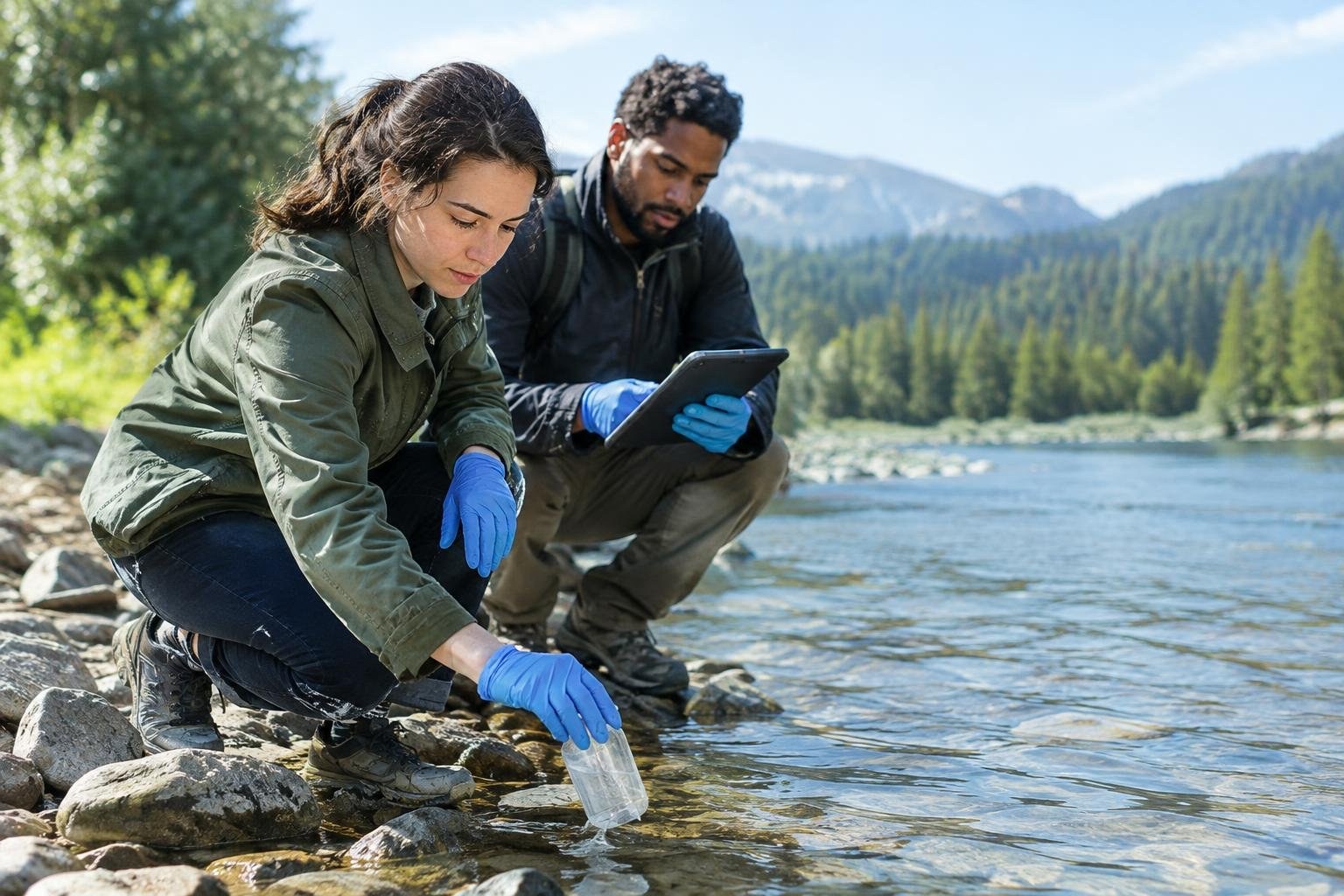
Environmental Health Degree Guide: Courses, Careers, Costs, and Fit
An Environmental Health program connects environmental science with public health. Learn what students study, how programs differ, possible career directions, costs to investigate, and how to choose a path that fits.
By David Slack · Staff Writer Assessment.com · Published November 1, 2026 · Last updated November 5, 2026
An Environmental Health degree focuses on how conditions in the places people live and work can affect health, and how those risks can be understood and managed. Students may study environmental science, public health, toxicology, epidemiology, risk assessment, and policy, with topics such as air and water quality, food protection, occupational safety, and hazardous waste. Environmental Health programs range from certificates to doctoral degrees. Depending on the curriculum and a graduate’s experience, possible directions include government and community health work, occupational safety, environmental science, consulting, research, or further study. The program name alone does not guarantee a particular job or credential, so compare each school’s curriculum and the requirements for roles that interest you.
Degree & Program Decision Insights
Explore your personal fit, education requirements, career potential and next steps.
01Motivational Fit
Discover whether this program fits you
Explore your preferences against the focus of Environmental Health. These prompts are not personal MAPP results.
Reasoning and public responsibility. Does studying public policy analysis interest you enough to examine competing interpretations and explain a careful conclusion?
Breadth of interest. Consider the place of “epidemiology” in this field. Is this another part you would choose to explore, or mainly a requirement you would tolerate?
Work reality. Related work can involve this task: “Review and implement environmental technical standards, guidelines, policies, and formal regulations that meet all appropriate requirements.” Would you want that activity to be a regular responsibility?
Interest in studying a field can differ from enjoying its related work.
Which part would you want to do repeatedly, and what would you try before deciding?
Discover Your Personal Program Fit
Before investing your time and money in your education, discover how this program aligns with your natural motivations, work preferences and career goals.
U.S. occupational wages are not guaranteed graduate earnings; OEWS excludes self-employed workers.
Projected openings include replacements as well as growth.
U.S. national estimates. A crosswalk does not establish entry-level eligibility; advanced, management and teaching roles can require further qualifications.
Compare the focus and route of these distinct instructional fields; their credentials and admission requirements are not interchangeable.
Occupational Health and Industrial HygieneCIP 51.2206. Compare its emphasis on occupational health and safety standards and regulations and health hazard testing and evaluation with this program’s focus.
Public Health Education and PromotionCIP 51.2207. Compare its emphasis on human development and health issues across the life span with this program’s focus.
Behavioral Aspects of HealthCIP 51.2212. Compare its emphasis on behavioral sciences and public health practice and policy with this program’s focus.
Explore your motivations. Use MAPP as a starting point for reflecting on your interest in “epidemiology”, then test that interest against a sample learning task.
Compare actual providers. Ask for the exact credential, course sequence and assessment methods. Compare how each provider teaches “biostatistics”, its entry criteria and its itemized costs.
Check the evidence before applying. Confirm prerequisites and any recognition or professional requirements for your intended route; ask for applicable rules and published outcome definitions in writing.
Verify the institution’s current offering, admissions requirements and outcomes; a search result does not establish your eligibility.
Environmental Health Degree Guide: Courses, Careers, Costs, and Fit
What Is an Environmental Health Degree?
Environmental Health examines connections between environmental conditions and human health. The field combines environmental and biomedical sciences with public health approaches to understand exposures, assess potential harm, and consider prevention or control. The University of Georgia describes its B.S. in Environmental Health as a rigorous, science-based applied degree preparing students for work in human and environmental health.
The subject can encompass air quality, food protection, water and soil quality, housing, occupational health and safety, hazardous waste, radiation protection, and environmental conditions in recreational areas. These areas are related, but a program may emphasize only some of them. Environmental health is therefore not simply a general environmental science degree or a clinical healthcare program; its central lens is how environmental factors may affect people and communities.
Program names can include environmental health, environmental and occupational health, or environmental health sciences. A title is not enough to determine what students will learn. Compare course requirements and applied experiences, and confirm that the program’s emphasis matches the work you want to explore.
Read the University of Georgia’s description of its B.S. in Environmental Health.
What Do Environmental Health Students Study?
Environmental health study asks students to connect a possible hazard with where it occurs, how people may encounter it, what health effects may follow, and what actions could reduce risk. The exact sequence depends on the school, credential, and concentration.
Common subject areas
Exposure and environmental agents: Identify physical, chemical, and biological hazards and examine how they may move through community or workplace environments.
Toxicology and health effects: Study how exposures can affect the body and how biological mechanisms may relate to later health outcomes.
Epidemiology and biostatistics: Learn ways to examine patterns in health data and interpret evidence about risks across groups.
Risk assessment and control: Evaluate evidence and consider interventions, prevention measures, or other ways to manage hazards.
Policy, law, and communication: Explore how public decisions, regulation, management, and clear communication influence environmental health work.
Course examples in university sources include hazards in food, air, water, and soil, exposures in occupational settings, and the routes environmental agents can take to reach people. Some programs may add practical projects, fieldwork, research, or a culminating experience; do not assume these are included without checking the catalog.
Johns Hopkins’ certificate catalogue outlines environmental and occupational health topics, while UW–Eau Claire’s graduate certificate description discusses environmental hazards and exposure.
Skills You Can Develop
Students develop a mix of scientific, analytical, and communication skills. Scientific reasoning helps them interpret how an exposure could relate to health. Data skills support reading evidence and evaluating patterns. Risk assessment requires weighing information carefully rather than treating every hazard as equally likely or equally harmful.
Communication matters because environmental health work can involve explaining technical findings to colleagues, decision-makers, employers, or communities. Depending on the job, graduates may also need to organize projects, document observations, work across disciplines, and translate evidence into practical recommendations. These are program goals and work skills to investigate, not a promise that every graduate will master every tool or qualify for every position.
Ask schools how students practice these abilities. Look for concrete course assignments, field or laboratory work, research opportunities, presentations, or applied projects, if they are part of that particular program.
Who Is Environmental Health Best For?
This field may suit students who are curious about science and interested in protecting health beyond individual clinical care. It can appeal to people who like investigating causes, working with evidence, considering how policy and practice affect communities, or combining desk-based analysis with applied work.
There is no single personality type required. Some roles emphasize research and data; others involve communication, inspections, policy, or workplace safety. A student who prefers collaborative community work may approach the field differently from one drawn to laboratory or quantitative analysis. What matters is finding a program and career direction that fit your interests and tolerance for scientific coursework.
Does Environmental Health match you?
Salary, reputation, and job growth are useful decision factors, but they cannot tell you whether you will enjoy the subject matter or daily tasks. Consider whether you want to study health risks tied to environments, interpret scientific evidence, and communicate about prevention. Assessment.com’s MAPP assessment can be one reflection tool as you consider career and degree options. Use its results as a starting point for research, not as a substitute for reviewing curricula and job requirements.
Admissions and Preparation
Admission rules are set by each institution and credential. An undergraduate program will have its own entry requirements, while graduate degrees and certificates generally have separate application criteria. The supplied university program descriptions show that environmental health is available at undergraduate and graduate levels, but they do not establish one universal GPA, test, prerequisite, or application rule.
Before applying, check the official admissions page and current catalog for required prior coursework, transcripts, GPA expectations, essays, recommendations, work experience, or other materials. Ask whether science or math preparation is expected and whether transfer credits can satisfy prerequisites. Adult learners and career changers should also ask how prior education or relevant experience will be reviewed.
Students who are unsure about readiness can speak with an academic adviser before paying application fees. Ask for the required course sequence and identify any foundational science or quantitative courses that may need to come first.
Credential Levels, Format, and Completion Time
Environmental health credentials span certificates, associate and bachelor’s degrees, post-bachelor’s or graduate certificates, master’s degrees, and doctoral study across the field. This range does not mean every college offers every level. Confirm the exact award, program format, admission requirements, and completion plan with the institution.
Certificates may provide focused study or additional knowledge; a bachelor’s degree offers undergraduate preparation; and master’s or doctoral programs can support more advanced specialization or research goals. For one example of doctoral study, Drexel lists a Ph.D. in Environmental and Occupational Health, with different minimum credit totals depending on whether a student enters after a bachelor’s or master’s degree. That structure is specific to Drexel, not a general rule for doctoral programs.
Time to completion depends on the credential, course load, transfer credit, prerequisites, and whether a student attends full or part time. Ask for a written plan showing course availability and expected semesters. Online, hybrid, and campus formats also vary: the University of West Florida describes a fully online graduate certificate in environmental and occupational health, but that does not establish that all programs or related practical experiences are remote.
See Drexel’s published Ph.D. credit requirements and the University of West Florida’s online graduate certificate description.
Environmental Health Degree Costs and Financial Aid
There is no responsible one-number estimate for the cost of an Environmental Health degree without naming a school, credential, residency status, enrollment pace, and date. Compare each institution’s tuition and required fees for the program you would actually attend, then add books, equipment, transportation, housing, and any course-specific or technology costs that apply.
Build a total-cost estimate for the full path to completion, not just the first term. Ask how transfer credits affect the number of courses you must pay for, whether part-time attendance changes fees or aid eligibility, and whether a required in-person component adds travel or lodging costs. Get the program’s current cost estimate in writing and check which charges are recurring.
Ways to make the plan more affordable
Compare public and private institutions and the tuition that applies to your residency status.
Complete eligible general education coursework at a lower-cost institution only after confirming transferability in writing.
Submit required financial-aid forms on time and ask each college about grants, scholarships, work opportunities, and payment plans.
If employed, ask whether tuition assistance applies to this program and what completion or repayment conditions come with it.
Compare the cost of an online program with any travel, technology, or campus charges that may still apply.
Do not choose a lower sticker price without checking completion support, course availability, and whether the program matches your intended path. Funding rules and awards vary, so verify them with the school’s financial-aid office.
Environmental Health Careers and Jobs
Environmental health programs connect to career directions across public health, environmental protection, occupational safety, research, and related science. The University of Florida lists federal, state, and county health and environmental protection departments, other federal agencies, nonprofits, consulting and research companies, academic institutions, and industry as settings where its environmental health MPH graduates find positions.
The examples below are directions to investigate, not a guarantee of employment or a claim that a specific credential is sufficient. Job titles and qualification rules differ by employer. Research current job postings and ask programs about alumni pathways before treating any option as an entry-level outcome.
Possible career direction
How environmental health study may relate
What to verify
Environmental health specialist
Connects environmental hazards, public health, and prevention.
Employer and state requirements; field experience.
Occupational health and safety specialist or technician
Can relate to workplace exposure, hazards, and control strategies.
Whether the role requires a particular degree, experience, or credential.
Environmental scientist or specialist
May draw on environmental science and human-health impacts.
Technical specialization and the employer’s required coursework.
Epidemiology or public health research support
May use population-health methods and analysis of exposure evidence.
Quantitative preparation and whether graduate study is expected.
Environmental policy or program work
Can apply policy analysis, risk communication, and public management.
Writing, policy, and public-sector experience requirements.
Environmental consulting or industry roles
May apply risk assessment and environmental or occupational health knowledge.
Specialty-area experience, technical skills, and travel expectations.
Some graduates may pursue more advanced research, teaching, or academic work, where additional graduate education may be relevant. Environmental Health itself does not determine salary or job outlook. Use current, occupation-specific labor data and compare it with job postings in the locations where you would work.
Experience, Certifications, and Licensure
Environmental health work can involve internships, field observations, research projects, laboratory activities, or applied assignments, but the opportunities included differ by school. Ask whether these experiences are required, guaranteed, competitive, or something students must arrange themselves. If a program does not require an internship, ask how students can gain relevant experience and whether faculty or career services help identify placements.
To stand out to employers, be ready to show what you can do: describe a class or research project, explain how you evaluated evidence, and demonstrate clear written communication. Seek practical experience related to your chosen direction, such as community health, workplace safety, environmental monitoring, or policy work, when available. Join relevant academic or professional groups if they provide learning and networking opportunities.
A degree and a professional license or certification are not interchangeable. Requirements depend on role and jurisdiction, and the supplied program descriptions do not establish a universal Environmental Health license. Ask the school which credentials, if any, are relevant to its graduates, then confirm current rules with the responsible state agency or credentialing organization before relying on a program’s claim.
Graduate School and Advanced Pathways
Graduate study may make sense if your goal requires deeper specialization, research preparation, or advanced public health training. Options in the field include an MPH concentration in environmental health, an MS in public health with an environmental health sciences concentration, graduate certificates, and doctoral study. San Diego State University lists both MPH and MS options in environmental health. The University of Florida describes an MPH environmental health concentration and notes a pathway for some graduates to transfer eligible coursework toward a doctoral degree; transfer eligibility and terms must be checked with the institutions involved.
A Ph.D. may be relevant to students pursuing advanced research or academic work, but it is a substantial commitment and is not necessary for every environmental health job. Compare the intended role’s actual education requirements with the time and cost of graduate study. A certificate may be a more focused choice for someone seeking additional knowledge without starting another full degree, but it should not be assumed to replace a required degree or license.
Review SDSU’s Environmental Health graduate degree options and the University of Florida’s MPH concentration information.
Related Degrees and Alternatives
Environmental health is one option among several related fields. The best comparison is the work you want to do and the curriculum that supports it, not the similarity of program names.
Environmental Studies: Consider this if you want a broader examination of environmental issues; compare the balance of science, policy, and social perspectives.
Environmental Science: Consider this if you are more interested in environmental systems and scientific analysis; check how much human health is included.
Environmental and Occupational Health: Consider this if workplace exposures and worker health are a central interest.
Public Health: Consider this if you want a broader population-health foundation and can select an environmental health concentration where available.
Environmental Health Sciences: Consider this if you want a graduate-level science emphasis; compare research and applied requirements.
Forestry or natural resources: Consider these if land, forests, or resource management are more central than exposure-related human health.
Environmental design: Consider this if built environments and design decisions are your focus.
These labels are not standardized across all colleges. Use official course lists to compare scientific depth, policy content, practical training, graduate-school options, and the job requirements that matter to you. Assessment.com’s Environmental Studies, Environmental Science, and Forestry guides can help you explore adjacent choices.
How to Choose an Environmental Health Program
Program quality is not captured by a title or a school’s marketing language. Verify institutional accreditation through an authoritative source, then investigate any program-specific accreditation or professional recognition that is relevant to your intended career. The available program descriptions do not establish that any one accreditation applies to every Environmental Health program.
Compare the curriculum against your goals: required science and statistics, environmental and occupational health coverage, policy and communication coursework, and opportunities for applied learning. Ask who teaches core classes, what practical or research facilities students can use, whether internships are supported, and how the program evaluates student learning. Request evidence about graduation, placement, or other outcomes and ask how those figures are defined and for which graduating cohort.
If a school says its program prepares students for a license, certification, or professional examination, ask for the exact credential and written explanation of eligibility. Confirm current requirements with the official state or credentialing authority. Do not assume online delivery, a particular degree title, or a school’s general accreditation alone satisfies a job-specific rule.
Questions to Ask Before Enrolling
Use these questions to compare programs before submitting an application or deposit:
What is the exact credential and concentration, and which courses are required?
What is the estimated total cost through graduation, including fees and required travel?
Which credits can transfer, and can the school confirm that decision in writing?
Are internships, fieldwork, labs, or research included, optional, or student-arranged?
What delivery format is used, and are any in-person activities required?
What accreditation or professional recognition applies, and how can I verify it independently?
Does this curriculum meet the stated requirements for the jobs or credentials I am targeting?
What financial aid, scholarships, employer benefits, and payment options are available to me?
Can the school explain student outcomes and how they were measured?
What advising and career support is available before and after graduation?
Write down the answers and compare schools using the same questions. If a response is unclear, ask for a catalog, cost estimate, or policy in writing before you make a decision.
From Degree to Career
Career paths are not automatic ladders, but it can help to picture how education and experience might build over time. Examples to investigate include:
Bachelor’s coursework in environmental health → an entry-level environmental or public health support role, if an employer’s requirements are met → relevant field or program experience → a specialty in occupational health, exposure assessment, or environmental protection.
Environmental health or public health bachelor’s degree → an assistant or technician pathway in a related organization → experience with data, inspections, or projects → graduate study for a more specialized public health or research direction.
MPH or related graduate preparation → a role in a health or environmental agency, nonprofit, consulting or research organization, academia, or industry → deeper experience in a chosen area → doctoral study if research or academic goals call for it.
These are planning illustrations, not promised placements. Employers set their own qualifications, and geography, experience, degree level, and additional credentials can change the available options. Start with job descriptions for roles you might want, then work backward to identify the program and experience those employers request.
Is Environmental Health Right for You?
Environmental health uses science and public health to understand environmental conditions and exposures that may affect people’s health and safety. Its coursework can include hazards in food, air, water, soil, and workplaces, along with toxicology, epidemiology, risk assessment, and prevention. Credentials vary, and career outcomes depend on the specific program and role requirements. A thoughtful choice starts by comparing curriculum, cost, applied learning, and fit with the work you want to do.
Before you decide, review the site’s college-major selection resource and explore degree options or career information. Use the MAPP assessment as one way to reflect on your interests while you research programs and occupations.
Frequently asked questions
What is Environmental Health?
Environmental health studies how environmental conditions and exposures can affect people’s health and safety, and how risks can be assessed or reduced. Programs may cover air, water, food, soil, workplaces, toxicology, epidemiology, policy, and risk communication. The exact curriculum and practical training vary by credential and institution.
Is an Environmental Health degree hard?
It can be challenging because many programs combine scientific concepts with quantitative analysis, applied problem-solving, and communication. Coursework may ask you to connect an exposure or hazard to possible health effects and then consider ways to control it. Review the required science, math, statistics, lab, and field components at each school to judge the fit for your preparation.
What jobs can I get with an Environmental Health degree?
Possible directions include environmental health specialist work, environmental or occupational health and safety, environmental science, research, and public health policy. A degree does not qualify every graduate for every role: employers may require specific experience, further study, or credentials. The University of Florida describes graduates working across government, nonprofits, consulting, research, academia, and industry.
How much can you make with an Environmental Health degree?
There is no single Environmental Health salary. Pay depends on the specific occupation, employer, location, education, experience, and credentials. Compare current wage data for the exact job title and geographic area you are considering rather than treating the major itself as a salary guarantee.
Can I earn an Environmental Health credential online?
Some Environmental Health study is available online. The University of West Florida describes a fully online graduate certificate in environmental and occupational health. Online availability does not establish that every course, lab, field activity, or credential requirement can be completed remotely, so ask each program about its specific format.
Does Environmental Health require math?
Environmental Health is science-based, so students should expect scientific reasoning and may encounter statistics or other quantitative work. The precise math expectations differ by program and level. Read the course sequence and prerequisites, and ask admissions staff whether a particular math or science background is recommended or required.
Do I need graduate school for Environmental Health careers?
Not for every role. A certificate or bachelor’s program may support some entry-level directions, while research, academic, and advanced public health roles may call for graduate study. The University of Florida identifies a range of employer settings for MPH environmental health graduates, and some programs describe doctoral pathways. Check requirements for the specific job you want.
Does an Environmental Health degree require a license or certification?
Do not assume that completing a degree automatically grants a professional license or certification. Requirements depend on the job, employer, and state. Before enrolling, ask the program which credentials its curriculum prepares students for and verify current requirements with the relevant state or credentialing authority.
People Also Ask
What does environmental health mean?
Environmental health focuses on environmental conditions and exposures that may affect human health and safety. The field applies science and public health methods to assess risks and consider ways to prevent or control them.
What classes do environmental health majors take?
Students may encounter toxicology, epidemiology, biostatistics, exposure pathways, risk assessment, environmental policy, and hazards in air, water, food, soil, or workplaces. Course names and depth vary by program.
What degree levels are available in environmental health?
Environmental health study can be offered at different levels, including undergraduate degrees and graduate certificates or degrees. A specific institution may offer only some of these options, so confirm its current catalog.
Where do environmental health graduates work?
Potential settings include public health or environmental agencies, research and consulting organizations, universities, nonprofits, and industry. The specific role, employer, and qualifications vary.
How is environmental health different from environmental studies?
Compare the actual course lists. Environmental health links environmental exposures to human health and safety; environmental studies can take a broader approach to environmental issues. Program emphasis differs by institution, so compare required science, policy, and applied courses.
Are environmental health programs available online?
Yes, some programs offer online options. The University of West Florida describes a fully online graduate certificate in environmental and occupational health. Verify delivery details, required in-person components, and eligibility for any career credential directly with the school.
Environmental health may be a strong choice if you want to use science and public health to reduce risks that affect communities and workers. The field can lead toward inspection, occupational safety, environmental science, research, policy, or advanced public health work, but the route depends on the job and the education it requires. Compare curricula, applied experience, total cost, and any state or employer credential requirements before committing. Most importantly, consider whether the daily work and subject matter suit your interests as well as your career goals.
Find out which Career or College Major is right for you!
We use cookies to offer you a better browsing experience, analyze site traffic and personalize content.
Read about how we use cookies and how you can control them in our
Privacy Policy.
If you continue to use this site, you consent to our use of cookies.
×
Exciting News!
Be one of the first to Beta Test the new AI-Powered Assessment.com Platform.