History of Medicine Degree Guide: Courses, Careers, Costs, and Fit
A guide to studying the history of medicine, choosing a program, understanding career routes, and evaluating whether this research-centered field fits your goals.
By David Slack · Staff Writer Assessment.com · Published November 1, 2026 · Last updated November 5, 2026
History of medicine is the study of how people have understood disease, developed treatments, organized healthcare, and experienced illness across time. Students use historical evidence to examine medical theories, technologies, patients, healers, and the social conditions that shaped health and care. The field combines history with the study of science, medicine, and society; it does not train students to provide clinical care. Programs and pathways differ. Some students encounter the subject through undergraduate history or science courses, while focused certificates and graduate programs offer deeper study. If you are weighing this major or a related pathway, talk with your family and an academic advisor about the research work, education commitment, and careers that interest you. Assessment.com’s MAPP career assessment can help you explore career and degree options as one part of that decision.
Degree & Program Decision Insights
Explore your personal fit, education requirements, career potential and next steps.
01Motivational Fit
Discover whether this program fits you
Explore your preferences against the focus of History of Medicine. These prompts are not personal MAPP results.
Subject curiosity. Would you choose to explore “the concepts and methods of the historiography of medicine” in depth? Ask for a sample learning activity to test that interest.
Breadth of interest. Consider the place of “the history of science, medicine, and technology” in this field. Is this another part you would choose to explore, or mainly a requirement you would tolerate?
Work reality. Related work can involve this task: “Collaborate with colleagues to address teaching and research issues.” Would you want that activity to be a regular responsibility?
Interest in studying a field can differ from enjoying its related work.
Which part would you want to do repeatedly, and what would you try before deciding?
Discover Your Personal Program Fit
Before investing your time and money in your education, discover how this program aligns with your natural motivations, work preferences and career goals.
Explore these official instructional-field associations. They describe possible occupational routes, not measured outcomes of this program.
History Teachers, PostsecondarySOC 25-1125 · O*NET 25-1125.00$83,820/year median (May 2025); 0% projected change (2025–2035); 1,500 projected openings/year.
Typical occupational entry: doctoral or professional degree (BLS). Postsecondary teaching is a separate appointment and may require advanced study; this programme alone is not a promise of a teaching post.
U.S. occupational wages are not guaranteed graduate earnings; OEWS excludes self-employed workers.
Projected openings include replacements as well as growth.
U.S. national estimates. A crosswalk does not establish entry-level eligibility; advanced, management and teaching roles can require further qualifications.
Compare the actual offering and credential before committing your time or money.
Request the itemized fees, materials and equipment associated with “the concepts and methods of the historiography of medicine”; confirm what tuition includes.
Compare the full attendance budget, course availability and time away from paid work, rather than tuition alone.
No institution- and credential-matched cost, debt or graduate-earnings amount is reported here; occupational pay is not program ROI.
Financial aid depends on the school, program and student’s eligibility.
Science, Technology and SocietyCIP 30.1501. Compare the official Science, Technology and Society field description and actual course requirements; confirm which parts support your intended specialization.
Arts in Medicine/HealthCIP 51.3206. Compare its emphasis on dance and literary arts with this program’s focus.
Explore your motivations. Use MAPP as a starting point for reflecting on your interest in “the concepts and methods of the historiography of medicine”, then test that interest against a sample learning task.
Examine the work. Compare History Teachers, Postsecondary and Historians on daily work and entry qualifications, as well as pay. Explore History Teachers, Postsecondary.
Compare actual providers. Ask for the exact credential, course sequence and assessment methods. Compare how each provider teaches “the history of science, medicine, and technology”, its entry criteria and its itemized costs.
Check the evidence before applying. Confirm prerequisites and any recognition or professional requirements for your intended route; ask for applicable rules and published outcome definitions in writing.
Verify the institution’s current offering, admissions requirements and outcomes; a search result does not establish your eligibility.
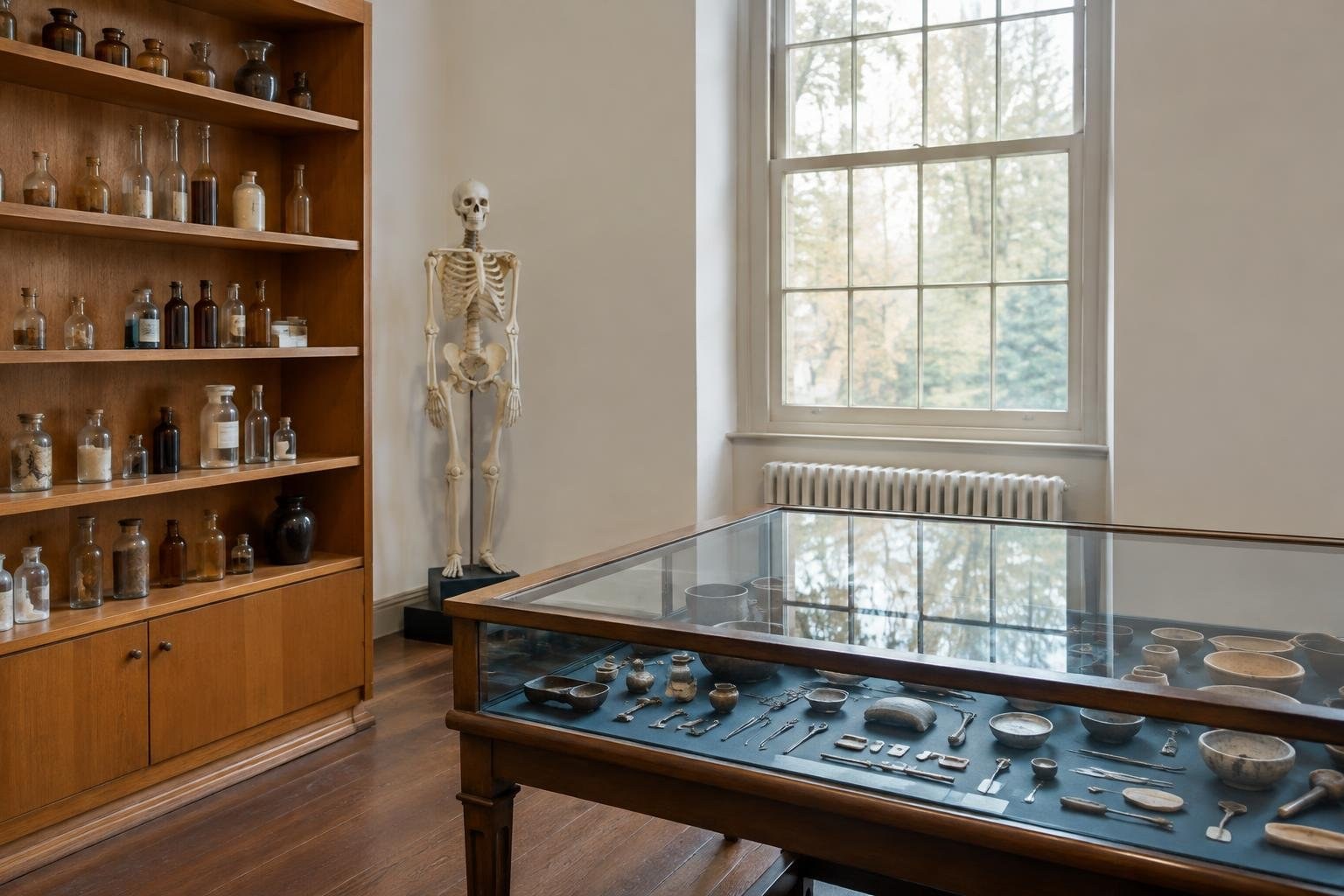
Archival research materials related to the history of medicine
What Is a History of Medicine Program?
History of medicine investigates the historical development of medical knowledge and practice, including the social conditions surrounding disease, treatment, healthcare education, technology, patients, and healers. The field asks how ideas and institutions changed, whose experiences shaped them, and how medicine interacted with wider scientific and social developments.
It is not the same as a medical degree. A history of medicine credential does not prepare a student to diagnose, prescribe, or treat patients. Johns Hopkins describes instruction in the history of medicine and related sciences, including public health, for students in its medical program; that is an academic option within medical education, not a clinical qualification in itself. See the Johns Hopkins catalog description.
Program names can sit within history, history of science, medical humanities, or interdisciplinary departments. Yale, for example, describes a graduate track within its Department of History whose students receive History degrees with a concentration in the History of Science and Medicine. This illustrates why prospective students should check the official credential name, department, and curriculum rather than rely on a label alone.
What Do Students Study?
Courses typically build historical understanding and research ability. Depending on the program, students may examine the history of disease, medical theories, therapeutics, healthcare education, scientific instruments, public health, or the changing roles of patients and practitioners. The focus can span different periods and subjects, so review the actual course list and faculty areas of interest.
Expect substantial reading and writing. Students learn to ask a researchable question, place evidence in context, distinguish different kinds of sources, and support an interpretation with documented evidence. Graduate-level work may involve a research paper, thesis, or other substantial project, but exact requirements vary. The supplied university descriptions establish research and historical-analysis emphasis, not one universal course sequence.
Some programs connect medical history with science and technology studies or global health and social medicine. Harvard describes history of medicine teaching and research through its Department of Global Health and Social Medicine, while its Faculty of Arts and Sciences program is based in the Department of the History of Science. This interdisciplinary context can affect course choices and advising.
Before enrolling, request a recent syllabus or sample course plan. Ask how much work involves original research, which archives or collections students can access, whether a thesis is required, and how students receive feedback on writing.
Skills You Can Develop
The central skills are interpretive and research-based. Students learn to examine documents and other historical evidence, compare interpretations, build a defensible argument, and communicate complex ideas clearly. Strong work requires careful reading, attention to context, accurate citation, and the ability to explain why evidence supports a conclusion.
Research: locating relevant evidence, refining questions, and organizing a sustained investigation.
Critical analysis: considering who created a source, what it can show, and what it cannot establish.
Writing and communication: presenting evidence in essays, research papers, presentations, or public-facing interpretation.
Interdisciplinary thinking: relating medical and scientific ideas to institutions and social contexts.
These capabilities can be useful in history research, teaching, writing, and humanities-related work. They do not replace occupation-specific preparation: a museum, archive, school, or university role may ask for additional education or experience. Treat the degree as a foundation whose value depends partly on how deliberately you build experience alongside coursework.
Who Is This Field Best For?
This subject may suit students who are curious about how medical knowledge formed and changed, enjoy reading and writing, and want to investigate the relationship between health and society. It can appeal to students who like open-ended questions and evidence-based interpretation more than laboratory practice or direct patient care.
No single personality or academic background is required for everyone. Students may enter through history, science, healthcare, or another field, depending on the program. Families should distinguish interest in medicine from interest in the history of medicine: enjoying biology or wanting to help patients does not automatically mean that a humanities research pathway is the right choice.
Does history of medicine match you?
Consider whether you would enjoy spending sustained time reading, evaluating evidence, and revising written arguments. Also consider your preferred work setting and whether your goals require a clinical credential, a teaching qualification, or graduate research training. Salary, institutional reputation, and broad labor-market trends matter, but they cannot determine whether the day-to-day work will suit you.
Assessment.com’s MAPP career assessment can help you explore motivations and career options. Use it as one input, alongside academic advising, conversations with faculty, and careful research into specific jobs.
Admissions and Preparation
There is no single admissions rule for history of medicine programs. Requirements depend on whether the option is an undergraduate course, certificate, graduate degree, or a pathway attached to another professional program. Check the official catalog for academic prerequisites, prior degree requirements, application materials, deadlines, and any enrollment restrictions.
The differences between program types are important. Johns Hopkins states that candidates for its on-site one-year MA in the History of Medicine must already be enrolled in an MD or another graduate program at its School of Medicine or School of Public Health. Its on-site two-year MA in Critical Approaches to Science, Technology, and Medicine requires a BA or equivalent from an accredited institution by admission. These are program-specific conditions, not general rules for the field.
For preparation, strengthen academic reading and writing, explore history or science courses, and keep examples of substantial research papers. If you are applying from a different discipline, ask whether faculty expect prior history coursework or offer methods support. Parents can help students check prerequisites early and distinguish published requirements from informal advice.
Credential Levels, Format, and Time to Completion
History of medicine appears at different academic levels, but the availability of a certificate, bachelor’s degree, master’s degree, or doctorate depends on the institution. A field-of-study classification that lists several credential types does not mean every school offers each one. Confirm the actual award, department, and admission pathway directly with the college.
Examples in the supplied university catalogs include an online post-baccalaureate certificate at Johns Hopkins, online and on-site master’s study, and graduate pathways at Yale and the University of Minnesota. Johns Hopkins describes its online certificate as six courses. Its catalog also lists an online MA. These examples are not a guarantee of current availability or a typical completion time across institutions; consult the latest catalog and ask about enrollment pace, transfer credit, and required milestones.
Part-time study may be useful for students balancing work or family responsibilities, but the option and its effect on completion time are school-specific. Request a term-by-term plan for both full-time and part-time enrollment before making a financial or scheduling commitment.
Online vs. On-Campus Study
Online study can make focused coursework possible without attending classes on campus, but the format does not tell you whether a program fits your needs. Johns Hopkins lists both an online MA and an online post-baccalaureate certificate in the field, as well as an on-site MA option in its catalog. Compare the current delivery details and requirements for the exact program you are considering.
Ask whether courses are live or asynchronous, how students meet faculty, whether research can be completed remotely, and whether any campus visits or other in-person requirements apply. Do not assume that “online” means self-paced, lower-cost, or identical to the on-campus experience. Check how online learners access library resources, advising, archives, and peer discussion.
For an on-campus option, consider the department’s research environment and access to relevant collections. In either format, ask how the program supports students in developing research questions and completing major writing projects.
Tuition, Costs, and Financial Aid
No single tuition figure describes history of medicine study. Price varies by institution, credential, residency rules, enrollment pace, and the way a program charges for courses or credits.
Ask for the full expected amount, including tuition, required fees, books, technology, travel, and any other program costs that apply. For an online program, check whether there are separate distance-learning charges or required campus visits. For an on-campus program, include housing and transportation if relevant to your family’s budget.
Ways to plan and fund study
Contact the financial aid office about eligibility for grants, scholarships, assistantships, employer support, and payment plans. Availability depends on the school, credential, and student circumstances. Ask whether funding is renewable and whether it depends on academic progress or a work commitment. Compare net cost after confirmed aid, not only the published tuition rate.
Transfer credit or a shorter credential may affect cost, but do not assume credits will apply to a later degree. Get any transfer or pathway agreement in writing before enrolling.
Careers, Jobs, and Employment Outlook
Career options depend on the level of study, additional qualifications, experience, and the employer. The field is most directly connected to historical scholarship and teaching, but related opportunities may also involve writing, archives, museums, and health humanities. The university program descriptions support research and teaching as core activities; they do not establish placement rates, job growth, or a guaranteed career outcome.
Career direction
How the study may apply
Important qualification to check
Historian or historical researcher
Researching and interpreting medical history evidence
Research employers set their own degree and experience requirements
Postsecondary history teacher
Teaching history or a related area and guiding student research
Advanced study is commonly relevant; verify requirements for each position
Writer or editor in a history or health context
Explaining historical research for readers or organizations
Writing samples and subject-specific experience may matter
Archive, museum, or public-history work
Researching, organizing, or interpreting historical materials
Employers may require specialized training or relevant experience
Health humanities or academic program work
Connecting historical perspectives with teaching or research
Role expectations vary by institution and job description
These are possible directions, not promises of employment. For each role, examine recent job postings and distinguish entry-level work from academic positions that require advanced credentials.
Technology can assist with searching, organizing, and analyzing digital materials, but students still need to assess source quality, context, and interpretation. Learn to use relevant digital research tools while maintaining careful citation and scholarly judgment.
Find out which Career or College Major is right for you!
History of medicine is an academic field, not a professional clinical license. Completing a history degree, certificate, or research program does not authorize a graduate to practice medicine or another regulated healthcare profession. If your goal is patient care, identify the separate accredited education and licensing pathway for that occupation before choosing this subject.
There is no universal professional certification presented in the supplied program descriptions for historians of medicine. A particular employer may value additional training in archives, teaching, public history, or research methods, but requirements should be verified for the role rather than assumed to be mandatory across the field.
When evaluating a program, verify the institution’s accreditation status through authoritative sources and ask how the credential is recognized by the next school or employer you have in mind. The program sources included here describe academic offerings and admission conditions; they do not make a general accreditation claim about every institution or course.
Related Degrees and Alternatives
Compare the degree with options that lead toward a different kind of work. A history of medicine program emphasizes historical change and evidence; nearby fields can emphasize scientific discovery, population health, healthcare systems, ethics, or direct clinical service. Course titles differ by school, so compare required courses and final projects rather than assuming two programs with similar names teach the same content.
History: consider this if you want a broader historical foundation beyond medicine.
History of science: consider this if you want to study scientific ideas and practices across disciplines.
Medical humanities: consider this if you want an interdisciplinary approach to health, culture, and human experience.
Public health: consider this if your main interest is population health, prevention, or public health systems.
Health policy: consider this if you want to focus on healthcare decisions, organizations, and policy questions.
Biology or another life science: consider this if you want scientific coursework and laboratory study.
Medicine or another clinical profession: consider this if your goal is to provide patient care and you are prepared for that profession’s separate requirements.
Program structures can cross department lines. Yale’s graduate offering is a History degree with a concentration in History of Science and Medicine, while Harvard describes work based in both global health and social medicine and history of science. Use these examples to ask how a proposed program balances disciplinary methods, not to assume that all programs share one structure.
How to Choose the Right Program
A program’s name is only a starting point. Before applying, compare its academic structure, faculty, costs, schedule, and relevance to your goals. Look for courses that match your interests in periods, subjects, and methods. Ask whether students receive individual advising and can pursue a substantial research question.
What exact credential and department will appear on the transcript?
What are the current prerequisites, application requirements, and expected time to completion?
Is the format online, on campus, or mixed, and what participation is required?
What is the total cost after fees, books, travel, and confirmed financial aid?
What research support, library access, archival resources, and faculty advising are available?
Does the program include a thesis or capstone, and what support is provided to complete it?
What do graduates do, and can the department explain how the program prepares students for those paths?
Will the credential meet the requirements of the next degree or career you are considering?
Use official catalogs and speak with program staff, current students, and academic advisors. Assessment.com’s college-major guidance and education resources can help structure the broader discussion, but they do not replace confirmation of school-specific rules.
From Degree to Career: Possible Pathways
There is no guaranteed career ladder, but students can plan a plausible sequence and test it as they learn. For example:
History coursework → research assistant or writing experience → graduate study or specialized archival preparation → historical research, public interpretation, or academic work.
History of medicine certificate → expanded subject knowledge alongside an existing job or degree → a focused research or communication project → a role that benefits from health-history knowledge.
Graduate study in history or a related field → teaching or research experience → deeper subject specialization → consideration for advanced academic roles, depending on qualifications and openings.
Make each step concrete. Review real job descriptions, ask faculty about typical preparation, and seek research, internship, or volunteer experiences that build evidence of your skills. If your goal is university teaching, ask what level of graduate education is expected in the specialty. If your goal is a clinical profession, plan for its separate education and licensing route rather than treating history of medicine as a substitute.
Questions to Ask Before Enrolling
Before committing, students and parents can use this checklist to identify unanswered questions:
What specific academic credential does the school award, and which department offers it?
What prerequisites, admission conditions, and application materials apply to this exact program?
What is the complete estimated cost, and which aid options are confirmed for this credential?
How many courses are required, what is the expected schedule, and what determines completion time?
What research methods, thesis, capstone, or other major work will students complete?
How will online or campus students access faculty, libraries, archives, and advising?
What additional training is needed for the careers I am considering?
Does this program lead to the next degree or satisfy the requirements I have in mind?
Can I speak with a current student, graduate, or faculty member about the everyday work?
Write down the answers and compare schools using the same questions. For program-specific facts, rely on current official catalogs and written guidance from the institution.
Is History of Medicine Right for You?
History of medicine can be worthwhile for students who are motivated by historical research and want to understand medicine as a changing human and social practice. It may be a poor match for someone seeking a direct clinical qualification or a guaranteed career outcome from a narrowly vocational program. The best decision depends on academic fit, cost, credential level, and a realistic plan for the work that follows.
Explore programs carefully, compare related fields, and discuss your priorities with people who know your goals. Assessment.com’s MAPP career assessment is another way to explore career and degree options as you make that decision.
Before Choosing a Degree, Find Out What Fits You
Choosing a college program can affect years of education and decades of work. Salary, job growth, and school reputation matter, but so does whether the work fits your motivations, interests, and natural preferences.
Explore career and degree options with the MAPP career assessment. Consider your possible career paths, educational routes, and the kinds of work that fit your interests before committing to a program.
Frequently asked questions
What is the history of medicine?
History of medicine is the study of how medical ideas, diseases, healthcare practices, technologies, institutions, and patient experiences have changed across time. Students examine these subjects using historical research methods and interpret them in social and cultural contexts. It is an academic field, not clinical training.
Is history of medicine a difficult subject to study?
It can be demanding because students must read closely, assess evidence, work with primary and secondary sources, and write clear, supported arguments. The challenge is generally research and interpretation rather than clinical practice. Course expectations vary by school and credential level.
What jobs can you get with a history of medicine degree?
Possible directions include historical research, teaching, writing, museum or archival work, and roles related to health humanities. The right preparation depends on the job. Postsecondary teaching and independent scholarly research commonly require graduate study, while other positions may ask for relevant experience or specialized training.
How much can you earn with a history of medicine degree?
Compare reliable occupation-specific information with program costs, likely education requirements, location, and your career goals before estimating return on investment.
Can I study history of medicine online?
Some study options are available online. Johns Hopkins lists an online History of Medicine MA and an online post-baccalaureate certificate. Delivery, admission rules, time to completion, and any in-person requirements depend on the individual program, so confirm the current details in its official catalog.
Does history of medicine require math or science?
The field centers on historical analysis, research, and writing rather than a defined clinical or quantitative curriculum. Specific programs may include methods or interdisciplinary coursework, so review course descriptions and prerequisites instead of assuming that every program has the same math or science requirements.
Do you need a graduate degree to work in history of medicine?
Not for every goal. A certificate or standalone graduate course may support focused study, while research careers and university teaching often involve advanced academic preparation. Confirm the education expected for the particular job or academic role you want before choosing a credential.
How is history of medicine different from public health?
The field can overlap with history of science, public health, medical humanities, and health policy, but each has a different emphasis. History of medicine focuses on change over time and historical evidence; public health examines population health and interventions, while health policy centers on systems, decisions, and rules. Compare actual curricula because program names vary.
People Also Ask
What do you learn in history of medicine?
History of medicine examines medical ideas, disease, treatments, technologies, institutions, and patient experiences through historical research. Students interpret how these changed and how they related to social and cultural conditions.
What are the entry requirements for a history of medicine program?
Requirements vary. A focused graduate degree may require a bachelor’s degree, while some programs limit admission to students already enrolled in a medical or other graduate program. Check the official program catalog for current prerequisites and application materials.
How long does a history of medicine degree take?
There is no single completion time for the subject. It depends on credential level, enrollment pace, transfer credit, and the program’s structure. As one specific example, Johns Hopkins describes its on-site MA in Critical Approaches to Science, Technology, and Medicine as a two-year program; confirm current details with the school.
Are there online history of medicine degrees?
The subject is available through more than one credential and format, but offerings are institution-specific. Johns Hopkins lists an online MA and an online post-baccalaureate certificate, while its catalog also describes an on-site MA option. Compare the program’s exact degree title and delivery details.
What can you do with a history of medicine degree?
History of medicine may connect to academic research, teaching, writing, archives, museums, and health humanities. A degree does not guarantee a specific job, and education requirements differ. Research the responsibilities and qualifications for individual roles before selecting a program.
Does studying history of medicine make you a doctor?
A history of medicine program is not medical school and does not qualify graduates to practice medicine. It develops historical understanding and research skills. Students seeking to become clinicians need to follow the separate education and licensing pathway for their chosen profession.
How much does a history of medicine program cost?
Costs depend on the school, credential, residency status, enrollment format, and financial aid. No general price applies to every program. Ask each institution for its current tuition and mandatory fees, and calculate the full expected cost rather than comparing tuition alone.
History of medicine may suit students who want to understand how medical knowledge, healthcare institutions, illness, and patient experiences have changed over time. It is a humanities and research-focused path, not clinical training: the degree itself does not qualify graduates to diagnose or treat patients. Before enrolling, compare a specific program’s academic level, requirements, total cost, research opportunities, and likely career pathways. Discuss the choice as a family, explore related degrees and careers, and consider whether the research and writing work genuinely fits your interests. Assessment.com’s MAPP career assessment can be one tool for exploring career and degree options alongside conversations with advisors and program faculty.
Want to see your options? Try our comprehensive Degree, Program & College Search tool
We use cookies to offer you a better browsing experience, analyze site traffic and personalize content.
Read about how we use cookies and how you can control them in our
Privacy Policy.
If you continue to use this site, you consent to our use of cookies.
×
Exciting News!
Be one of the first to Beta Test the new AI-Powered Assessment.com Platform.