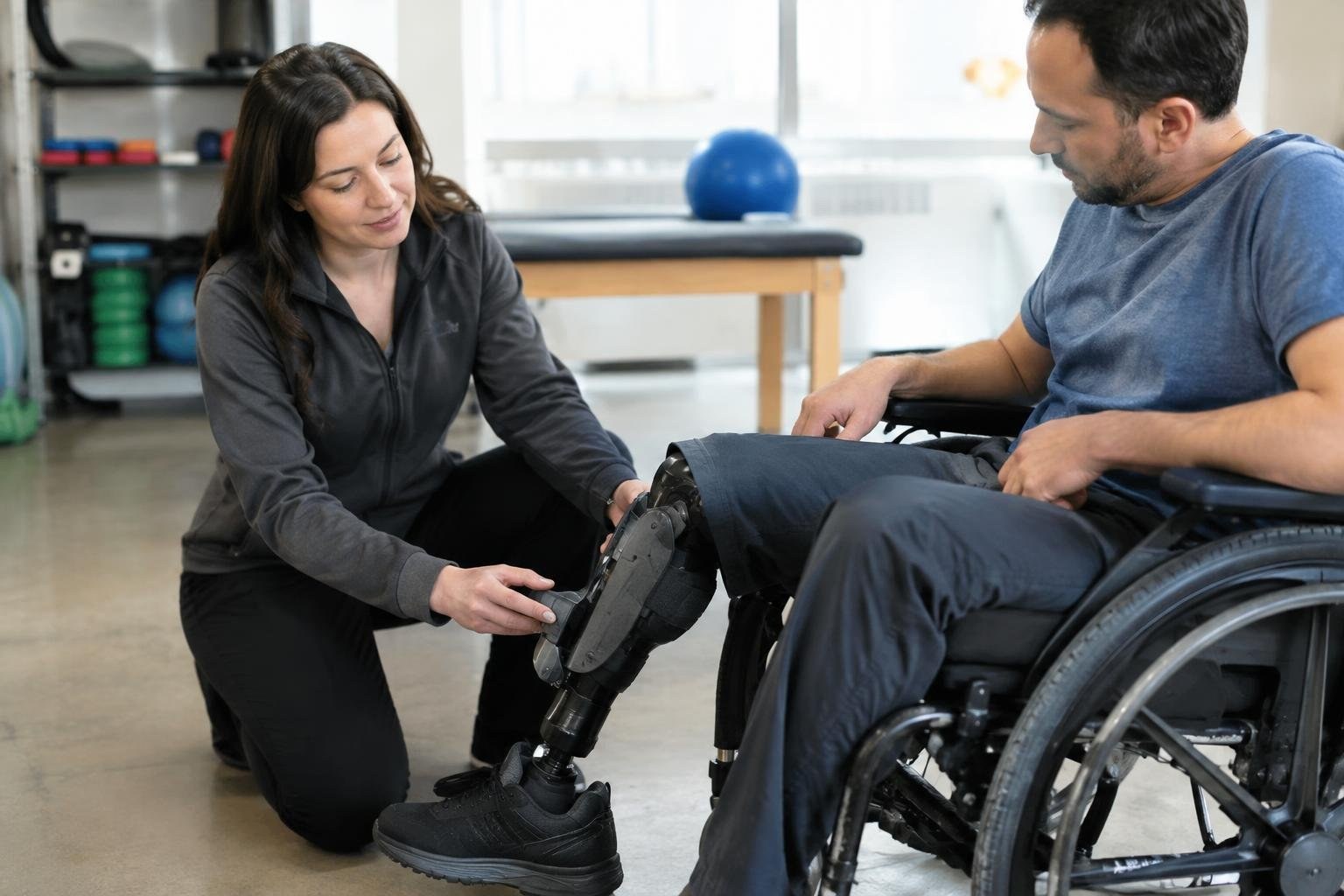
Assistive Technology and Rehabilitation Engineering Degree Guide
Explore assistive and augmentative technology and rehabilitation engineering programs, what students learn, possible career paths, credentials, online study, and how to compare options.
By Tome Fierre · Staff Writer Assessment.com · Published November 1, 2026 · Last updated November 5, 2026
Assistive and augmentative technology and rehabilitation engineering apply technology to access, communication, mobility, and daily function. Programs bring together ideas from engineering, psychology, rehabilitation, and occupational therapy to help people participate more fully in education, work, health care, and community life. Depending on the program, students may focus on selecting and applying assistive technology, designing or evaluating devices and environments, or preparing for work in a related rehabilitation profession. This is not one fixed degree path. The field is represented by certificates as well as undergraduate and graduate study, and the credential offered at a particular institution may have a narrower scope than the field as a whole. Prospective students and parents should compare the curriculum with actual job requirements, especially if the goal is a clinical or engineering position. Not sure whether this subject fits you? The MAPP career assessment can help you reflect on how your motivations and preferences align with career and degree options.
Degree & Program Decision Insights
Explore your personal fit, education requirements, career potential and next steps.
01Motivational Fit
Discover whether this program fits you
Explore your preferences against the focus of Assistive/Augmentative Technology and Rehabilitation Engineering. These prompts are not personal MAPP results.
Care and responsibility. Would you want to develop the skills involved in rehabilitation research, while taking the other person’s needs and professional boundaries seriously?
Breadth of interest. Consider the place of “ergonomics” in this field. Is this another part you would choose to explore, or mainly a requirement you would tolerate?
Work reality. Related work can involve this task: “Supervise rehabilitation counselors and staff.” Would you want that activity to be a regular responsibility?
Interest in studying a field can differ from enjoying its related work.
Which part would you want to do repeatedly, and what would you try before deciding?
Discover Your Personal Program Fit
Before investing your time and money in your education, discover how this program aligns with your natural motivations, work preferences and career goals.
Typical occupational entry: master's degree (BLS). Check the exact professional credential and jurisdiction requirements for this occupation; the classification association alone does not establish eligibility.
Orthotists and ProsthetistsSOC 29-2091 · O*NET 29-2091.00$81,110/year median (May 2025); +12.9% projected change (2025–2035); 700 projected openings/year.
Typical occupational entry: master's degree (BLS). BLS lists internship/residency as typical occupational training. Check the exact professional credential and jurisdiction requirements for this occupation; the classification association alone does not establish eligibility.
U.S. occupational wages are not guaranteed graduate earnings; OEWS excludes self-employed workers.
Projected openings include replacements as well as growth.
U.S. national estimates. A crosswalk does not establish entry-level eligibility; advanced, management and teaching roles can require further qualifications.
Compare the focus and route of these distinct instructional fields; their credentials and admission requirements are not interchangeable.
Rehabilitation ScienceCIP 51.2314. Compare its emphasis on sensory and motor function and dysfunction and biomechanics and kinesiology with this program’s focus.
Explore your motivations. Use MAPP as a starting point for reflecting on your interest in “ergonomics”, then test that interest against a sample learning task.
Examine the work. Compare Rehabilitation Counselors and Orthotists and Prosthetists on daily work and entry qualifications, as well as pay. Explore Rehabilitation Counselors.
Compare actual providers. Ask for the exact credential, course sequence and assessment methods. Compare how each provider teaches “seating and mobility design”, its entry criteria and its itemized costs.
Check the evidence before applying. Confirm prerequisites and any recognition or professional requirements for your intended route; ask for applicable rules and published outcome definitions in writing.
Verify the institution’s current offering, admissions requirements and outcomes; a search result does not establish your eligibility.
What Is Assistive Technology and Rehabilitation Engineering?
Assistive/augmentative technology and rehabilitation engineering is an interdisciplinary area concerned with technology that supports function and participation. Study may address how people interact with tools and environments, how technology can support communication or mobility, and how a solution is selected, designed, or evaluated for a particular need.
Program titles are not interchangeable guarantees of the same curriculum. Some are assistive technology certificates intended to expand professional knowledge; others combine engineering and rehabilitation content. The federal Classification of Instructional Programs identifies the field under CIP 51.2312, but a school’s degree title, course plan, and credential availability must be checked directly.
Examples of university certificates illustrate the range: Ohio State lists undergraduate and graduate assistive and rehabilitative technology certificates; Tufts offers an assistive technology certificate for working professionals and graduate students; and the University of Colorado Denver describes a graduate certificate in assistive technology and inclusive engineering. These examples do not mean every credential level is available everywhere.
Related disciplines include occupational therapy, physical therapy, speech-language pathology, special education, rehabilitation counseling, and engineering. The technology field can overlap with each, but a certificate in assistive technology does not itself make someone a licensed clinician or engineer.
Explore broader degree fields and program guides as you compare directions.
What Do Students Study?
Courses vary, but the program description for this field points to a blend of human-centered and technical learning. Students may study ergonomics and biomechanics to understand how bodies interact with devices, seating, mobility systems, and everyday environments. They may also examine communication access, universal design, rehabilitation research, technology standards, testing, and service delivery.
Depending on the emphasis, assignments may involve analyzing a use case, considering an individual's goals and context, comparing possible technology solutions, or evaluating how well a design works. Engineering-oriented study may place greater weight on design and technical systems; professional certificates may focus more on applying assistive technology in service settings.
Practical learning is worth investigating. The University of Colorado Denver lists a rehabilitation and assistive technology course with a lab. Ohio State describes graduate study intended to prepare students for professional certification exams. These examples show why the course catalog matters: a program title alone does not tell you whether it includes labs, field experience, research, or a capstone.
Ask for syllabi or sample assignments when available. Find out whether the program teaches communication supports, seating and mobility, accessible environments, or other areas relevant to the work you want to do. A short credential may offer a focused introduction rather than broad preparation in every specialty.
Skills You May Develop
Students may develop the ability to connect a person's needs with suitable technology and to communicate the reasoning behind a recommendation. Depending on coursework, useful skills can include:
Technology application: understanding how assistive tools and systems can support access, communication, mobility, or daily activities.
Human-centered problem solving: considering a person's goals, environment, preferences, and barriers rather than treating a device as a one-size-fits-all answer.
Technical thinking: interpreting design, ergonomics, biomechanics, testing, and standards concepts where the curriculum includes them.
Collaboration: communicating with people who have different expertise, such as rehabilitation professionals, educators, engineers, and families.
Evaluation and explanation: reviewing whether a technology approach works in context and explaining options clearly.
Ask programs to show how students practice these abilities. A lab, project, practicum, or applied assignment can provide different kinds of experience, and not all certificates include the same components. The University of Illinois Chicago describes its certificate as professional training that can expand work in areas including rehabilitation, education, engineering, and vocational rehabilitation.
Who Might Enjoy This Field?
This field may appeal to students who like solving practical problems and want their work to connect technology with human needs. It can interest people who enjoy asking how a device, communication method, or environment could make an activity more accessible. You do not need to arrive with a single personality type or a fixed career plan.
Consider whether you are curious about both people and systems. Some coursework can be technical, while other work involves listening, explaining options, and collaborating across professional boundaries. Engineering-focused programs may require stronger preparation in math and science than a professional certificate aimed at applying assistive technology. Check prerequisites rather than judging difficulty from the program title.
Does this field match you?
Salary, reputation, and employment projections are only part of a college decision. The day-to-day tasks, level of technical work, contact with clients or patients, and need for further education matter too. Use a career assessment as one reflection tool, then compare its suggestions with course requirements, conversations with advisors, and real job descriptions. Assessment.com provides the MAPP assessment and education guidance for students exploring major choices.
Start with guidance for choosing college majors, then use your results as a prompt for research rather than as a final decision.
Admissions, Credential Levels, Time, and Difficulty
Admissions depend on the credential and institution. An undergraduate certificate may be intended for students in health sciences, engineering, or special education, as well as people working in support roles. Graduate certificates may require a bachelor's degree or current enrollment in a graduate program. For example, UNH states that applicants to its online graduate certificate must have completed a bachelor's degree or higher; Ohio State describes its graduate certificate for post-professional applicants and students already enrolled in related graduate programs.
Before applying, check the current admissions page for degree prerequisites, transcripts, minimum grades, application materials, and whether professional experience is expected. Do not assume that a program designed for working professionals is open to first-year undergraduates, or that every certificate requires a prior degree.
There is no single completion time for the whole field. Ohio State describes its undergraduate certificate as 12 credits, but other certificates and degrees have different requirements. Full-time or part-time pace, course availability, transfer credit, and enrollment status affect a student's timeline. Ask for a realistic plan based on your circumstances, especially if you need to keep working while studying.
Common challenges may include learning technical vocabulary, balancing human needs with design constraints, and understanding how a solution works in a specific setting. Students can prepare by reviewing prerequisite math or science expectations and asking whether introductory support is available.
Online, Hybrid, or On Campus?
Online certificates are available, including Ohio State's undergraduate certificate and graduate certificate offerings and the University of New Hampshire's online graduate certificate. Online delivery can make it easier to study alongside work, but it does not tell you whether courses include synchronous meetings, practical assignments, or required in-person activities.
Ask the department how labs, projects, field experiences, and any hands-on assessments work for distance students. The University of Colorado Denver lists a lab course in its graduate certificate, so a prospective student should confirm the current delivery and participation requirements directly with the program. Hybrid and campus options may suit students who want more face-to-face learning or access to particular facilities.
Compare format with your learning style, schedule, access to equipment, and ability to travel. Get any placement or attendance requirements in writing before you commit.
Costs, Financial Aid, and Affordability
Program cost depends on the institution, credential, residency classification, and number of credits. The figures available from the program examples do not establish a typical national price, so request a current written estimate from every school you are considering.
Compare the full cost of attendance, not just the advertised tuition. Ask about mandatory fees, books, software or equipment, lab expenses, travel for in-person requirements, and whether courses are billed differently for online or out-of-state students. If you are comparing a certificate with a degree, confirm whether certificate credits can apply toward a later credential rather than assuming they will transfer.
Ways to make study more affordable
Ask the financial aid office about grants, scholarships, and eligibility for federal or institutional aid.
Check whether your employer offers tuition assistance or professional-development funding.
Compare the cost and schedule of part-time study with full-time enrollment.
Request a transfer-credit review before enrolling, and confirm decisions in writing.
Ask whether required equipment, materials, and travel are included in the estimate.
For working professionals, a focused certificate may be a smaller educational commitment than a new degree, but its value depends on whether it supports the career goal you have identified.
Careers, Jobs, Pay, and Employment Outlook
Programs in this area may support several career directions, but the best fit depends on the student's underlying qualification and the work involved. A short certificate may help someone deepen current professional practice; it should not be treated as a universal substitute for an occupational degree, engineering education, or any required license.
Career direction
How study may connect
What to verify
Assistive technology service or support roles
Study may cover applying assistive technology to individual needs and settings.
Employer requirements, experience expectations, and certification eligibility.
Seating and mobility specialization
Coursework may include seating, mobility, ergonomics, or related technology.
Credential prerequisites and the scope of the position.
Rehabilitation engineering
Engineering and rehabilitation content can inform technology design and evaluation.
Whether the job requires an engineering degree or specific technical experience.
Inclusive technology
Inclusive design study can relate to accessible products and environments.
Required technical portfolio, experience, and employer expectations.
Occupational therapy
Assistive technology can be relevant to a therapist's practice.
Professional education and licensure requirements for the location.
Physical therapy
Rehabilitation technology may connect with mobility and functional goals.
Professional degree and licensure requirements for the location.
Speech-language pathology
Augmentative and alternative communication may be relevant to communication support.
Required professional degree, supervised practice, and local credential rules.
Special education or vocational rehabilitation
Assistive technology can support access and participation in learning or work.
School, employer, and state qualification requirements.
Ohio State describes its graduate curriculum as preparation for the Assistive Technology Professional and Seating and Mobility Specialist certifications administered by RESNA. That does not establish eligibility for every student or program; review the current certification rules before relying on a course to qualify.
Pay and employment outlook are occupation-specific, not degree-wide. Compare current labor-market information for the exact job title and geographic area you hope to enter. The field's range of possible pathways makes a single salary figure misleading.
Explore related areas in healthcare practitioner and technical careers and architecture and engineering careers.
Find out which Career or College Major is right for you!
Program completion, professional certification, and a state license are different things. A certificate records completion of a defined course of study; it does not automatically grant permission to practice a separately regulated profession. If your career goal involves clinical care or engineering work subject to specific qualifications, confirm requirements with the appropriate state licensing authority and the employer.
RESNA administers the Assistive Technology Professional and Seating and Mobility Specialist certifications referenced by Ohio State. The university says its graduate curriculum is designed to prepare students for these certifications. Preparation does not guarantee eligibility, exam success, or certification. Check RESNA's current requirements and ask the program whether your educational background and work experience meet them.
Accreditation should also be checked at the right level. Confirm the institution's recognized accreditation and, where a target profession requires an accredited program, verify that the specific program meets that requirement. Do not infer professional accreditation from a university's general institutional status.
Related Degrees and Alternative Pathways
Related pathways include occupational therapy, physical therapy, speech-language pathology, special education, rehabilitation counseling, engineering, and computer science. The right alternative depends on whether you want to provide a regulated clinical service, build technical systems, support learning and communication, or add a specialization to work you already do.
Occupational therapy: consider this if you want a broader clinical profession focused on function and participation; assistive technology may be one aspect of practice.
Physical therapy: consider this if your central interest is movement and rehabilitation through a clinical pathway.
Speech-language pathology: consider this if communication and swallowing practice are your primary focus, with communication technology as a possible area of interest.
Special education: consider this if your main goal is teaching and supporting students in educational settings.
Rehabilitation counseling: consider this if you are drawn to counseling and vocational support rather than technology design.
Engineering: consider this if you want deeper preparation in designing and testing devices and systems.
Computer science: consider this if software and computing are your main interests, with accessibility as an application area.
Assistive technology certificate: consider this if you already have relevant training and want focused additional knowledge.
These are comparison points, not statements that one credential qualifies you for another profession. For a clinical career, compare its formal education, supervised practice, and licensing rules with the scope of an assistive technology certificate.
For a closer comparison, read about occupational therapist careers and review the applicable college program requirements.
Experience, Projects, and Building a Strong Profile
Hands-on experience can help students connect concepts with real settings. Depending on the program and a student's existing field, useful opportunities may include a lab, a technology evaluation project, a supervised practicum, research, volunteer work, or a workplace project. The available sources confirm that some coursework includes a lab, but they do not show that every program requires an internship or clinical placement.
To stand out, keep a clear record of the problems you studied, your role in a project, the choices you considered, and what you learned from evaluation. Protect private information and follow any applicable consent and confidentiality rules. For job applications, be ready to explain how you collaborate and adapt a solution to a person's context instead of relying only on a list of devices or software.
Ask program staff about placement partners, project supervision, and access to technology. Check whether an internship is guaranteed, competitive, optional, or arranged by the student.
Graduate School and Further Study
Graduate study may make sense if you want advanced technical work, research, leadership, or a credential required for a particular profession. Options could include a master's program in a related engineering, rehabilitation, education, or health discipline, or a post-baccalaureate or graduate certificate focused on assistive technology. The best next step depends on the job you want, not on a general belief that more school is always better.
For a clinical profession, identify its required professional degree and licensing path separately. For research or university teaching, investigate whether doctoral study is expected in your intended specialty. For a working professional who wants to extend current practice, a graduate certificate may offer a more focused route. Tufts describes its certificate for working professionals and graduate students, while Ohio State presents its graduate certificate for post-professional applicants and related graduate students.
Before applying, ask whether credits can count toward another credential and whether the sequence fits your schedule. Do not assume certificate credits will transfer or replace professional prerequisites.
How to Choose the Right Program
Use this checklist when you compare schools. Request answers from the department or registrar when a policy is unclear.
What exact credential will I earn, and what courses are required?
Does the curriculum emphasize applying technology, engineering design, communication access, seating and mobility, or another specialty I want?
What prior education, experience, or enrollment status is required for admission?
Are labs, practicums, internships, projects, or in-person sessions required? How are they arranged?
What is the complete estimated cost, including fees, books, equipment, and travel?
Is the institution accredited, and is any program-specific accreditation needed for my intended profession?
Does the program prepare students for a certification, and do I independently meet its current eligibility rules?
Can credits transfer to a degree or another program? Can the school confirm this in writing?
What are the actual graduation, continuation, and career-support services for this program?
What financial aid, scholarships, employer support, or payment options may apply to me?
Can I speak with current students, graduates, or a faculty advisor about the workload and learning format?
Compare at least two programs using the same questions. Assessment.com's education and career resources can help you explore choices, but verify admissions, costs, and professional rules directly with the college and relevant credentialing body.
From Education to Career: Possible Pathways
Career development is not automatic, and graduates may follow different routes. These examples illustrate possible sequences rather than guaranteed outcomes:
Related health or education role → assistive technology coursework → expanded technology-support responsibilities → focused service or access specialization.
Engineering or computer science study → assistive technology or inclusive design coursework → project or research experience → technical role focused on accessibility or rehabilitation applications.
Graduate study in a related field → assistive technology certificate → professional certification if eligible → specialized practice aligned with the person's existing qualification.
Clinical professional education → work in a licensed profession → additional assistive technology learning → broader use of technology within that profession's scope.
Progress depends on the student's initial education, experience, location, employer requirements, and any certification or license needed. When reviewing job postings, note which qualifications are required and which are preferred. Then work backward to identify the smallest credible education and experience plan for your target role.
Is This Field Worth It? Advantages and Tradeoffs
Assistive technology and rehabilitation engineering may be worthwhile for students who want to connect technical problem solving with access and human function. It can also be a practical specialty for people already working in rehabilitation, health, education, engineering, or vocational support. A focused certificate may be less time-intensive than beginning a new professional degree, but its value depends on whether it helps meet a specific career or learning goal.
Potential drawbacks include a field name that covers very different curricula, uncertainty about whether a short credential meets an employer's expectations, and the need for additional education or licensure for some career paths. Cost and format also matter: an online label does not guarantee a fully remote experience, and advertised tuition may not include required equipment or travel.
Evaluate value by comparing total cost and time with the qualifications required for your intended job. Ask employers or professional advisors how they view a specific credential. Then consider whether the coursework and work environment fit your interests. A degree decision is stronger when both the education plan and the day-to-day career seem workable.
Students and parents can use the MAPP assessment to explore career and education options alongside conversations with counselors, faculty, and professionals in the field.
Frequently asked questions
What is assistive technology and rehabilitation engineering?
It combines accessibility, rehabilitation, and technology. Programs may teach students to assess needs and use or design technology that supports communication, mobility, daily activities, and participation. Course emphasis differs: some certificates focus on applying assistive technology in professional settings, while engineering-oriented study may emphasize design, testing, and technical systems.
Is assistive technology and rehabilitation engineering a hard major?
It can be challenging because the field brings together technical concepts, human needs, and real-world constraints. Depending on the program, students may encounter biomechanics, ergonomics, technology, disability-related topics, design, and research. Check the course list and prerequisites for your target program to understand its mathematics, science, clinical, or hands-on demands.
How long does an assistive technology program take?
There is no single standard timeline because the field includes certificates and degree-level study, and programs set their own credit requirements. For example, Ohio State describes an online undergraduate certificate with 12 credits. Check each institution's catalog for its current requirements, course schedule, and expected time to completion.
Can I study assistive technology online?
Some programs offer online study. Ohio State describes an online undergraduate certificate, and the University of New Hampshire describes an online graduate certificate. Online does not automatically mean every activity is remote, so confirm whether your selected program includes labs, fieldwork, in-person meetings, or practical experience.
What jobs can I get with an assistive technology certificate?
Potential paths include assistive technology services, rehabilitation technology support, seating and mobility, inclusive technology, and engineering-related work. The appropriate job depends on your education, experience, and any required professional credential. A certificate can add focused knowledge, but it does not automatically qualify someone for every clinical or engineering role.
Does an assistive technology degree lead to professional certification?
Some employers and professional roles may value certifications, but eligibility and requirements differ. Ohio State says its graduate curriculum is designed to prepare students for RESNA's Assistive Technology Professional and Seating and Mobility Specialist certifications. Check RESNA's current eligibility rules and determine whether a specific certificate meets them before enrolling.
How much does an assistive technology program cost?
Tuition depends on the institution, residency status, credential, and other charges. Compare total program cost rather than tuition alone, including fees, books, equipment, travel, and any required in-person experiences. Ask financial aid offices about grants, scholarships, employer support, and whether credits can transfer into a later degree.
Do I need a bachelor's degree to work in assistive technology?
Not always. A certificate may provide focused study for people already working in health, education, engineering, or rehabilitation fields. Engineering positions and regulated clinical careers may require a relevant degree or additional professional preparation. Review job requirements and the certificate's intended audience before treating it as a stand-alone career qualification.
People Also Ask
What is the difference between assistive technology and rehabilitation engineering?
Assistive technology refers to tools and systems used to support a person's function and participation. Augmentative and alternative communication includes approaches and tools that support communication. Rehabilitation engineering applies engineering concepts to rehabilitation needs, including design, evaluation, access, and mobility. Program names and emphasis vary across institutions.
Can working professionals earn an assistive technology certificate?
Yes, some university certificates are designed for professionals or graduate students in fields such as occupational therapy, rehabilitation, engineering, education, and computer science. Other programs may have different entry requirements. Read the admissions page and confirm whether applicants need a prior degree, relevant work, or enrollment in another program.
Is an assistive technology certificate worth it?
It may be a useful specialization for someone whose existing education or work is related to health, education, engineering, or rehabilitation. Its value depends on the target job and whether employers recognize the credential. Compare the course outcomes with job postings and certification eligibility rather than assuming the certificate replaces a required degree or license.
Are assistive technology programs fully online?
It depends on the program. The field includes online certificates, but other pathways may involve labs, projects, field experiences, or in-person learning. Ask the program to identify all required attendance, equipment, placement, and assessment activities before you enroll, particularly if you live far from campus.
How does assistive technology study compare with occupational therapy?
A dedicated assistive technology program focuses on the application or development of technology for access and function. Occupational therapy prepares students for a broader clinical profession and may include assistive technology as one part of practice. Engineering programs usually provide deeper technical preparation. Compare course plans and credential outcomes before choosing.
What subjects are taught in assistive technology programs?
Some programs cover communication access, mobility, seating, ergonomics, technology use, or inclusive environments. The exact topics depend on the institution. Review course descriptions and ask whether students practice evaluating needs and matching technology to individual circumstances, not just learn device terminology.
Assistive/augmentative technology and rehabilitation engineering can suit students who want to connect technology, accessibility, and human needs. The field includes several distinct paths, from assistive technology services to engineering and clinical professions, and each may require different education or credentials. Compare program content, practical experience, cost, and the requirements of the careers you are actually considering. A career-fit assessment can help you reflect on whether the day-to-day work aligns with your interests and motivations.
Want to see your options? Try our comprehensive Degree, Program & College Search tool
We use cookies to offer you a better browsing experience, analyze site traffic and personalize content.
Read about how we use cookies and how you can control them in our
Privacy Policy.
If you continue to use this site, you consent to our use of cookies.
×
Exciting News!
Be one of the first to Beta Test the new AI-Powered Assessment.com Platform.