Physical Fitness Technician Programs: Courses, Careers, Costs & Fit
Explore what Physical Fitness Technician programs teach, possible credentials and careers, costs to investigate, and how to compare programs before enrolling.
By Kieth Nelson · Staff Writer Assessment.com · Published October 26, 2026 · Last updated November 5, 2026
A Physical Fitness Technician program prepares students to support fitness instruction and wellness activities in settings such as health clubs, recreation facilities, hospitals, and workplace fitness programs. Coursework may cover anatomy and physiology, exercise science, fitness techniques, personal training, nutrition, and customer service. Depending on the credential and program, graduates may pursue fitness instruction or related program-support work, or continue their education. For students and parents, the key question is not only what the program teaches, but whether its cost, hands-on learning, and career preparation fit a realistic next step.
Degree & Program Decision Insights
Explore your personal fit, education requirements, career potential and next steps.
01Motivational Fit
Discover whether this program fits you
Explore your preferences against the focus of Physical Fitness Technician. These prompts are not personal MAPP results.
Subject curiosity. Would you choose to explore “human anatomy and physiology” in depth? Ask for a sample learning activity to test that interest.
Breadth of interest. Consider the place of “fitness techniques” in this field. Is this another part you would choose to explore, or mainly a requirement you would tolerate?
Work reality. Related work can involve this task: “Maintain fitness equipment.” Would you want that activity to be a regular responsibility?
Interest in studying a field can differ from enjoying its related work.
Which part would you want to do repeatedly, and what would you try before deciding?
Discover Your Personal Program Fit
Before investing your time and money in your education, discover how this program aligns with your natural motivations, work preferences and career goals.
Typical occupational entry: master's degree (BLS). Check the exact professional credential and jurisdiction requirements for this occupation; the classification association alone does not establish eligibility.
U.S. occupational wages are not guaranteed graduate earnings; OEWS excludes self-employed workers.
Projected openings include replacements as well as growth.
U.S. national estimates. A crosswalk does not establish entry-level eligibility; advanced, management and teaching roles can require further qualifications.
Sport and Fitness Administration/ManagementCIP 31.0504. Compare its emphasis on program planning and development and business and financial management principles with this program’s focus.
Explore your motivations. Use MAPP as a starting point for reflecting on your interest in “human anatomy and physiology”, then test that interest against a sample learning task.
Compare actual providers. Ask for the exact credential, course sequence and assessment methods. Compare how each provider teaches “fitness techniques”, its entry criteria and its itemized costs.
Check the evidence before applying. Confirm prerequisites and any recognition or professional requirements for your intended route; ask for applicable rules and published outcome definitions in writing.
Verify the institution’s current offering, admissions requirements and outcomes; a search result does not establish your eligibility.
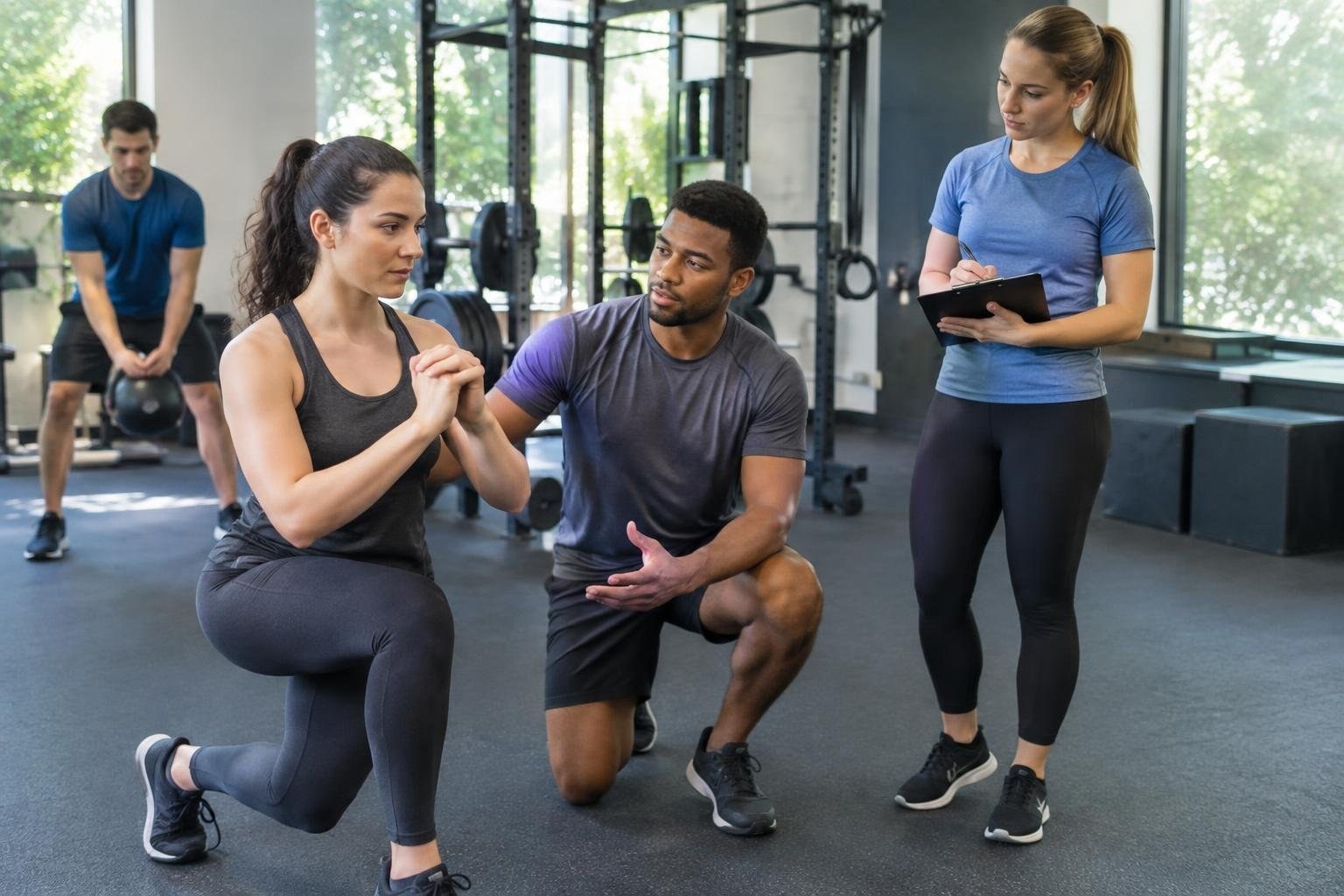
Students learning to assess movement and discuss exercise plans under instructor supervision
What Is a Physical Fitness Technician Program?
A Physical Fitness Technician program is a course of study in fitness and exercise that prepares students for instructional and administrative work in settings such as fitness clubs, wellness centers, recreation facilities, hospitals, and corporate fitness programs. Its subject areas can include human anatomy and physiology, exercise science, personal training, nutrition, fitness techniques, and customer service.
The name may describe a particular program or area of study rather than one standardized credential. Similar coursework may be housed in kinesiology, exercise science, or fitness studies departments. A program’s title alone does not tell you how much practical training it offers or which jobs its graduates are qualified to pursue.
For one example, Portland Community College’s Exercise Science program description lists anatomy and physiology, applied kinesiology, exercise physiology, nutrition for fitness, fitness assessment, and exercise prescription among graduate learning areas. Treat examples as a starting point for comparison, not a promise that every school’s curriculum is the same.
Credential Levels, Study Formats, and Time to Completion
Students may encounter a certificate, associate degree, bachelor’s degree, or graduate-level study connected to fitness, kinesiology, or exercise science. The available credentials and their names depend on the institution. These options are not interchangeable: a focused certificate may concentrate on job skills, while a degree can include broader academic study and may provide a route to further education.
For example, College of the Desert describes its Fitness Specialist Certificate of Achievement as preparation for personal training, group fitness, and exercise leadership. Its Kinesiology information also describes associate-level students pursuing entry-level fitness or recreation positions or continuing to bachelor’s or graduate study. Check each school’s catalog for the credential actually awarded and confirm whether the courses transfer to a program you may want later.
Do not assume that an academic certificate is the same as a professional certification. One is awarded by a school for completing its course of study; the other may be a separate credential with its own requirements. Ask schools and prospective employers how each credential is viewed.
What Do You Study? Courses and Practical Learning
Expect some combination of scientific foundations, applied exercise study, communication, and practice. The exact sequence varies by school, but useful topics to look for include:
Anatomy and physiology: how body systems and movement relate to physical activity.
Exercise science and applied kinesiology: how exercise and movement principles inform fitness instruction.
Fitness assessment and exercise prescription: how to gather relevant information and use it to plan exercise activities.
Nutrition for fitness: foundational nutrition concepts in a fitness context.
Client motivation and behavior: ways to communicate, support participation, and encourage realistic behavior change.
Emergency response: training topics such as CPR, AED, and first aid may appear in some programs.
Portland Community College’s published Exercise Science description provides an example of these learning areas, including client motivation, behavior modification, emergency response, and fitness promotion. Ask whether your program includes labs, practice assessments, supervised instruction, a project, or a field experience. A list of course titles cannot show how often students apply the ideas with feedback.
Who Is This Program For? Interests and Entry Requirements
This field may fit students who are curious about how the body moves and who enjoy explaining ideas, encouraging participation, and working toward practical goals with other people. Fitness work can involve instruction and customer service as well as exercise knowledge. Depending on the setting, students should also consider whether they are comfortable demonstrating movements and adapting communication to different clients.
You do not need to arrive as an expert athlete. The more useful questions are whether you want to learn the science behind exercise, whether you enjoy helping people practice skills, and whether you can approach health and fitness topics with care rather than assumptions about what every person can do.
Admissions requirements are set by each college. Review its current page for academic prerequisites, placement rules, application materials, deadlines, and any requirements for clinical, lab, or field experiences. Ask about transfer-credit evaluation if you have previous college coursework. Do not assume that fitness experience replaces an academic prerequisite or that all programs have the same entry rules.
Skills You Can Develop
Training in this area can combine subject knowledge with practical communication. Students may learn to discuss exercise principles, interpret fitness assessments, plan activities, explain safe technique, motivate clients, and support fitness programming. These abilities connect directly to work in personal training, group exercise, exercise leadership, and fitness or recreation-program support, depending on the program and employer.
Experience with client motivation and behavior modification is especially relevant because fitness instruction is not just a matter of demonstrating movements. Instructors need to listen, give understandable guidance, and help clients work toward appropriate goals. Program descriptions may also include emergency response and fitness promotion, so check the curriculum for those elements rather than assuming they are part of every credential.
Ask the college how students practice communication and assessment skills, what equipment or facilities are available, and whether instructors observe or evaluate applied work. These details help you judge whether a program builds capabilities you can describe to an employer.
How Long Does It Take, and Can You Study Online?
There is no single completion time for a Physical Fitness Technician pathway. A focused certificate, associate degree, and bachelor’s degree involve different amounts of study, and the schedule depends on the institution, course availability, transfer credits, and whether you study full time or part time. Ask for a term-by-term plan that shows required courses and any prerequisites.
Online or hybrid availability also varies. Some reading and lecture work may be possible remotely, while fitness assessments, equipment practice, demonstrations, or supervised experience may require in-person participation. Before you enroll in an online program, ask which activities require campus attendance and whether any travel or field placement is your responsibility.
For students planning to continue to a four-year college, confirm transferability before paying for courses. Ask the receiving institution to review the exact course list, not just the name of the associate degree or certificate. Keep written guidance about which credits count toward the intended major.
Tuition, Total Cost, and Financial Aid
Tuition cannot be estimated from the field name alone. A student’s total budget depends on the institution, residency classification, credential level, attendance pattern, and whether fees or additional expenses apply. Request a written estimate for the complete program, not only a per-course or per-credit figure.
Ask whether the estimate includes books, lab or activity fees, required supplies, transportation to practical experiences, and any separate exam or credential costs. Compare net cost after grants, scholarships, or other aid for which you may qualify. Financial aid rules and eligibility vary, so review current information with the college’s financial aid office.
Ways to manage costs may include comparing public and private institutions, starting at a community college when the credits transfer, studying part time while working, asking an employer about education assistance, and applying for scholarships. Check that a lower-cost route still includes the preparation and practical work needed for your goal. Families should also ask how withdrawing or changing course load could affect aid and time to completion.
Careers, Jobs, and Employment Outlook
Career options depend on the credential, coursework, additional qualifications, experience, and the employer. A program can be relevant preparation without guaranteeing a particular job. The examples below describe possible directions, not universal eligibility.
Career direction
How study may apply
What to verify
Personal fitness trainer
Exercise instruction, fitness assessment, exercise planning, and client communication.
Employer expectations and any separate certification or experience requirements.
Group fitness instructor
Fitness techniques, exercise leadership, and motivating participants.
Class-specific skills, employer requirements, and any credential expectations.
Exercise leader
Applied exercise knowledge and guiding participants through activities.
Setting, population served, and additional training requested.
Community recreation or youth sports coordinator
Fitness and kinesiology knowledge may support activity programming.
Administrative, recreation, or youth-program experience employers seek.
Fitness or wellness program support
Customer service and fitness-promotion knowledge may apply to program operations.
Whether the role focuses on instruction, scheduling, administration, or health services.
Athletic trainer
A related interest in human movement may prompt comparison with this profession.
It is a distinct career. Verify its current education, certification, and state requirements.
College of the Desert identifies personal fitness trainer, community recreation, and youth sports coordinator as possible entry-level directions for students earning its associate degree in kinesiology. That example should not be read as a guarantee or as a national employment forecast. Pay and outlook depend on the occupation and location; compare current data for each exact job title rather than assigning one salary to this program. Fitness employers may include health clubs, recreation organizations, wellness centers, hospitals, and workplace fitness programs described in the field overview.
Digital tools may assist with scheduling, tracking activity, or delivering remote instruction, but they do not replace a program’s need to teach sound exercise knowledge and communication. Ask programs how they address technology used in the work, and evaluate claims about job security or automation against actual duties in local job postings.
Find out which Career or College Major is right for you!
Certification, Licensure, and What a School Credential Means
Completing a school program does not automatically mean you hold every professional credential an employer may request. The Fitness Specialist Certificate of Achievement described by College of the Desert is an academic program credential; its catalog language about preparing students for fitness-industry opportunities should not be taken to mean that every graduate receives a separate industry certification.
Ask the college which credentials it awards, whether students are eligible to pursue a separate certification, and what additional steps are involved. Confirm current requirements with the organization that issues a credential and with employers in your area. Requirements can differ by occupation, employer, and location.
Fitness instruction and athletic training are not identical career paths. If you are considering athletic training, verify the relevant professional education and licensing or certification pathway before choosing a fitness-focused program. Do not rely on a program title or an informal comparison to establish eligibility.
Related Degrees and Alternatives
Related majors can overlap in subject matter but lead toward different work. Use each school’s catalog and job requirements to compare depth and purpose.
Kinesiology: consider this if you want a broader study of human movement and the option to continue into further study.
Exercise science: consider this if you want to focus on exercise physiology, assessment, and exercise planning.
Health and fitness studies: consider this if you are interested in wellness, fitness programming, and community or workplace settings.
Physical education: consider this if teaching physical activity in an educational setting is your goal; confirm teacher-preparation requirements.
Recreation studies: consider this if your priority is community activities, recreation programming, or youth sports.
Athletic training: consider this if you want to explore a distinct healthcare-related profession and are prepared to meet its specific education and credential requirements.
For instance, College of the Desert presents its associate-level kinesiology study as a route to selected entry-level roles or continued education. Portland Community College’s exercise science description emphasizes applied exercise topics. Compare actual classes and transfer arrangements rather than assuming a major label alone determines the career outcome.
How to Choose a Program and Check Accreditation
Before choosing a school, compare the program as a practical investment in a specific next step. Review the curriculum, instructor experience, access to exercise equipment, supervised practice, transfer options, and career support. Ask for written answers when a feature affects your schedule or budget.
What credential will appear on the transcript, and what courses are required?
How much time is spent applying concepts through assessments, demonstrations, or supervised instruction?
What additional credential or experience do local employers request for the jobs I want?
Can I complete the program online, and which activities require campus or field attendance?
What is the total estimated cost, including fees and required supplies?
Can these credits transfer to a named bachelor’s program, and who can confirm that in writing?
What career advising, internship support, and employer connections are available?
Does the institution hold recognized accreditation, and is any specialized approval relevant to my intended pathway?
Check accreditation and any profession-specific requirements through the appropriate official organization. Do not treat marketing language such as “career-ready” as proof of accreditation, licensure eligibility, or a job placement rate. When comparing outcome figures, ask how the school defines them, which graduates are counted, and what time period they cover.
Does Physical Fitness Technician Match You?
Fitness work can be physical, social, instructional, and service-oriented. Think about whether you enjoy explaining a process, working with people toward goals, and learning how exercise relates to the body. Also consider less visible parts of the work, such as scheduling, client follow-up, program organization, or adapting instructions for individual needs.
To test your interest, speak with people in more than one fitness setting, observe a class if permitted, and read job postings for roles you may want. Note the tasks that recur and the qualifications employers actually request. A short conversation or observation cannot guarantee that you will like the work, but it can make your college decision more concrete.
Personal fit is one factor, not a substitute for checking academic preparation, cost, or job requirements. If you are unsure whether fitness, recreation, healthcare, or another field aligns with your motivations, Assessment.com’s MAPP career assessment can help you explore career and degree options. Use results as a starting point for research rather than a final verdict.
From Program to Career: Possible Pathways
Career development is not a guaranteed ladder, but a few pathways illustrate how education and experience can build on one another:
Fitness-focused certificate → assistant or entry-level fitness role → supervised client or class experience → specialized instruction or program support.
Associate degree in kinesiology or exercise science → personal training or recreation-related entry role → continued bachelor’s study → broader opportunities tied to further coursework and experience.
Fitness studies → group exercise or exercise leadership → experience coordinating sessions → fitness or wellness program coordination, when an employer’s requirements are met.
College of the Desert describes both entry-level possibilities for associate kinesiology students and continuing education as options. These are examples, not promises of promotion or admission to another school. Keep building relevant experience through supervised practice, projects, community recreation, or work in a fitness setting, and check whether any role requires a separate credential.
Questions to Ask Before Enrolling
Before submitting an application or paying a deposit, discuss these points with a college advisor and, where possible, an employer in your target setting:
What exact credential will I earn, and which jobs does the curriculum prepare me to pursue?
What is the total cost after aid, including fees, supplies, and travel for practical work?
What hands-on experiences are required, and how are they supervised?
Which courses or credentials do local employers expect?
If I transfer, which credits will count toward my next degree?
How do online, hybrid, and campus schedules differ for applied coursework?
What evidence does the school provide about graduate outcomes and career support?
Which official source can confirm accreditation or a professional requirement?
Save course plans, cost estimates, and transfer evaluations so you can compare programs on the same basis. If you have a particular career in mind, start with its job requirements and work backward to the education and experience that employers ask for.
Is a Physical Fitness Technician Program Right for You?
A Physical Fitness Technician program can be a sensible option for students who want to study exercise and support fitness instruction, but the right route depends on the specific job goal. Compare what you will learn, how much practical application you will get, whether further credentials are expected, and how the full cost fits your plans.
Students who want a broader foundation or a route to additional study may prefer a degree in kinesiology or exercise science. Those interested in athletic training should investigate that separate career pathway. For students and parents, careful comparison is more useful than choosing by program title alone.
Explore related education and career information on Assessment.com, and consider using the MAPP career assessment as one tool for thinking about personal fit. The next step is to compare real program requirements and career expectations before making a commitment.
Frequently asked questions
Is a Physical Fitness Technician program hard?
A Physical Fitness Technician program can be challenging if anatomy, physiology, exercise science, or communicating with clients are new to you. Coursework may combine body systems and exercise concepts with fitness assessment, exercise planning, nutrition, and client motivation. Ask programs how much supervised practice they include and whether introductory science support is available. The challenge depends on the curriculum and your preparation.
Is a Physical Fitness Technician program worth it?
It may be worthwhile if the program teaches skills for a career you want, offers relevant practical experience, and fits your budget. It is not automatically valuable because fitness is an area of interest: confirm which jobs graduates pursue, what employers require, and whether a separate credential or further education is needed. Compare the full cost with your specific career plan before deciding.
What jobs can I get with a Physical Fitness Technician credential?
Possible entry-level directions include personal fitness training, group fitness instruction, exercise leadership, and fitness or recreation program support. A College of the Desert kinesiology program describes personal fitness trainer, community recreation, and youth sports coordinator as possible entry-level directions for its associate degree students. Specific job qualifications vary, so compare program content with local employer postings.
How much can you make with a Physical Fitness Technician degree?
Pay depends on the job title, employer, location, schedule, experience, and any credentials required. A degree or certificate name alone does not determine earnings. Compare current wage data for the exact occupations you are considering and look at entry-level job postings in the area where you expect to work. Do not treat a general fitness-industry salary as a guaranteed outcome for graduates.
Can I earn a Physical Fitness Technician credential online?
Some fitness-related coursework may be offered online, but delivery varies by institution and course. Ask whether anatomy or exercise-science labs, fitness assessments, supervised instruction, or internships require campus or community-site attendance. Also confirm that online classes include the practical experience needed for the roles you plan to pursue.
Does a Physical Fitness Technician program require math?
Expect to study the body and exercise, but the amount of math varies by program. Fitness assessment and exercise planning can involve measurements, interpreting results, and using basic calculations. Review course descriptions and prerequisites, and ask an advisor about tutoring or placement support if you are concerned about science or quantitative coursework.
Do I need graduate school after a Physical Fitness Technician program?
Not for every fitness role. Some students pursue certificates or associate degrees for entry-level work, while others continue into a bachelor's or graduate program. The appropriate level depends on the job: for example, becoming an athletic trainer is a distinct career path from fitness instruction, and students should verify its current education and licensing requirements before choosing a program.
What certifications help fitness technicians?
A program certificate and a professional certification are not necessarily the same thing. Check what credential the school awards, whether a separate industry certification is available or expected for your target job, and whether the curriculum prepares you for its requirements. Confirm current eligibility, exam, renewal, and employer expectations directly with the relevant credentialing organization.
People Also Ask
What degree is a Physical Fitness Technician?
Programs may be offered as certificates or as part of broader associate or bachelor’s study, but availability and course plans vary by institution. Compare the exact credential, course list, practical learning, and career outcomes rather than relying on the program title alone.
Is Physical Fitness Technician the same as kinesiology?
The field’s study areas can appear under program names such as fitness, kinesiology, or exercise science. Names do not guarantee identical content. Review required courses and ask whether the curriculum includes anatomy and physiology, exercise assessment, prescription, nutrition, and client communication.
How long does a Physical Fitness Technician program take?
A short certificate may take less time than an associate or bachelor’s program, but there is no single completion timeline for this field. Prior credits, part-time attendance, course sequencing, and any required practical experience affect how long an individual student takes.
Is a fitness certificate the same as a professional certification?
Compare program-awarded certificates with professional industry certifications carefully. A school credential documents completion of its program; a professional certification may have separate eligibility and assessment rules. Ask employers and the credentialing organization what is expected for the job you want.
Can I transfer from an associate degree into a bachelor’s program?
Yes, students may continue from an associate-level kinesiology or exercise science path toward a bachelor’s degree or graduate study. Before enrolling, ask receiving institutions which credits transfer and whether the courses meet prerequisites for the next program.
What is the difference between a fitness technician and an athletic trainer?
Fitness programs can prepare students for roles in fitness instruction and related wellness or recreation settings. Athletic training is a separate occupation with its own education and credential requirements, so compare the two career paths before selecting a major.
A Physical Fitness Technician program may suit students who want to understand exercise and help people participate in fitness activities. The most useful choice depends on the role you want, the level of education it requires, the program’s practical learning opportunities, and its total cost. Compare course plans and job requirements before enrolling, and consider whether the day-to-day work of coaching, instruction, or fitness-program support matches your interests. Assessment.com’s MAPP career assessment can help you explore career and degree options as you make that decision.
Want to see your options? Try our comprehensive Degree, Program & College Search tool
We use cookies to offer you a better browsing experience, analyze site traffic and personalize content.
Read about how we use cookies and how you can control them in our
Privacy Policy.
If you continue to use this site, you consent to our use of cookies.
×
Exciting News!
Be one of the first to Beta Test the new AI-Powered Assessment.com Platform.