Molecular Genetics Degree Guide: Courses, Careers, Costs, and Fit
Learn what molecular genetics students study, what careers the field can lead to, how to compare program costs and formats, and what to ask before enrolling.
By David Slack · Staff Writer Assessment.com · Published October 26, 2026 · Last updated November 5, 2026
A molecular genetics degree focuses on how organisms store, copy, regulate, and use genetic information. Students explore genes and the molecular processes behind heredity, often through biology and chemistry courses alongside laboratory work. The field can lead toward research, biotechnology, biomedical science, public health, or further study for specialized careers. Programs differ in their emphasis and the credentials they offer, so it is important to examine specific course plans rather than assume every degree with a similar name is the same. Not sure whether molecular genetics fits you? Take the Free MAPP Career Assessment to explore how your motivations, interests, and preferences may align with this field and related careers.
Degree & Program Decision Insights
Explore your personal fit, education requirements, career potential and next steps.
01Motivational Fit
Discover whether this program fits you
Explore your preferences against the focus of Molecular Genetics. These prompts are not personal MAPP results.
Subject curiosity. Would you choose to explore “the regulation of these processes” in depth? Ask for a sample learning activity to test that interest.
Breadth of interest. Consider the place of “neurogenetics” in this field. Is this another part you would choose to explore, or mainly a requirement you would tolerate?
Work reality. Related work can involve this task: “Engage in research activities related to the field of medical genetics or genetic counseling.” Would you want that activity to be a regular responsibility?
Interest in studying a field can differ from enjoying its related work.
Which part would you want to do repeatedly, and what would you try before deciding?
Discover Your Personal Program Fit
Before investing your time and money in your education, discover how this program aligns with your natural motivations, work preferences and career goals.
Typical occupational entry: master's degree (BLS). Check the exact professional credential and jurisdiction requirements for this occupation; the classification association alone does not establish eligibility.
Typical occupational entry: bachelor's degree (BLS). BLS lists 5 years or more of related work experience as typical for this occupation; this programme is not a direct promise of entry.
U.S. occupational wages are not guaranteed graduate earnings; OEWS excludes self-employed workers.
Projected openings include replacements as well as growth.
U.S. national estimates. A crosswalk does not establish entry-level eligibility; advanced, management and teaching roles can require further qualifications.
Explore your motivations. Use MAPP as a starting point for reflecting on your interest in “the regulation of these processes”, then test that interest against a sample learning task.
Examine the work. Compare Genetic Counselors and Natural Sciences Managers on daily work and entry qualifications, as well as pay.
Compare actual providers. Ask for the exact credential, course sequence and assessment methods. Compare how each provider teaches “neurogenetics”, its entry criteria and its itemized costs.
Check the evidence before applying. Confirm prerequisites and any recognition or professional requirements for your intended route; ask for applicable rules and published outcome definitions in writing.
Verify the institution’s current offering, admissions requirements and outcomes; a search result does not establish your eligibility.
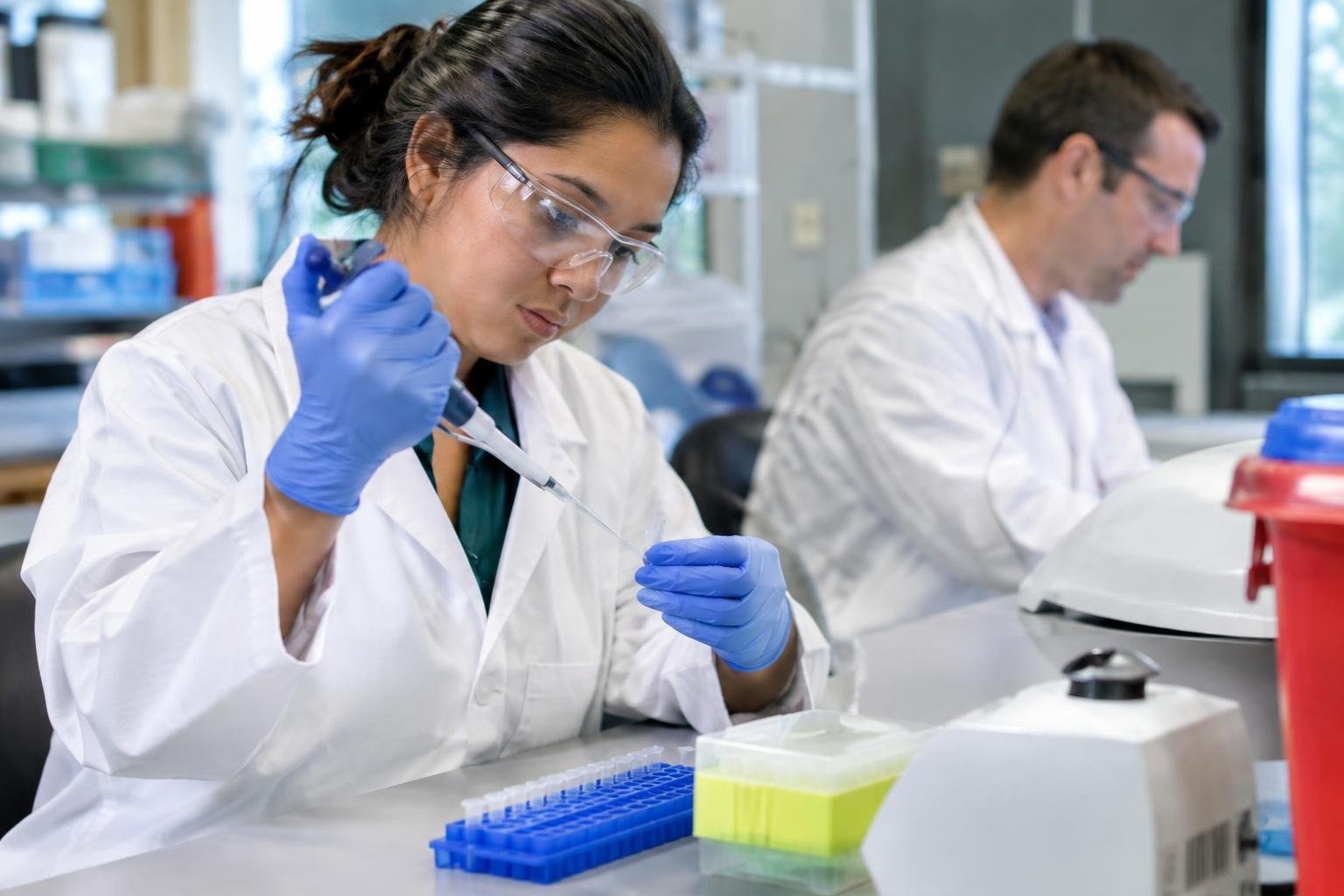
A college student conducting supervised molecular biology lab work
What Is a Molecular Genetics Degree?
Molecular genetics examines genetic material and the mechanisms that control how heritable information is copied, expressed, transferred, regulated, and maintained. The field connects molecular biology, genetics, and cellular processes. The program description associated with CIP 26.0802 includes organisms such as bacteria, phages, and viruses, as well as DNA, RNA, proteins, and neurogenetics.
Schools may call a program molecular genetics, molecular biology and genetics, or use a broader biology or biomedical sciences label. Names are not interchangeable guarantees: read the course requirements and research opportunities to see whether the program centers on genes and molecular mechanisms.
Depending on the institution, students may encounter undergraduate majors, graduate degrees, or certificates in related subjects. Available credential levels and admissions rules are institution-specific, not universal features of the field.
What Do You Study in Molecular Genetics?
Expect a progression from broad scientific foundations to focused study. Related undergraduate curricula describe grounding in biological sciences, chemistry, and physics, followed by specialized study that can include cellular and microbial physiology, immunology, molecular biology, and genetic engineering.
Laboratory work helps translate concepts into practice. Depending on the program, students may learn to work with microscopy, gene cloning, genomics, or bioinformatics. A lab is not simply a demonstration: students learn to follow protocols, keep records, handle samples carefully, interpret results, and recognize that experimental findings need evidence and context.
Advanced courses or projects may involve reading scientific literature, presenting results, or completing supervised research. The exact mix of courses, labs, internships, and capstones varies. Compare required courses, elective choices, and opportunities to join a research group before you commit.
For examples of how related programs structure study, review the Texas State microbiology and molecular genetics program description and the Youngstown State molecular biology and biotechnology catalog entry.
Skills You Can Develop
The major can develop several connected abilities, though students should verify what each school actually teaches and practices.
Scientific reasoning: connect biological mechanisms to testable questions and distinguish observations from conclusions.
Laboratory practice: work carefully with protocols, measurements, samples, and instruments. Related programs describe hands-on lab experience and techniques such as microscopy and gene cloning.
Data interpretation: read results, assess limitations, and communicate what the evidence does and does not show. Genomics and bioinformatics exposure can introduce computational approaches to biological questions.
Communication and teamwork: document methods, explain findings to peers, and collaborate with researchers or technical staff.
Professional habits: attention to detail, patience with iterative work, ethical handling of data, and consistent recordkeeping.
These abilities are relevant to research-support and biotechnology work, and can provide a foundation for further education. They do not by themselves qualify a graduate for every clinical, research, or regulated occupation.
Who Is Molecular Genetics Best For?
Molecular genetics may suit students who like asking how small-scale biological processes produce larger effects. It can appeal to people who enjoy careful observation, evidence-based problem solving, and work that moves between theory and hands-on experiments. Patience matters: experiments can require precise steps, repeated trials, and thoughtful interpretation.
You do not need to arrive with a fixed “science personality.” Curiosity and willingness to practice can matter more than a particular temperament. Still, consider your response to chemistry, detailed reading, quantitative reasoning, and laboratory routines. If you prefer direct patient contact, fieldwork, or broad environmental questions, compare this major with programs designed around those activities.
Does molecular genetics match you?
Do not choose only by salary expectations, prestige, or a general claim about job growth. Those measures do not show whether you will enjoy the day-to-day work or whether a particular job needs further education. Assessment.com’s MAPP assessment can help you explore motivations and interests alongside program research. Treat it as one input, not a substitute for reviewing curricula and career requirements.
Admissions, Program Length, and Academic Difficulty
There is no single admissions checklist for all molecular genetics programs. Undergraduate applicants should review each institution’s entry requirements and course prerequisites. Science preparation in biology and chemistry can be useful because related curricula build on those subjects; some programs also require physics or math preparation. Transfer applicants should ask which prior credits will count toward the major.
Graduate certificates and post-baccalaureate programs commonly target students who already hold a bachelor’s degree or have relevant science preparation. For example, the University of Rhode Island describes a cell and molecular biology graduate certificate for professionals with a bachelor’s degree, while the George Washington University post-baccalaureate certificate is focused on medical genetics and molecular biology. These are examples, not universal admissions rules.
Study length depends on credential, course load, transfer credit, and program design. Full-time, part-time, accelerated, and online availability must be confirmed with the institution. Ask for the total required credits, typical course sequence, lab schedule, and expected time to completion. The field can feel demanding because it combines detailed concepts, laboratory precision, and interpretation of evidence. Build a study plan early and use faculty office hours and academic support.
Online, Hybrid, or On Campus?
Online study can make some coursework more flexible, and related biomedical science certificates are offered online. However, “online” does not automatically mean that every activity can be completed remotely. Molecular genetics training may include practical laboratory work, and a program may require campus visits or another approved hands-on arrangement.
Ask admissions staff to explain how lab requirements work for distance students, whether equipment or placements are arranged locally, and whether any in-person sessions are required. Compare hybrid and campus programs on access to research mentors, lab facilities, schedule, and total travel costs. The GW post-baccalaureate certificate page describes hands-on experience; confirm the current delivery and practical requirements directly with the program.
Tuition, Costs, and Financial Aid
Total cost depends on the institution, residency status, credential, enrollment pace, delivery format, and how many credits transfer. Add tuition and mandatory fees, books, lab-related expenses, technology, transportation, and living costs where applicable. A certificate may require fewer credits than a degree, but its cost and usefulness still depend on the specific program and outcome you want.
Start with each school’s official tuition and fee information and request an estimated full-program cost, not just a per-credit rate. Complete the federal financial aid process if eligible, and ask the financial aid office about grants, scholarships, work-study, payment plans, and employer tuition assistance. Check whether scholarships apply to your credential and enrollment intensity. Transfer pathways and community college coursework may reduce costs when credits are accepted, but confirm equivalencies before enrolling.
Do not assume an online option is automatically cheaper: compare fees, required travel, equipment, and the cost of any in-person labs. Avoid borrowing based on an assumed salary; connect likely debt with specific occupations and their verified requirements.
Careers, Jobs, Pay, and Employment Outlook
Molecular genetics can connect to research, biotechnology, biomedical science, public health, or environmental science, according to a related undergraduate program description. The actual role available after graduation depends on the degree level, practical skills, experience, and employer requirements. The table is a set of directions to investigate, not a promise of eligibility.
Career direction
Typical preparation to investigate
Pay and outlook
How the field may apply
Research laboratory assistant or technician
Relevant undergraduate science coursework and demonstrated lab experience
Varies by role and location; check current occupational data
Lab methods and biological foundations may support supervised research work
Biotechnology laboratory roles
Relevant science education; practical methods valued by specific employers
Varies by employer and occupation
Molecular biology and genetic engineering are relevant subject areas
Bioinformatics scientist
Biology combined with strong computational and quantitative preparation; requirements vary
Occupation-specific; verify current data
Genomics and bioinformatics can connect biological questions with data analysis
Clinical research coordinator
Education and experience depend on the position and employer
Occupation-specific; verify current data
Scientific literacy may be relevant to research projects, but the degree does not itself authorize clinical practice
Geneticist or molecular and cellular biologist
Advanced study may be important for specialized research roles
Varies by role, seniority, and sector
Focused study of genes and cellular mechanisms provides a relevant foundation
Genetic counselor
Requires specialized education and credential review; check the relevant official requirements
Occupation-specific; verify current data
Genetics knowledge can be relevant, but this major alone should not be assumed to qualify a graduate
Biological science teacher, postsecondary
Education level depends on institution and position
Occupation-specific; verify current data
Advanced subject knowledge can support teaching pathways
Natural sciences manager
Typically a longer-term path involving scientific work experience; check specific employer expectations
Occupation-specific; verify current data
Scientific training may support progression into coordinating teams or programs
Water resource specialist
Requirements vary; compare science coursework and environmental specialization needs
Occupation-specific; verify current data
Biological knowledge may be relevant to some environmental projects
No single salary or job-growth figure describes a molecular genetics degree. Pay and outlook attach to occupations and vary by location, experience, and education. Use current Bureau of Labor Statistics and O*NET information for each specific job title before making a financial decision. Employers can include universities, research laboratories, biotechnology organizations, healthcare-related research settings, and public-sector or environmental organizations; verify roles and hiring needs in your region.
Automation and computational methods are changing how biological data may be processed, but they do not remove the need for sound experimental design, careful sample handling, quality checks, and human interpretation. Students can prepare by pairing molecular knowledge with data literacy and clear communication.
Find out which Career or College Major is right for you!
Experience, Certificates, and Professional Requirements
For a lab-oriented career, seek experience before graduation. Ask whether undergraduates can assist with faculty research, complete an independent project, or take a supervised internship or co-op. Keep a clear record of projects, methods learned, responsibilities, and results you can discuss appropriately in interviews.
Certificates in biomedical sciences, biotechnology, cell and molecular biology, or medical genetics may provide focused study for particular goals. Their value depends on the curriculum, practical components, cost, and employer expectations. A certificate is not automatically a professional license, and completing a degree does not independently authorize clinical or regulated work.
How to stand out to employers
Build relevant lab experience and be able to describe your contribution accurately.
Practice explaining a scientific result to both technical and nontechnical audiences.
Learn computational and data-analysis tools when they are part of your intended direction.
Ask faculty and career services about research groups, internships, and professional organizations.
Read job postings early to identify skills and credentials employers actually request.
For examples of certificates, compare the GW medical genetics and molecular biology certificate with the UNC Charlotte biomedical sciences certificate. These programs have distinct purposes and are not substitutes for checking job-specific licensing requirements.
Graduate and Professional School Options
Further study can deepen research skills or help meet the requirements of a specific profession. Options may include a master’s degree, doctoral research training, a professional health program, or a post-baccalaureate certificate for targeted preparation. Choose the next credential based on the role you want, not simply because it is the next step on an academic ladder.
Students considering medical, dental, or other professional programs should check prerequisites and admissions criteria for those programs separately. Some universities describe biomedical science certificates as preparation or exposure for applicants to professional schools, but a certificate does not guarantee admission. Research-focused careers may call for graduate education, while some support roles may be accessible with an undergraduate degree and appropriate experience. Confirm this using current job postings and official program requirements.
Related Degrees and Alternatives
Choose an alternative based on the questions you want to study and the kind of work you hope to do:
General biology: consider this if you want broad coverage across living systems before choosing a specialty.
Biochemistry: consider this if chemical processes and the structure or function of biological molecules interest you most.
Microbiology: consider this if you want to focus more heavily on microorganisms.
Biotechnology: consider this if you prefer applied biological methods and technology-oriented work.
Bioinformatics: consider this if you want to combine biology with computing, statistics, and data analysis.
Genetics: consider this if you want to study heredity and genetic variation more broadly, rather than emphasize molecular mechanisms alone.
Biomedical sciences: consider this if you want a broader foundation connected to human health and disease or professional-school preparation.
Cell biology: consider this if cell structure and function are more central to your interests than heredity.
Program names can overlap. Compare required courses, laboratory methods, research areas, and graduate-school prerequisites. A molecular biology and biotechnology certificate, for example, emphasizes preparation for fields where in-depth molecular biology knowledge is relevant, while a biomedical science certificate may be designed around biomedical competencies. Neither label alone tells you whether the program meets your goals.
Accreditation, Licensure, and Certification
There is no universal professional license for simply earning a molecular genetics degree. However, individual jobs may have specific education, certification, or state requirements, especially where work involves clinical practice or regulated laboratory functions. Confirm requirements with the relevant employer, state authority, and professional body before selecting a program. Do not treat a degree or certificate as a substitute for a required license.
Check institutional accreditation as well as any program-specific approval relevant to a career you intend to enter. Ask the school for the accreditor’s name and status, and independently verify it through official channels. For a research or biotechnology pathway, also inspect the quality and availability of lab instruction, faculty expertise, and project experience. Career preparation and licensure preparation are related but not identical.
How to Choose the Right Molecular Genetics Program
Compare programs using evidence you can verify, not slogans. A short list of questions can reveal whether a program fits a student’s academic interests and a family’s budget:
Is the institution appropriately accredited, and is any career-specific accreditation relevant?
Do required courses focus on molecular genetics, or is the concentration mostly electives?
What laboratory, research, internship, or capstone experience is available, and is access guaranteed or competitive?
What is the full estimated cost after fees, equipment, travel, and living expenses?
What credentials do graduates pursue, and what additional study do those paths require?
Are the courses available in a schedule and format the student can sustain?
Will transfer credits count toward the major, and can the school provide a written evaluation?
What academic advising, career services, and employer connections are available?
Does the program prepare students for any stated certification or licensure requirement?
Ask for current program documents and speak with an advisor, faculty member, and current student if possible. Assessment.com’s education resources can support exploration, but final decisions should rest on verified school information and the student’s goals.
From Degree to Career: Possible Pathways
Career progress is not automatic, but a few realistic patterns show how education, experience, and specialization can combine:
Molecular genetics coursework → undergraduate research assistant role → deeper lab experience → specialized research or graduate study.
Biology and genetics foundation → biotechnology laboratory position → experience with a specific workflow → technical or quality-focused responsibilities.
Molecular genetics plus computing and quantitative skills → bioinformatics-related entry role → additional data-science experience → specialized analysis or research work.
Undergraduate study → professional-school prerequisites or a targeted post-baccalaureate certificate → application to a health profession program.
Each path depends on job availability, the student’s record, additional credentials, and employer or admissions requirements. Use an internship, research placement, and conversations with working professionals to test whether the day-to-day work matches your expectations.
Questions to Ask Before Enrolling
Before paying an enrollment deposit, review this checklist with the student and, where appropriate, a parent or counselor:
What is the total cost for the full credential, including fees and lab expenses?
Which courses and hands-on experiences are required?
How are labs delivered, and are any in-person activities mandatory?
What are the admissions prerequisites and expected time to completion?
Will existing credits transfer, and can the decision be confirmed in writing?
What jobs do graduates pursue, and what additional education do those jobs require?
Does the intended occupation require certification, licensure, or supervised experience?
What scholarships, grants, aid, or employer funding may apply?
What support is available for academic advising, research experience, and career planning?
Does the student find the actual coursework and work settings appealing, not just the degree name?
Use these answers to compare at least two plausible paths, including an alternative major or a lower-cost transfer route when appropriate. A careful decision is more useful than choosing quickly based on a broad career promise.
Frequently asked questions
What is a molecular genetics degree?
Molecular genetics focuses on how genetic information is stored, copied, expressed, regulated, and passed on in organisms. Programs commonly combine biology and chemistry foundations with molecular and genetics coursework and laboratory learning. Exact course plans and credential offerings differ by institution, so compare each program’s curriculum and admissions information.
Is molecular genetics hard to study?
It can be challenging because students must learn detailed biological concepts, interpret experimental results, and develop careful lab practices. Some programs also require chemistry, physics, statistics, or data analysis. The workload depends on the institution and degree level. Reviewing course prerequisites and asking about tutoring or academic support can help you prepare.
What jobs can I get with a molecular genetics degree?
Graduates may pursue research-support, biotechnology, laboratory, public health, or related science roles, depending on their training and experience. Further study may be needed for some specialized or independent research positions. The degree title alone does not guarantee a particular job, so check the education and experience requirements for specific roles before choosing a program.
How much can you make with a molecular genetics degree?
There is no single salary for a molecular genetics degree. Pay depends on the occupation, location, employer, education level, and experience. Compare current wage information for the particular jobs you are considering rather than treating one degree-level estimate as a guarantee. This research package does not provide verified salary figures for those occupations.
Can I earn a molecular genetics credential online?
Some molecular genetics and closely related programs offer online coursework or certificates, but laboratory components may require in-person work. For example, George Washington University describes its post-baccalaureate certificate as including hands-on experience. Ask whether online students must travel to a campus or complete a local lab placement, and confirm how each requirement is assessed.
Does molecular genetics require a lot of math?
Many molecular genetics pathways include quantitative work, but the amount varies. Students may encounter chemistry calculations, statistics, experimental measurements, or analysis of biological data. Ask programs for the required math sequence and course syllabi. If quantitative courses are a concern, find out what prerequisite refreshers, tutoring, or advising are available before enrolling.
Do you need graduate school for molecular genetics careers?
Not for every job. Some entry-level research-support or biotechnology roles may be open to bachelor’s graduates, depending on the employer and the applicant’s laboratory experience. Advanced research, university teaching, and certain specialized professions may require graduate or professional education. Review job postings and official program descriptions for the roles you want to pursue.
What certifications or certificates help in molecular genetics?
A credential may be useful when it teaches skills relevant to a specific role, but there is no universal molecular genetics certificate required for all careers. Some programs offer molecular biology, biotechnology, biomedical science, or medical genetics certificates. Check whether employers in your target field recognize the credential and whether it includes practical laboratory preparation.
How does molecular genetics compare with biology or biochemistry?
Molecular genetics emphasizes genes and molecular mechanisms, including how genetic information is maintained and expressed. General biology provides broader coverage across living systems, while biochemistry focuses more on the chemical processes and molecules involved in life. Actual course offerings differ, so compare degree requirements and research opportunities rather than relying only on program names.
Is a molecular genetics degree worth it?
It may be worth it if the curriculum fits your interests and leads toward career options you have researched, at a cost and time commitment you can manage. Consider whether your intended job requires additional education and whether the school provides meaningful lab or research experience. Weigh those factors against other majors and your personal fit rather than relying on salary or prestige alone.
People Also Ask
What does molecular genetics study?
Molecular genetics studies genetic structures and the mechanisms that control genetic information, including its replication, expression, transfer, and stability. Programs may examine these processes in organisms ranging from microbes to humans.
What is the CIP code for molecular genetics?
The CIP code supplied for this field is 26.0802. CIP codes classify fields of study, but they do not guarantee that every school uses the same program title or offers the same credential levels.
How long does it take to complete a molecular genetics program?
The time depends on the credential, enrollment pace, transfer credits, and institution. A bachelor’s program is usually a multi-year undergraduate path, while certificates and graduate credentials have institution-specific requirements. Confirm the credit total and expected completion schedule with each school.
Are there lab classes in molecular genetics?
Yes, programs may include theoretical coursework and hands-on laboratory experience. A related Texas State program description, for example, identifies laboratory learning and techniques such as gene cloning, microscopy, genomics, and bioinformatics. Confirm what a particular molecular genetics program includes.
Are online molecular genetics programs available?
Some online options exist among related molecular genetics and biomedical credentials. George Washington University describes an online post-baccalaureate certificate in medical genetics and molecular biology with hands-on experience. Ask how in-person requirements are handled before applying.
What degree is similar to molecular genetics?
Possible alternatives include general biology, biochemistry, biotechnology, microbiology, genetics, and bioinformatics. The right comparison depends on whether you prefer broad biology, chemical mechanisms, applied lab methods, microorganisms, heredity, or computational analysis.
Can you work in a laboratory with a bachelor's in molecular genetics?
An undergraduate molecular genetics degree may prepare students for some research-support or biotechnology positions, depending on training and employer requirements. Specialized roles can require graduate study, additional credentials, or relevant experience. Check real job descriptions before choosing a degree.
Molecular genetics can be a strong choice for students interested in how DNA, RNA, genes, and cells work, especially if they are willing to build laboratory, analytical, and communication skills. The best path depends on the kind of work you want: a bachelor’s degree may support research or biotechnology entry points, while advanced research and some specialized health careers may require further education. Compare actual curricula, costs, hands-on opportunities, and career requirements, then use Assessment.com’s MAPP career assessment to explore how your motivations and interests relate to degree and career options.
Want to see your options? Try our comprehensive Degree, Program & College Search tool
We use cookies to offer you a better browsing experience, analyze site traffic and personalize content.
Read about how we use cookies and how you can control them in our
Privacy Policy.
If you continue to use this site, you consent to our use of cookies.
×
Exciting News!
Be one of the first to Beta Test the new AI-Powered Assessment.com Platform.