Experimental Psychology Degree Guide: Courses, Careers, and Program Fit
Experimental psychology programs focus on behavior as a subject of scientific study. Compare what students learn, research opportunities, graduate pathways, costs to investigate, and careers before choosing a program.
By David Slack · Staff Writer Assessment.com · Published October 25, 2026 · Last updated November 5, 2026
An experimental psychology degree focuses on the scientific study of behavior and mental processes. Students learn how to frame research questions, design studies, measure psychological variables, analyze evidence, and explain what findings mean. Programs may be offered at several credential levels, but availability and requirements vary by institution. The field is especially relevant to students interested in research, psychological science, and graduate study. It is distinct from clinical training designed to prepare practitioners to provide therapy. Not sure whether experimental psychology fits you? Take the Free MAPP Career Assessment to reflect on how your motivations, interests, and natural preferences align with research-focused study and related career possibilities.
Degree & Program Decision Insights
Explore your personal fit, education requirements, career potential and next steps.
01Motivational Fit
Discover whether this program fits you
Explore your preferences against the focus of Experimental Psychology. These prompts are not personal MAPP results.
Quantitative reasoning. Does working carefully with statistical design and methods appeal to you, including checking assumptions rather than only arriving at an answer?
Scientific investigation. Would you enjoy investigating research design and experimental methods and explaining your conclusions from evidence?
Work reality. Related work can involve this task: “Collaborate with colleagues to address teaching and research issues.” Would you want that activity to be a regular responsibility?
Interest in studying a field can differ from enjoying its related work.
Which part would you want to do repeatedly, and what would you try before deciding?
Discover Your Personal Program Fit
Before investing your time and money in your education, discover how this program aligns with your natural motivations, work preferences and career goals.
Typical occupational entry: doctoral or professional degree (BLS). Postsecondary teaching is a separate appointment and may require advanced study; this programme alone is not a promise of a teaching post.
Psychologists, All OtherSOC 19-3039 · O*NET 19-3039.00$110,840/year median (May 2025); +2.3% projected change (2025–2035); 3,500 projected openings/year.
Typical occupational entry: master's degree (BLS). BLS lists internship/residency as typical occupational training. Check the exact professional credential and jurisdiction requirements for this occupation; the classification association alone does not establish eligibility.
U.S. occupational wages are not guaranteed graduate earnings; OEWS excludes self-employed workers.
Projected openings include replacements as well as growth.
U.S. national estimates. A crosswalk does not establish entry-level eligibility; advanced, management and teaching roles can require further qualifications.
Psychometrics and Quantitative PsychologyCIP 42.2708. Compare the official Psychometrics and Quantitative Psychology field description and actual course requirements; confirm which parts support your intended specialization.
Social PsychologyCIP 42.2707. Compare its emphasis on social learning theory and group theory and dynamics with this program’s focus.
Explore your motivations. Use MAPP as a starting point for reflecting on your interest in “learning theory”, then test that interest against a sample learning task.
Examine the work. Compare Psychology Teachers, Postsecondary and Psychologists, All Other on daily work and entry qualifications, as well as pay. Explore Psychology Teachers, Postsecondary.
Compare actual providers. Ask for the exact credential, course sequence and assessment methods. Compare how each provider teaches “research design and experimental methods”, its entry criteria and its itemized costs.
Check the evidence before applying. Confirm prerequisites and any recognition or professional requirements for your intended route; ask for applicable rules and published outcome definitions in writing.
Verify the institution’s current offering, admissions requirements and outcomes; a search result does not establish your eligibility.
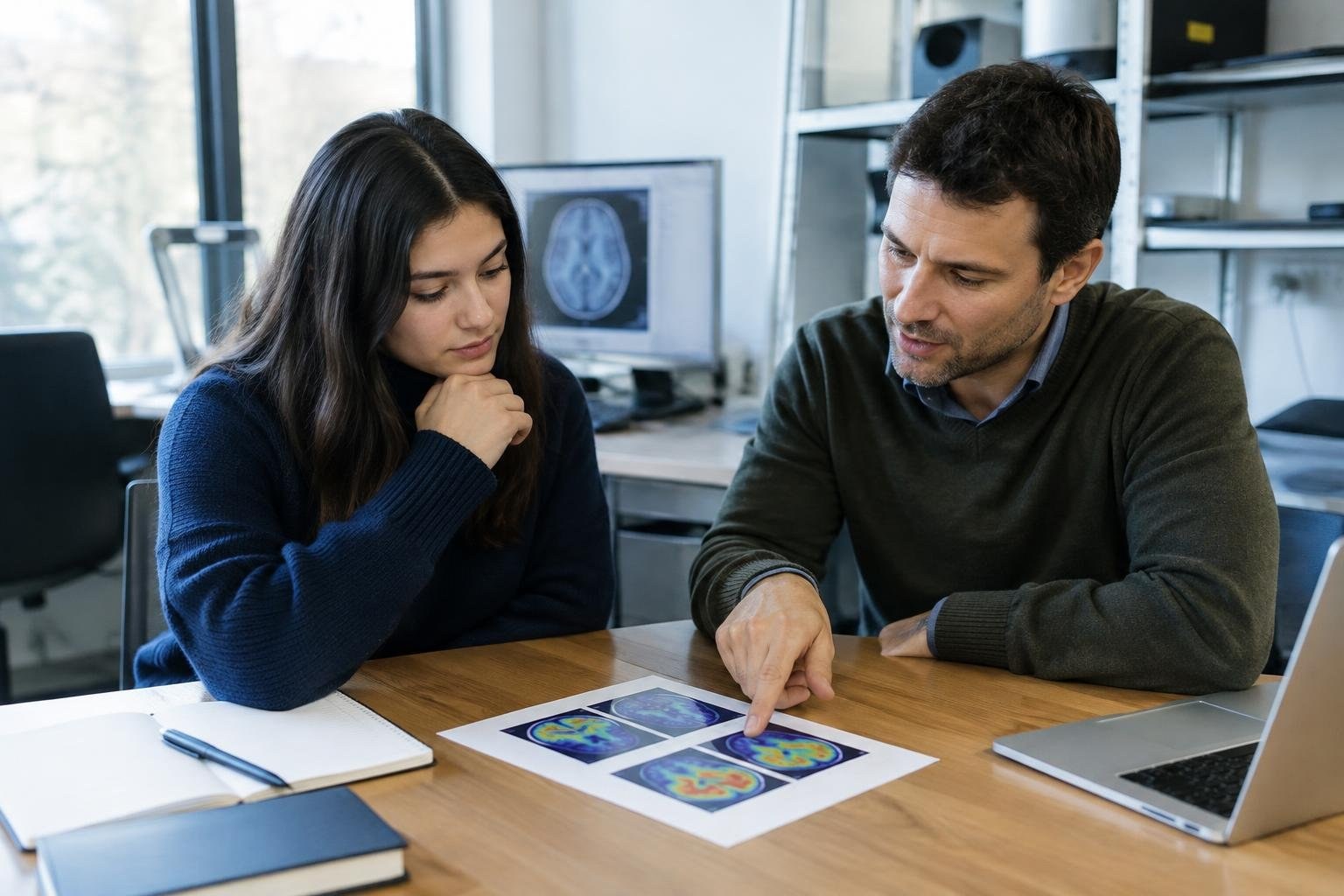
A student and mentor discussing a research study, data display, or experimental design
What Is an Experimental Psychology Degree?
Experimental psychology applies systematic research methods to questions about behavior and mental processes. Students learn how to turn a question into a testable study, select ways to measure behavior, gather evidence, and interpret results. The subject area is broad: research may examine learning, cognition, development, or other behavioral and psychological variables.
The phrase can describe a field of study, a concentration, or a named program. Degree and certificate labels vary. Some institutions offer specialized undergraduate certificates; others offer master’s or doctoral programs. For example, Minnesota State University, Mankato lists an experimental psychology certificate, while universities also describe master’s and doctoral pathways.
Experimental psychology differs from clinical psychology in purpose. A research-centered program builds scientific skills; it should not be assumed to prepare graduates to deliver therapy. Read the program’s stated outcomes and course plan rather than judging from the word “psychology” alone.
What Do Experimental Psychology Students Study?
Expect a combination of psychology content and research training. The exact course sequence depends on the institution, credential, and area of emphasis. The subject description for experimental psychology includes learning theory, research design, experimental methods, psychological measurement, statistical methods, and analysis of cognitive and behavioral variables.
In practice, this means learning to define a research question, review relevant scholarship, select or develop measures, consider how study conditions affect results, and interpret data with appropriate caution. A research project may require planning, ethical review through the institution’s process, data collection or analysis, and a written report or presentation. Confirm which experiences are built into the degree rather than assuming every program includes the same laboratory work.
Graduate programs may add seminars, individualized research practica, and independent projects. The University of Memphis describes a sequence that includes an empirical master’s thesis, a midpoint project, and an empirical doctoral dissertation. Those milestones illustrate why research intensity and advising access deserve close attention when comparing graduate programs.
Skills You Can Develop
The central skill is learning to make a defensible claim from evidence. That involves asking a focused question, choosing a method that can address it, checking the quality of measurements, and recognizing limits in the data. Statistical literacy matters because students need to understand what analyses show, not simply produce numbers.
Research training also develops practical abilities: writing clearly, presenting findings, collaborating with faculty or research teams, keeping organized records, and explaining technical ideas to non-specialists. These skills can apply to laboratory research, research coordination, graduate study, and other roles that value structured analysis.
Look for opportunities to practice more than course exams. A thesis, research practica, poster presentation, or supervised project can help you demonstrate how you work through a question. Some programs describe students co-authoring papers or presenting at scientific meetings, but those are examples of outcomes at a particular institution, not guarantees for every student.
Who Is This Program Best For?
This field may suit students who enjoy asking why behavior occurs and want to answer questions with evidence. It can appeal to people who like careful observation, puzzles with no immediate answer, reading research, revising a hypothesis, and working through a project over time. The day-to-day work may be more analytical and writing-intensive than a student expects from popular portrayals of psychology.
It is not reserved for one personality type. Curiosity, patience, attention to detail, and willingness to consider alternative explanations are useful, but students can build these habits. Comfort with quantitative reasoning is important because research methods and statistics are part of the subject. Applicants who feel rusty can ask about prerequisites and support before enrolling.
Does experimental psychology match you?
Weigh interest in research alongside time, cost, and likely next steps. A high salary estimate or prestigious program cannot ensure that you will enjoy designing studies or analyzing results. Assessment.com’s MAPP career assessment can help you reflect on interests and motivations; use results as one input, then test your assumptions by reviewing course plans and speaking with researchers or advisers.
Admissions, Completion Time, and Academic Demands
Admissions standards depend on the award level and institution. Undergraduate applicants should check general college admission requirements and whether psychology prerequisites are expected. Graduate applicants should read the department’s current criteria, including required prior coursework, transcripts, recommendations, writing materials, research interests, and any interview or faculty-mentoring process. Do not assume one university’s rules apply elsewhere.
Plan the time commitment around the degree map you are offered. A certificate may be completed alongside another program, while a bachelor’s, master’s, or doctorate follows a different credit and research structure. Part-time enrollment, transfer credits, course availability, and thesis progress can change the time to completion. Ask the department to explain a realistic schedule for your circumstances.
Common academic demands include reading research carefully, writing and revising, learning statistics, and managing research tasks with care. To prepare, refresh quantitative skills, practice summarizing articles, and ask how students receive methods instruction and research mentoring. The University of Memphis program description, for example, shows that doctoral study can involve sequential research milestones rather than coursework alone.
Online, Hybrid, and On-Campus Study
Experimental psychology may be available through campus-based programs, and some schools may offer online or hybrid coursework. Do not assume a program can be completed fully online because individual classes are delivered remotely. Research practica, access to a laboratory, participant-facing work, thesis advising, and in-person seminars may affect how the program operates.
Ask the department which requirements require physical attendance, whether research can be completed with a local or remote team, and how students receive supervision. For online study, also ask about live meeting times, access to software or data resources, and the process for presenting or defending a major project. Get the answer in writing if location or schedule is a deciding factor.
Format is a practical consideration, not a shortcut around research expectations. Compare the learning experience and supervision available in each delivery model with your goals, work schedule, and access to research settings.
Cost, Financial Aid, and Affordability
There is no single price for an experimental psychology degree. Your total cost depends on the institution, residency status, credential level, course load, time to completion, fees, and whether the program requires travel or specialized research resources. Graduate study may also involve costs beyond tuition, so request a complete estimate for the full path you are considering.
Compare net cost rather than a headline tuition rate. Ask the financial aid office about grants, scholarships, assistantships where available, federal aid eligibility, payment plans, and employer tuition assistance. Confirm eligibility, renewal terms, work expectations, and whether funding is guaranteed for the full program or awarded year by year.
Transfer credit can reduce repeated coursework when the school accepts it, but verify how credits apply to the major and research requirements. A lower-cost route is not necessarily less expensive if it adds semesters or does not provide the methods training you need. Build a budget that includes tuition, fees, books, technology, transport, and time away from paid work where relevant.
Careers, Jobs, Pay, and Employment Outlook
Experimental psychology study can connect to research-focused employment, but the degree title alone does not determine a graduate’s job. The program evidence includes master’s graduates moving into research laboratories or doctoral study. Research experience, analytic ability, communication, and the requirements of a particular employer can affect which opportunities are realistic.
Possible direction
Education or preparation to investigate
How the program may connect
Research assistant or laboratory staff
Review the employer’s stated degree and experience requirements
Research methods, measurement, data work, and project experience
Research coordinator or project support
Check requirements for the organization and study type
Organizing study tasks, communicating procedures, and documenting work
Research analyst roles
Look for required analytic tools, subject knowledge, and experience
Training in design, statistics, and interpreting behavioral data
Doctoral study and academic research
Meet the target program’s admission and research expectations
Thesis or other research work can help demonstrate preparation
Employment outlook and pay are tied to specific occupations, location, experience, and education, not to a degree label in isolation. Before making a financial decision, compare current job postings for several target roles and note their qualifications. Senior faculty and management positions should be treated as longer-term possibilities, not assured first jobs. Automation and analytic software may change research workflows, but sound study design, judgment, and responsible interpretation remain skills students should deliberately develop.
Find out which Career or College Major is right for you!
Accreditation, Licensure, and Professional Credentials
Psychology degree completion and professional authorization are separate questions. A research-oriented experimental psychology degree should not be presented as a license to provide clinical services. Sam Houston State University describes its experimental psychology MA as training in psychological science that does not provide training in the delivery of psychological services.
If your goal involves therapy, assessment, or another regulated service, identify the exact job title and state requirements before choosing a program. Ask the relevant licensing board or professional authority about required degrees, supervised experience, examinations, and any other rules. For research careers, ask employers whether they expect a particular credential, human-subjects training, or specialized technical skills. Requirements depend on the role and jurisdiction.
Accreditation is also distinct from a program’s topic. Verify the institution’s and program’s current status through appropriate official sources, and ask how credits will transfer or support your intended next step. Do not infer professional approval from the presence of “psychology” in a program name.
Research Experience, Projects, and Ways to Stand Out
Research experience can make academic training easier to evaluate. Ask faculty about undergraduate assistantships, supervised projects, practica, thesis options, and opportunities to present findings. If a program does not guarantee access to a lab, find out how students are selected and how early they can apply. A research portfolio can include a poster, a writing sample, a methods project, or a clear description of your role on a team, subject to privacy and research rules.
To stand out to employers, connect your coursework to a particular role. Describe the question you worked on, the methods you used, your contribution, and what you learned from the results. Build relationships with faculty and research colleagues, and seek feedback on communicating findings to people outside psychology. Murray State reports that students in its program have co-authored faculty publications and presented at scientific meetings; consider that an example to ask other departments about, not a promised outcome.
Certificates may add focused coursework, but do not assume a certificate substitutes for a degree or professional credential. Confirm its purpose, credit value, and recognition with prospective employers or graduate programs.
Graduate School and Further Study
Graduate study can deepen research expertise and may be needed for some advanced research or academic paths. Options include a master’s in experimental psychology, a doctoral degree in experimental psychology, or a related psychology-science specialization. Some programs are mentor-based and offer areas of concentration; the University of Texas at Arlington, for example, describes a doctoral program with psychological sciences and health/neuroscience concentrations.
Program structures differ. Saint Louis University describes an MS in experimental psychology for doctoral students who do not already hold a qualifying psychology or closely related master’s degree with a completed research thesis. The University of Memphis outlines thesis, midpoint, and dissertation milestones. These examples show why students should compare milestones and entry requirements rather than treating “master’s-to-PhD” as one standard route.
A master’s may help a student strengthen research preparation, pursue laboratory work, or apply to doctoral programs. A doctorate is a substantial commitment and should be considered in light of the work you want to do, funding, faculty fit, and your willingness to conduct independent research.
Related Degrees and Alternatives
Compare experimental psychology with related programs by looking at what students do, not only the title. A general psychology degree may offer broader coverage; experimental psychology places stronger emphasis on research methods and controlled study. Clinical psychology is more appropriate to investigate if your priority is professional assessment or treatment preparation. Cognitive science may appeal if you want an interdisciplinary focus on mind and information processing, while behavioral neuroscience may add a stronger biological emphasis. Verify each program’s actual curriculum.
General psychology: Consider this if you want a broad survey of psychology and do not yet want to specialize in research.
Clinical psychology: Consider this if your intended direction is clinical assessment or treatment, and investigate graduate and state requirements early.
Cognitive science: Consider this if you want to combine psychological questions with other approaches to cognition.
Behavioral neuroscience: Consider this if biological or health-related questions are central to your interests.
Statistics or data science: Consider this if you are more interested in quantitative methods that can be applied across fields.
Research methods or a psychology certificate: Consider this for focused preparation alongside another degree, after checking its credit and employer value.
Compare whether students complete a thesis, gain hands-on research experience, and receive the preparation required for their next educational or career step. Assessment.com’s degree resources and major-selection guidance can support your exploration.
Advantages, Drawbacks, and Is It Worth It?
Experimental psychology can be worthwhile for someone who wants rigorous research preparation and has a clear plan to use it. A strong program may offer close faculty mentoring, structured research practice, and opportunities to complete substantial projects. These experiences can help students prepare for research work or further study.
Tradeoffs include the time required to build advanced skills, the possibility that a desired role will require graduate education, and uncertainty about job titles and pay without a specific occupation in mind. A research degree is not automatically the best choice for students whose main goal is direct clinical practice. Compare total cost with the realistic requirements of target jobs, not with broad promises about psychology careers.
Before deciding, speak with an adviser, review job descriptions, ask about research access, and compare at least two program plans. Students and parents can also use Assessment.com’s college guidance resources as one part of a wider decision process.
How to Choose the Right Program
Compare programs on evidence of what students will actually learn and do. A practical checklist:
What research areas and methods are taught, and how much statistics is included?
Can students join a research team, complete a thesis, or undertake a supervised project?
How accessible are faculty mentors, and how are research opportunities allocated?
What is the total estimated cost through completion, including fees and research-related expenses?
Which courses or research requirements are available online, hybrid, or only on campus?
What are the institution’s accreditation status and the program’s stated educational outcomes?
How do transfer credits apply to the major and research requirements?
What further education or job requirements do graduates typically pursue, and what evidence can the school provide?
Does the program prepare for the professional credential or licensure you need, if applicable?
Ask for answers from the department and financial aid office, then compare them against your own priorities. Faculty interests matter: a program may offer strong general methods training but little supervision in your area of curiosity. Assessment.com’s education resources can help you continue exploring degree options alongside direct research with institutions.
From Degree to Career: Example Pathways
Career paths are possibilities, not promised promotions. A realistic planning exercise is to map a degree to a role, then identify the experience or additional education that role actually requires.
Bachelor’s-level study → research assistant or lab support role → added study and project responsibility → specialized research support. Check the employer’s degree, skills, and experience requirements before relying on this route.
Master’s study → research laboratory position or doctoral application → deeper methods experience → advanced research responsibilities. Central Michigan University identifies research laboratories and doctoral programs as destinations for its master’s students, but individual outcomes vary.
Doctoral study → independent research and dissertation work → postdoctoral or other advanced research experience where relevant → academic or specialized research work. The steps and availability depend on the area, employer, and career goal.
Use job postings and graduate-program admissions pages to test each step. If a target job asks for a different credential or technical skill, make that part of the education plan before enrolling.
Questions to Ask Before Enrolling
Before committing, ask the admissions office and department questions that produce specific, comparable answers:
What credential will I earn, and what are the exact admission requirements?
What is my estimated total cost if I finish on the proposed schedule?
Which grants, scholarships, assistantships, or employer benefits could apply, and what conditions come with them?
When can I begin research, and how are faculty mentors assigned?
Is a thesis, practicum, or other research milestone required?
Which courses and research activities require campus attendance?
How will my previous coursework transfer into the degree plan?
What career or graduate-school outcomes can the department document?
Does the curriculum meet any specific credential or licensure requirements relevant to my goal?
What support is available for statistics, writing, research skills, and career planning?
For students and families, the most useful next step is to review two or three program plans together and discuss how each fits academic interests, finances, location, and career aims. Then speak with an adviser or faculty member before paying an application or enrollment deposit.
Frequently asked questions
What is experimental psychology?
Experimental psychology is the scientific study of behavior and mental processes using systematic research methods. Programs commonly emphasize research design, experimental methods, psychological measurement, statistics, and analysis. Depending on the institution and credential level, students may complete research projects, a thesis, or a dissertation. Experimental psychology is not, by itself, training to provide therapy.
Is experimental psychology hard?
It can be challenging because students must learn to evaluate evidence, design studies, work with data, and explain results clearly. The level of difficulty depends on your preparation, the program’s expectations, and your comfort with statistics and independent research. Ask current students and faculty about the workload, research mentoring, and support available before applying.
What jobs can I get with an experimental psychology degree?
Possible directions include research-assistant or laboratory roles, further graduate study, and research-focused work in organizations that use behavioral evidence. A degree alone does not guarantee a particular job, and requirements differ by employer. Review job descriptions for roles that interest you and compare their education, technical, and experience requirements with the program’s curriculum.
How much can you make with an experimental psychology degree?
There is no single salary for an experimental psychology degree because pay is associated with a specific occupation, education level, employer, experience, and location. Compare current salary information for individual job titles rather than relying on a degree-wide estimate. Research roles, academic positions, and management work may have different requirements and compensation structures.
Can I earn an experimental psychology degree online?
Some psychology courses and research tasks can be completed online, but program formats differ. Before enrolling, ask whether research practica, lab activities, thesis advising, or other milestones require campus attendance or in-person participation. Confirm the format for the entire program, not just the courses advertised as online.
Does experimental psychology require math?
Expect quantitative work in research design, psychological measurement, and statistical methods. The amount and level depend on the program and your specialization. You do not need to arrive as a statistician, but you should be prepared to interpret data, learn analytic methods, and explain what a study’s results can and cannot support.
Do I need graduate school for experimental psychology careers?
A bachelor’s degree may support entry-level research or related roles, but advanced research positions and academic careers may require graduate education. Some doctoral programs include a master’s degree as a milestone for students who do not already meet the program’s prior-master’s and thesis requirements. Check the requirements of specific jobs and graduate programs.
How is experimental psychology different from clinical psychology?
Experimental psychology is generally oriented toward scientific research rather than training in therapy delivery. A clinical psychology program is a more direct path for people whose goal is assessment or treatment, although licensure requirements depend on the role and state. Compare course plans, supervised practice, and the program’s stated professional outcomes before choosing.
People Also Ask
What do you learn in experimental psychology?
Experimental psychology studies behavior and mental processes through research. Students learn to develop questions, design studies, measure behavior, and analyze evidence. Programs can emphasize areas such as cognition, development, or health and neuroscience, depending on the institution and faculty expertise.
Is experimental psychology the same as therapy or clinical psychology?
No. Experimental psychology focuses on research and psychological science, while clinical training prepares students for professional assessment or treatment roles. Program aims and professional requirements vary, so check the curriculum and any relevant state licensing rules before selecting a degree.
How long does an experimental psychology degree take?
It varies by credential, enrollment status, transfer credits, and program structure. Graduate programs can include several research milestones, while undergraduate timelines depend on the degree plan and course load. Ask each school for a written completion plan based on your own prior credits and schedule.
What are the admission requirements for experimental psychology?
Requirements are set by each institution and degree level. Graduate programs may ask for prior psychology coursework, academic records, recommendations, a statement of purpose, or evidence of research interests. Check the current admissions page and speak with the department before applying.
How much does an experimental psychology program cost?
Costs depend on the institution, residency classification, tuition model, time to completion, and additional fees. Compare the total expected cost rather than tuition alone, and ask how assistantships, scholarships, grants, employer aid, or transfer credit might affect your individual budget.
Is experimental psychology a math-heavy major?
Yes. Experimental psychology emphasizes research design and analysis, so students should expect quantitative coursework. A program may teach methods progressively, but applicants should review prerequisites and identify tutoring or statistics support if they want to strengthen their preparation.
What can I do with a master’s in experimental psychology?
A research-focused master’s degree may support doctoral applications or research-laboratory work, but outcomes depend on the student, program, and employer. Some programs include thesis or other research milestones. Check whether the program’s research experience matches the requirements of your intended next step.
What is the difference between experimental and clinical psychology?
Compare goals and curriculum. Experimental psychology is centered on scientific research, methods, and analysis. Clinical psychology is oriented toward professional preparation for assessment and treatment, with additional education and supervised experience typically relevant to licensure. Confirm the exact requirements for the job and jurisdiction you have in mind.
Experimental psychology may be a good fit if you want to investigate behavior through careful research, data, and evidence rather than focus primarily on providing therapy. The strongest programs give students meaningful practice in research design, measurement, analysis, and communicating findings. Before enrolling, compare the actual curriculum, research mentoring, total cost, and the degree level required for the work you want. Explore Assessment.com’s education and career resources, and use the MAPP assessment to reflect on how your interests and motivations align with possible pathways.
Want to see your options? Try our comprehensive Degree, Program & College Search tool
We use cookies to offer you a better browsing experience, analyze site traffic and personalize content.
Read about how we use cookies and how you can control them in our
Privacy Policy.
If you continue to use this site, you consent to our use of cookies.
×
Exciting News!
Be one of the first to Beta Test the new AI-Powered Assessment.com Platform.