Food Preparation and Professional Cooking Programs: Courses, Careers, and How to Choose
Compare food preparation and professional cooking programs by courses, credentials, practical training, costs, and potential kitchen careers.
By Kieth Nelson · Staff Writer Assessment.com · Published October 7, 2026 · Last updated November 5, 2026
A Food Preparation/Professional Cooking/Kitchen Assistant program teaches practical skills for supporting chefs and other food-service professionals. Depending on the school and credential, coursework may cover basic preparation, kitchen operations, sanitation, quality control, cooking techniques, menu planning, and food presentation. Graduates may pursue kitchen-support and commercial food-preparation work, while some programs describe additional cook or assistant roles. The program name, credential, and amount of hands-on training differ by institution, so compare the actual curriculum rather than relying on the title alone.
Degree & Program Decision Insights
Explore your personal fit, education requirements, career potential and next steps.
01Motivational Fit
Discover whether this program fits you
Explore your preferences against the focus of Food Preparation/Professional Cooking/Kitchen Assistant. These prompts are not personal MAPP results.
Subject curiosity. Would you choose to explore “kitchen organization and operations” in depth? Ask for a sample learning activity to test that interest.
Breadth of interest. Consider the place of “sanitation and quality control” in this field. Is this another part you would choose to explore, or mainly a requirement you would tolerate?
Work reality. Related work can involve this task: “Wash pots, pans, dishes, utensils, or other cooking equipment.” Would you want that activity to be a regular responsibility?
Interest in studying a field can differ from enjoying its related work.
Which part would you want to do repeatedly, and what would you try before deciding?
Discover Your Personal Program Fit
Before investing your time and money in your education, discover how this program aligns with your natural motivations, work preferences and career goals.
Typical occupational entry: postsecondary nondegree award (BLS). BLS lists less than 5 years of related work experience as typical for this occupation; this programme is not a direct promise of entry.
U.S. occupational wages are not guaranteed graduate earnings; OEWS excludes self-employed workers.
Projected openings include replacements as well as growth.
U.S. national estimates. A crosswalk does not establish entry-level eligibility; advanced, management and teaching roles can require further qualifications.
Institutional Food WorkersCIP 12.0508. Compare its emphasis on selecting, storing, preparing, and serving food and food products and basic nutrition with this program’s focus.
Culinary Arts/Chef TrainingCIP 12.0503. Compare its emphasis on recipe and menu planning and preparing and cooking of foods with this program’s focus.
Explore your motivations. Use MAPP as a starting point for reflecting on your interest in “kitchen organization and operations”, then test that interest against a sample learning task.
Examine the work. Compare Cooks, Institution and Cafeteria and Cooks, Private Household on daily work and entry qualifications, as well as pay. Explore Cooks, Institution and Cafeteria.
Compare actual providers. Ask for the exact credential, course sequence and assessment methods. Compare how each provider teaches “sanitation and quality control”, its entry criteria and its itemized costs.
Check the evidence before applying. Confirm prerequisites and any recognition or professional requirements for your intended route; ask for applicable rules and published outcome definitions in writing.
Verify the institution’s current offering, admissions requirements and outcomes; a search result does not establish your eligibility.
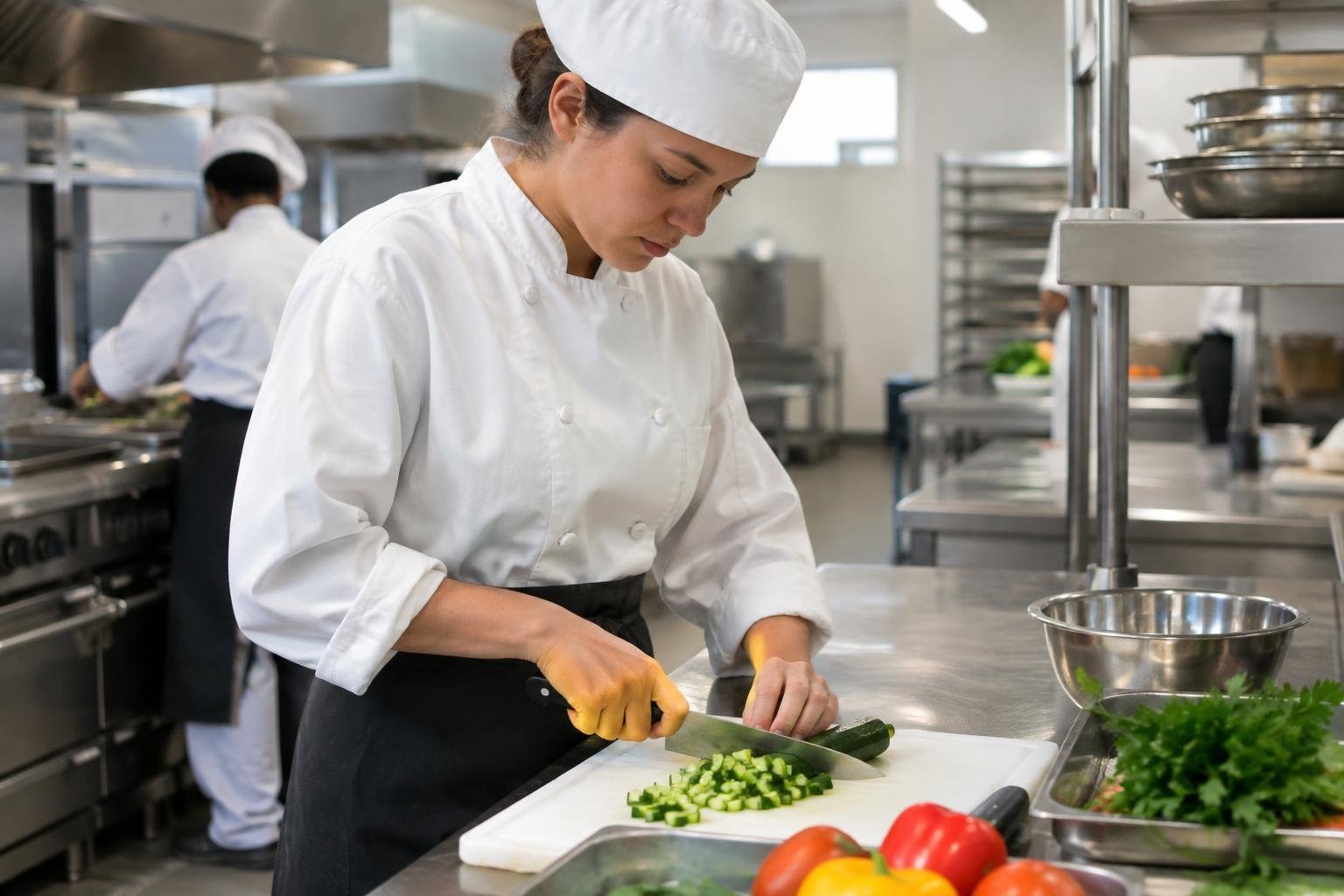
A student working at a kitchen preparation station
What Does a Food Preparation and Professional Cooking Program Teach?
What This Program Covers
Food Preparation/Professional Cooking/Kitchen Assistant is a program category focused on preparing students to work as kitchen support staff and commercial food-preparation workers under the supervision of chefs and other food-service professionals. In the U.S. Classification of Instructional Programs, CIP 12.0505 is the code associated with this program title.
Do not assume every school using a related name teaches the same breadth of material. A focused food-preparation program may concentrate on basic preparation, kitchen organization and operations, sanitation, and quality control. Culinary arts coursework can extend further into recipes and menus, cooking methods, food presentation, management of supplies and kitchen resources, and supervising or training kitchen assistants.
When comparing programs, look at course descriptions and practical requirements. A college’s title may use “culinary arts,” “professional cooking,” or “food preparation,” while the actual balance of kitchen practice and broader topics is what matters for your goals.
What Courses and Skills Should You Expect?
Courses and Skills You May Develop
Coursework in a focused program can introduce basic food preparation and the organization of a working kitchen. Sanitation and quality control are also identified as instructional areas. Those topics connect directly to dependable food-service work: preparing ingredients, following kitchen routines, keeping work organized, and understanding standards for handling and checking food.
Broader culinary coursework may teach students to plan recipes and menus, prepare and cook a range of foods, use varied culinary techniques, and present food attractively. Programs may also address food supplies and kitchen resources, along with the skills involved in supervising or training kitchen assistants.
These subjects build both practical and planning skills. Students can ask how much class time is devoted to hands-on practice, what equipment or supplies are needed, and how learning is assessed. A course list is more useful when the school explains what students will be able to do after completing each class.
Curricula vary by school and credential. Use the published course catalog and program plan to confirm which of these topics are actually included.
Who Is This Program Best For?
Who Might Be a Good Fit?
This path may appeal to students who want practical, food-centered training and are interested in the coordinated work of a professional kitchen. It can be worth exploring if you would like to develop food-preparation skills, learn kitchen routines, and contribute to work overseen by chefs or other food-service professionals.
There is no single personality or background required by the program description. To test your fit, consider whether you prefer learning by doing, can focus on specific preparation and quality steps, and are comfortable working toward shared kitchen goals. Ask a current student or instructor what a typical class involves, and if possible, observe a relevant workplace before enrolling.
Questions to ask yourself
Do I want a practical program centered on food and kitchen work?
Am I interested in preparation and kitchen organization, not only creating new recipes?
Would I be comfortable learning under direction and contributing to a team?
Do the roles I am considering match what this particular program teaches?
For parents and prospective students, a useful next step is to compare the student’s interests with the daily tasks in local job postings. A program can be a poor fit even when the subject sounds appealing if its training does not match the intended work.
How Long Does It Take, and What Are the Entry Requirements?
Admissions criteria are set by each institution, so ask each school for its current checklist, prerequisites, application dates, and any placement steps. Credentials and completion schedules also differ. Harper College lists a 32-credit-hour Culinary Arts Certificate; this is one school’s program, not a standard for all institutions. Ask whether the timeline assumes full-time study, which courses must be taken in sequence, and whether part-time attendance or transfer credit is possible.
Can You Study Food Preparation Online?
Online, Hybrid, and Campus Learning
Do not infer the delivery format from a program’s general description. The available school example identifies a 32-credit-hour certificate but does not establish that it, or other programs in this category, can be completed online. Ask the institution to distinguish online lectures from any required in-person kitchen instruction or practice.
Before enrolling in a distance or hybrid option, get clear answers about the location, schedule, and supervision of practical learning. Confirm whether you must travel to campus or another site, whether equipment is provided, and how missed practice is handled. If you live far from the school, ask whether the required activities can be completed locally.
For campus programs, compare class schedules and access to training facilities with your work and family responsibilities. The most convenient format is not necessarily the best one if it does not provide the practical preparation you want.
How Much Does Training Cost, and How Can You Pay?
Cost, Financial Aid, and Affordability
No single tuition figure applies to this program category. Schools set their own charges, and the credential and delivery arrangement affect what a student pays. Request a written estimate from each college for the full time needed to finish, not just a per-course or per-credit price.
Check whether the estimate includes tuition, mandatory fees, books, supplies, tools, uniforms, and any costs connected with practical learning. Ask which items are required before the first class and which can be borrowed, rented, or purchased later. Confirm the current financial-aid application process and ask about grants, scholarships, payment plans, and employer assistance if applicable to your situation.
To compare affordability, subtract confirmed grants and scholarships from the estimated total, then consider any remaining amount you would pay or borrow. Compare that amount with the credential awarded and the roles the program prepares students to pursue. Do not rely on an assumed salary or job outcome to justify a cost; verify local employment opportunities and current labor-market information independently.
Transferable credit may reduce repeated coursework, but acceptance is determined by the receiving institution. Get a written evaluation before counting on transfer savings.
What Jobs Can You Get, and What About Salary and Outlook?
The program category describes preparation for kitchen-support and commercial food-preparation work. Harper College says its certificate graduates may be able to secure positions such as head cooks or assistants; that school-specific description is not a guarantee or an outcome for every program. Duties and entry requirements vary by employer. Compare course plans with local postings for food preparation workers, restaurant cooks, institution and cafeteria cooks, and chefs and head cooks. For possible supervisory work, compare local requirements with the food preparation and serving worker supervisor career profile. The U.S. Bureau of Labor Statistics publishes occupational employment and wage estimates; consult current information for the specific occupation and location rather than treating a general figure as an individual forecast.
Career questions to investigate
Which job titles do local employers use for the work I want?
What training or experience do their postings request?
Does the program offer practical learning relevant to those duties?
What are the wages and schedules in the local market now?
Find out which Career or College Major is right for you!
What Should You Know About Accreditation and Credentials?
Accreditation, Certification, and Licensure
Program completion and professional or regulatory credentials are not automatically the same thing. The available sources describe instructional content and a college certificate, but do not establish a universal accreditation, certification, or licensing requirement for this program category.
Ask the college what institution or program accreditation applies, and verify the status with the accrediting organization rather than relying on marketing language. If a job posting or local authority identifies a required food-safety credential, contact that employer or authority to confirm whether the program includes it and whether the credential remains valid after graduation.
Request the name of any certificate or exam, who issues it, whether it is included in tuition, and whether additional fees or renewal steps apply. These questions help distinguish a school’s academic award from a separate credential recognized by employers or regulators.
Which Related Degrees or Training Paths Should You Compare?
Related Programs and Alternatives
Compare adjacent programs by the work they prepare you to do, not just by similar-sounding names. Culinary arts curricula may include a wider range of cooking techniques, menu planning, presentation, and kitchen resource or staff management. A narrower food-preparation or kitchen-assistant curriculum may put more emphasis on support work, basic preparation, kitchen operations, sanitation, and quality control.
Culinary arts: Consider this if you want to compare a broader curriculum in cooking techniques, menus, presentation, and kitchen management topics.
Hospitality or food-service management: Consider this if your intended work is more focused on managing service operations than on hands-on food preparation. Review the actual course plan before deciding.
Work-based training: Consider this if you want to investigate practical experience directly. Ask local employers what training and progression they offer, and compare that with the cost and structure of college study.
Names do not guarantee particular courses, job outcomes, or transfer pathways. Request syllabi and ask the receiving school or employer how it views each credential.
How to Choose a Qualified Program
How to Choose a Program
Use a side-by-side comparison rather than choosing from a program title or an advertised career claim. Start with the credential, full curriculum, hands-on learning, and total cost. Then check admissions, course availability, scheduling, and what the school says about career preparation.
Program comparison checklist
What exact credential will I earn, and which courses are required?
How much practical kitchen instruction is included, and where does it take place?
What is the complete estimated cost, including supplies and fees?
What financial aid is available, and what amount would remain for me to pay?
What admission steps, prerequisites, and application deadlines apply?
Can I attend part time, and are required courses offered when I need them?
What accreditation applies to the institution or program, and how can I verify it?
Does the school explain graduate roles, employer relationships, or career services?
Will credits transfer to a program I might pursue later?
Does the program prepare students for any certification or local requirement I have identified?
Ask for written answers where possible. Compare the school’s claims with course documents, local job postings, and the requirements of employers you may want to approach.
A Checklist for Your Next Steps
Questions to Ask Before You Enroll
Use these questions with an admissions adviser, faculty member, financial-aid office, and, where relevant, local employers:
What jobs does this particular curriculum prepare students to apply for?
Can I review the complete course sequence and descriptions before paying a deposit?
What practical training is required, and what happens if I cannot attend a scheduled session?
What is my estimated total cost through completion, including materials and fees?
Which grants, scholarships, payment plans, or employer benefits might I qualify for?
What are the current entrance requirements and deadlines?
Is the program available in my preferred format and schedule?
What accreditation applies, and how do I verify it independently?
Are certificates or other credentials included, or do they require a separate process?
How does the school support job searches, and can it share outcome information?
Will these credits count toward another credential if my plans change?
Before committing, make sure the answers fit your finances, schedule, and career purpose. If a school cannot explain the credential, practical training, or total price clearly, pause and compare alternatives.
Frequently asked questions
Is a food preparation or professional cooking program worth it?
It may suit students seeking practical preparation for kitchen support or commercial food-preparation work. Compare the curriculum, practical instruction, credential, and full cost with the jobs you want to pursue before deciding.
What jobs can I pursue after a food preparation program?
Program descriptions focus on kitchen support and commercial food-preparation work. A Harper College certificate description says graduates may be able to secure positions such as head cooks or assistants, but outcomes and job titles vary by program and employer.
How long does a food preparation program take?
Length depends on the institution and credential. Harper College lists a 32-credit-hour Culinary Arts Certificate; that example does not establish a standard completion time for other programs.
How much does professional cooking training cost?
Costs differ by school and program. Request a written estimate for the full credential, including tuition, fees, supplies, and any required equipment, then confirm what financial aid may apply to you.
What does CIP code 12.0505 mean?
The NCES classification identifies Food Preparation/Professional Cooking/Kitchen Assistant as CIP 12.0505. A program description focuses on preparation for kitchen support and commercial food-preparation work.
Can I study food preparation online?
Do not assume a program is entirely online. Ask the institution which courses and practical activities require in-person attendance, where they occur, and whether the schedule fits your needs.
What is the difference between culinary arts and food preparation?
Course scope varies. Compare the actual course plans: a focused food-preparation program may differ from a culinary arts curriculum in the cooking, planning, presentation, and other subjects it covers.
Does a professional cooking program include food-safety certification?
A course covering sanitation does not by itself confirm that a particular food-safety credential is included. Ask the school which certificates or exams, if any, are part of the program and verify requirements with prospective employers or the relevant authority.
People Also Ask
What is a food preparation and professional cooking program?
It is an instructional program category for preparation to work as kitchen support staff and commercial food-preparation workers under the supervision of chefs and other food-service professionals.
What does CIP code 12.0505 mean?
CIP 12.0505 is the NCES Classification of Instructional Programs code for Food Preparation/Professional Cooking/Kitchen Assistant. It identifies a field of study, not a guarantee that every school has the same curriculum or credential.
How do I choose a professional cooking program?
Review the required courses, credential, practical instruction, schedule, and full cost. Check the school’s career information against local job postings and the requirements of employers you may want to approach.
Are professional cooking programs available online?
Delivery formats differ by school. Ask whether kitchen practice is in person, where it takes place, and how much of the curriculum can be completed remotely before enrolling.
What salary can I expect after a professional cooking program?
Pay depends on the occupation, location, and employer. The supplied program descriptions do not establish a personal salary estimate; compare current local job postings and authoritative labor-market information for the specific role.
Will I need a separate food-safety certificate?
Not necessarily. Ask the school whether it includes a separate food-safety credential, then confirm any relevant requirements with employers or the appropriate local authority.
Compare curricula, hands-on instruction, credentials, and total costs before choosing a food preparation or professional cooking program. Explore related career and degree options on Assessment.com, and use the MAPP assessment to consider how your interests align with possible paths.
Want to see your options? Try our comprehensive Degree, Program & College Search tool
We use cookies to offer you a better browsing experience, analyze site traffic and personalize content.
Read about how we use cookies and how you can control them in our
Privacy Policy.
If you continue to use this site, you consent to our use of cookies.
×
Exciting News!
Be one of the first to Beta Test the new AI-Powered Assessment.com Platform.