Biology Teacher Education: Programs, Careers, Certification & Fit
Learn what biology teacher education includes, how certification pathways differ, how to compare programs, and what to consider before choosing a teaching career.
By Kieth Nelson · Staff Writer Assessment.com · Published October 7, 2026 · Last updated November 5, 2026
Biology teacher education prepares students to teach biology and related life sciences, often at the middle or high school level. Programs pair subject-matter study with preparation for classroom teaching; the exact balance and route to certification vary by college and state. Students may pursue an undergraduate degree that includes teacher preparation, study biology first and complete a post-baccalaureate certification program, or follow a pathway that adds graduate study. Prospective students and parents should compare not only the biology curriculum, but also supervised classroom experience, certification requirements, and total program cost. Not sure whether biology teacher education fits you? Take the Free MAPP Career Assessment to explore how your motivations, interests, and preferences may align with teaching and related careers.
Degree & Program Decision Insights
Explore your personal fit, education requirements, career potential and next steps.
01Motivational Fit
Discover whether this program fits you
Explore your preferences against the focus of Biology Teacher Education. These prompts are not personal MAPP results.
Scientific investigation. Would you enjoy investigating teach biology programs at various educational levels and explaining your conclusions from evidence?
Choosing a learning environment. Compare actual Biology Teacher Education offerings. Would their reading, projects or practical work suit how you prefer to learn? Confirm the format rather than assuming one from the field name.
Work reality. Related work can involve this task: “Prepare materials and classrooms for class activities.” Would you want that activity to be a regular responsibility?
Interest in studying a field can differ from enjoying its related work.
Which part would you want to do repeatedly, and what would you try before deciding?
Discover Your Personal Program Fit
Before investing your time and money in your education, discover how this program aligns with your natural motivations, work preferences and career goals.
Typical occupational entry: bachelor's degree (BLS). Check the exact professional credential and jurisdiction requirements for this occupation; the classification association alone does not establish eligibility.
Typical occupational entry: bachelor's degree (BLS). Check the exact professional credential and jurisdiction requirements for this occupation; the classification association alone does not establish eligibility.
U.S. occupational wages are not guaranteed graduate earnings; OEWS excludes self-employed workers.
Projected openings include replacements as well as growth.
U.S. national estimates. A crosswalk does not establish entry-level eligibility; advanced, management and teaching roles can require further qualifications.
Compare the actual offering and credential before committing your time or money.
Request the itemized fees, materials and equipment associated with “teach biology programs at various educational levels”; confirm what tuition includes.
Compare the full attendance budget, course availability and time away from paid work, rather than tuition alone.
No institution- and credential-matched cost, debt or graduate-earnings amount is reported here; occupational pay is not program ROI.
Financial aid depends on the school, program and student’s eligibility.
Compare the focus and route of these distinct instructional fields; their credentials and admission requirements are not interchangeable.
Science Teacher Education/General Science Teacher EducationCIP 13.1316. A program that prepares individuals to teach general science programs, or a combination of the biological and physical science subject matter areas, at various educational levels.
Music Teacher EducationCIP 13.1312. A program that prepares individuals to teach music and music appreciation programs at various educational levels.
Computer Teacher EducationCIP 13.1321. A program that prepares individuals to teach computer education programs at various educational levels.
Explore your motivations. Use MAPP as a starting point for reflecting on your interest in “teach biology programs at various educational levels”, then test that interest against a sample learning task.
Compare actual providers. Ask for the exact credential, course sequence and assessment methods. Compare how each provider teaches “Biology Teacher Education”, its entry criteria and its itemized costs.
Check the evidence before applying. Confirm prerequisites and any recognition or professional requirements for your intended route; ask for applicable rules and published outcome definitions in writing.
Verify the institution’s current offering, admissions requirements and outcomes; a search result does not establish your eligibility.
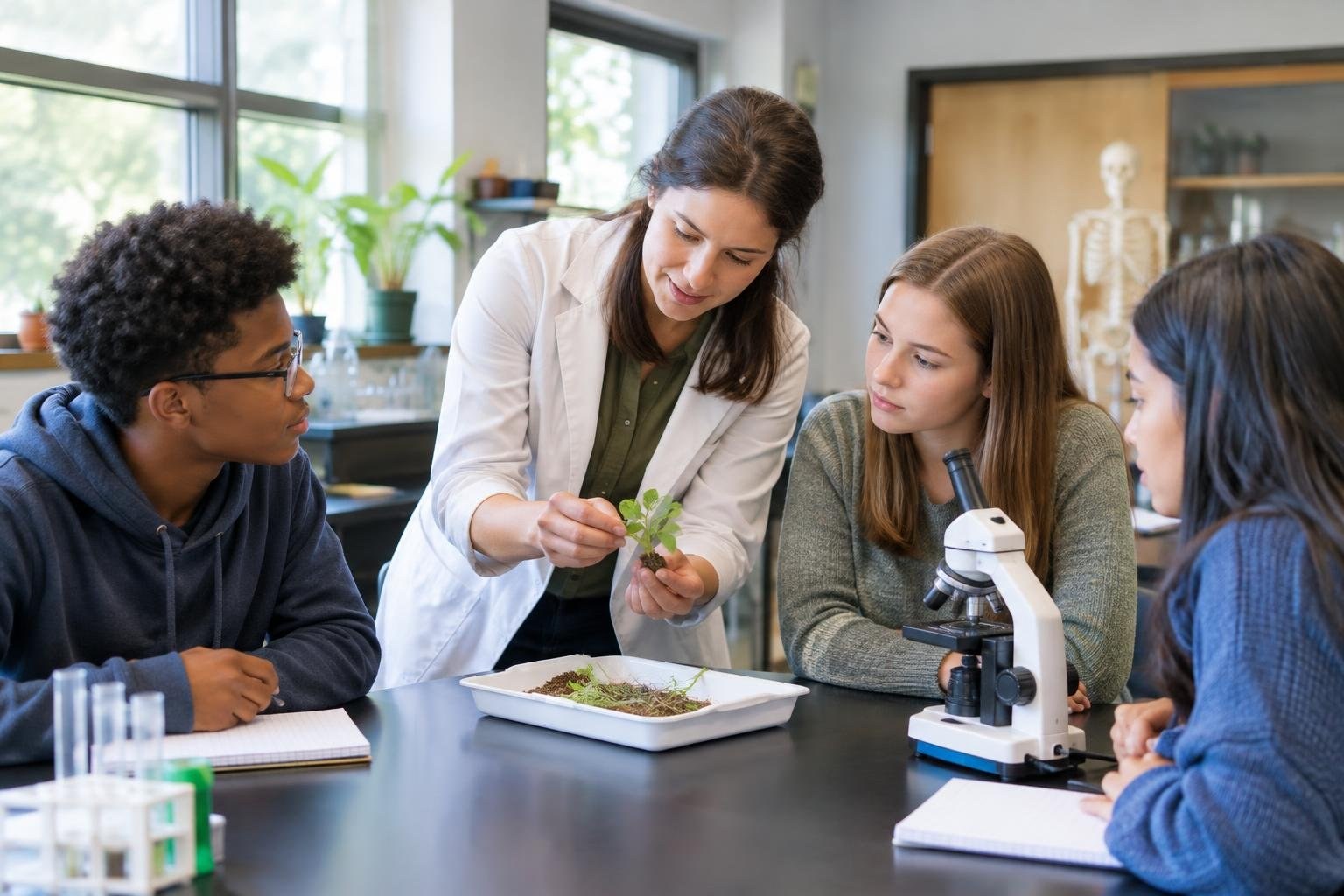
A prospective biology teacher guiding a classroom science activity
What Is Biology Teacher Education?
Biology teacher education is a field of study that prepares students to teach biology or life science while building knowledge of biological systems. The program code supplied for this topic is CIP 13.1322. Depending on the college, the credential may be described as biology education, biology with teacher certification, or biology with a secondary education emphasis.
Program structures differ. Some colleges integrate biology and teaching preparation into one undergraduate pathway. Another option is to earn a biology degree first, then complete a post-baccalaureate teacher certification program. These pathways share a teaching goal but can differ in course sequence, credential awarded, and when classroom preparation occurs. For examples, see the University of North Texas biology program with teacher certification and Arcadia University's post-baccalaureate certification program.
What Do You Study?
What Do You Study in a Biology Teacher Education Program?
The biology portion develops understanding of living systems across multiple levels, from genetic inheritance to interactions between organisms and their environments. Individual colleges determine the specific courses and depth of study, so review the catalog rather than assuming every program follows the same sequence.
The teaching component prepares students to translate subject knowledge into instruction. Program pathways can also include supervised student teaching. That experience gives future teachers a chance to work in a school setting under supervision; confirm its duration, placement process, and requirements with each college.
A combined program may prepare students to complete teacher certification requirements alongside biology study. A biology major followed by a post-baccalaureate certification program separates those stages. Compare whether the planned sequence gives you enough time to meet the program's science requirements and complete its teaching preparation.
Examples of degree structures include the Texas State biology and secondary education pathway and the Missouri State biology education pathway.
Skills You Develop
Skills You Can Develop
Biology coursework builds subject knowledge that can support explaining life-science concepts to students. Teacher preparation and supervised classroom practice are intended to help candidates apply that knowledge in an educational setting. What particular teaching skills a program emphasizes depends on its curriculum and clinical requirements.
Scientific understanding: connect biological ideas, including inheritance and the relationships between organisms and environments.
Clear explanation: make subject knowledge understandable to learners with different levels of preparation.
Classroom practice: gain supervised experience in a school setting when the pathway includes student teaching.
Professional readiness: understand the steps required to qualify for a teaching credential in the intended state.
When comparing programs, ask how students practice teaching, receive feedback, and demonstrate readiness before completing the credential.
Who Is This Program Best For?
Who Is Biology Teacher Education Best For?
This program may be worth exploring if you are interested in biology and also want to help students understand science. It combines study of living systems with a pathway toward teaching, rather than focusing only on biology as an academic subject.
Consider how you feel about both parts of the work. A strong interest in biology is useful, but so is willingness to prepare for a teaching role and complete supervised classroom experience if required. There is no single personality type for successful teachers. Talk with current teachers, observe a classroom if possible, and compare the day-to-day demands with what you want from work.
Does Biology Teacher Education Match You?
Salary, job availability, and a school's reputation matter, but they do not tell you whether you will enjoy studying biology or teaching it. Assessment.com's Free MAPP Career Assessment, Degree Matching, and Career Matching tools can help you reflect on interests and explore related education and career paths. Treat them as planning aids, not substitutes for program research or state credential checks.
Admissions, Length, and Difficulty
Admissions, Program Length, and Academic Demands
Admission requirements are set by each college. Check the program's current requirements for prior coursework, grades, applications, and any additional steps before applying. The sources available for the pathways described here do not establish one admissions standard for all colleges.
A bachelor's degree is identified as the minimum education for high school science teachers in one career guide, which estimates that becoming a biology teacher typically takes about four to five years. The precise timeline depends on the student's circumstances and pathway. A student who already has a bachelor's degree may instead consider post-baccalaureate teacher certification, such as the secondary biology route described by Arcadia University.
Expect to plan for biology study and teacher preparation, and ask whether supervised student teaching is required. For transfer students and adult learners, request a written degree audit before committing so you can understand which previous credits apply and what remains.
Online vs. On-Campus Programs
Online, Hybrid, and On-Campus Options
Delivery format varies by college and by course. Before choosing an online program, ask whether biology classes include in-person requirements and how the college handles supervised school experience. A distance format for coursework does not by itself establish that every part of teacher preparation can be completed remotely.
Get specific answers about where student teaching takes place, who arranges the placement, whether you can complete it near home, and whether there are campus visits or other in-person requirements. If you plan to work while studying, confirm the expected schedule for classroom experience before making a decision.
Cost and Ways to Fund Your Education
Cost, Affordability, and Financial Aid
Total cost depends on the institution, credential route, and the classes or experiences required. Compare the full estimated price through completion, not only the per-credit tuition figure. Ask each college for a written breakdown of tuition, fees, books, required technology, and any costs associated with supervised school experience or certification steps.
Check the college's financial aid office for current eligibility rules and available grants, scholarships, work-study, payment plans, or employer assistance. If you already have college credits, ask how they transfer and whether they shorten the remaining program without disrupting the certification sequence. Do not assume a shorter route is less expensive until you compare all required coursework and fees.
Because program structures vary, compare the cost of an integrated biology-and-teaching degree with the combined cost of a biology degree plus post-baccalaureate certification. Ask whether scholarships or aid apply to every part of the route.
Careers and Jobs You Can Pursue
Careers, Jobs, and Employment Outlook
The clearest career direction for this program is teaching biology or life science in a middle or high school, subject to the qualifications required for the position and state. Program examples include secondary certification pathways for grades 7–12 and preparation for middle or high school biology teaching.
Career direction
How the education may apply
What to verify
Middle or high school biology teacher
Biology study paired with teacher preparation is directly relevant to this teaching goal.
State certification, grade-level eligibility, and employer requirements.
Science teacher with a biology focus
A biology or life-science credential may support teaching within its authorized subject area.
Whether the credential covers the grade and science subjects required by the district.
Biologist or other biology-related work
A biology degree may offer a broader subject foundation; one university describes its biology degree as preparation for a biologist career as well as a route toward teacher certification.
Specific job qualifications and whether further education or experience is expected.
Pay and hiring conditions differ across employers and locations. Compare current school-district salary schedules and job postings where you intend to work. The sources cited here do not establish current salary medians or employment projections, so this guide does not assign numerical pay or outlook estimates. A teaching degree also does not guarantee a job or authorize teaching in every state.
Find out which Career or College Major is right for you!
Completing a degree and qualifying for a teaching credential are related but distinct steps. Requirements depend on the state and teaching role. A biology teacher pathway may include supervised student teaching and state certification exams. The route for a candidate who already has a biology degree can differ from an undergraduate program that incorporates teacher certification preparation.
Before enrolling, contact the relevant state education agency and ask the college to confirm in writing whether its program meets the requirements for the state where you plan to teach. If you may move, ask how the credential can be recognized elsewhere rather than assuming that certification transfers automatically.
Alternative certification may be available in some circumstances, but eligibility and acceptance vary by state. Verify the program and its outcome with the state agency before paying for coursework or relying on a particular pathway.
Graduate School and Additional Pathways
Graduate School and Other Pathways
Not every biology teacher needs to follow the same education sequence. Some routes connect a bachelor's degree with certification, while the Missouri State pathway described in the research includes a bachelor's degree, a master's degree, and teaching certification. These are examples rather than universal rules.
Graduate study may be relevant to someone who wants advanced subject or education study, but first check whether it is required for the credential or position you want. If you already have a bachelor's in biology, compare a post-baccalaureate certification program with a graduate route on admission requirements, time, total cost, and state eligibility.
Related Degrees and Alternatives
Biology: consider this if you want to study biological systems without committing to teacher preparation immediately. Some biology degrees can be paired with later certification.
Biology education: consider this if you want biology and teaching preparation integrated into an undergraduate route.
Secondary education with a biology focus: consider this if you want a teaching-centered route aimed at secondary grades.
Biology degree followed by post-baccalaureate certification: consider this if you already hold a biology bachelor's degree or want to complete subject study before teacher preparation.
Other science teacher education: consider a different science subject emphasis if another area of science better matches your interests and the credential you intend to pursue.
Compare the amount of biology coursework, timing of teacher preparation, supervised classroom work, credential awarded, and graduate-school implications. Degree names alone do not confirm that a program qualifies graduates for a particular state credential.
Pros, Cons, and Is the Degree Worth It?
Advantages, Drawbacks, and Is It Worth It?
A potential advantage is that some programs connect biology study with preparation for teaching, which can create a direct route toward a classroom career. Other students may value the flexibility of completing a biology degree first and adding certification later.
Tradeoffs include the time and expense of completing both subject and teacher preparation, the need to verify state credential requirements, and the possibility that a biology-focused program does not match a student's preferred work. If you are unsure about teaching, compare biology-only coursework and talk with educators before choosing a route designed around classroom work.
Whether the degree is worth it depends on the full cost, time to completion, eligibility for the jobs you want, and your interest in teaching. Compare local job requirements and salary schedules rather than relying on broad national promises. No program guarantees a job, certification, or a particular salary.
How to Choose the Right Program
How to Choose a Biology Teacher Education Program
Start with the teaching role and state where you hope to work, then check that the program's credential pathway fits that goal. Compare the course sequence, science preparation, student-teaching arrangements, format, total cost, and the support available for completing certification steps.
Does the program prepare students for the grade range and subject you want to teach?
What biology and teacher-preparation requirements are included?
Is supervised student teaching required, and how are placements arranged?
Does the state education agency recognize the pathway for the credential you want?
What is the total expected cost after fees and required experiences?
Which courses can be taken online, and what must be completed in person?
How are transfer credits evaluated, and will they fit the required sequence?
What academic advising and career support are available?
Assessment.com's Degree Matching and Career Matching tools can help you compare interests with related pathways. Use them alongside college catalogs, state credential rules, and direct conversations with program advisers.
From Degree to Career
From Degree to Career: Possible Pathways
Career sequences are examples, not guaranteed outcomes. Each step depends on qualifications, state rules, openings, and the person's choices.
Biology bachelor's with teacher preparation → pursue the applicable state certification steps → seek a biology or life-science teaching role → build classroom experience and consider further subject or education study.
Biology bachelor's → complete post-baccalaureate secondary teacher certification → meet state requirements → apply for biology teaching positions.
Biology degree → explore biology-related work or further study, checking each role's qualifications rather than assuming the teacher-preparation credential alone qualifies you.
Questions to Ask Before Enrolling
What exact degree or certificate will I earn?
Does the pathway meet the current credential requirements for the state and grade level where I plan to teach?
What biology coursework and supervised teaching experience are required?
What is the estimated total cost through completion, including fees and required experiences?
Which financial aid, scholarships, or payment options can I apply for?
Which classes are online, hybrid, or in person?
How will my previous credits transfer, and can I see a degree audit?
How does the college support certification steps, student-teaching placements, and job searches?
What are the program's completion and career outcomes, and how are those figures defined?
Request answers in writing when they affect cost, eligibility, transfer credit, or time to completion.
Frequently asked questions
What is a biology teacher education degree?
Biology teacher education combines study of biology with preparation for teaching science. Depending on the program, students may complete a biology or biology education degree alongside teacher preparation. To teach in public schools, candidates generally need to meet the certification or licensure requirements of the state where they plan to work, which may include supervised student teaching and exams.
Is biology teacher education hard?
The academic demands depend on the program, but students should expect college-level biology alongside education and teaching preparation. Biology can cover subjects ranging from genetics to organisms and ecosystems. If you enjoy scientific study but are less interested in planning lessons, working with students, or completing classroom preparation, compare biology-only programs as well.
How long does it take to become a biology teacher?
A common route is a four-year bachelor's degree, although becoming ready to teach can take approximately four to five years depending on the program and individual pathway. Students who already hold a bachelor's degree may pursue post-baccalaureate teacher preparation. Requirements and timing differ by institution and state.
Can I earn a biology teacher education degree online?
Yes. Some biology courses and education coursework may be available online, but the format depends on the institution. Teacher preparation can include supervised student teaching or other in-person school experience, so confirm which requirements must be completed in person before enrolling.
Does biology teacher education require math?
A biology teacher education program includes biology coursework, so students should expect scientific concepts and related coursework. The sources available for this guide do not establish a universal math prerequisite or course list. Review each college's catalog and admissions requirements to see what mathematics or science preparation it expects.
Do biology teachers need a master's degree?
A master's degree is not a universal requirement for starting the pathways described here. Program and state requirements vary: some routes combine a bachelor's degree with certification, while other institutions offer a pathway involving bachelor's and master's study. Check the exact credential needed for the grade level and state where you plan to teach.
What certification do biology teachers need?
Certification or licensure depends on the state and intended teaching role. The routes described in the research include supervised student teaching and state certification exams, while a post-baccalaureate route may prepare a bachelor's degree holder for secondary certification. Verify current requirements with the state education agency and the program.
What is the difference between biology and biology teacher education?
A biology degree emphasizes biology and can be paired with post-baccalaureate teacher certification. A biology teacher education degree combines subject study with teacher preparation. The first may suit someone who wants to build subject expertise before deciding about teaching; the second may integrate preparation for a teaching role into the undergraduate pathway.
People Also Ask
What does biology teacher education include?
Biology teacher education programs combine subject study in biology with preparation to teach. The degree or credential sequence varies by college, and public-school teachers must check the requirements of the state where they plan to work.
What degree do you need to teach biology?
A bachelor's degree is a common starting point for teaching high school science. Some students earn a biology education degree, while others complete a biology degree followed by teacher certification preparation.
How many years of college does it take to become a biology teacher?
It depends on the route. A bachelor's pathway is commonly described as taking about four years, while one career guide estimates roughly four to five years to become a biology teacher. Prior college credits, added certification coursework, and program design can change the timeline.
Can you become a biology teacher through an online program?
Some teacher preparation is offered online or in hybrid formats, but supervised school experience may require in-person attendance. Ask the college which classes are online and how it arranges student teaching.
How much do biology teachers make?
The pay information available for this guide does not support a reliable national salary figure. Compare current salary schedules for school districts where you may work, and check how they treat education level and experience.
Is biology teacher education a good major?
A biology teacher education program can suit students interested in both life science and explaining ideas to learners. Students who mainly want to study or work in biology without teaching should compare biology degrees that do not include teacher preparation.
Biology teacher education may suit students who want to understand living systems and help young people learn science. The route commonly combines biology study with preparation to teach, and may include supervised classroom experience and state-specific certification steps. Compare programs by their science curriculum, classroom preparation, total cost, and the requirements where you hope to work. If you prefer biology without classroom teaching, a biology degree without teacher preparation may offer a better starting point. Your interests, preferred work, and career goals are important parts of the decision.
Want to see your options? Try our comprehensive Degree, Program & College Search tool
We use cookies to offer you a better browsing experience, analyze site traffic and personalize content.
Read about how we use cookies and how you can control them in our
Privacy Policy.
If you continue to use this site, you consent to our use of cookies.
×
Exciting News!
Be one of the first to Beta Test the new AI-Powered Assessment.com Platform.