Nursing Education Guide: Programs, Courses, Careers, and Fit
Explore Nursing Education programs, common coursework, graduate certificates, career options, admissions, costs, and questions to ask before choosing a nurse educator pathway.
By Kieth Nelson · Staff Writer Assessment.com · Published October 26, 2026 · Last updated November 5, 2026
Nursing Education is the study of how to teach nursing knowledge and clinical practice. Programs prepare nurses to help students learn in academic settings or to support professional development and staff education in healthcare workplaces. Coursework may cover adult learning, curriculum planning, course design, clinical instruction, and ways to evaluate whether learners have met their goals. The name can describe a broad field of study, a graduate degree concentration, or a certificate for nurses who already have advanced education. It is different from an entry-level nursing program: its focus is preparing people to teach nursing, not qualifying a new student to become a registered nurse. Prospective students and families should look beyond the program title. Ask what prior nursing education it expects, which teaching setting it serves, whether practice experiences are included, and what employers in your area require. The right route depends on your current credentials and the work you want to do.
Degree & Program Decision Insights
Explore your personal fit, education requirements, career potential and next steps.
01Motivational Fit
Discover whether this program fits you
Explore your preferences against the focus of Nursing Education. These prompts are not personal MAPP results.
Subject curiosity. Would you choose to explore “advanced nursing practice” in depth? Ask for a sample learning activity to test that interest.
Breadth of interest. Consider the place of “nursing role development” in this field. Is this another part you would choose to explore, or mainly a requirement you would tolerate?
Work reality. Related work can involve this task: “Maintain a clinical practice.” Would you want that activity to be a regular responsibility?
Interest in studying a field can differ from enjoying its related work.
Which part would you want to do repeatedly, and what would you try before deciding?
Discover Your Personal Program Fit
Before investing your time and money in your education, discover how this program aligns with your natural motivations, work preferences and career goals.
Typical occupational entry: doctoral or professional degree (BLS). BLS lists less than 5 years of related work experience as typical for this occupation; this programme is not a direct promise of entry. Postsecondary teaching is a separate appointment and may require advanced study; this programme alone is not a promise of a teaching post.
Typical occupational entry: master's degree (BLS). BLS lists less than 5 years of related work experience as typical for this occupation; this programme is not a direct promise of entry.
U.S. occupational wages are not guaranteed graduate earnings; OEWS excludes self-employed workers.
Projected openings include replacements as well as growth.
U.S. national estimates. A crosswalk does not establish entry-level eligibility; advanced, management and teaching roles can require further qualifications.
Explore your motivations. Use MAPP as a starting point for reflecting on your interest in “advanced nursing practice”, then test that interest against a sample learning task.
Examine the work. Compare Nursing Instructors and Teachers, Postsecondary and Education Administrators, Postsecondary on daily work and entry qualifications, as well as pay. Explore Nursing Instructors and Teachers, Postsecondary.
Compare actual providers. Ask for the exact credential, course sequence and assessment methods. Compare how each provider teaches “nursing role development”, its entry criteria and its itemized costs.
Check the evidence before applying. Confirm prerequisites and any recognition or professional requirements for your intended route; ask for applicable rules and published outcome definitions in writing.
Verify the institution’s current offering, admissions requirements and outcomes; a search result does not establish your eligibility.
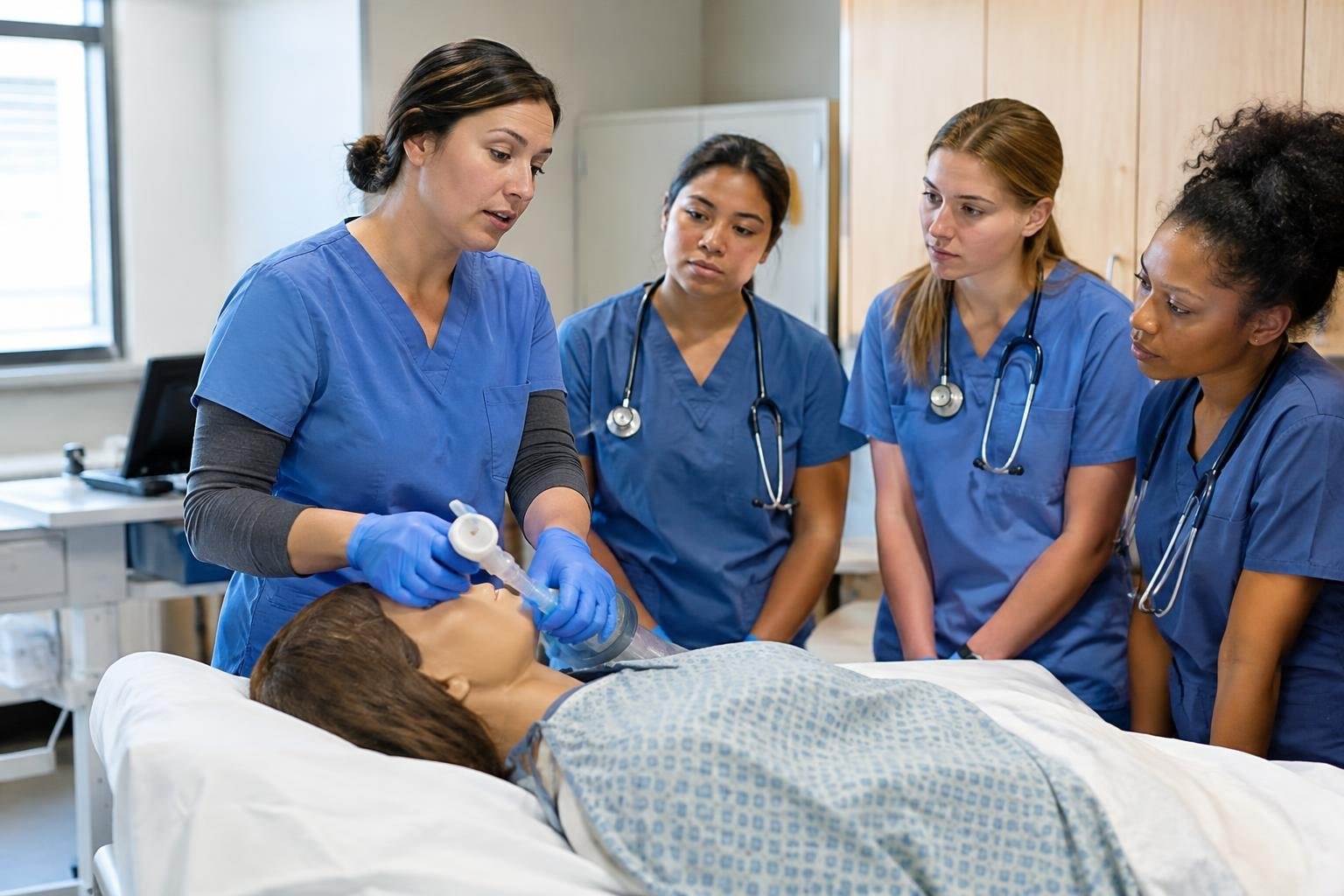
Nurse educator demonstrating a clinical skill to a small group of nursing students
What Is a Nursing Education Program?
Nursing Education is a field focused on preparing nurses to teach nursing knowledge and practice. Nurse educators may teach in academic programs, guide clinical learning, or help healthcare staff build and maintain professional skills. The work brings nursing expertise together with teaching, assessment, communication, and curriculum planning.
“Nursing Education” can refer to an area of study rather than one standardized credential. A school might offer a graduate concentration, a post-master’s certificate, or another pathway. Examples of post-master’s certificates are described by Johns Hopkins and Penn Nursing. Program titles and requirements are not uniform.
This field is not the same as prelicensure nursing education. Entry-level nursing programs prepare students for nursing practice; Nursing Education programs focus on preparing nurses to teach and develop other learners. A school’s catalog should make clear whether its program is intended for new nursing students or for nurses moving toward educator work.
What Do You Study in Nursing Education?
Students learn to turn nursing knowledge into instruction that learners can understand, practice, and demonstrate. The exact curriculum varies, but programs may combine teaching theory with nursing education practice.
Learning and instruction: Adult learning concepts and teaching strategies help students plan for learners with different experience levels.
Curriculum and course design: Students may learn to organize course goals, learning activities, and assessments into a coherent plan.
Clinical instruction: Coursework can address how to guide learning in practice environments and connect classroom concepts with clinical work.
Evaluation: Students consider how to assess learning and use results to improve instruction.
Nursing role development: Advanced nursing practice and the educator’s role may be part of the program’s academic foundation.
Program descriptions from Penn Nursing and other university sources emphasize adult learning, curriculum, course design, clinical instruction, and evaluation. Check a specific catalog for required courses, supervised teaching, practicum or capstone work, and whether experience must be completed at an approved site.
Skills You Can Develop
Nursing educators use clinical judgment and communication skills, but they also need to plan learning experiences and assess whether instruction works. Coursework can help students develop skills in:
Teaching and explanation: Presenting complex clinical ideas in a clear, organized way.
Curriculum planning: Connecting learning objectives, practice activities, and assessment.
Feedback and evaluation: Giving learners useful feedback and identifying where more instruction is needed.
Collaboration: Working with faculty, clinical colleagues, administrators, and learners.
Professional communication: Creating course materials, guiding discussions, and documenting learner progress.
Adaptability: Adjusting teaching approaches for different settings, from a classroom to a clinical or staff-development environment.
These skills are relevant to nursing faculty, clinical instructors, and professional development specialists. Programs may use learning-management systems or other education technology, but tools differ by school and employer. Ask what platforms students will use and whether technology training is included.
Who Is Nursing Education Best For?
Nursing Education is worth exploring if you are a nurse who enjoys explaining clinical concepts, supporting colleagues, mentoring learners, or improving how people prepare for nursing practice. It may appeal to people who like both the subject matter and the process of helping others learn it.
You do not need one particular personality or teaching style to consider the field. Some educators prefer structured lesson planning; others enjoy coaching in clinical settings or supporting staff development. The common thread is an interest in communicating knowledge and helping learners build competence.
Start with your current credentials. Many programs are intended for experienced nurses or graduate-prepared nurses rather than applicants who have not yet entered nursing. For example, Johns Hopkins describes its certificate as a route for nurses with a master’s or doctoral degree and an interest in developing the nursing workforce. That is an example of one program’s audience, not a universal admission rule.
Does Nursing Education Match You?
Consider whether you want to spend a substantial part of your work explaining, assessing, and supporting others, rather than focusing only on direct patient care. Salary, title, and perceived prestige matter, but they do not tell you whether day-to-day teaching fits your interests. Use Assessment.com’s MAPP assessment as one input while researching career and degree options; it is not a substitute for program or employer requirements.
Admissions and Entry Requirements
Admission rules are set by each institution and credential. A post-master’s certificate may ask for a master’s or doctoral degree in nursing; another pathway may have different prerequisites. Some programs may also consider nursing experience, transcripts, recommendations, or a statement of goals. Do not assume that a general nursing degree or certificate description applies to every school.
Before applying, ask the program to confirm:
Which prior nursing degree and license, if any, are required?
Whether clinical experience is expected and how it is evaluated.
Which courses or transcripts are needed to establish eligibility.
Whether the program is designed for academic teaching, staff development, or both.
Whether admission is available to applicants in your state or location.
One university’s page describes an educator certificate for nurses interested in academic or care-delivery education, while other examples specifically target nurses who already hold graduate degrees. Treat each as a program-specific model and get admission guidance in writing before planning around it.
Credential Levels, Format, and Completion Time
The time required depends on the award, course load, transfer credit, and whether you are already eligible for graduate study. Nursing Education offerings include certificates and degree pathways, but the available levels differ by institution. A full-time student may follow a different schedule from a working nurse studying part time.
One concrete example is Arizona State University’s online nurse education certificate, described as a nondegree, 15-credit-hour program available to full- or part-time students. This should not be treated as a typical credit count or timeline for all programs. Ask the school for a term-by-term plan, expected weekly workload, and the time allowed to complete required practice experiences.
Online programs can offer remote coursework, but clinical teaching, supervised instruction, or other practice requirements may still involve an in-person site. Confirm whether the school helps arrange a placement or expects you to identify one. Also ask whether an employer’s schedule can be accommodated.
How Difficult Is the Program?
The main academic challenge is learning to teach as well as continuing to draw on nursing knowledge. Students may need to design a lesson, explain why a teaching method fits a learning goal, assess performance, and revise instruction based on results. Balancing these responsibilities with work and family commitments can also be demanding.
Preparation can make the transition easier. Refresh your academic writing and research skills, review the program’s prerequisite list, and ask how much time students spend on assignments and supervised teaching. If you have not taught before, look for low-risk opportunities to mentor, orient, tutor, or present in a workplace setting, with permission from your employer. These experiences can help you test your interest before committing to a longer program.
Parents and prospective students comparing programs should review the course sequence together. A shorter credential is not automatically easier or more suitable; the decisive question is whether it meets your educational starting point and the qualifications expected for your intended role.
Tuition, Costs, and Financial Aid
Tuition is only one part of the total price. Compare program tuition with fees, books, required technology, travel to practice sites, and any costs connected to clinical or supervised learning. If you must reduce work hours to study, consider the effect on household income as well.
Prices vary by institution, residency status, delivery format, and credential. Since one school’s rate cannot represent the field, request a written cost estimate for the complete program, not just the first term. Ask whether the estimate includes all required courses and practice components and whether fees can change.
Potential funding sources include federal or state aid where eligible, scholarships, employer tuition assistance, and payment plans offered by the institution. Check eligibility and conditions directly. Employer benefits may have requirements about grades, continued employment, or repayment if you leave, so review the terms before relying on them.
A lower-cost route may be to use existing graduate preparation and complete a focused certificate, if that credential matches your goals and the program accepts you. Compare total cost and employer recognition, not credits alone.
Careers, Jobs, and Employment Outlook
There is no single wage attached to a Nursing Education credential. Graduates may seek academic faculty roles, clinical teaching positions, or education work within healthcare organizations; each employer can set different education, experience, and pay requirements. A certificate does not by itself guarantee a particular job or salary.
Rather than relying on an average for the degree label, identify a target role and compare current job postings in your preferred location. Record the required degree, nursing experience, educator credentials, and stated pay range when available. Postsecondary nursing teacher and education administrator are relevant career families to investigate, but these roles have distinct responsibilities and entry requirements.
For employment outlook, consult current labor-market data for the specific occupation and geography you are considering. Do not assume that demand for nurses directly predicts openings for nurse educators. The most useful comparison is between local employer requirements and the actual content and practice opportunities in the program.
Career Directions to Research
Nursing instructor or teacher in a postsecondary setting.
Clinical instructor or clinical educator.
Staff development or professional development specialist.
Education coordinator or, with relevant experience and qualifications, an academic program leadership role. See postsecondary education administrators for a related career profile.
Explore related education and training careers and healthcare practitioner careers on Assessment.com. These career profiles are starting points for exploration, not substitutes for checking employer requirements.
Find out which Career or College Major is right for you!
Teaching nursing content and supporting student learning in an academic setting.
Required degree level, clinical background, teaching experience, and any credential expectations.
Clinical instructor or educator
Guiding learners as they connect nursing concepts with clinical practice.
Required nursing experience, site responsibilities, and supervision arrangements.
Staff development or professional development specialist
Designing or delivering learning for nurses and other healthcare staff.
Employer requirements, audience, and whether the role includes curriculum or competency assessment.
Education administrator or program leader
Potential longer-term direction for experienced professionals with relevant leadership preparation.
Management experience, additional education, and institution-specific qualifications.
These are career directions, not guaranteed outcomes. Postsecondary teaching and education administration are different occupations, and a program may be more closely aligned with one than another. Review job descriptions before choosing electives or paying for an additional credential.
Healthcare education also uses digital course materials and learning platforms. Technology may change how instruction is delivered, but it does not remove the need for accurate clinical content, judgment, feedback, and human support. Ask programs how they prepare students to teach across in-person, online, and blended settings.
Accreditation, Licensure, and Certification
Completing a degree or certificate is not the same as receiving a nursing license or a professional certification. A Nursing Education credential is academic preparation; it does not automatically grant authority to practice nursing, teach in a particular jurisdiction, or meet every employer’s hiring criteria.
The National League for Nursing Certified Nurse Educator exam is a credential to investigate if it fits your goals. USF describes one route to exam eligibility involving a master’s or doctoral degree in nursing plus a post-master’s certificate in nursing education, or a graduate nursing degree with at least nine graduate-level education credits. Eligibility rules can change and other options may apply, so confirm current criteria with the certifying organization before choosing courses.
Also check state nursing-board rules and employer policies relevant to your intended position. Ask the program whether its curriculum is designed to support a certification pathway, then verify directly with the certifier. Never assume that a program’s marketing language guarantees exam eligibility.
Affordability and Ways to Fund Your Education
Compare the full financial plan, not just the advertised price per credit. Build a checklist that includes tuition for all required credits, fees, books, equipment, travel, and the cost of any in-person practice requirements. Then compare the likely time to completion with your work and caregiving responsibilities.
Complete the Free Application for Federal Student Aid if relevant to your situation and the program’s eligibility.
Ask the school’s financial aid office about grants, scholarships, and payment options.
Check whether your employer offers tuition assistance or education benefits, and read any repayment conditions.
Ask whether prior coursework can transfer and whether accepted credits shorten the program without changing eligibility for the desired outcome.
Compare a focused graduate certificate with a full degree only if both are appropriate for your educational background and career goal.
For an adult learner, the least expensive option on paper may not be the lowest-cost choice if it requires extra travel, delays completion, or does not meet employer expectations. Confirm every assumption with the institution and your employer before enrolling.
Graduate School and Related Pathways
A focused graduate certificate may suit a graduate-prepared nurse who wants additional education coursework without beginning another full degree. A master’s or doctoral nursing pathway may be relevant for students seeking broader advanced study or for positions whose employers require that level. The appropriate route depends on your existing education, long-term goals, and the requirements of the job you want.
Examples of Nursing Education certificates are described by ASU, USF, Penn Nursing, and Johns Hopkins. They are institution-specific programs and should not be treated as interchangeable. Compare the required credits, course content, expected nursing background, format, and any teaching experience included.
Related alternatives can help clarify fit:
General nursing degree: Consider this if your priority is qualifying for nursing practice rather than teaching it.
Advanced nursing practice: Consider this if you want to deepen clinical practice rather than focus on instruction.
Education or instructional design: Consider this if you want to design learning across fields and do not need a nursing-specific educator pathway.
Healthcare administration: Consider this if organizational operations or leadership is more appealing than teaching.
Professional development training: Consider this if workplace education interests you but an academic nursing faculty role does not.
Discuss how each option affects the job titles you can realistically pursue. Related credentials do not automatically substitute for one another.
Related Degrees and How They Compare
A useful comparison begins with the work, not the credential name. A Nursing Education program centers teaching and learning in nursing. A general nursing program may focus on clinical preparation; an education degree may cover teaching across subjects; and an administration program may emphasize organizational leadership. Each can lead to different employer expectations.
Before comparing cost or prestige, write down two or three job titles you would be glad to pursue. Find recent postings for each and note the minimum education, nursing background, certification, and experience requested. Then compare those requirements with each program’s stated outcomes and course plan. If a program does not explain how practice or teaching experience is arranged, ask the department directly.
For students who are not sure which direction to take, compare a direct-care nursing path with an education-focused route and consider whether you prefer patient care, learner support, course planning, or management. Explore degree options, the registered nurse career profile, and the nursing instructors and teachers profile on Assessment.com. The MAPP assessment can help you reflect on fit, but it should supplement rather than replace credential and employer research.
Advantages, Drawbacks, and Is Nursing Education Worth It?
The value of Nursing Education depends on whether the credential helps you qualify for work you want at a cost and time commitment you can manage. It may be worthwhile for a nurse who wants to teach, coach, or support professional learning and has confirmed that the program meets relevant employer expectations.
Potential advantages include applying clinical knowledge in a teaching role, contributing to learner development, and building skills in curriculum and evaluation. Possible drawbacks include the cost of graduate study, the need for prior nursing education or experience, and the fact that a certificate alone may not meet every faculty or employer requirement.
Do not judge return on investment using the credential title alone. Compare program cost, the likely time away from work, potential employer support, local job requirements, and realistic roles available to you. Ask current program staff about learning activities and graduate pathways, and speak with nurses who teach in the setting you are considering. There is no universal answer about whether the field is worth it.
How to Choose the Right Nursing Education Program
Programs with similar names can differ in admission requirements, content, practice opportunities, and intended learner. Use this checklist to compare them:
Accreditation: Ask which institutional and program accreditations apply and verify their scope with the accrediting organization.
Curriculum: Look for adult learning, curriculum design, course development, clinical instruction, and evaluation relevant to your goals.
Practice: Confirm whether the program includes teaching practice, a practicum, or a clinical experience and how placements are arranged.
Cost: Request a complete estimate for tuition, fees, learning materials, and any in-person requirements.
Delivery: Clarify online, hybrid, and campus expectations, including location and scheduling.
Outcomes: Ask what roles the program is designed to support and what outcome information the school can provide.
Certification: Verify exam eligibility independently with the relevant certifying body.
Transfer and support: Ask about transfer credit, advising, career services, and employer connections.
Avoid choosing from a program title or a single headline claim. Request a written answer to any question that affects your eligibility or plan.
Frequently asked questions
What is a Nursing Education program?
Nursing Education programs prepare nurses to teach nursing knowledge and clinical skills in colleges, healthcare organizations, and staff-development settings. Coursework can address adult learning, curriculum design, teaching methods, clinical instruction, and evaluation. The exact credential and admission requirements vary by school. Many post-master’s certificate examples are intended for nurses who already hold a graduate degree in nursing, so check prerequisites before applying.
Is Nursing Education hard?
It can be challenging because students must connect nursing expertise with teaching practice. Assignments may involve designing lessons, evaluating learning, communicating complex clinical ideas clearly, and completing supervised teaching or clinical instruction. A nurse educator pathway can also require graduate-level study. The challenge depends on the program, your prior education, and whether you are studying while working.
What jobs can I get with Nursing Education?
Nurses who complete relevant preparation may pursue academic teaching, clinical instruction, staff development, or professional development work. The credential alone does not guarantee a faculty or educator position; employers may require nursing experience, a graduate nursing degree, or other qualifications. Review job postings in your intended setting to see what local employers request.
How much can you make with a Nursing Education degree?
There is no single salary for Nursing Education because graduates may work in different roles and settings. Pay depends on the job, location, employer, experience, and required education. Compare current openings and employer pay information for the exact role you want rather than treating the degree name as a salary predictor.
Can I study Nursing Education online?
Some nurse educator courses and certificates are offered online. Online coursework does not always mean every requirement can be completed remotely: a program may require clinical teaching, supervised practice, or other in-person activity. Ask the institution where these components take place, how they are arranged, and whether your location is eligible.
Does Nursing Education require math?
Nursing Education coursework is not necessarily centered on advanced mathematics, but students may need to understand evidence, research, assessment results, and performance data. Course content varies. Review syllabi and prerequisites, and ask an adviser how much statistics or research methods the program includes.
Do nurse educators need a master’s or doctorate?
The required education depends on the position. A post-master’s certificate is one route for nurses who already hold a graduate nursing degree, while academic employers may set their own degree and experience requirements. Check recent job postings for your intended teaching setting and confirm that the program meets the requirements you are targeting.
What certification can help a nurse educator?
The National League for Nursing’s Certified Nurse Educator exam is a potential credential to investigate. Eligibility depends on meeting the exam’s current criteria; a USF program page describes one eligibility route involving a master’s or doctoral degree in nursing plus specified nursing education preparation. Confirm current eligibility directly with the certifying organization before relying on any program description.
People Also Ask
What is the difference between Nursing Education and nursing school?
Nursing Education focuses on preparing nurses to teach in academic or clinical settings. Depending on the program, students study curriculum development, adult learning, course design, clinical instruction, and evaluation of learning. It is distinct from a prelicensure nursing program, which prepares students for initial nursing practice and licensure.
Can you earn a Nursing Education certificate without a master’s degree?
No. Some certificate programs are designed for nurses who already hold a master’s or doctoral degree in nursing. Certificate admission requirements differ, so review each program’s prerequisites. Nursing degrees and educator preparation exist at several credential levels, but a particular institution may offer only selected options.
How long does a nurse educator certificate take?
Program length varies with credential type, course load, prior education, and school requirements. One specific ASU graduate certificate is described as a 15-credit nondegree program and is available to full- or part-time students. That is an example, not a standard for every Nursing Education program.
How do I choose a nurse educator program?
Compare programs by the teaching settings they prepare students for, course content, faculty expertise, teaching practice, admission requirements, and total cost. If certification matters to your plans, verify current exam eligibility with the certifying body. Also review job postings in the location and setting where you hope to work.
Where do nurse educators work?
Potential settings include nursing schools and healthcare organizations that provide staff development or professional development. A program’s design may emphasize academic teaching, clinical instruction, or workplace education. The exact role depends on employer requirements and your nursing education and experience.
Are nurse educator certificates available online?
Yes, some graduate nursing education certificates are offered online. However, clinical teaching or supervised learning activities may require an in-person component or arrangements with a local site. Confirm the delivery format and practice requirements with the institution before enrolling.
Nursing Education may suit registered nurses who want to help others learn, improve clinical practice, or prepare the next generation of nurses. The right route depends on your current education, nursing experience, preferred teaching setting, and the qualifications employers expect. Compare program outcomes and total cost before enrolling, and distinguish an academic credential from RN licensure or optional educator certification. If teaching and coaching feel like a good match, explore the pathways carefully and use the MAPP assessment to reflect on career and degree fit.
Want to see your options? Try our comprehensive Degree, Program & College Search tool
We use cookies to offer you a better browsing experience, analyze site traffic and personalize content.
Read about how we use cookies and how you can control them in our
Privacy Policy.
If you continue to use this site, you consent to our use of cookies.
×
Exciting News!
Be one of the first to Beta Test the new AI-Powered Assessment.com Platform.