Science Teacher Education: Compare Subjects, Practice and Pathways
Compare science teacher education pathways by science focus, classroom practice, certification route, study format, and fit for your goals.
By Kieth Nelson · Staff Writer Assessment.com · Published October 7, 2026 · Last updated November 5, 2026
Choosing a science teaching pathway means making two linked decisions: what science you want to teach and what preparation you need to teach it. Some programs center a specific subject, such as biology or physics; others focus on general science. Their routes may differ by prior degree, grade range, supervised practice, and state certification. This guide helps prospective students and families compare those choices by working backward from the classroom role they have in mind. Because program requirements and credentials are not interchangeable, confirm details with the college and the state where you plan to teach. If you are weighing whether teaching fits your interests, Assessment.com’s MAPP career assessment can help you explore career and degree options.
Degree & Program Decision Insights
Explore your personal fit, education requirements, career potential and next steps.
01Motivational Fit
Discover whether this program fits you
Explore your preferences against the focus of Science Teacher Education/General Science Teacher Education. These prompts are not personal MAPP results.
Subject curiosity. Would you choose to explore “teach general science programs” in depth? Ask for a sample learning activity to test that interest.
Breadth of interest. Consider the place of “or a combination of the biological and physical science subject matter areas” in this field. Is this another part you would choose to explore, or mainly a requirement you would tolerate?
Work reality. Related work can involve this task: “Prepare materials and classrooms for class activities.” Would you want that activity to be a regular responsibility?
Interest in studying a field can differ from enjoying its related work.
Which part would you want to do repeatedly, and what would you try before deciding?
Discover Your Personal Program Fit
Before investing your time and money in your education, discover how this program aligns with your natural motivations, work preferences and career goals.
Typical occupational entry: bachelor's degree (BLS). Check the exact professional credential and jurisdiction requirements for this occupation; the classification association alone does not establish eligibility.
Typical occupational entry: doctoral or professional degree (BLS). Postsecondary teaching is a separate appointment and may require advanced study; this programme alone is not a promise of a teaching post.
U.S. occupational wages are not guaranteed graduate earnings; OEWS excludes self-employed workers.
Projected openings include replacements as well as growth.
U.S. national estimates. A crosswalk does not establish entry-level eligibility; advanced, management and teaching roles can require further qualifications.
Compare the focus and route of these distinct instructional fields; their credentials and admission requirements are not interchangeable.
Earth Science Teacher EducationCIP 13.1337. A program that prepares individuals to teach earth science programs at various educational levels.
Social Science Teacher EducationCIP 13.1317. A program that prepares individuals to teach specific social science subjects and programs at various educational levels.
Chemistry Teacher EducationCIP 13.1323. A program that prepares individuals to teach chemistry programs at various educational levels.
Explore your motivations. Use MAPP as a starting point for reflecting on your interest in “teach general science programs”, then test that interest against a sample learning task.
Compare actual providers. Ask for the exact credential, course sequence and assessment methods. Compare how each provider teaches “or a combination of the biological and physical science subject matter areas”, its entry criteria and its itemized costs.
Check the evidence before applying. Confirm prerequisites and any recognition or professional requirements for your intended route; ask for applicable rules and published outcome definitions in writing.
Verify the institution’s current offering, admissions requirements and outcomes; a search result does not establish your eligibility.
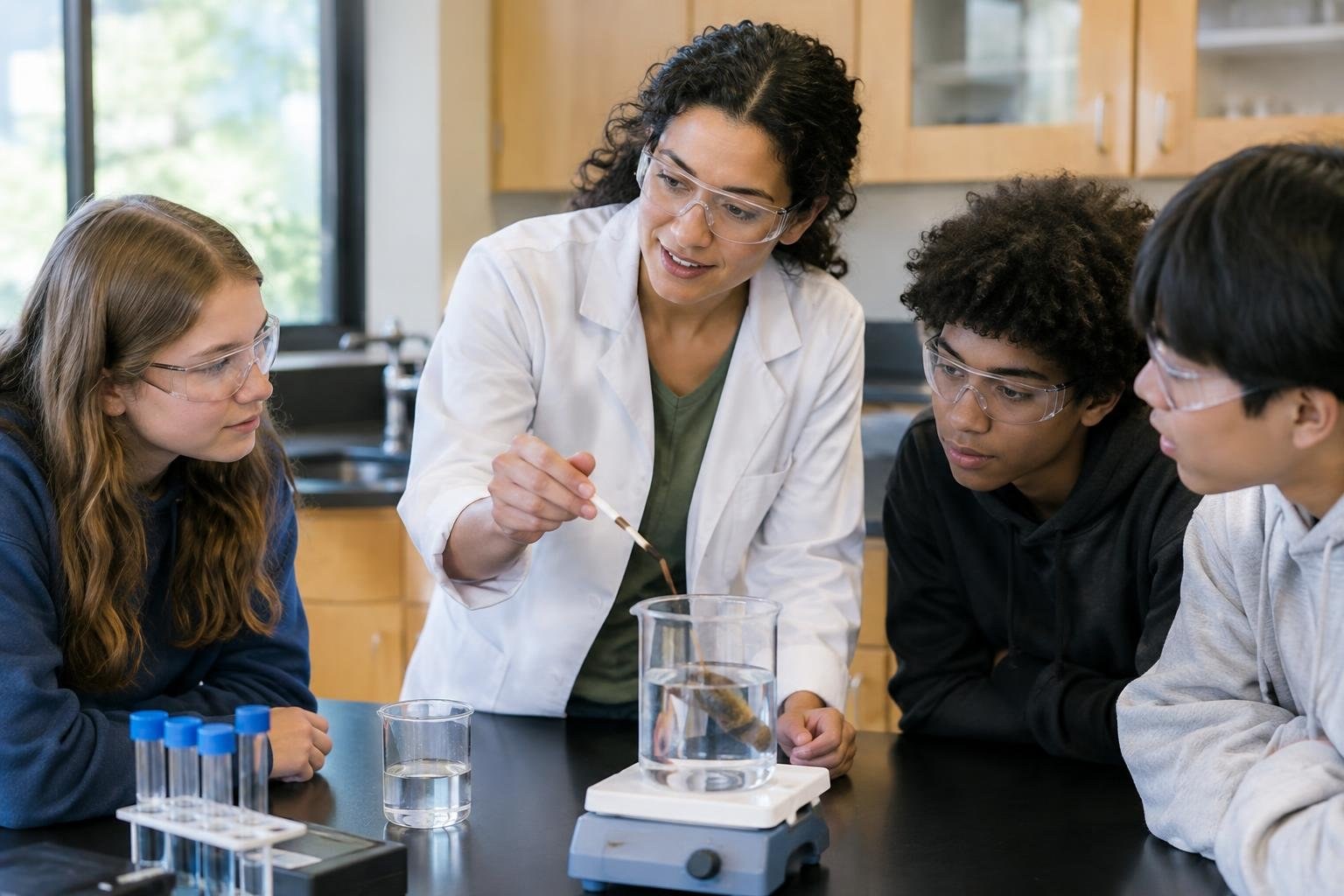
A science teacher facilitating an inquiry-based classroom demonstration
Start With the Science You Want to Teach
Think of science teacher education as a two-part preparation: building enough knowledge in a science area to teach it, and learning how to guide students through that material. The balance varies. One undergraduate program, for example, lists certification areas in biological sciences, chemistry, earth science, physical science, and physics. That is a useful illustration of subject-specific options, not a universal program template.
The field also includes routes for people at different points in their education. A high school graduate may compare an undergraduate degree that includes teacher preparation; someone with a bachelor’s degree may look at post-baccalaureate certification; graduate study may combine advanced science education with certification or serve educators seeking further study. The label “science education” alone does not tell you which of these outcomes a program offers.
Before comparing schools, write down the age group and science subjects you hope to teach. Use those goals to screen for programs whose subject coverage and intended credential align.
The University of Oklahoma’s listed certification areas show one example of subject choices within science education.
General Science or a Subject-Specific Route?
The phrase “general science” can suggest a broad teaching assignment, while another route may be organized around a discipline such as chemistry or physics. The research brief describes the field as preparation to teach general science or a combination of biological and physical science subject matter. Actual course requirements and certification categories are set by each program and credential route.
Do not choose solely by the subject you enjoyed most in school. Look at the science courses required, how much the program expects you to cover across disciplines, and whether the eventual credential names a particular subject. If you want flexibility across science topics, ask how breadth is built into the plan. If you want depth in one field, check that the program’s subject coursework and certification area match.
A useful comparison is the program map beside the credential description. Mark each science course and teaching course, then note which areas are missing or left to electives. This simple exercise can expose a mismatch before you commit.
Read the Course Plan as a Sequence of Practice
Course lists are more informative when read as a connected sequence rather than as a list of titles. Look for the relationship between science subject preparation, teaching methods, and supervised school practice. Ask an adviser to explain when candidates begin applying what they learn in a classroom setting and how that work relates to the intended science field.
Program examples illustrate different structures. Stony Brook describes clinical practice beginning in the first semester for its options, while the University of Florida describes supervised field experience in the candidate’s content area. These are institution-specific details, not requirements that apply everywhere.
For each program, request a sample schedule and answers to practical questions: what setting hosts fieldwork, who coordinates it, how much of it is supervised, and whether the student must attend at particular times. The details matter especially if you need to balance study with work or family responsibilities.
Stony Brook’s program overview and the University of Florida’s science education certificate information provide examples of distinct practice arrangements.
Online Study Still Needs a Fieldwork Plan
The central practical question is not simply whether a course is online. It is whether the complete route, including any supervised experience, can work from your location and schedule. The University of Florida describes an online post-baccalaureate program connected to Florida teacher professional certification and supervised field experience. That example does not establish that every online program has the same format or can support candidates in every state.
Ask whether online classes meet at set times, where required school practice occurs, and who helps arrange it. If you live outside the state tied to a program’s credential route, request a clear explanation of what the program can and cannot support. Confirm the destination state’s current requirements independently.
For a campus or hybrid option, make the same comparison: identify which parts require travel, daytime availability, or a local placement. Format is a practical constraint, but it should not distract from the subject and credential fit.
Choose a Route That Matches Your Starting Point
There is no single route that fits every prospective science teacher. Undergraduate programs can integrate science study and teacher preparation. A post-baccalaureate option may serve someone who already has a bachelor’s degree. Graduate routes can include initial certification, deepen an educator’s study of teaching and learning science, or focus on research. Combined undergraduate and graduate pathways also appear in university program descriptions.
Examples make the differences concrete: Arcadia describes post-baccalaureate preparation for Pennsylvania certification in general science for grades 7–12; the University of Georgia describes initial secondary science certification in the context of master’s studies; Penn State describes graduate study that may include initial certification or support practicing educators. These outcomes are not interchangeable.
Start with your current education, desired credential, subject, and grade range. Then ask each school to identify the exact route and what it is designed to accomplish. Do not assume that a graduate degree automatically adds certification or that a certificate is appropriate for someone without a prior degree.
See Arcadia’s post-baccalaureate example, Georgia’s graduate certification example, and Penn State’s graduate science education information.
Verify the Credential, Not Just the Degree Name
Certification is a specific program outcome to verify, not a general promise implied by a science education title. Before enrolling, get the intended state, subject area, grade range, and credential pathway in writing. Ask what the program itself includes and what remains for you to complete afterward.
The saved program examples refer to routes connected with Florida, New York, Pennsylvania, and other states. Their differences reinforce a key point: a route described for one jurisdiction should not be assumed to satisfy another’s current requirements. Check the state education agency where you plan to teach as well as the college’s program adviser.
Also distinguish academic completion from certification eligibility. Ask what documentation the college provides about the credential outcome, which steps occur after coursework, and whether your personal circumstances affect the route. Avoid relying on broad phrases such as “teacher-ready” without a precise explanation.
Indiana University of Pennsylvania notes a required teacher-education process; use official program and state information to confirm the route relevant to you.
Test the Fit of Teaching and Science Together
Science teaching may be a good fit if you want to keep engaging with science while making it accessible to learners. The preparation involves more than understanding a topic yourself: it asks you to study how science teaching is structured and to practice in educational settings. Consider whether you want daily work centered on helping students learn, rather than primarily on conducting research in a science discipline.
Explore the work before treating a major as a commitment. Talk with program advisers about field practice and compare the age groups and subjects included in possible routes. Assessment.com’s MAPP career assessment can help you reflect on career and degree options; use that exploration alongside direct program research.
For broader career exploration, the Assessment.com profiles for secondary school teachers and middle school teachers offer related starting points. These are career pages, not a substitute for confirming certification or job requirements.
Plan for the Sequence and the Workload
Program length cannot be inferred from the field name. A student entering an undergraduate program, a graduate student with a prior science degree, and a career changer pursuing post-baccalaureate preparation may face different sequences. University examples also show varied structures, including evening coursework and daytime clinical practice, or combined undergraduate and graduate routes.
Before applying, ask for a term-by-term plan based on your prior coursework and intended enrollment. Confirm when field practice starts, whether it creates daytime scheduling demands, and whether prerequisites or program entry points affect progress. If transferring credits, get an evaluation from the institution rather than assuming a prior course will count toward the science or teacher-preparation requirements.
Academic difficulty is personal, but the design itself can require students to manage science study alongside teaching preparation and school practice. A sample schedule can help you judge workload and fit more reliably than a broad claim that a program is easy or hard.
Compare Total Pathway Cost, Not a Headline Price
Program costs vary, and the supplied program information does not support a national price or standard time-to-completion estimate. Compare the full route needed for your intended credential. Ask each college for current tuition and required fees, then add any expenses the institution identifies for materials, travel, or in-person practice.
For a useful comparison, request estimates that reflect your residency classification, study pace, prior credits, and financial aid situation. Ask whether the quoted amount includes all coursework and supervised experiences, and whether a different route would change the total. A low advertised rate is not a fair comparison if it covers only part of the pathway.
Put cost beside the actual outcome: subject area, grade range, supervised practice, and intended certification. This helps avoid choosing an inexpensive program that does not meet the goal you set.
Connect the Degree to a Specific Teaching Setting
Secondary science teaching is a direct career connection for programs designed around secondary certification. The subject and grade band vary. Some university descriptions also discuss graduate study or research in science education, but those are different aims from initial preparation for a school teaching role.
Use career exploration to clarify the setting you want, then check what the relevant employer and state require. Assessment.com has profiles for secondary school teachers, middle school teachers, and postsecondary biological science teachers. The last is a distinct higher-education direction, not a claim that a secondary certification program qualifies someone for college teaching.
Do not treat degree completion, certification, and employment as the same outcome. Ask institutions what they report for each, and review the role requirements for the place and setting you are considering.
Distinguish Teacher Preparation From Advanced Study
Related pathways differ by the work they prepare you to do. A science major can emphasize scientific study without necessarily including teacher preparation. An undergraduate science education route can build subject study and teaching preparation together. A post-baccalaureate certificate is designed for candidates who already hold a bachelor’s degree in the relevant route. Graduate science education may include initial certification, advanced study for current educators, or research-oriented preparation.
When a route is described as combined undergraduate and graduate study, check the requirements for each stage and the final credential. A doctorate in science education, for example, has a different purpose from an initial secondary teaching pathway. Do not choose an advanced degree simply because it sounds like a stronger version of a certification program.
Compare the intended outcome first, then weigh duration, cost, subject depth, and field practice. The right option is the one whose documented pathway matches your starting point and teaching goal.
Explore related Assessment.com career profiles for postsecondary chemistry teachers and postsecondary physics teachers if college-level teaching is part of your longer-term exploration.
A Shortlist Checklist for Comparing Programs
Compare programs using a small set of questions that reveal the actual route, not just its marketing label:
Which science subject or range of subjects does the curriculum cover?
What grade band and state credential is the program designed to support?
What supervised school or clinical practice is required, and when does it begin?
Which requirements are online, campus-based, or completed in a school setting?
Is the program designed for someone at your current education level?
What is the estimated total cost and course sequence for your circumstances?
What requirements remain after graduation before certification eligibility?
Request answers from the program and confirm state-specific credential requirements with the relevant agency. If details are unclear, pause before paying an application or enrollment deposit. For an initial comparison of career and education interests, use Assessment.com’s MAPP career assessment as an exploration tool, not as a substitute for official program information.
Is This Pathway a Good Investment for Your Goals?
Science teacher education can be a worthwhile choice when you want teaching to be part of your work and have identified a route that fits your science interests, preferred grade range, and certification plans. The value depends on the whole pathway: coursework, practice, cost, time, and the credential outcome.
It may be a poor match if your main goal is to study science without teaching, or if you are drawn to research rather than school-based instruction. Compare a science major or an advanced science education route only after clarifying those different goals. For career exploration beyond the degree decision, visit Assessment.com’s MAPP assessment and related career profiles.
Before deciding, make sure the college can explain what the program prepares you for and what steps you must take next. A clear answer is more useful than a broad promise.
Frequently asked questions
What does a science teacher education program prepare you to do?
It is a field of study that combines science content with preparation to teach science. Depending on the program, the route may be an undergraduate degree, post-baccalaureate certificate, or graduate program, with different subject areas, grade ranges, and certification outcomes.
How does science teacher education coursework differ by program?
No single course plan applies to every program. Common distinctions to check are the science field, how science coursework connects to teaching methods, and whether classroom or clinical practice is part of the route. Ask for the course sequence and fieldwork details before applying.
Can someone with a bachelor’s degree enter a science teacher preparation pathway?
Yes, some options are designed for people who already hold a bachelor’s degree. For example, Arcadia describes a post-baccalaureate route toward Pennsylvania certification in general science for grades 7–12. Confirm that a program’s state-specific route matches your plans.
Does an online science teacher program include in-person experience?
Some science education programs offer online coursework, but online study does not automatically mean all requirements are remote. The University of Florida describes an online post-baccalaureate route connected to Florida certification and supervised field experience. Ask where practice takes place and how it is arranged.
Will a science education degree automatically qualify me for teacher certification?
A science education degree and a teaching credential are not necessarily the same outcome. Ask which credential the curriculum is intended to support, for which science subject and grade range, and what requirements remain after graduation. Verify current rules with the relevant state agency.
How long does science teacher preparation take?
The available examples show different formats and purposes, including undergraduate, post-baccalaureate, graduate, and combined routes. Your completion plan depends on the program and your prior education. Request an individualized course sequence instead of relying on a general timeline.
What costs should I compare for science teacher education?
Compare the full estimated cost of the pathway you need, not just a course rate or first-year tuition. Ask each college for tuition, required fees, field-placement expenses where applicable, aid options, and how accepted prior credits affect your remaining plan.
How is science teacher education different from a science major?
It is designed to prepare people to teach science, while a science degree may center on disciplinary study without including teacher preparation. Check the credential outcome and supervised practice rather than assuming the degree name tells you whether it leads toward certification.
People Also Ask
What subjects are included in science teacher education?
Programs can combine study in a science field with preparation for teaching, but the exact balance varies. Compare the science subject, teaching coursework, field practice, grade range, and intended credential for each route.
Can I become a science teacher after studying a different subject?
Some routes begin with an undergraduate teacher-preparation degree; other programs are designed for people who already have a bachelor’s degree. The pathway and credential depend on the institution and state, so verify both before applying.
Can science teacher training be completed remotely?
Some programs offer online coursework, while supervised classroom or clinical experience may still involve in-person participation. Ask the college how placements work and which state certification the route is designed to support.
Is a master’s degree required to teach science?
Not necessarily. Some graduate science education programs may include initial certification, while others serve practicing educators or focus on advanced study. Confirm the program’s specific outcome rather than assuming a master’s degree alone provides a credential.
Does a science education credential transfer between states?
Certification routes can be tied to a particular state, subject, and grade range. Ask the program to identify its intended credential, then check current requirements with the state where you hope to teach.
How much does a science teacher education program cost?
The supplied program examples do not establish a national cost or typical timeline. Request a personal estimate from each college based on program structure, prior credits, enrollment, tuition, fees, and field experience.
Science teacher education is a strong direction to explore when you want both science and teaching to shape your work. Start by deciding whether you want broad science coverage or a subject-specific focus, then compare how each pathway connects coursework, school practice, and the certification you need. A program title is only a starting point: its grade range, credential route, fieldwork, total cost, and fit with your preferred work all deserve a closer look. Explore your interests and career direction with Assessment.com’s MAPP career assessment.
Find out which Career or College Major is right for you!
We use cookies to offer you a better browsing experience, analyze site traffic and personalize content.
Read about how we use cookies and how you can control them in our
Privacy Policy.
If you continue to use this site, you consent to our use of cookies.
×
Exciting News!
Be one of the first to Beta Test the new AI-Powered Assessment.com Platform.