Physical Science Technologies/Technicians Degree Guide: Programs, Careers, and How to Choose
Physical Science Technologies/Technicians, Other is a broad program category rather than one standard curriculum. Learn what to compare in courses, credentials, careers, costs, and program fit.
By Kieth Nelson · Staff Writer Assessment.com · Published November 1, 2026 · Last updated November 5, 2026
Physical Science Technologies/Technicians, Other is a broad college program category for physical science technology instruction that does not fall under a more specifically named program. It is not one standard major with the same classes at every college. A school may define its version around a particular technical application, so the course list and credential matter more than the label alone. Students considering this field often want practical science learning and a route toward technical work. Potentially related career paths include environmental science and protection technicians, geological technicians, quality control analysts, and remote sensing technicians, but a program title does not guarantee preparation for any particular job. Compare what employers ask for with what each school actually teaches. Not sure whether this field fits you? Take the Free MAPP Career Assessment to explore how your motivations, interests, and natural preferences may align with related careers and education paths.
Degree & Program Decision Insights
Explore your personal fit, education requirements, career potential and next steps.
01Motivational Fit
Discover whether this program fits you
Explore your preferences against the focus of Physical Science Technologies/Technicians, Other. These prompts are not personal MAPP results.
Subject curiosity. Would you choose to explore “physical science technologies not listed above” in depth? Ask for a sample learning activity to test that interest.
Choosing a learning environment. Compare actual Physical Science Technologies/Technicians, Other offerings. Would their reading, projects or practical work suit how you prefer to learn? Confirm the format rather than assuming one from the field name.
Work reality. What would an actual workday connected with Physical Science Technologies/Technicians, Other involve? Investigate the setting and entry requirements separately from your interest in studying the field.
Interest in studying a field can differ from enjoying its related work.
Which part would you want to do repeatedly, and what would you try before deciding?
Discover Your Personal Program Fit
Before investing your time and money in your education, discover how this program aligns with your natural motivations, work preferences and career goals.
Typical occupational entry: associate's degree (BLS). BLS lists moderate-term on-the-job training as typical occupational training.
U.S. occupational wages are not guaranteed graduate earnings; OEWS excludes self-employed workers.
Projected openings include replacements as well as growth.
U.S. national estimates. A crosswalk does not establish entry-level eligibility; advanced, management and teaching roles can require further qualifications.
Chemical Process TechnologyCIP 41.0303. Compare its emphasis on mathematics, chemistry, and physics and computer applications with this program’s focus.
Science Technologies/Technicians, GeneralCIP 41.0000. Compare its emphasis on standard laboratory practices and procedures and techniques for analysis, testing and inspection with this program’s focus.
Explore your motivations. Use MAPP as a starting point for reflecting on your interest in “physical science technologies not listed above”, then test that interest against a sample learning task.
Examine the work. Compare Life, Physical, and Social Science Technicians, All Other and Hydrologic Technicians on daily work and entry qualifications, as well as pay.
Compare actual providers. Ask for the exact credential, course sequence and assessment methods. Compare how each provider teaches “Physical Science Technologies/Technicians, Other”, its entry criteria and its itemized costs.
Check the evidence before applying. Confirm prerequisites and any recognition or professional requirements for your intended route; ask for applicable rules and published outcome definitions in writing.
Verify the institution’s current offering, admissions requirements and outcomes; a search result does not establish your eligibility.
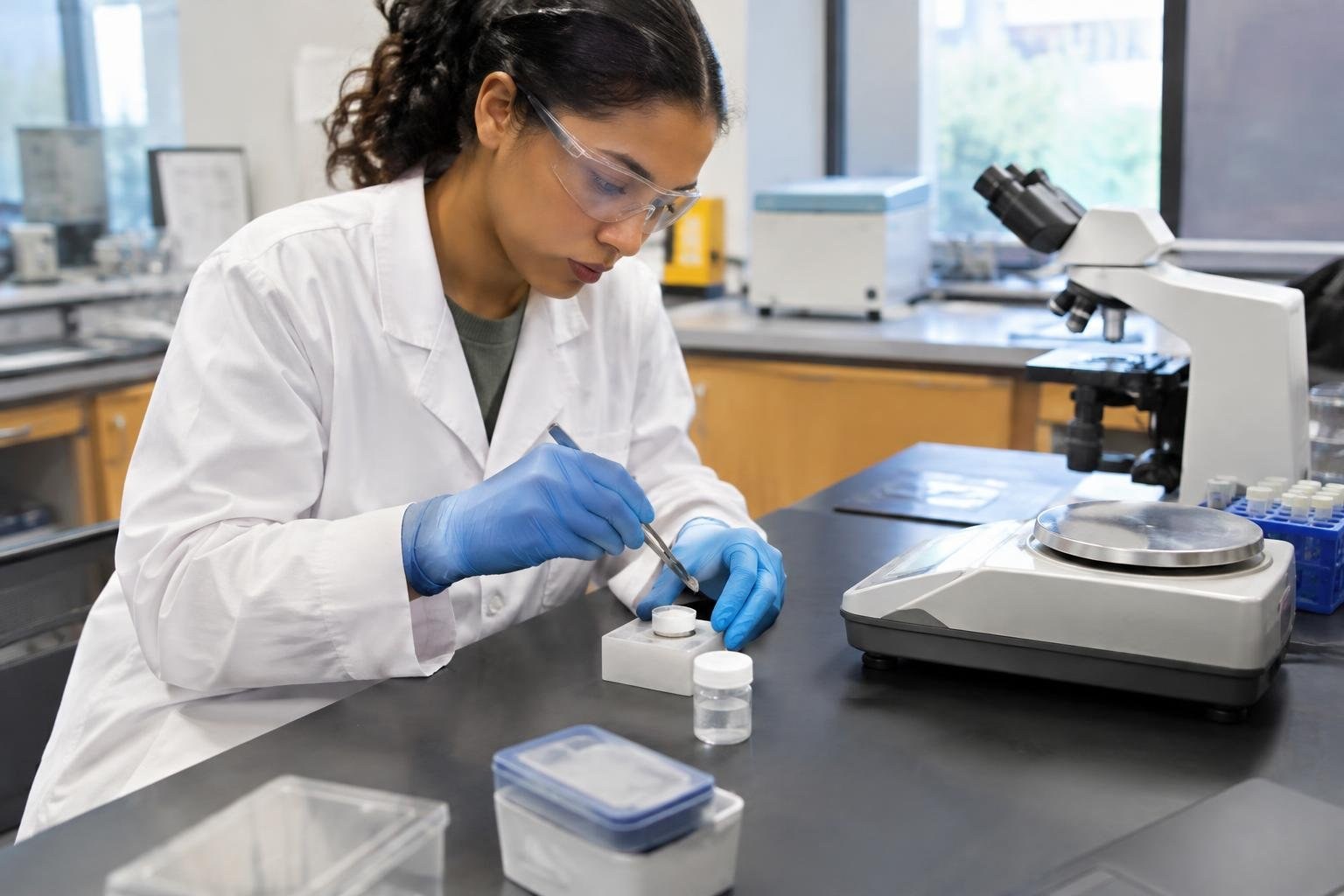
A student working with measurement tools and a labeled sample at a college laboratory bench
What Is Physical Science Technologies/Technicians, Other?
Physical Science Technologies/Technicians, Other is a category for instructional programs in physical science technologies that are not described by a more specific program title. The National Center for Education Statistics places this category within the broader physical science technologies group, whose instructional content is defined across CIP codes 41.0301 through 41.0399. The code identifies a program area; it does not describe one universal major or set of required courses.
That distinction matters when comparing colleges. A program may be called “other” because its particular focus does not fit a separately listed category. The actual content must be verified in the institution's catalog. The NCES CIP program description and the CIP 41.0399 listing are useful for understanding the classification, not for assuming what a specific college teaches.
How it differs from a named science major
A named program such as chemical technology or chemical process technology identifies a more specific subject area in the CIP family. The “other” designation is broader and less informative by itself. It may suit a specialized technical program, but prospective students should ask the department to explain the focus in plain language and identify the intended occupations.
What Do You Study in This Program?
There is no single course plan for all programs coded 41.0399. The program category describes a broad instructional grouping, while each institution determines its program design. Therefore, do not assume that a course list from one college represents what another college offers.
When you review a catalog, look for how the curriculum moves from introductory concepts to technical practice. Identify the science subjects included, the instruments or methods students learn to use, how data are handled, and whether students complete practical assignments, projects, or research. These are questions to verify with each school rather than features guaranteed by the classification.
Read the course descriptions, not just the title
Check required courses as well as electives. A specialized subject may appear only as an optional course.
Ask whether lab, field, or equipment-based work is part of the program and how it is delivered.
Look for a capstone, portfolio, internship, or other applied project if you want evidence of practical work for employers.
Ask what software, measurement tools, or technical procedures students use, and whether students can access them outside scheduled class time.
Compare learning outcomes with entry-level job descriptions in your preferred career area.
Ask an adviser to explain how the courses fit together and what a graduate should be able to do. Request the current catalog and a sample degree plan before you apply.
Skills to Look for and Develop
Potentially relevant work can involve scientific procedures, careful observation, consistent measurement, recordkeeping, data review, and explaining technical results. Which skills students actually gain depends on the course and practical experiences available at their college. Ask for examples of student assignments and projects rather than relying on broad promises about “hands-on science.”
Skills that may matter in technical workplaces include attention to detail, following documented procedures, troubleshooting equipment or process issues, organizing information, communicating findings, and working safely. Treat these as career skills to investigate, not as a guaranteed curriculum list. The federal O*NET resource provides occupation descriptions and related information for a broad “all other” technician group; use it as one starting point, then research the specific role you have in mind.
Build evidence of your skills while studying. Keep a record of projects, methods, tools, and results you can discuss, while following any class or employer rules about confidential information. A concise portfolio or project summary can help explain what your coursework prepared you to do.
Explore the O*NET technician occupation profile and compare it with job descriptions for particular occupations, since a broad occupation group does not replace role-specific research.
Who Might This Program Suit, and What Are the Entry Requirements?
This field may be worth exploring if you are curious about physical science, enjoy careful technical work, and want to investigate how scientific methods are applied outside a purely theoretical setting. It may also appeal to students who like structured tasks, practical problem-solving, and interpreting observations or measurements. These are possible preferences, not admission criteria or requirements for success.
Because program content varies, the best fit depends on the actual focus. A student interested in environmental sampling, for example, should verify that a prospective program teaches relevant methods rather than relying on the broad program name. Someone drawn to geology, chemistry, or remote sensing should similarly check the course list and occupational requirements for that subject.
Entry requirements are set by the institution
The CIP category does not specify admission standards. Check each college's admissions page for prerequisites, transcripts, placement procedures, application materials, deadlines, and any program-specific expectations. Ask whether prior science or math coursework is recommended, and what support is available if you need to refresh those subjects. Parents can help students compare requirements and costs, but the student should also speak directly with an adviser or department representative.
Use Assessment.com's major-selection guidance to structure a conversation about interests and options. A career assessment can help generate questions to explore, but it should complement, not replace, reviewing courses and talking with colleges.
Credential Levels, Format, and Time to Completion
Credentials associated with a field of study are not all offered at every institution. The supplied program context includes certificate, associate, graduate certificate, and master's levels, but that list should not be read as proof that a particular college offers each award in this category. Confirm the exact credential and program status with the institution.
There is likewise no universal completion time or credit total established by CIP 41.0399. Time to finish depends on the college's requirements, course availability, a student's study pace, transfer credit, and whether the student attends full time or part time. Ask for a degree map showing the courses in sequence and whether required classes are offered each term.
Online, hybrid, and campus study
Program format is school-specific. Before choosing online study, determine whether all learning outcomes can be completed remotely or whether any lab, field, equipment, or supervised activity requires an in-person visit. Ask where those activities occur, who arranges access, and whether the schedule works for students who live far from campus. Do not assume that an online label means every program requirement is remote.
If you plan to transfer, request a written evaluation of previous coursework and confirm how accepted credits apply to the credential, not simply how many transfer in.
Tuition, Costs, and Financial Aid
Tuition is only one part of the cost of a college program. Ask each institution for a student-specific estimate that includes tuition, mandatory fees, course materials, required equipment, technology, transportation, and housing when relevant. Lab or field requirements, if present, may add costs or travel that are not obvious from a headline tuition figure. Prices differ by school, residency status, enrollment intensity, and program requirements, so compare like with like.
Complete the Free Application for Federal Student Aid if appropriate to your circumstances, and speak with the college financial aid office about available federal, state, and institutional aid. Ask about scholarships, grants, work-study, employer tuition assistance, payment plans, and the rules for maintaining aid. Eligibility and amounts vary, so obtain current details directly from the relevant school or government program.
Plan for affordability before enrolling
Compare estimated total cost for the full credential, not only cost per term.
Ask how transfer credits affect both time and the total bill.
Include books, lab supplies, travel, and the cost of required technology in your budget.
Review loan terms and expected monthly repayment before borrowing.
Ask whether a lower-cost public or local option offers the curriculum and practical experiences you need.
Do not choose a program solely because it advertises a short duration or low tuition. Confirm the credential, required courses, and likely next step toward your goals.
How to Choose the Right Program
Program selection is especially important for a category whose title alone reveals little about the curriculum. Compare at least several schools on the same questions, and keep the answers in writing. The goal is not to find the most impressive-sounding label; it is to find a credible, affordable learning path connected to the work you are considering.
Questions that make college comparisons clearer
Curriculum: What subjects and technical methods are required? Which classes are electives?
Practical learning: What projects, labs, field activities, internships, or research opportunities are available?
Faculty and facilities: Who teaches the technical courses, and what equipment or learning resources can students access?
Format: Are courses online, hybrid, or on campus? What in-person obligations apply?
Cost: What is the estimated total price after fees and supplies? What aid is available to you?
Outcomes: What occupations do graduates pursue, and how does the school gather or report that information?
Transferability: Which previous credits will apply to this specific credential?
Career support: Can students access internships, project feedback, career advising, and employer connections?
Also ask the institution how it classifies the program and why the “other” designation applies. Check institutional and program accreditation information through official sources. Accreditation is not the same as a guarantee of employment or professional eligibility.
Careers, Jobs, Salary, and Employment Outlook
Possible career directions associated with the subject area include environmental science and protection technicians, geological technicians, quality control analysts, and remote sensing technicians. These are options to investigate, not occupations guaranteed by the program name. Each role can have different education, experience, and employer requirements. Look at current job postings and official occupational descriptions for the region where you hope to work.
The U.S. Bureau of Labor Statistics publishes occupational employment information for the broad “Life, Physical, and Social Science Technicians, All Other” group. That classification is not a salary promise for graduates of CIP 41.0399, and it should not be confused with data for a more specific occupation. Pay and outlook depend on the job, industry, location, and time period. Use current data for the specific occupation before making financial plans.
Possible career direction
What to verify
Why the program details matter
Environmental science and protection technician
Employer expectations for relevant science courses, sampling or monitoring experience, and field work
A broad title may not include environmental methods
Geological technician
Geology-related coursework, field or laboratory experience, and employer requirements
Technical preparation may vary substantially among programs
Quality control analyst
Industry, measurement, documentation, and process requirements
Quality-control work is shaped by the employer's products and standards
Remote sensing technician
Relevant data, imagery, software, and technical preparation in current job listings
Do not assume remote sensing is taught unless it appears in the curriculum
For more context, review the BLS occupational employment page for the broad technician group. The supplied page is a 2023 data release, so it should not be presented as a current-year wage estimate. For career exploration across the science fields, see Assessment.com's life, physical, and social science careers.
Find out which Career or College Major is right for you!
Accreditation, Licensing, Certification, and Experience
The broad program classification does not itself establish a professional license or certification requirement. Such requirements, when applicable, depend on the specific occupation, employer, work duties, and jurisdiction. Before enrolling, identify the job you want and ask employers or the relevant government agency which credentials are required or preferred.
For federal physical science technician positions, the Office of Personnel Management's qualification standard notes that certain laboratory mechanic or trade experience may be credited when it involved close work with physical scientists or technical personnel and provided intensive knowledge of scientific principles and methods. This is a specific federal hiring standard, not a blanket rule for private employers or every technician role. Review the OPM Physical Science Technician Series 1311 standard if considering a covered federal position.
Experience and ways to stand out
Ask the college about internships, supervised projects, research assistance, field activities, and career services. Keep examples of relevant work, document the tools and procedures you have learned, and practice explaining results to a non-specialist. Join professional or student organizations only after checking that their activities fit your intended field. Confirm any credential's cost, eligibility rules, renewal requirements, and employer recognition before paying for it.
Related Degrees and Alternatives
Alternatives may provide a clearer subject focus than a broad “other” program. The right choice depends on the work you want, the courses you enjoy, and the education employers request. These are comparison directions, not claims that every listed degree is offered locally or has a fixed curriculum.
Chemical technology: Consider this instead if you want a more specifically named chemical technology pathway; compare the exact curriculum and lab instruction.
Chemical process technology: Consider this instead if you are focused on process-oriented chemical work and want to verify that coursework aligns with target employers.
Environmental science: Consider this instead if environmental topics are your main interest and you want to compare a named environmental science program.
Environmental studies: Consider this instead if you want to compare a related program that may take a broader approach to environmental issues; inspect each school's courses.
Geology or earth science: Consider this instead if geological subjects, fieldwork, or earth materials are your clear priority.
Physics or chemistry: Consider these instead if you want a discipline-centered science curriculum rather than a broad technical program.
Engineering technology: Consider this instead if your intended work centers on applying engineering methods and equipment; compare the technical focus and prerequisites.
NCES lists chemical technology and chemical process technology as distinct program categories within the science technology and technician taxonomy. That distinction can help narrow a search, but the college catalog remains the authority on what students learn. Browse Assessment.com's environmental science guide, environmental studies guide, and forestry guide as starting points for adjacent interests.
Advantages, Drawbacks, and Is It Worth It?
Whether this program is worth the investment depends on its fit with a specific goal. Possible advantages include exploring applied science in a technical setting and comparing several occupational directions. A program with a clear focus, practical learning, and manageable cost may give a student a useful way to build relevant knowledge.
There are also real drawbacks to weigh. The broad title can make it harder to understand the curriculum or explain the credential to an employer. If the program has no clear connection to the roles you want, you may need additional coursework or experience. Costs can be difficult to judge without a full student-specific estimate, and online delivery may still involve in-person requirements.
Evaluate value for your circumstances
Compare tuition and living costs with your likely time to completion, available aid, transfer credits, and the requirements of the occupations you are considering. Ask whether the program's learning outcomes address those requirements. Do not use a broad occupation-group salary figure as a personal earning forecast, and do not treat general job growth as a guarantee of hiring. A program may be a sound choice for one student and a poor match for another.
From Degree to Career: Possible Pathways
Map a possible direction before assuming a particular career ladder. For example:
Program with relevant environmental coursework → apply for an entry-level environmental technician opening → build relevant field or laboratory experience → specialize in a method or environmental topic → consider advanced technical responsibilities if employer requirements and experience support them.
Program with relevant geology coursework → pursue an appropriate technician role → gain experience with the employer's procedures and equipment → focus on a technical specialty → evaluate further study if it is needed for a desired next role.
Program with relevant quality procedures → seek a suitable quality-control position → learn the organization's documentation and testing process → take on more complex analytical work as qualified.
These are illustrative possibilities, not guaranteed progressions. A program's title does not establish eligibility for an occupation. Verify required education, experience, and credentials in job postings and official resources for your intended location. The BLS and O*NET occupational resources can help you identify the specific occupation group to research.
Questions to Ask Before Enrolling
Use this checklist with a parent, counselor, or college adviser before submitting an enrollment deposit:
What is the exact credential and CIP classification?
What does “other” mean for this particular program, and what are its intended career directions?
Can I review a current catalog, course sequence, and sample project?
Which classes are required, and which are electives?
Are there labs, field activities, internships, or other in-person requirements?
What is the total estimated cost, including fees, supplies, equipment, and travel?
Which forms of financial aid may apply, and what conditions come with them?
How will previously earned credits transfer into the credential?
What accreditation applies to the institution or program, and where can I verify it?
What do graduates do, and how does the school document those outcomes?
Which employers, if any, recruit students or offer work-based learning?
What academic advising and career services can students use?
What specific licensing, certification, or employer requirements apply to my target occupation?
If the school cannot clearly explain the curriculum and its connection to your goals, pause and ask for more detail. Compare the answers across institutions before deciding.
Does This Program Match Your Interests and Goals?
A career assessment can help you consider whether the kinds of tasks and work settings associated with a possible path sound appealing. Use it as one input, alongside the courses, college costs, academic requirements, and employer expectations you have verified.
Assessment.com offers the Free MAPP Career Assessment to explore career and degree options. You can also browse degree topics and career areas as you compare directions. Treat a match as a prompt for further research, not a promise of admission, employment, or a particular salary.
Frequently asked questions
Is a Physical Science Technologies/Technicians program hard?
It can be, depending on the institution and the courses within the program. Students may encounter scientific concepts, measurement, data, and technical practice, but the precise subjects and level of math or lab work vary. Review course descriptions and ask about academic support before enrolling.
What is Physical Science Technologies/Technicians, Other?
This broad CIP category is defined as instructional content for programs not otherwise listed in the physical science technologies group. The exact subjects, courses, and credential depend on the school. Compare the published curriculum rather than assuming every program with this name teaches the same material.
What jobs can I get with this degree?
Potentially relevant job families include environmental science and protection technicians, geological technicians, quality control analysts, and remote sensing technicians. A program title alone does not qualify someone for a particular job. Check employer requirements and compare them with the specific courses and practical experience offered by the college.
How much can I make with a physical science technology credential?
There is no single salary figure that reliably describes every program graduate. The category covers varied programs and does not map to one occupation. Pay depends on the actual job, location, employer, experience, and other factors. Use current Bureau of Labor Statistics data for a specific occupation, not a broad degree label.
Can I earn this credential online?
Some coursework may be offered online, but availability and the treatment of any lab or practical work depend on the institution and program. Ask whether required activities take place on campus or at an approved location, and whether an online student can complete every requirement before committing.
Does this program require math?
The program category itself does not establish a single math requirement. Courses may differ in their use of measurement, calculations, or data analysis. Inspect the course sequence and prerequisites, and ask the department what math preparation successful students typically need for that particular program.
Do I need graduate school after this program?
A graduate credential is not automatically required for every technical job, and job requirements vary. First identify the occupation you want, then review current employer postings and official occupational resources to see which education and experience are requested. A graduate certificate or master's degree may make sense for a defined next step, not simply because the program title is broad.
What certifications or licenses help in this field?
There is no single certification requirement established by the broad CIP category. Requirements depend on the occupation, employer, and jurisdiction. Before paying for a certificate, ask prospective employers whether they value it and whether a particular credential is required for the work you want to do.
People Also Ask
What does CIP code 41.0399 mean?
CIP 41.0399 identifies Physical Science Technologies/Technicians, Other, a residual program category within physical science technologies. It describes an instructional program grouping, not a guarantee of a particular course sequence, job title, or credential at every school.
How do I know what a college program actually teaches?
Start with the published catalog and course descriptions. Identify the science subjects, technical methods, lab or field activities, and final projects actually included. Then compare those learning opportunities with requirements in job postings for occupations you are considering.
How long does this program take to complete?
The broad program designation does not set one standard credential level or completion time. Check the institution's current program page for the award, required credits, course rotation, and part-time or online availability. Confirm transfer credit and any required in-person work with an academic adviser.
Which credential level should I choose?
A certificate or associate program may be a shorter route into technical study, while graduate credentials require prior education and address a different level of study. The available options vary by school. Choose based on job requirements and the actual curriculum, not on the credential name alone.
Do physical science technology students need lab or field experience?
Ask what students do in labs, projects, field placements, internships, or other applied learning experiences. Because programs under this broad category can differ, verify whether hands-on work is required, where it happens, and whether online students can complete it.
How can I compare the cost of science technology programs?
Compare the full published cost, including tuition, required fees, materials, equipment, travel, and housing if applicable. Then ask the financial aid office for a student-specific estimate of grants, scholarships, work options, and loan eligibility before deciding.
Physical Science Technologies/Technicians, Other may be worth exploring if you want applied science training but have not settled on one specific technical field. The key is to look beyond the broad program label: compare the actual courses, hands-on learning, total cost, credential awarded, and career outcomes for each college. If you prefer a clearly defined subject or occupation, a focused program in chemistry, environmental science, geology, or another technical area may be easier to evaluate. Use Assessment.com to explore careers and education paths, then confirm program details directly with colleges. A good decision weighs likely work, learning preferences, and affordability together.
Want to see your options? Try our comprehensive Degree, Program & College Search tool
We use cookies to offer you a better browsing experience, analyze site traffic and personalize content.
Read about how we use cookies and how you can control them in our
Privacy Policy.
If you continue to use this site, you consent to our use of cookies.
×
Exciting News!
Be one of the first to Beta Test the new AI-Powered Assessment.com Platform.