Industrial and Product Design: Choosing a Program That Fits
See how industrial and product design programs differ, what to inspect in student work, and how to weigh credentials, costs, and career possibilities.
By David Slack · Staff Writer Assessment.com · Published October 26, 2026 · Last updated November 5, 2026
Choosing industrial and product design is not just choosing a creative major. It means deciding what kinds of problems you want to work through: understanding people’s needs, shaping manufactured objects, exploring how products perform, or making and revising prototypes. Programs can combine those activities in different ways. For students and parents comparing colleges, the practical question is whether the required work, facilities, credential, and cost match the student’s goals. This guide offers a way to inspect those details, compare possible routes, and connect a degree decision with further career exploration.
Degree & Program Decision Insights
Explore your personal fit, education requirements, career potential and next steps.
01Motivational Fit
Discover whether this program fits you
Explore your preferences against the focus of Industrial and Product Design. These prompts are not personal MAPP results.
Subject curiosity. Would you choose to explore “designing in a wide variety of plastic and digital media” in depth? Ask for a sample learning activity to test that interest.
Breadth of interest. Consider the place of “prototype construction” in this field. Is this another part you would choose to explore, or mainly a requirement you would tolerate?
Work reality. Related work can involve this task: “Confer with engineering, marketing, production, or sales departments, or with customers, to establish and evaluate design concepts for manufactured products.” Would you want that activity to be a regular responsibility?
Interest in studying a field can differ from enjoying its related work.
Which part would you want to do repeatedly, and what would you try before deciding?
Discover Your Personal Program Fit
Before investing your time and money in your education, discover how this program aligns with your natural motivations, work preferences and career goals.
U.S. occupational wages are not guaranteed graduate earnings; OEWS excludes self-employed workers.
Projected openings include replacements as well as growth.
U.S. national estimates. A crosswalk does not establish entry-level eligibility; advanced, management and teaching roles can require further qualifications.
Compare the actual offering and credential before committing your time or money.
Request the itemized fees, materials and equipment associated with “designing in a wide variety of plastic and digital media”; confirm what tuition includes.
Compare the full attendance budget, course availability and time away from paid work, rather than tuition alone.
No institution- and credential-matched cost, debt or graduate-earnings amount is reported here; occupational pay is not program ROI.
Financial aid depends on the school, program and student’s eligibility.
Compare the focus and route of these distinct instructional fields; their credentials and admission requirements are not interchangeable.
Design and Visual Communications, GeneralCIP 50.0401. Compare the official Design and Visual Communications, General field description and actual course requirements; confirm which parts support your intended specialization.
Graphic DesignCIP 50.0409. Compare its emphasis on computer-assisted art and design and printmaking with this program’s focus.
Explore your motivations. Use MAPP as a starting point for reflecting on your interest in “designing in a wide variety of plastic and digital media”, then test that interest against a sample learning task.
Examine the work. Compare Commercial and Industrial Designers and Graphic Designers on daily work and entry qualifications, as well as pay. Explore Commercial and Industrial Designers.
Compare actual providers. Ask for the exact credential, course sequence and assessment methods. Compare how each provider teaches “prototype construction”, its entry criteria and its itemized costs.
Check the evidence before applying. Confirm prerequisites and any recognition or professional requirements for your intended route; ask for applicable rules and published outcome definitions in writing.
Verify the institution’s current offering, admissions requirements and outcomes; a search result does not establish your eligibility.
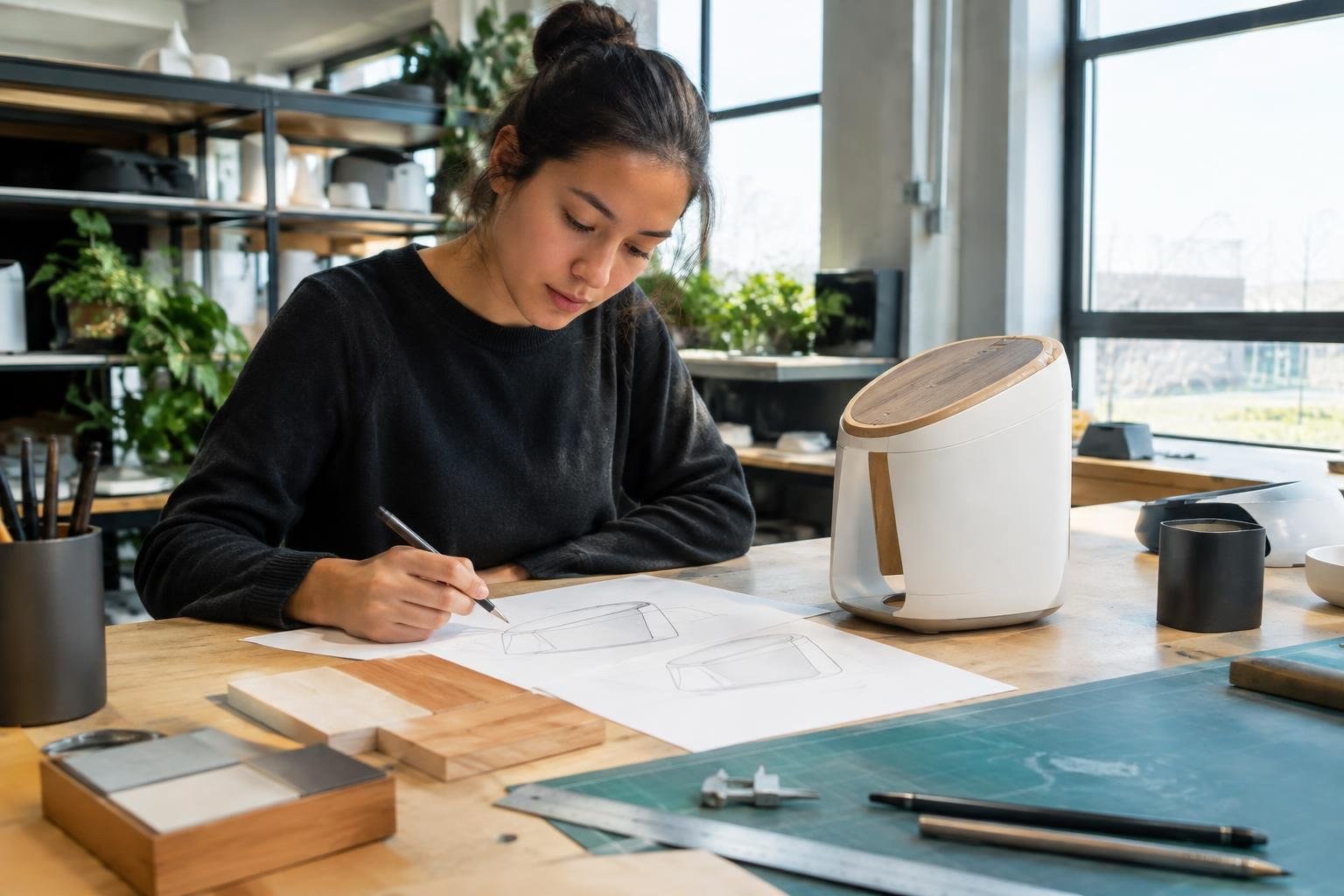
A student sketching a product concept beside a physical prototype and design tools
Begin With the Work, Not the Major Name
Industrial and product design concerns the development of manufactured objects for everyday use. Arizona State University frames the work around products that serve people, consumers, manufacturers, and the environment. San Francisco State University describes its industrial design degree through people, process, product, and user-centered needs. Those examples point to a broad field, not a single required sequence of courses.
Titles also vary. Colleges may describe an offering as industrial design, product design, product development, or industrial design technology. A credential name does not tell you whether the program is research-led, studio-heavy, or production-oriented. Read the official program description and course plan before comparing two offerings.
For a useful first comparison, ask what students design, what methods they use to develop ideas, and what kind of work they are expected to present by graduation.
Read Arizona State University’s industrial design program description and San Francisco State University’s concentration description.
Read a Curriculum as a Sequence of Design Decisions
Course lists can sound similar while preparing students for different kinds of design work. One useful comparison is to trace a project from the first question to the final explanation. Does a student investigate context and user needs? Are ideas developed and revised? Does the curriculum include a hands-on stage, such as solid design or rapid part manufacturing?
Appalachian State University’s BS in Industrial Design, Product Design focuses on creative problem-solving and contextual research. Maricopa Community Colleges describes product design, product development, rapid part manufacturing, and hands-on solid design in its Industrial Design Technology information. These are examples of program emphasis, not a universal checklist every school follows.
When reviewing sample work, look for the reasoning behind a result. Can the student explain the need being addressed, why a particular form was explored, and how the proposal changed during development? Ask faculty which digital and physical tools are taught; do not assume a particular software package is standard.
Explore Appalachian State’s program description and Maricopa’s Industrial Design Technology information.
Test Your Interest Against the Process
Instead of asking whether you are “creative enough,” consider which parts of a product project hold your attention. Do you like observing how people use objects? Would you enjoy making several alternatives before settling on one? Are you interested in explaining tradeoffs among an object’s appearance, intended use, and practical requirements?
These questions help students look beyond a finished product. Arizona State University describes industrial design in terms that include usefulness, safety, aesthetic appropriateness, ecological soundness, and social benefit. San Francisco State’s program description highlights people, process, and product. Together, those perspectives suggest that the field can involve both visual choices and consideration of context.
If your interests are still developing, compare the activities in a design program with those in neighboring fields. Assessment.com’s arts and design career area offers another starting point for exploring related roles. The MAPP career assessment can also support reflection, but it should not replace program research or conversations with advisors.
Choose a Credential by Mapping the Next Step
Choose a credential by working backward from what you want to do next. Do you want a shorter entry point, a degree that may connect to further study, or advanced interdisciplinary coursework? The answer depends on your circumstances and the specific program. Mt. San Antonio College lists an associate degree and certificate options in industrial design; LaGuardia Community College describes an associate degree in industrial design; the University of Pennsylvania describes a graduate certificate in Integrated Product Design.
These examples do not establish a standard progression or guarantee that one credential transfers into another. Diablo Valley College describes its associate degree for transfer as equivalent to the first two years of a bachelor’s program, but students should confirm how a particular agreement applies to their intended destination and major.
Before enrolling, request a written evaluation of prior credits and a course-by-course completion plan. Confirm the award title, admissions requirements, course sequence, and current availability with the college. Treat any transfer promise as specific to the named receiving institution and agreement.
See Mt. San Antonio College’s credentials, LaGuardia’s associate degree description, and Diablo Valley College’s transfer information.
Verify Studio Access Before Choosing a Study Format
For a design student, study format is a question of access as much as convenience. A program that includes physical design or prototype work may require tools, facilities, or collaboration that a student cannot assume will be available remotely. The supplied program descriptions include hands-on design and rapid part manufacturing, but they do not establish a common online delivery model across colleges.
Ask the department for the delivery format of each required course in your intended schedule. Find out whether studio sessions take place on campus, what equipment students can use, whether materials are supplied, and how remote students complete any physical work. If a course plan is described as hybrid, ask which meetings or activities are in person.
Get the answers in writing before comparing formats or making housing and transportation plans. A general statement that a college offers online classes does not establish that the full design credential can be completed online.
Build a Full Cost Estimate Before Comparing Colleges
There is no single price for this major in the available research. To compare offers, build a full-program estimate from each institution’s current tuition and fee information, then ask which materials, technology, equipment, or transportation costs are additional. If the program has a required course sequence, estimate cost across the likely completion plan rather than looking only at a first-term figure.
Ask the financial-aid office which grants, scholarships, work-study options, or payment arrangements may apply to you and what deadlines govern them. Confirm eligibility rather than treating potential aid as guaranteed. Students considering a transfer route should check whether credits will count toward the intended degree before assuming that the route reduces cost.
Put each estimate in the same format: tuition and fees, anticipated supplies, travel or housing, confirmed aid, and remaining amount to pay or borrow. The college can explain its charges and aid; it cannot determine whether a particular career outcome will justify your personal cost.
Connect Coursework to Actual Career Tasks
A design credential can lead toward different kinds of work, but a major title alone cannot establish a job match. The supplied program descriptions identify product design, product development, and industrial design as areas of study. Arizona State University describes preparing students for product design involving manufactured objects used by people. Employers and job postings may define roles differently, so compare their stated duties and qualifications with the work you have learned to do.
Possible direction
What to examine in your preparation
Commercial or industrial design
Whether projects demonstrate product-focused design development and clear presentation.
Product development support
Whether coursework includes the development or hands-on methods named in relevant postings.
Graphic design
Whether your interests are centered more on visual communication than manufactured objects.
Explore Assessment.com’s pages for commercial and industrial designers and graphic designers for related career exploration. Use current, authoritative labor-market information for the specific occupation and note its date and geography.
Turn Class Projects Into Credible Portfolio Evidence
Use course projects to build evidence of how you think, not only polished images of finished concepts. For each project, record the original question, context, alternatives considered, revisions, and your contribution. This makes it easier to explain the choices behind the result when speaking with faculty, internship contacts, or employers.
Ask the department what portfolio formats its students use and which projects may be shared publicly. If work involved a team or outside partner, state your role accurately and ask permission before publishing material that is not yours to disclose. The available program descriptions do not identify one required portfolio format, certification, or license for all industrial and product design roles, so verify expectations for a particular program or job.
Where possible, seek critique and revise the presentation. A portfolio should make the process legible to someone unfamiliar with the assignment; avoid implying that a class project was a commercial product or that a team result was completed individually.
Consider Graduate Study Only for a Clear Purpose
Graduate study is a choice to deepen or broaden a direction, not an automatic next step. The University of Pennsylvania’s Integrated Product Design certificate is one example of a product-design focus connected to engineering, business, and design schools. It illustrates an interdisciplinary option, but does not show that graduate study is necessary for every design role.
Before applying, write down what you want the additional credential to provide. Is it a subject area, a connection with another discipline, or an opportunity to approach product design from a different background? Then check eligibility, prerequisites, whether the certificate is standalone or attached to another program, time commitment, and total cost.
Compare that information with the requirements in postings for the roles you are considering. If the credential does not address a specific learning or career goal, pause and investigate other ways to gain the needed experience.
Review the University of Pennsylvania certificate description.
Compare Adjacent Fields by Their Central Problem
Compare neighboring fields by the object of the work and the kind of output students create. Industrial and product design focuses on manufactured objects; graphic design is a closer comparison for students drawn to visual communication. Engineering may be a better fit for students seeking a more technically focused course of study, while fine arts may suit those whose priority is personal artistic practice. These are broad distinctions, so confirm them in actual course plans.
Product development and industrial design technology can point toward more applied or production-related study, but program content still varies. Integrated Product Design offers an example of combining design with other disciplines at the graduate-certificate level. Do not assume that these fields share identical prerequisites or job outcomes.
Assessment.com’s environmental design degree guide and landscape architecture degree guide provide comparisons with place-focused fields. For a career-side comparison, explore graphic designers.
Use a Consistent Checklist to Compare Programs
Build a short comparison sheet for every college under consideration. Use the same questions for each one so that an appealing presentation or familiar major title does not distract from important differences.
Student work: What problems do projects address, and can students explain their design decisions?
Course sequence: Where do research, product development, hands-on design, and refinement appear?
Facilities: What studios or equipment are available, and who can use them?
Admission: What current prerequisites or application materials apply to this program?
Format: Which courses or project activities require attendance in person?
Transfer: Which credits will apply to the intended destination and degree?
Total cost: What are the full tuition, fees, materials, and other likely costs?
Outcomes: How does the institution define and document any employment claims?
Check institutional accreditation through the school’s official information and verify whether any separate requirement applies to your goal. Assessment.com’s college major selection resource can help structure exploration, alongside direct contact with each institution.
Plan a Route as a Set of Verified Transitions
Think of a degree-to-career route as a series of choices, not a guaranteed ladder. A certificate or associate-level program may be an entry point for some students; whether it leads to further study depends on program terms, transfer decisions, and the student’s goals. A bachelor’s program may provide a different depth and sequence of design work. An interdisciplinary graduate certificate is another possible option for eligible students who want to combine product design with other fields.
Examples in the supplied research include associate and certificate options at Mt. San Antonio College, a transfer-oriented industrial design degree described by Diablo Valley College, bachelor’s programs at Appalachian State and San Francisco State, and the University of Pennsylvania certificate. They are examples, not a single prescribed pathway.
Before committing, compare the course sequence and credential with entry-level postings you have reviewed, and ask the school to explain which next steps are supported by a formal agreement.
Questions That Make a College Visit More Useful
Bring these questions to the people who can answer them: admissions staff for entry rules, faculty for course and facility details, and financial-aid staff for your estimated costs and aid eligibility.
What is the exact credential and current course sequence?
Can I see recent student projects, including work in progress?
Which classes involve research, product development, and hands-on design?
Which studios, equipment, or digital tools are available to students?
Which required activities are in person?
What is my estimated total cost, including materials and fees?
How will prior credits apply to this major?
What exactly does a transfer agreement guarantee, and for which destination?
How does the school document career outcomes it discusses?
Where can I verify institutional accreditation and any separate professional requirement?
Record who provided each answer and when. If an answer affects cost, transfer, or completion time, ask for written confirmation and compare it with the official catalog or agreement.
Frequently asked questions
What does an industrial and product design degree teach?
Industrial design programs focus on developing manufactured goods for people. Depending on the curriculum, students may work on research, creative problem-solving, product development, and hands-on design. Review the program’s own course plan and project examples because the major name does not guarantee a standard curriculum.
How can I compare industrial design programs?
Start by identifying the balance you want among contextual research, product development, and hands-on model or prototype work. Then compare required courses, student projects, facilities, credential, transfer terms, and total cost at specific institutions.
What degree levels are available in industrial design?
Credential availability varies by institution. The supplied college examples include associate-level options and certificates, while other examples describe bachelor’s or graduate-level study. Confirm the award and current availability with the school before planning a route.
How do industrial design and product design programs differ?
Some programs emphasize hands-on solid design and product development, while others highlight contextual research and user-centered needs. Look at representative student projects and course descriptions to understand the emphasis rather than inferring it from the title.
Will an associate degree transfer into a bachelor’s program?
An associate degree for transfer may provide a route toward further study, but credit acceptance and admission depend on the receiving institution and the terms of the agreement. Ask both colleges to confirm which credits apply to your intended program.
What can I earn with an industrial design degree?
Compare the duties and requirements in current postings for roles you are considering, and consult an authoritative labor-market resource for dated wage information before estimating a return on tuition.
Can industrial design be studied online?
Do not assume that every course can be completed remotely. Ask the institution which classes require campus attendance, what prototype or studio access is available, and whether the delivery format for your intended sequence is documented.
What should an industrial design portfolio show?
A portfolio can communicate how you explored a design question, developed options, revised a concept, and presented the result. Check the expectations of each program or employer, and be clear about your contribution to collaborative work.
People Also Ask
What is industrial and product design?
It is an applied visual arts field concerned with developing manufactured objects. Program descriptions may include design development, creative problem-solving, research, and hands-on work. Review each college’s curriculum to see what its version of the field includes.
What should I look for in an industrial design program?
Look for evidence of the work students actually do. Compare project briefs, examples of finished and in-progress work, required courses, and access to studio or prototype facilities. These details reveal program emphasis more clearly than a major title alone.
Which credential should I choose for product design?
There is no single credential path that fits every student. Certificate, associate, bachelor’s, and graduate options appear in the supplied examples, but availability and transfer conditions differ. Verify details with the institutions involved.
How long does it take to study industrial design?
Program duration depends on the credential, course sequence, enrollment pace, and any credits accepted from prior study. Ask the college for a completion plan based on your circumstances rather than relying on a general estimate.
What is the difference between industrial design and product development?
The evidence supplied describes programs with different emphases, including hands-on design and product development, as well as contextual research and user-centered needs. Compare syllabi and student work to identify the difference that matters to you.
How do I estimate the cost of an industrial design degree?
Compare complete tuition and fees and ask what additional materials, technology, or equipment may be required. The actual cost depends on the college and student circumstances, so check the institution’s current cost and aid information.
A useful way to choose an industrial and product design program is to follow the work from the questions it teaches you to ask through the prototypes and explanations you will produce. Compare actual student projects, course sequences, facilities, transfer rules, and full costs before deciding. If you are still weighing your interests, use the MAPP assessment as one input, then investigate programs and career options directly.
Find out which Career or College Major is right for you!
We use cookies to offer you a better browsing experience, analyze site traffic and personalize content.
Read about how we use cookies and how you can control them in our
Privacy Policy.
If you continue to use this site, you consent to our use of cookies.
×
Exciting News!
Be one of the first to Beta Test the new AI-Powered Assessment.com Platform.