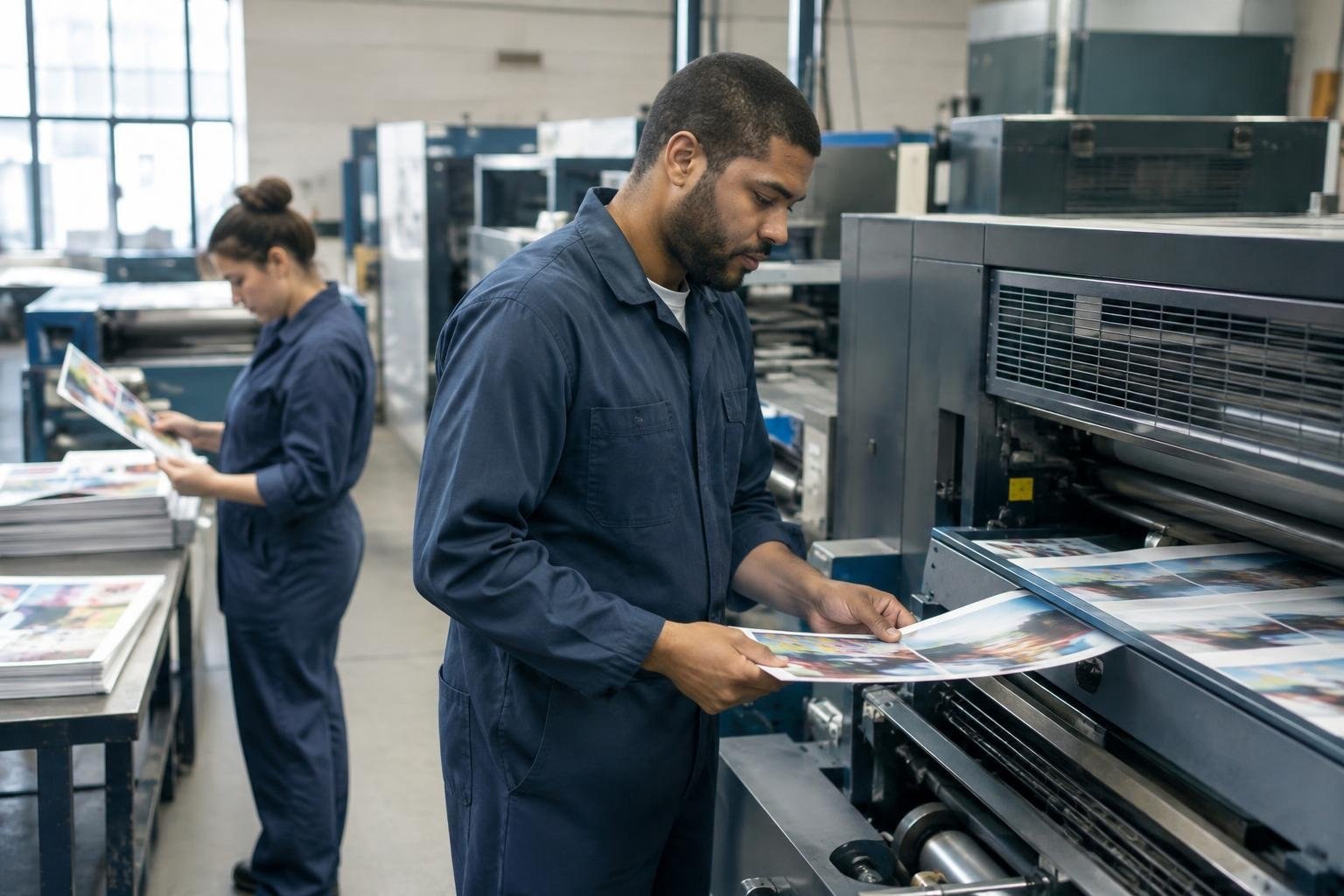
Printing Press Operator Program Guide: Training, Costs and Career Questions
Explore what a printing press operator program may cover, what to ask colleges, and how to compare costs, formats, credentials, and possible career pathways.
By Tome Fierre · Staff Writer Assessment.com · Published October 6, 2026 · Last updated November 5, 2026
A printing press operator program is an education pathway to investigate if you are interested in printing production. Its exact focus depends on the college: a program title alone does not tell you which processes, equipment, or practical experiences students will encounter. Review the curriculum and ask how closely it connects to the work you hope to do. The supplied program information places Graphic Communications within the broader Communications Technologies/Technicians and Support Services grouping. That grouping includes programs at different postsecondary credential levels, so broad education-group information should not be mistaken for outcomes specific to one printing press operator program. Not sure whether this path fits your interests? The Free MAPP Career Assessment can help you explore how your motivations and preferences align with work and education options. Compare its results with course requirements, local job postings, and the details colleges provide.
Degree & Program Decision Insights
Explore your personal fit, education requirements, career potential and next steps.
01Motivational Fit
Discover whether this program fits you
Explore your preferences against the focus of Printing Press Operator. These prompts are not personal MAPP results.
Subject curiosity. Would you choose to explore “apply technical knowledge and skills to set up, operate, and maintain printing presses” in depth? Ask for a sample learning activity to test that interest.
Choosing a learning environment. Compare actual Printing Press Operator offerings. Would their reading, projects or practical work suit how you prefer to learn? Confirm the format rather than assuming one from the field name.
Work reality. Related work can involve this task: “Maintain time or production records.” Would you want that activity to be a regular responsibility?
Interest in studying a field can differ from enjoying its related work.
Which part would you want to do repeatedly, and what would you try before deciding?
Discover Your Personal Program Fit
Before investing your time and money in your education, discover how this program aligns with your natural motivations, work preferences and career goals.
Typical occupational entry: high school diploma or equivalent (BLS). BLS lists moderate-term on-the-job training as typical occupational training.
Prepress Technicians and WorkersSOC 51-5111 · O*NET 51-5111.00$48,690/year median (May 2025); -15.3% projected change (2025–2035); 2,100 projected openings/year.
Typical occupational entry: postsecondary nondegree award (BLS).
U.S. occupational wages are not guaranteed graduate earnings; OEWS excludes self-employed workers.
Projected openings include replacements as well as growth.
U.S. national estimates. A crosswalk does not establish entry-level eligibility; advanced, management and teaching roles can require further qualifications.
Compare the actual offering and credential before committing your time or money.
Request the itemized fees, materials and equipment associated with “apply technical knowledge and skills to set up, operate, and maintain printing presses”; confirm what tuition includes.
Compare the full attendance budget, course availability and time away from paid work, rather than tuition alone.
No institution- and credential-matched cost, debt or graduate-earnings amount is reported here; occupational pay is not program ROI.
Financial aid depends on the school, program and student’s eligibility.
Printing ManagementCIP 10.0302. Compare its emphasis on the principles of graphic communications design and production and quality control with this program’s focus.
Computer Typography and Composition Equipment OperatorCIP 10.0308. Compare the official Computer Typography and Composition Equipment Operator field description and actual course requirements; confirm which parts support your intended specialization.
Explore your motivations. Use MAPP as a starting point for reflecting on your interest in “apply technical knowledge and skills to set up, operate, and maintain printing presses”, then test that interest against a sample learning task.
Examine the work. Compare Printing Press Operators and Prepress Technicians and Workers on daily work and entry qualifications, as well as pay.
Compare actual providers. Ask for the exact credential, course sequence and assessment methods. Compare how each provider teaches “Printing Press Operator”, its entry criteria and its itemized costs.
Check the evidence before applying. Confirm prerequisites and any recognition or professional requirements for your intended route; ask for applicable rules and published outcome definitions in writing.
Verify the institution’s current offering, admissions requirements and outcomes; a search result does not establish your eligibility.
Printing press operator is the specific topic to research; Communications Technologies/Technicians and Support Services is a wider instructional grouping. The National Center for Education Statistics (NCES) classification places communications technology programs within a broader series. The supplied program context also identifies Graphic Communications as part of that larger group. Neither label, by itself, describes the precise training a particular college offers.
Use the program name as a starting point, not proof of a particular curriculum or career outcome. Ask the school for its current course descriptions, credential title, and evidence of the kinds of work its students complete.
What Will You Study? Check the Actual Curriculum
Course titles and program descriptions are the best place to find what students actually study. Request the complete current curriculum and ask the department to explain which courses relate to printing production, what students do in those courses, and how learning is assessed.
Look for concrete answers about practical instruction, equipment access, projects, and any required work experience. Do not assume that a program includes a particular machine, software, production process, internship, or capstone unless the school confirms it in writing. Ask how often the curriculum is reviewed and whether students can see examples of completed work.
Who Might Consider This Program? Admissions to Verify
This pathway is worth exploring if you want to investigate printing production and are willing to compare specific training requirements with your goals. You do not need to fit a single personality profile to consider it. Instead, think about which work settings and day-to-day tasks interest you, then test those assumptions by speaking with program staff and people in relevant jobs.
Before applying, check the school’s published entry requirements. Ask about prior coursework, placement assessments, application materials, physical or technical prerequisites, and support for students who need to build foundational skills. Requirements vary by institution; do not assume that one college’s admissions rules apply elsewhere.
Credential Levels, Study Formats, and Time to Completion
The supplied program context lists certificate, associate’s, bachelor’s, post-bachelor’s certificate, graduate certificate, and master’s credentials within the broader area. This should not be read as a claim that every level is offered for printing press operation, or that each level is necessary for a particular job. Verify the award name and level with each college.
Ask for the number of credits, course sequence, typical completion schedule, and options for part-time study. If you have prior college credits, request a written transfer evaluation before counting on them. For online or hybrid study, confirm whether any required instruction or assessments must take place in person.
Tuition, Total Costs, and Financial Aid
There is no single price that applies to all printing press operator programs. Compare the full cost at each school, not a headline tuition figure. Ask for an itemized estimate that identifies tuition, mandatory fees, books or supplies, equipment-related charges, transportation, and housing if relevant to your situation.
Ask the financial aid office which grants, scholarships, work-study options, payment plans, or employer benefits may be available to you. Eligibility and amounts vary. Compare the expected out-of-pocket cost and borrowing needs for the full program, and ask whether changing enrollment pace or transferring credit would affect your financial plan.
Ways to Make the Education More Affordable
Affordability depends on more than a tuition rate. Compare total program cost with your available aid, likely time to completion, transportation or housing needs, and the income or other commitments you may have while studying. Ask the college whether fees, supplies, and any required practical components are included in its estimate.
Before borrowing, read the terms of any loan and estimate the payments you would need to manage after school. Ask about lower-cost public options, scholarships, payment plans, and transfer arrangements. Get answers in writing when a financial decision depends on a particular credit transfer, fee waiver, or aid offer.
How to Compare Programs and Avoid Common Mistakes
Program names do not guarantee identical preparation. The specific courses, credential, learning format, and student work may differ even when two programs sound similar. Compare them side by side and ask each college what a graduate can demonstrate at completion.
What skills and processes are taught, and in which courses?
What practical work or access to equipment is included?
What credential is awarded, and how many credits are required?
What are the full costs and available aid?
What outcomes can the college document for this exact program?
Request concrete examples rather than relying on broad promotional descriptions.
Related Programs and Alternatives
The supplied information connects Graphic Communications to the wider Communications Technologies/Technicians and Support Services category. That makes related program names useful search terms, but it does not establish that all programs have the same curriculum or lead to the same roles.
When considering another option, compare its course list and award with the printing press operator program you are evaluating. Ask whether it emphasizes a different part of communications technology, what practical work it includes, and which occupations graduates pursue. Choose based on the work and preparation you want, not on a title that sounds broader or more advanced.
Careers, Job Postings, and Employment Evidence
Printing press operator work is the direct occupation to investigate when reviewing this program. To assess whether the training is relevant, collect current job postings in the places where you might want to work. Note the education, skills, experience, and credentials employers actually request, then compare those requirements with the college’s curriculum.
Do not treat a general education-group survey as a job forecast for this specific occupation. The Job Bank pages provided describe responses from graduates across the broader Graphic Communications group and combine multiple postsecondary levels. They do not isolate U.S. printing press operator outcomes.
Accreditation, Licensure, and Certifications
Ask the program and relevant employers whether a license, certification, or other credential is expected for the work you hope to do. Do not assume that completing a college program automatically grants a professional license or certification. Requirements, when applicable, depend on the occupation and location.
Similarly, check accreditation at the level that matters: ask which organization accredits the institution or program, whether that recognition applies to your intended course of study, and whether a relevant employer or licensing body recognizes it. Verify claims directly with the accreditor or applicable authority.
Practical Experience and Preparing for Employers
Ask how students gain experience applying what they learn. Depending on the program, a school may or may not offer projects, work placements, or employer connections. Confirm which opportunities are part of the curriculum, which are optional, and whether students must arrange them independently.
To prepare for an employer conversation, keep a record of completed coursework and projects, and be ready to explain your role and the skills demonstrated. Ask faculty or career services how students can present relevant work to employers. Do not pay for an outside credential simply because it is advertised as essential; first verify that employers you are targeting request it.
Questions to Ask Before Enrolling
Use this checklist when comparing colleges:
What is the exact credential and current course sequence?
What are the admission requirements and expected completion schedule?
Which courses involve practical learning, and what access is provided?
What is the full cost after fees, supplies, and available aid?
What portion of the program is online, hybrid, or in person?
Which accreditation applies, and can the relevant authority verify it?
Can the school document outcomes for this exact program?
How are transfer credits reviewed, and what career support is available?
Record answers in a comparison sheet so you can evaluate programs using the same questions.
A Possible Route From Education to Work
Map a possible route without assuming a guaranteed outcome: printing press operator program → apply for an entry-level printing production role → build relevant work experience → explore a more specialized production role if local employers require it. The actual roles available, qualifications, advancement opportunities, and pay depend on the employer, location, and your experience.
Before committing, check whether local job postings support the route you have in mind. If they repeatedly ask for skills the program does not cover, ask the college how students can develop them or compare another pathway.
Frequently asked questions
What is a printing press operator program?
A printing press operator program is a career-focused program to investigate for instruction related to printing production. The exact curriculum, equipment, credential, and amount of hands-on practice depend on the school. Ask for a current course list and details about practice with production equipment before you apply.
Is a printing press operator program hard?
Difficulty depends on your preparation and the program. Before enrolling, review the course sequence and ask which classes involve production equipment, troubleshooting, or technical procedures. If those subjects are unfamiliar, ask whether the college offers introductory coursework, tutoring, or other support.
What jobs can I get after studying printing press operation?
You might pursue printing press operator work, but a program title does not guarantee a job or qualify you for every role. Check local job postings for the skills employers request, then compare them with course content and the program’s documented graduate outcomes.
How much does a printing press operator program cost?
There is no single cost for this program. Tuition, fees, supplies, equipment access, and living expenses depend on the college and your circumstances. Request a written estimate of total attendance costs, then ask the financial aid office about grants, scholarships, payment plans, and transfer credit.
Can I study printing press operation online?
Some coursework may be available online, but do not assume a fully online option provides practice with production equipment. Ask whether the program requires campus sessions, labs, internships, or other in-person learning, and how those requirements affect your schedule and costs.
What degree or certificate do I need to become a printing press operator?
The program description provided identifies several possible credential levels, from certificates to graduate credentials. That does not mean every college offers every level for this subject. Confirm the actual award, entry requirements, credit total, and expected completion time with each school.
People Also Ask
What credential can a printing press operator program award?
The credential depends on the college and the specific program. The supplied program context lists certificates, associate and bachelor’s degrees, and several post-bachelor’s or graduate credentials across the broader education category. Confirm which credential a particular school awards and whether it matches your goal.
How do I know whether a program teaches practical printing skills?
Do not rely on a general category label to judge the curriculum. Ask the school which production skills it teaches, what equipment or learning environments students use, and how student work is assessed. Compare those details with requirements in local job postings.
What costs should families compare when choosing a program?
Costs vary by institution and student situation. Compare total charges rather than tuition alone, including required fees, supplies, equipment, transportation, and housing where applicable. Request an itemized estimate and review available aid directly with the college.
What is the salary and job outlook for printing press operators?
The supplied sources describe education-group information for Graphic Communications, not a U.S. salary or employment forecast for printing press operators. For current prospects, compare local job listings and consult current U.S. occupational information before making a financial decision.
Find out which Career or College Major is right for you!
How does printing press operator training compare with graphic communications?
A related program may have a different title or emphasis, so compare course descriptions rather than relying on the name alone. Look at the specific skills taught, credential awarded, hands-on requirements, and jobs graduates pursue.
Are printing press operator classes available online?
Ask whether instruction requires campus access, production equipment, labs, or other in-person activities. A school can explain which courses, if any, are online and whether remote students have the same access to required practical learning.
A printing press operator pathway may suit students who want to explore production-focused work in printing and graphic communications. The right decision depends on the actual equipment and skills a program teaches, its total cost, and whether its graduates pursue work you want. Compare curricula and ask schools for clear, current answers before enrolling; treat broad education-group outcomes as context, not a promise about this specific program.
Want to see your options? Try our comprehensive Degree, Program & College Search tool
We use cookies to offer you a better browsing experience, analyze site traffic and personalize content.
Read about how we use cookies and how you can control them in our
Privacy Policy.
If you continue to use this site, you consent to our use of cookies.
×
Exciting News!
Be one of the first to Beta Test the new AI-Powered Assessment.com Platform.