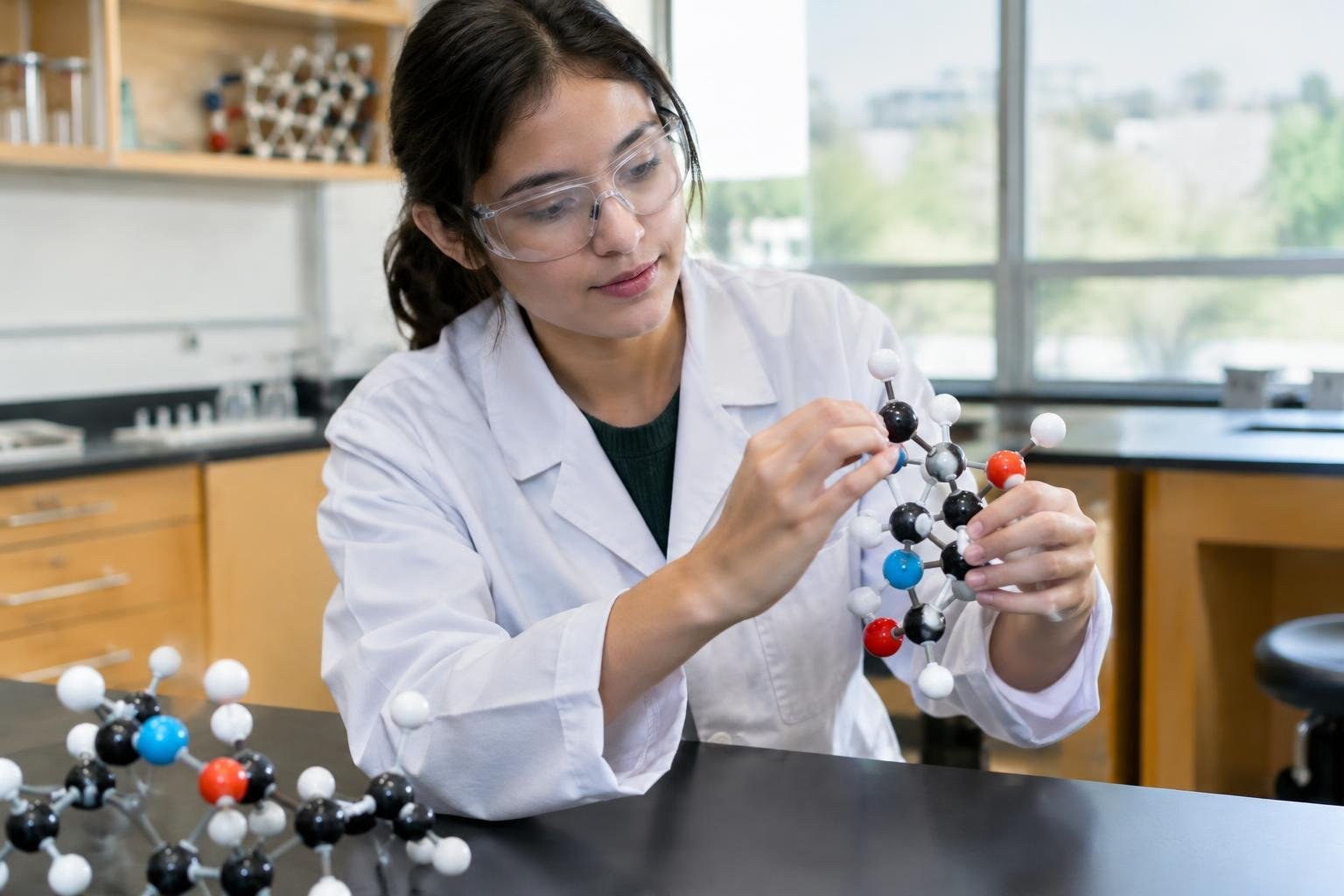
Organic Chemistry Degree Guide: Courses, Careers, Costs, and Fit
Explore what organic chemistry programs teach, how credentials and online study vary, possible career directions, and questions to ask before choosing a program.
By Kieth Nelson · Staff Writer Assessment.com · Published October 9, 2026 · Last updated November 5, 2026
An organic chemistry program focuses on carbon-containing molecules: their structures, properties, reactions, and preparation. Depending on the school and credential, students may encounter organic chemistry as a course sequence, a concentration within chemistry, or a certificate or graduate specialization. The subject connects molecular-level science with research, industry, materials, and health applications. It may appeal to students who enjoy detailed problem-solving and want to understand how chemical structure shapes behavior. For prospective students and parents, the key decision is not just whether the topic sounds interesting, but whether the program’s depth, cost, and next-step requirements fit the student’s goals.
Degree & Program Decision Insights
Explore your personal fit, education requirements, career potential and next steps.
01Motivational Fit
Discover whether this program fits you
Explore your preferences against the focus of Organic Chemistry. These prompts are not personal MAPP results.
Subject curiosity. Would you choose to explore “molecular conversion and synthesis” in depth? Ask for a sample learning activity to test that interest.
Breadth of interest. Consider the place of “molecular synthesis and design” in this field. Is this another part you would choose to explore, or mainly a requirement you would tolerate?
Work reality. Related work can involve this task: “Prepare and submit required reports related to instruction.” Would you want that activity to be a regular responsibility?
Interest in studying a field can differ from enjoying its related work.
Which part would you want to do repeatedly, and what would you try before deciding?
Discover Your Personal Program Fit
Before investing your time and money in your education, discover how this program aligns with your natural motivations, work preferences and career goals.
Typical occupational entry: doctoral or professional degree (BLS). Postsecondary teaching is a separate appointment and may require advanced study; this programme alone is not a promise of a teaching post.
U.S. occupational wages are not guaranteed graduate earnings; OEWS excludes self-employed workers.
Projected openings include replacements as well as growth.
U.S. national estimates. A crosswalk does not establish entry-level eligibility; advanced, management and teaching roles can require further qualifications.
Compare the focus and route of these distinct instructional fields; their credentials and admission requirements are not interchangeable.
Chemistry, GeneralCIP 40.0501. Compare the official Chemistry, General field description and actual course requirements; confirm which parts support your intended specialization.
Chemistry, OtherCIP 40.0599. Any instructional program in chemistry not listed above.
Inorganic ChemistryCIP 40.0503. A program that focuses on the scientific study of the elements and their compounds, other than the hydrocarbons and their derivatives.
Explore your motivations. Use MAPP as a starting point for reflecting on your interest in “molecular conversion and synthesis”, then test that interest against a sample learning task.
Examine the work. Compare Chemistry Teachers, Postsecondary and Chemists on daily work and entry qualifications, as well as pay. Explore Chemistry Teachers, Postsecondary.
Compare actual providers. Ask for the exact credential, course sequence and assessment methods. Compare how each provider teaches “molecular synthesis and design”, its entry criteria and its itemized costs.
Check the evidence before applying. Confirm prerequisites and any recognition or professional requirements for your intended route; ask for applicable rules and published outcome definitions in writing.
Verify the institution’s current offering, admissions requirements and outcomes; a search result does not establish your eligibility.
Organic chemistry is the study of the structure, properties, reactions, and preparation of carbon-containing compounds. It examines how molecular structure relates to chemical behavior and how chemists can analyze or synthesize compounds. The field’s applications span research and other areas of science and health, though a program’s emphasis depends on the institution.
Students may encounter organic chemistry as a required part of a broader chemistry degree, a concentration, a certificate, or graduate-level study. The title alone does not tell you how much laboratory work, research, or breadth a program includes. Read the current catalog and compare actual required courses.
The University of Washington describes chemistry study as spanning analytical, inorganic, organic, and physical chemistry, with electives allowing students to pursue interests. The University of California San Diego describes organic chemistry research as including the synthesis and study of small and large carbon-based molecules. These examples illustrate why programs with similar names can differ in scope.
See the University of Washington’s chemistry curriculum description and UC San Diego’s organic chemistry research track.
What Do You Study in Organic Chemistry?
Expect coursework that builds from chemical fundamentals toward the structure and reactivity of molecules. Organic chemistry learning involves interpreting structures, considering how compounds may react, and understanding methods used to prepare and analyze them. Depending on the program, related chemistry courses may add analytical, inorganic, or physical chemistry perspectives.
Laboratory experiences, when included, give students practice working with chemical procedures and interpreting observations. Advanced coursework or research may focus on designing or studying carbon-based molecules. At graduate level, work can connect organic chemistry with other areas such as materials science, molecular biology, optics, or theoretical chemistry, as described by the University of Oregon’s chemistry graduate program.
Ask for a sample plan of study and identify which experiences are required versus optional. Look for the balance among lectures, labs, research, electives, and any capstone or thesis requirement. Do not assume a certificate, undergraduate major, and doctoral track teach the same depth of material.
Review the University of Oregon’s overview of chemistry graduate specializations.
Skills You May Develop
Organic chemistry develops habits of careful analysis: reading molecular representations, relating structure to properties, evaluating possible reactions, and explaining conclusions with evidence. Depending on the coursework, students may also gain experience with synthesis, analytical methods, laboratory records, and scientific communication.
These capabilities can be relevant in laboratory, research, production, and scientific support settings. Their usefulness to employers depends on the student’s complete credential, practical experience, and the job’s requirements. A course or certificate alone should not be treated as proof of qualification for every chemistry role.
Scientific reasoning: form a hypothesis, interpret evidence, and explain a result.
Precision: follow detailed procedures and keep organized records.
Communication: describe methods and findings clearly to peers or non-specialists.
Adaptability: apply core molecular concepts to unfamiliar compounds or questions.
Who Might Find This Program a Good Fit?
This field may be worth exploring if you are curious about molecules, enjoy careful investigation, and are willing to work through complex scientific ideas over time. Students often need patience with abstract representations and a willingness to revise an explanation when evidence changes. There is no single personality type required.
Before committing, test your interest through introductory chemistry, a conversation with a chemistry instructor, or a review of actual course descriptions. Consider whether you enjoy both conceptual problem-solving and structured laboratory work. If the intended goal is a job rather than a subject area, search current job descriptions and note their minimum education and experience requirements.
Does Organic Chemistry Match You?
Salary, reputation, and broad claims about job growth cannot answer whether you will like the everyday work. Weigh them alongside your motivations, interests, preferred work style, and willingness to pursue additional study. Assessment.com’s MAPP assessment, Degree Matching, and Career Matching can help you explore connections among interests, study paths, and occupations. Treat matching tools as prompts for exploration, not guarantees.
Admissions, Prerequisites, and Academic Readiness
Admission rules depend on the credential and institution. An introductory or undergraduate program may have different entry expectations from a graduate certificate or doctoral program. Check the official admissions page for prerequisites, application materials, transfer-credit rules, and any minimum academic standards.
Graduate study can require substantial prior science preparation. For example, the University of Massachusetts Lowell’s chemistry doctoral catalog says applicants are expected to have a bachelor’s degree in a relevant field and undergraduate courses in analytical, organic, and physical chemistry, physics, and calculus. This is an example of one doctoral program’s expectations, not a universal rule for all chemistry programs.
For a certificate or graduate application, ask whether prior coursework is required and whether your transcript meets it. If you are changing fields or returning to school, request a transcript review before assuming you can start immediately.
Credential Levels, Time to Completion, and Online Options
Organic chemistry study is offered at different credential levels, but availability is school-specific. The field’s credential range can include certificates, associate’s and bachelor’s study, graduate certificates, master’s degrees, and doctorates; not every institution offers each option under the same title. A certificate may be a short focused pathway, while a full degree includes a wider course plan. Confirm the award, credit total, course sequence, and expected time to completion directly with the school.
Online access also varies. Oregon State University lists online general, organic, and engineering chemistry courses and labs. That is evidence that online course options exist, not that every full program is online or that every lab can be completed remotely. Ask whether any in-person lab sessions are required and whether credits transfer to your intended next program.
Part-time, transfer, or accelerated routes may be available at some schools. Compare the specific schedule and prerequisites rather than relying on a typical timeline for a different credential.
Explore Oregon State’s online chemistry and lab course information.
Tuition, Total Cost, and Financial Aid
Program cost depends on the institution, credential, enrollment pattern, and what is included in published tuition. When comparing offers, calculate the full amount you expect to pay, not just the per-course figure. Ask about mandatory fees, laboratory charges, books and materials, technology costs, and whether commuting or housing will affect your budget.
Do not assume that an online course or certificate is automatically less expensive. Request an individualized cost estimate from each institution and confirm whether financial aid applies to the specific credential. Ask the financial-aid office about grants, scholarships, eligible federal or state aid, payment plans, employer education benefits, and transfer-credit evaluation. Compare the net cost after confirmed aid, not a projected award that is not yet approved.
For parents helping a student, discuss borrowing and repayment before enrollment. For adult learners, include lost work time and scheduling needs in the decision. No single price is appropriate for every school or student.
Careers, Jobs, and Employment Considerations
Organic chemistry study can connect to chemistry-related laboratory and research work, and the broader field has applications in research, industry, and health. The University of Oregon notes that chemistry research areas can support work spanning materials science, molecular biology, optics, and theoretical chemistry. A degree does not guarantee access to any one occupation; job requirements depend on the employer and position.
Possible direction
How organic chemistry may connect
What to verify
Chemistry laboratory or research work
Molecular analysis, synthesis, or study may be relevant, depending on the position.
Required degree level, lab experience, and methods.
Chemical technician roles
Chemistry knowledge may support work with samples, procedures, or testing.
Whether the employer accepts a certificate, associate’s degree, or other preparation.
Chemistry or postsecondary teaching
Subject knowledge may provide a foundation for teaching pathways.
Teaching credentials and the education level expected by the employer.
Clinical research coordination
Scientific background may be relevant in some research settings, but coordination work has distinct duties.
Experience, research procedures, and role-specific qualifications.
Natural sciences management
Advanced scientific experience can be relevant to overseeing scientific work.
Experience and education required for the specific management position.
These are exploratory directions, not promises of employment or substitutes for current job-posting research. Also check whether a role is entry-level or commonly expects further education or experience.
Automation and computational tools may change how some scientific tasks are performed, but they do not remove the need to understand procedures, evaluate results, and communicate responsibly. Ask programs how students gain practical experience with current analytical and research methods.
Explore Assessment.com resources for chemistry careers, postsecondary chemistry teaching, and clinical research coordination.
Accreditation, Licensure, and Certification
Before enrolling, ask whether the department or program holds accreditation relevant to the credential and whether that status matters for your intended next step. Do not assume a course, certificate, and degree have identical recognition. Verify accreditation and program standing with the institution and the appropriate accrediting organization.
Organic chemistry study itself does not establish that a graduate is licensed for a regulated profession. If you plan to enter a job with licensing or certification requirements, confirm those rules with the relevant state authority or professional organization. Ask the program whether its curriculum is designed to meet those requirements and request the exact documentation.
For students targeting research or graduate school, ask whether the program’s credits and prerequisites are accepted by the next institution. A credential title by itself cannot confirm transferability or eligibility.
Related Degrees and Alternatives
Related options include:
General chemistry: consider this if you want broader coverage across major chemistry areas rather than a strong organic emphasis.
Biochemistry: consider this if you want to focus more on chemical processes in living systems. Compare biology and chemistry requirements in each program.
Analytical chemistry: consider this if measurement and identifying what substances are present are closer to your interests.
Materials science: consider this if you are drawn to how materials are designed, characterized, and used.
Chemical engineering: consider this if you want an engineering-oriented route toward chemical processes and systems rather than a chemistry-centered course of study.
Pharmaceutical or medicinal chemistry: consider this if your interests are directed toward chemical questions related to medicines; verify program availability and prerequisites.
Environmental science: consider this if you want a broader environmental focus rather than a molecular chemistry specialty.
These are broad comparison prompts; program names and curricula vary. Chemistry degrees commonly include analytical, inorganic, organic, and physical chemistry, while an organic track may focus more deeply on carbon-based molecules and their synthesis and study. The University of Florida catalog, for example, lists chemistry graduate degrees with organic and other specializations. Compare specific course lists and admissions requirements before choosing.
Review the University of Florida’s chemistry graduate-degree options.
How to Choose an Organic Chemistry Program
When comparing programs, ask for clear answers to these questions:
What credential will appear on the transcript and diploma?
Which organic chemistry courses and laboratories are required?
Are research projects, internships, or independent study available?
What are the full costs after fees and confirmed financial aid?
Can credits transfer to a degree or graduate program you may pursue?
What are the program’s completion and continuation expectations?
What career services, faculty advising, and employer connections are available?
Does the program prepare students for any credential or licensure requirement relevant to my goal?
Compare more than course titles. Ask to see a sample schedule, lab format, and policies for transfer credit. For online study, verify whether laboratories and exams are remote, scheduled live, or in person. For advanced programs, confirm that your prior courses meet prerequisites before paying an application fee.
Assessment.com’s college-major guidance and college guidance resources can support broader exploration. Use them alongside official catalogs and direct conversations with program advisers.
From Coursework to Career: Possible Pathways
A realistic pathway depends on the student’s chosen credential and destination. For example, a student could complete chemistry coursework that includes organic chemistry, seek an entry-level laboratory or technical role if qualified, build experience with relevant methods, and later pursue advanced study or a specialized position. Another student may continue from an undergraduate chemistry degree into graduate study and research.
These are examples, not automatic promotions. A graduate credential may open additional academic options, but admission and employment depend on preparation, available opportunities, and the requirements of the specific role. Check current job postings and graduate admissions pages before selecting courses.
To explore related work, compare published Assessment.com career guides for chemists, natural sciences managers, and water resource specialists.
Is an Organic Chemistry Program Worth It? Benefits and Tradeoffs
Organic chemistry may be worth pursuing if the subject itself interests you and the program offers a reasonable route to your next step. Its value depends on total cost, the credential earned, practical experience, geography, and what employers or graduate programs require. A narrow specialization can be valuable for a clear goal, but a broader chemistry curriculum may preserve more options for students still deciding.
Common mistakes include choosing by program title alone, assuming online study means no in-person lab requirements, treating a certificate as equivalent to a degree, and relying on generalized salary claims instead of investigating specific occupations. Another risk is overlooking prerequisites for the next program. Request written answers from the school before enrolling.
As a family, discuss the student’s academic interests, budget, willingness to continue studying, and preferred work setting. Do not treat a career assessment or a labor-market forecast as a decision made on the student’s behalf. Combine personal reflection with program facts and conversations with advisers.
Practical Next Steps Before You Enroll
Before applying, make a short comparison sheet for two or three programs. Record the credential, required courses, laboratory and research options, prerequisites, delivery format, estimated total cost, confirmed aid, transfer rules, and possible next steps. Then ask each institution to clarify anything that is not stated in its catalog.
If the main uncertainty is personal fit, reflect on whether you enjoy molecular-level questions, detailed analysis, and careful scientific work. Compare organic chemistry with related subjects and explore occupations before committing to a long education path. Assessment.com’s MAPP assessment and matching resources can help you examine fit, while the institution’s advisers can confirm academic details.
Frequently asked questions
What is organic chemistry in a college program?
Organic chemistry is the study of the structure, properties, preparation, and reactions of carbon-containing compounds. A college program may be a focused course sequence, concentration, certificate, or part of a broader chemistry degree. Students study how molecular structure influences chemical behavior and how chemists analyze and synthesize compounds. Program requirements and depth differ by institution and credential.
Is organic chemistry hard?
Organic chemistry can be challenging because it asks students to connect molecular structures with reaction patterns, use evidence to explain outcomes, and apply concepts across new examples. Laboratory or research work may also require careful procedures and clear records. Prior preparation in chemistry, mathematics, and physics can help, but course sequences and expectations vary by program.
What jobs can I get with an organic chemistry degree?
Possible directions include chemistry laboratory or research work, chemical technology, and further study toward specialized research or teaching. The right role depends on the credential, coursework, experience, and employer requirements. A focused organic chemistry course or certificate is not the same as a full chemistry degree, so check job postings and program outcomes before treating a particular position as a direct route.
How much can you make with an organic chemistry degree?
There is no single salary for an organic chemistry degree. Pay depends on the job title, education level, experience, employer, location, and industry. Compare current official labor-market information for the specific occupations you are considering, not an overall degree estimate. Also check whether the occupation typically expects graduate education or specialized experience.
Can I study organic chemistry online?
Some chemistry courses and laboratories are available online. Oregon State University describes online general, organic, and engineering chemistry classes and labs. That does not mean every organic chemistry program can be completed remotely. Ask each school how laboratory instruction works, whether any in-person sessions are required, and whether the courses meet your next program’s prerequisites.
Does organic chemistry require math?
Organic chemistry is not mathematics-free. The amount and level depend on the credential and curriculum, but chemistry programs may require quantitative coursework. For example, UMass Lowell’s chemistry doctoral admission information lists calculus and physics among expected undergraduate preparation, along with several chemistry subjects. Review the prerequisites and course sequence of each program you are considering.
Do I need graduate school after studying organic chemistry?
Not every job connected to chemistry requires graduate school, but advanced research, specialized scientific work, and many academic roles may involve graduate study. Chemistry departments offer different graduate paths, including master’s and doctoral degrees, while admissions can require substantial undergraduate preparation. Identify a target occupation first, then confirm its education expectations with employers and official program information.
How does organic chemistry compare with a general chemistry degree?
A chemistry degree is broader than a program or concentration focused on organic chemistry. Chemistry curricula commonly include analytical, inorganic, organic, and physical chemistry, while an organic emphasis devotes more attention to carbon-based molecules and their synthesis and reactions. Compare course requirements, laboratory and research opportunities, and the career or graduate-school prerequisites you want to meet.
People Also Ask
What does an organic chemistry program teach?
Organic chemistry studies the structure, properties, reactions, and preparation of carbon-containing compounds. Programs may cover synthesis, molecular analysis, and applications in research, industry, or health.
How long does it take to study organic chemistry?
The credential and completion time depend on the institution. Organic chemistry may appear as courses within a chemistry degree, a focused certificate, or graduate study. Check the official catalog for credits, prerequisites, and the expected schedule.
Are organic chemistry labs available online?
Yes, some schools offer online chemistry courses and labs, including organic chemistry. Availability and lab format differ. Confirm that the online course is accepted for your intended degree or prerequisite before enrolling.
What is an organic chemistry graduate certificate?
A graduate certificate can provide focused advanced coursework, but it is not interchangeable with a graduate degree. One university catalog describes a 12-credit-hour organic chemistry graduate certificate; other institutions may set different requirements and purposes.
Should I choose organic chemistry, chemistry, or biochemistry?
Compare organic chemistry with broader chemistry, biochemistry, chemical engineering, and materials-related study by looking at course requirements and the work each prepares you to pursue. Organic chemistry centers on carbon-containing molecules; other fields may emphasize different systems or applications.
What prerequisites are needed for a chemistry PhD?
A doctorate in chemistry may require a relevant bachelor’s degree and substantial prior coursework. UMass Lowell lists chemistry, physics, calculus, and other science preparation among expectations for its chemistry doctoral applicants. Specific admissions standards differ by school.
An organic chemistry program can suit students who want to understand how carbon-containing molecules are built, behave, and change, and who are prepared for detailed science coursework and laboratory or research learning. It may lead toward chemistry-related work in research, industry, or health, but a degree alone does not guarantee a particular job, salary, or professional qualification. Before enrolling, compare the curriculum, hands-on opportunities, total cost, and the additional education expected for your intended role. If you are unsure whether this subject fits your interests and motivations, use the MAPP assessment and Assessment.com’s education and career resources to explore options.
Find out which Career or College Major is right for you!
We use cookies to offer you a better browsing experience, analyze site traffic and personalize content.
Read about how we use cookies and how you can control them in our
Privacy Policy.
If you continue to use this site, you consent to our use of cookies.
×
Exciting News!
Be one of the first to Beta Test the new AI-Powered Assessment.com Platform.