Simulation Fellowship Program Guide: Training, Requirements, and Career Paths
A Simulation Fellowship Program gives physicians advanced preparation in healthcare simulation education, curriculum design, research, and program development. Learn about entry requirements, training, costs, career pathways, and how to compare programs.
By David Slack · Staff Writer Assessment.com · Published October 26, 2026 · Last updated November 5, 2026
A Simulation Fellowship Program is advanced, usually post-residency training for physicians who want to build expertise in healthcare simulation. Fellows learn to create and teach simulation-based activities, develop curricula, assess educational programs, conduct research, or contribute to simulation center leadership. The mix depends on the program: some focus on emergency medicine, some on surgical education, and others on multidisciplinary simulation medicine. This is not a typical undergraduate major or a route into medicine for someone who has not completed physician training. It is a specialized professional pathway for physicians who want to use simulated clinical experiences to support learning and healthcare practice. Prospective fellows and their families should compare eligibility, duration, mentorship, scholarly expectations, clinical responsibilities, and financial terms before applying.
Degree & Program Decision Insights
Explore your personal fit, education requirements, career potential and next steps.
01Motivational Fit
Discover whether this program fits you
Explore your preferences against the focus of Simulation Fellowship Program. These prompts are not personal MAPP results.
Subject curiosity. Would you choose to explore “develop, implement, manage, and assess healthcare simulation-based activities and programs” in depth? Ask for a sample learning activity to test that interest.
Choosing a learning environment. Compare actual Simulation Fellowship Program offerings. Would their reading, projects or practical work suit how you prefer to learn? Confirm the format rather than assuming one from the field name.
Work reality. Related work can involve this task: “Prepare reports on academic or institutional data.” Would you want that activity to be a regular responsibility?
Interest in studying a field can differ from enjoying its related work.
Which part would you want to do repeatedly, and what would you try before deciding?
Discover Your Personal Program Fit
Before investing your time and money in your education, discover how this program aligns with your natural motivations, work preferences and career goals.
Figures cover the named national occupation, rather than graduates of this programme. These statistics describe qualified occupational practice, not resident/fellow stipends or training-programme compensation.
Typical occupational entry: master's degree (BLS). BLS lists less than 5 years of related work experience as typical for this occupation; this programme is not a direct promise of entry.
Health Specialties Teachers, PostsecondarySOC 25-1071 · O*NET 25-1071.00$107,310/year median (May 2025); +17.9% projected change (2025–2035); 24,900 projected openings/year.
Figures cover the named national occupation, rather than graduates of this programme. These statistics describe qualified occupational practice, not resident/fellow stipends or training-programme compensation.
Typical occupational entry: doctoral or professional degree (BLS). BLS lists less than 5 years of related work experience as typical for this occupation; this programme is not a direct promise of entry. Postsecondary teaching is a separate appointment and may require advanced study; this programme alone is not a promise of a teaching post.
U.S. occupational wages are not guaranteed graduate earnings; OEWS excludes self-employed workers.
Projected openings include replacements as well as growth.
U.S. national estimates. A crosswalk does not establish entry-level eligibility; advanced, management and teaching roles can require further qualifications.
Compare the actual training or appointment terms before treating this route as an ordinary tuition-based degree.
Request the itemized fees, materials and equipment associated with “develop, implement, manage, and assess healthcare simulation-based activities and programs”; confirm what tuition includes.
Compare any written support or appointment terms with application, relocation and professional expenses; do not assume this training charges ordinary degree tuition.
No institution- and credential-matched cost, debt or graduate-earnings amount is reported here; occupational pay is not program ROI.
Do not assume degree-based financial aid or a stipend; verify the actual arrangement.
Compare the focus and route of these distinct instructional fields; their credentials and admission requirements are not interchangeable.
Medical Education Fellowship ProgramCIP 61.0207. A fellowship training program that prepares physicians to teach deliver, design, and evaluate courses and curricula for medical students, residents, and faculty.
Integrative Medicine Fellowship ProgramCIP 61.0206. Compare the official Integrative Medicine Fellowship Program field description and actual course requirements; confirm which parts support your intended specialization.
Health Policy Fellowship ProgramCIP 61.0204. Compare the official Health Policy Fellowship Program field description and actual course requirements; confirm which parts support your intended specialization.
Explore your motivations. Use MAPP as a starting point for reflecting on your interest in “develop, implement, manage, and assess healthcare simulation-based activities and programs”, then test that interest against a sample learning task.
Examine the work. Compare Education Administrators, Postsecondary and Health Specialties Teachers, Postsecondary on daily work and entry qualifications, as well as pay. Explore Education Administrators, Postsecondary.
Compare actual training appointments. Verify the specialist route, current entry prerequisites, selection process and written financial arrangements with the training provider.
Check the evidence before applying. Confirm prerequisites and any recognition or professional requirements for your intended route; ask for applicable rules and published outcome definitions in writing.
College Search is a general education resource; specialist training coverage and eligibility require separate verification.
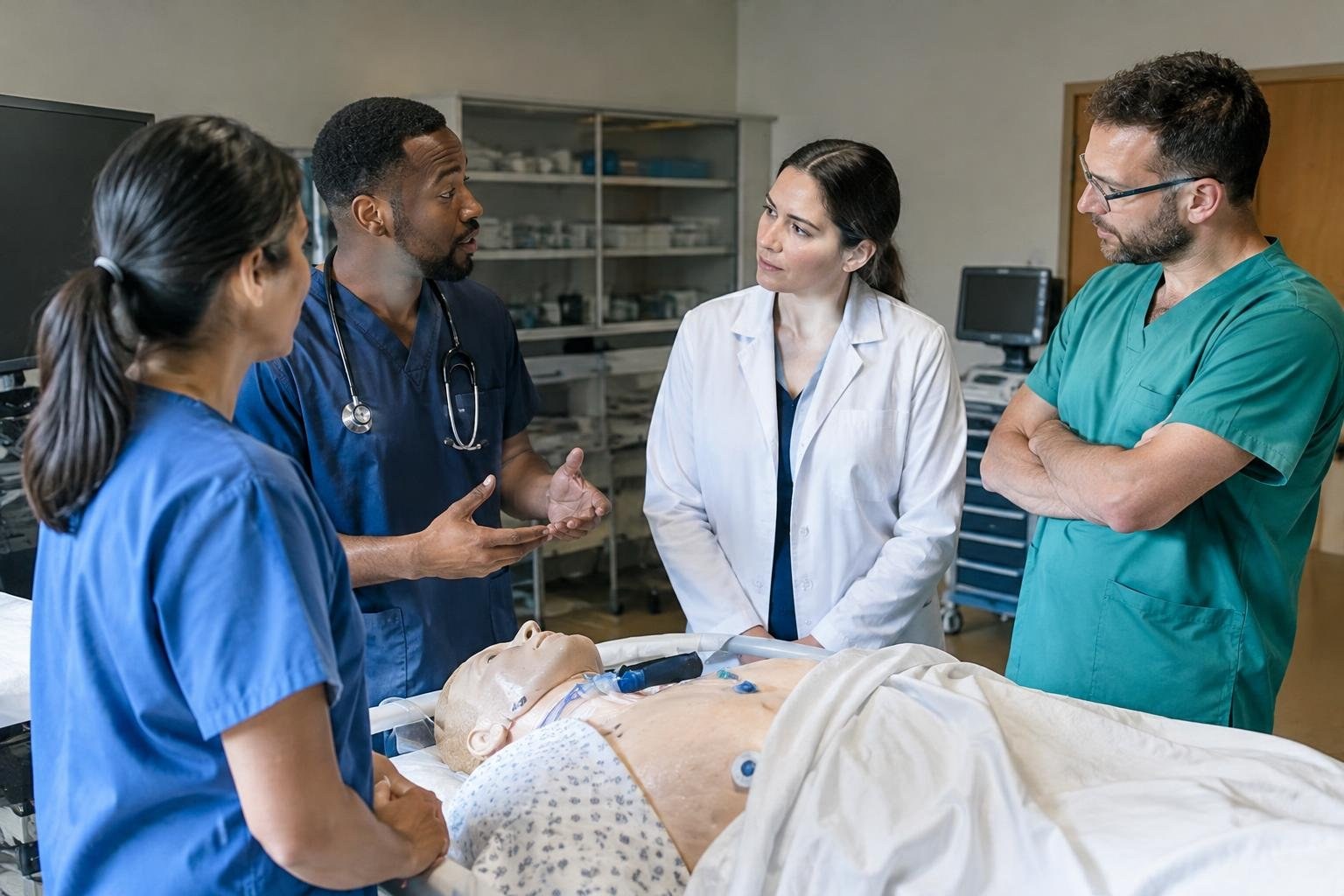
A multidisciplinary team debriefing after a simulated clinical learning activity
What Is a Simulation Fellowship Program?
A Simulation Fellowship Program is focused professional training in the design, teaching, evaluation, or administration of healthcare simulation. Simulation creates structured opportunities for learners to practice clinical or team-based skills in a learning environment before applying them in patient care. A fellowship may prepare physicians to build scenarios, teach learners, develop educational programs, study outcomes, or help manage simulation resources.
It is a fellowship rather than a standard undergraduate or graduate degree. The supplied CIP classification is not valid for IPEDS reporting, so it should not be treated as a conventional degree program classification. Institutions may use different names, including simulation medicine, medical simulation, or emergency medicine simulation fellowship. Read the actual curriculum: a shared label does not guarantee the same specialty focus or training experience.
For example, the University of California, Irvine describes a one-year, mentored emergency medicine simulation fellowship, while University of California San Diego describes a one-year curriculum in simulation administration, design, research, and education. Review UCI's fellowship overview and read UCSD's program description.
What Fellows Learn and Do
Programs use simulation to give learners structured practice and feedback. Fellows may help create a clinical scenario, prepare the learning environment, facilitate the activity, and lead a debrief that helps participants examine decisions and teamwork. The Washington University Institute for Simulation and Education describes simulation as a way for learners to practice skills before using them with patients.
Fellowship training can also include curriculum design, educational program implementation, study design, research, and simulation administration. These activities connect practical teaching with questions about how learning is planned and evaluated. The exact mix is program-dependent: UCI highlights teaching, curriculum, implementation, study design, and research, while UCSD identifies administration, design, research, and education.
When reviewing a curriculum, look beyond course or topic names. Ask what fellows will do: lead sessions, design curricula, contribute to research, manage projects, or develop assessment tools? Ask how much mentorship is provided and what completed work a fellow is expected to present, publish, or leave for the program. Read how the University of Washington describes its simulation fellowship.
Skills You Can Develop
Simulation fellowships often bring together clinical knowledge, teaching, project planning, and inquiry. The specific skills depend on specialty and program design, but program descriptions support several common learning areas:
Teaching and facilitation: helping learners engage with simulation-based activities and educational debriefing.
Curriculum development: shaping learning objectives and activities for a defined educational purpose.
Program implementation: translating an educational plan into a workable simulation activity or program.
Research and study design: framing questions and developing ways to examine simulation education.
Administration and systems thinking: understanding how simulation activities are designed and managed within a broader healthcare education setting.
These skills may support work in teaching, research, simulation program development, or education leadership. They do not guarantee a particular job or title. Ask each program which skills are directly taught, which are learned through projects, and how fellows receive feedback on their progress.
Who Should Consider This Fellowship?
This pathway may suit a physician who enjoys helping others learn, improving educational activities, studying how people practice clinical skills, or building a program that connects simulation with healthcare education. It can appeal to people who like combining practical teaching with planning, collaboration, and research. A fellow may need to work with learners and colleagues from more than one specialty, depending on the program.
It is not necessary to have one particular personality or work style. However, applicants should consider whether they want a substantial role in education and program development in addition to, or alongside, clinical work. Someone seeking only further clinical subspecialty training may prefer a different fellowship. Someone drawn mainly to patient care without teaching, simulation, or research responsibilities should examine the day-to-day work carefully before committing.
Program requirements vary. The UCI emergency medicine fellowship identifies graduation from an accredited emergency medicine residency as an eligibility condition. Do not assume every program accepts the same specialties or training backgrounds. Check each institution’s current criteria and ask whether applicants need prior teaching, research, or simulation experience.
Entry Requirements and Application Preparation
Start by confirming that the fellowship matches your professional stage and specialty. These are not entry-level college programs. At least one cited program is specifically intended for graduates of an accredited emergency medicine residency, and the program description for this pathway identifies completion of an accredited medical residency as a prerequisite. Individual eligibility rules still differ.
Applications may ask for evidence of medical training, professional goals, and interest in simulation, but requirements such as reference letters, interviews, test scores, prior research, or a particular application system should be verified with the program. Do not rely on another institution’s application checklist as a substitute for the current instructions.
Before applying, prepare a clear explanation of why simulation training fits your goals. Gather details about relevant teaching, educational design, research, quality improvement, or leadership experiences if you have them. Ask the program whether these experiences are required or simply helpful. If your residency is not in the listed specialty, contact the fellowship director before investing time in an application.
Length, Format, and Schedule
Published examples show meaningful variation in fellowship length. UCI describes a one-year emergency medicine simulation fellowship. UCSD also describes a one-year curriculum. Mayo Clinic’s multidisciplinary simulation centers offer one-year and two-year fellowships, and its Jacksonville Simulation Medicine Fellowship is described as one to two years.
These examples are not a universal rule. A program’s duration may be tied to its specialty, curriculum, or available training structure. Confirm the appointment dates, whether the program is one or two years, and whether the longer option is a separate track or continuation. Ask how much time is protected for simulation work and whether clinical responsibilities are also part of the schedule.
Online, hybrid, and in-person arrangements are institution-specific. A program based in a simulation center may involve facility-based activities, but the provided program descriptions do not establish one standard attendance model. Ask which teaching sessions, research meetings, clinical duties, and mentorship activities require physical attendance. Compare the Mayo Clinic fellowship overview with the individual program page.
Tuition, Costs, Funding, and Financial Aid
There is no single cost figure that can be applied to every simulation fellowship. Before accepting an offer, ask for the complete financial terms, including whether the position provides a salary or stipend, what benefits are included, whether tuition or program fees apply, and whether travel, research, or professional development expenses are covered. Ask how clinical responsibilities, if any, relate to compensation.
Request written information about appointment length, funding, and any expenses you are expected to pay. Consider the practical effects of location, commuting or relocation, and time away from other paid work. These are personal budget questions, not a substitute for the program’s official offer details.
Do not compare programs using a headline figure alone. A shorter program may have different duties and support from a longer one, and institutions may structure appointments differently. If information is unclear, ask the program coordinator or fellowship director to explain all compensation and cost terms before you make a decision.
Accreditation, Licensure, and Credentials
A simulation fellowship is specialized training, not a separate license to practice medicine. Applicants should distinguish the fellowship credential from the medical degree, residency completion, specialty credentials, and state requirements that apply to their physician practice. The program examples describe advanced simulation training; they do not establish a single additional license or certification required of every fellow.
Ask whether the fellowship provides any institution-specific certificate or documented completion credential, and what it means. Confirm whether the program expects you to maintain your existing clinical credentials or meet other professional requirements during training. If your goal includes practicing medicine, check the relevant licensing authority and specialty requirements directly rather than assuming a simulation fellowship changes your clinical scope.
Also ask about accreditation precisely. The UCI eligibility language refers to an accredited emergency medicine residency; that is not a claim that every simulation fellowship itself holds a particular accreditation. Request the exact name and status of any accreditation or approval that the institution says applies to the fellowship.
Career Paths and Employment Considerations
Possible directions include physician-educator work, simulation program development or administration, research, and teaching in health-professions education. Program descriptions also connect simulation fellowships with systems-based practice and simulation-based surgical education. These are potential areas of work, not guaranteed job titles or placements.
For career exploration, compare the fellowship’s actual training with the roles you may want. The Assessment.com pages for postsecondary health specialties teachers and postsecondary education administrators can help you explore adjacent occupational categories. These broader categories are not specific salary or employment forecasts for simulation fellowship graduates.
A simulation fellowship does not have one standard salary or labor-market outlook because it is a training pathway rather than a single occupation. Assess compensation and demand using the actual role, clinical specialty, employer, geography, and experience level you are considering. Ask fellowship leaders where recent fellows have gone and whether those outcomes are tracked, while recognizing that past placements do not guarantee future opportunities.
Compare Program Approaches and Tradeoffs
Fellowship names can make programs sound interchangeable when their focus is not. The UCI example centers on emergency medicine and includes teaching, curriculum design, program implementation, study design, and research. Mayo Clinic describes multidisciplinary simulation medicine fellowships, including one- and two-year options. The University of Minnesota describes a focus that includes simulation-based surgical education and research. Brown describes training for emergency medicine providers interested in simulation, with education, research, and systems-based practice.
Compare these dimensions side by side:
Specialty and learner group: Which clinicians or students are the main learners?
Curriculum: How much emphasis falls on teaching, administration, research, or clinical duties?
Mentorship: Who supervises educational and scholarly work?
Duration: Is the appointment one year, two years, or variable?
Outputs: What projects or research work are fellows expected to complete?
Read the individual program description and ask for a sample schedule before deciding.
Experience, Research, and Ways to Prepare
Before enrollment, look for opportunities to gain experience that helps you test the work. This may include teaching or mentoring learners, contributing to an educational project, participating in simulation sessions, or assisting with research when such opportunities are available through your institution. The value is not simply adding activities to a résumé; it is learning whether you enjoy the work and can explain what you contributed.
Ask prospective programs whether fellows receive mentorship in research design, curriculum development, teaching, or project management. Find out whether there are opportunities to present or publish work, and what support is available. The University of Minnesota program description specifically includes research and simulation-based surgical education activities; other programs describe different emphases.
Keep a record of projects, your responsibilities, feedback, and outcomes that you can discuss accurately in an application or interview. Do not claim expertise based only on brief exposure. A thoughtful account of what you learned and what you want to develop can be more useful than a long list of unrelated experiences.
Related Fellowships and Alternative Pathways
Related routes depend on the work you want to do. If you want to deepen clinical expertise, investigate a clinical subspecialty fellowship in your own field. If you want to focus on educational theory or curriculum, compare simulation training with formal health-professions education study. If research is your main goal, consider research-focused training or an academic pathway. If your interest is leadership, compare simulation program work with broader healthcare or education administration.
Clinical subspecialty fellowship: consider this if your priority is advanced clinical practice in a specialty.
Health-professions education pathway: consider this if you want broader preparation in teaching and learning.
Research training: consider this if developing and conducting studies is your primary aim.
Healthcare or education administration: consider this if program operations and organizational leadership interest you more than teaching simulation sessions.
Continuing professional development: consider focused courses or projects if you need to explore the area before committing to a fellowship.
These are directions to investigate, not interchangeable credentials. Compare the eligibility, time commitment, and work each route prepares you to do.
Is a Simulation Fellowship Worth It?
Whether a simulation fellowship is worth pursuing depends on the role you want and the training the program actually provides. It may be worthwhile for a physician who wants structured mentorship and focused experience in simulation education, curriculum development, research, or program administration. It may be a poor fit if the main objective is a clinical subspecialty credential, if the fellowship’s focus does not match your interests, or if the financial and time commitments do not work for you.
Assess value against the full opportunity cost: appointment length, funding, clinical workload, relocation, research expectations, and the career activities you hope to perform afterward. Ask recent graduates or program leaders about the range of outcomes, and seek specific examples rather than broad promises. Consider whether similar experience could be gained through a different educational or research pathway.
No fellowship can guarantee a job, advancement, or a particular return on investment. Make a decision based on fit between your goals, the program’s curriculum, the support offered, and realistic employment plans.
How to Choose a Simulation Fellowship
Compare programs using the details that will shape your training and work afterward, rather than relying on reputation or a program title. Review the curriculum, faculty or mentors, simulation facilities, specialty focus, scholarly expectations, schedule, and funding terms. Ask how the program assesses fellows and what feedback or mentorship is available.
What residency and specialty backgrounds are eligible?
How many months or years does the fellowship last?
What is the balance of simulation, research, teaching, administration, and clinical work?
What projects are expected, and what support is provided to complete them?
What are the salary, benefits, fees, and out-of-pocket expenses?
Which activities require in-person attendance?
What outcomes or career directions have recent fellows pursued?
What accreditation or completion credential applies, and who verifies it?
Use Assessment.com’s education resources to explore education decisions and career options as you consider whether this focused training aligns with your longer-term plans.
From Fellowship to Career: Possible Progressions
Career development is not automatic, but a few realistic sequences can help clarify what a fellowship may contribute:
Residency graduate → simulation fellow → physician educator or simulation faculty role → lead curriculum or educational projects.
Residency graduate → simulation fellow with a research emphasis → contribute to simulation education studies → pursue a research or academic role.
Residency graduate → simulation fellow → support simulation program operations → take on broader education or program leadership responsibilities over time.
These are examples, not guaranteed ladders. Actual progression depends on specialty, experience, available positions, institutional needs, and the fellow’s goals. Brown describes education, research, and systems-based practice as areas of development, while Columbia frames its fellowship around future leadership in healthcare simulation science. Ask programs how their curriculum connects to the kinds of work you want to pursue.
Questions to Ask Before You Enroll
Before applying or accepting an offer, use this checklist with each program:
Does my residency and specialty meet the written eligibility requirements?
What is the full duration, and are there one- and two-year options?
What does a typical week include, including any clinical responsibilities?
Which curriculum areas are emphasized: teaching, administration, research, or program design?
Who will mentor my educational and research work?
What projects, presentations, or other work must I complete?
What are the salary or stipend, benefits, fees, and likely out-of-pocket costs?
Which activities require in-person attendance or travel?
What exact credential or accreditation does the program provide or hold?
Can the program describe recent fellow outcomes without promising a particular result?
Write down answers from program representatives and compare them in one place. If an important point is not clear in the written offer, request clarification before committing.
Frequently asked questions
What is a Simulation Fellowship Program?
A Simulation Fellowship Program is advanced training for physicians who want to design, teach, research, or lead healthcare simulation activities. Programs commonly combine education and curriculum work with simulation administration, research, or systems-based practice. The precise focus and duration depend on the institution and specialty. It is post-residency training, not a substitute for medical school or residency.
Is a simulation fellowship difficult?
Expect substantial demands in addition to clinical or other professional responsibilities. Fellows may need to learn instructional design, simulation operations, research methods, and assessment, then apply them to real educational activities. The difficulty depends on a fellow’s previous teaching, research, and leadership experience and on the program’s expectations. Ask for the weekly schedule and examples of completed projects before applying.
How long does a simulation fellowship take?
The examples in this guide range from one-year programs to programs offering one- or two-year options. The specific program determines the appointment length and curriculum. Confirm the start and end dates, protected time, clinical expectations, and whether a second year is optional or part of a distinct pathway before making plans.
Do I need to complete residency before applying?
The programs described here are physician fellowships, and the UCI example specifies completion of an accredited emergency medicine residency. Eligibility can differ by program and specialty. Read the program’s current eligibility criteria and contact its coordinator if your residency, specialty, or training status does not match the stated requirements.
What do physicians learn in a simulation fellowship?
Simulation fellowship activities can include teaching, curriculum design, simulation program administration, educational research, and systems-based practice. Some programs emphasize simulation-based surgical education, while others have a broader multidisciplinary or emergency medicine focus. The balance of activities varies, so compare curriculum details and ask what fellows actually produce during training.
Are simulation fellowships paid?
Do not assume that all fellowships have the same funding or costs. Ask each program about salary or stipend, benefits, tuition or fees, travel, research support, and any clinical duties that affect compensation. Request the terms in writing and compare the full financial arrangement rather than considering a single stated figure.
What salary can I expect after a simulation fellowship?
There is no single salary figure that represents all physicians who complete a simulation fellowship. A fellowship is training rather than a standardized job classification, and later work may combine simulation with a clinical specialty, teaching, research, or administration. For a realistic estimate, examine the compensation for the specific roles and specialty you expect to pursue.
Can I complete a simulation fellowship online?
Some fellowship activities may be possible remotely, but simulation facilities, teaching events, mentorship, research, or clinical responsibilities can require in-person participation. Do not assume an online-only format is available. Ask each program which activities require campus or clinical-site attendance and how often fellows must be physically present.
How does a simulation fellowship differ from a clinical fellowship?
For a physician interested specifically in healthcare simulation education, a simulation fellowship offers focused training in areas such as teaching, curriculum development, research, and program administration. A different fellowship may be a better fit if your main goal is deeper clinical subspecialty training. Compare the daily work you want, not just the program titles.
People Also Ask
What qualifications do you need for a simulation fellowship?
Simulation fellowships are usually advanced physician training after residency. Individual program requirements vary, so applicants should check specialty and residency criteria directly with each program.
What does a medical simulation fellow do?
A simulation fellow may work on teaching, curriculum design, program administration, research, or systems-based practice. A physician’s eventual role depends on the program, specialty, experience, and available positions.
Are simulation fellowships one or two years?
Program examples include one-year fellowships and programs that offer one- or two-year options. Check whether the duration is fixed, flexible, or tied to a particular program track.
Should I choose a simulation fellowship or a clinical fellowship?
A physician considering this route should compare simulation-focused training with a clinical fellowship. The former centers on education, simulation program development, or research; the latter may align more closely with a clinical subspecialty goal.
How do I compare funding for simulation fellowships?
Funding arrangements are program-specific. Before accepting, ask about salary or stipend, benefits, fees, clinical duties, research expenses, and travel requirements, and request written details.
Are medical simulation fellowships fully online?
Some simulation fellowship work may involve online meetings or coursework, but facilities-based teaching, simulation sessions, and clinical commitments can require in-person attendance. Ask programs for their actual attendance expectations.
A Simulation Fellowship Program may be a strong next step for a physician who wants to make healthcare simulation a substantial part of their work, whether through teaching, curriculum development, research, or program leadership. The commitment is significant: these fellowships generally follow medical residency, and programs differ in duration, emphasis, and expectations. Compare the actual curriculum, mentorship, scholarly work, funding, and career opportunities rather than relying on the fellowship title alone. If you are weighing this path against other education or career directions, start with the work you want to do and the skills you want to use.
Find out which Career or College Major is right for you!
We use cookies to offer you a better browsing experience, analyze site traffic and personalize content.
Read about how we use cookies and how you can control them in our
Privacy Policy.
If you continue to use this site, you consent to our use of cookies.
×
Exciting News!
Be one of the first to Beta Test the new AI-Powered Assessment.com Platform.