
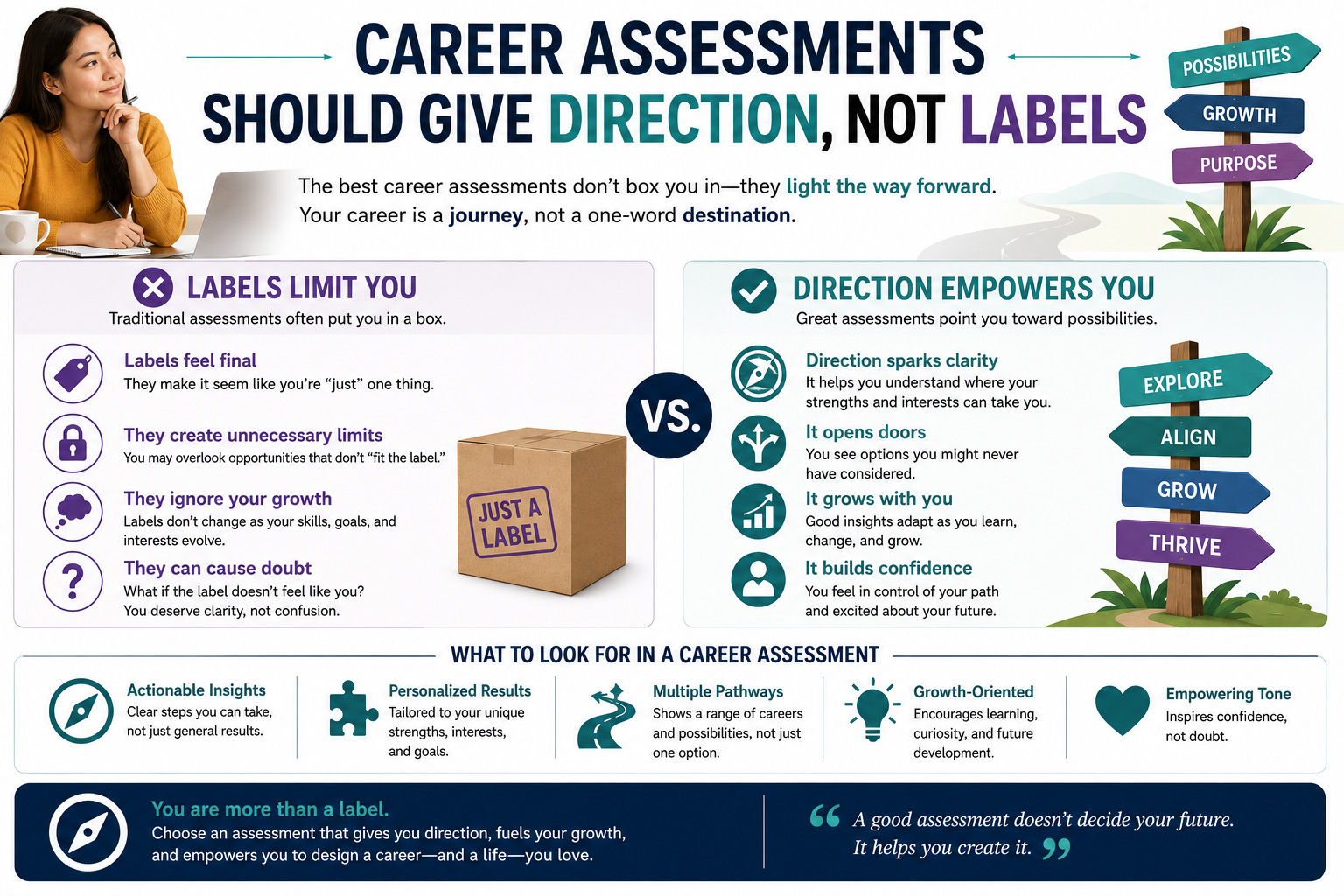
Career Assessments Should Give You Direction, Not Labels
By Tom Fierre
Choosing a career is one of the most important decisions a person can make, but it is rarely a decision that should come from one simple label.
Many people take a career assessment hoping it will give them a direct answer. They want the test to say, “You should be a teacher,” “You should be a nurse,” “You should be an engineer,” or “You should go into business.”
That kind of answer can feel comforting because it seems clear and simple. But careers are not simple. People are not simple either.
The best career assessments should not box you into one identity or one job title. They should help you understand yourself more clearly, explore possible directions, compare options, and make better decisions based on your motivations, strengths, goals, and real-world opportunities.
That is one of the reasons the MAPP™ assessment was designed to provide career direction, not limiting labels.
A good assessment should act more like a compass than a verdict. It should point you toward possible paths, help you understand why those paths may fit, and give you the insight needed to decide what to explore next.
Why One Career Label Is Usually Not Enough
A single career label can be misleading.
At first, it may seem helpful to be told that you match a specific job title. But one job title rarely captures the full range of your motivations, preferences, abilities, and future possibilities.
For example, imagine a person receives a career result suggesting “teacher.” That may be useful, but it may not tell the whole story. The deeper insight might be that the person is motivated by explaining ideas, helping others grow, organizing information, communicating clearly, and guiding people toward improvement.
That same pattern could connect to many possible careers, including:
- Teacher
- Corporate trainer
- Instructional designer
- Career coach
- Academic advisor
- Curriculum developer
- Youth program director
- Learning and development specialist
- Education consultant
- Customer success trainer
The original label may be useful, but the direction behind the label is much more powerful.
The same is true for many other career areas. A person who matches with “sales” may actually be motivated by persuasion, communication, competition, relationship-building, entrepreneurship, or problem-solving. A person who matches with “analyst” may be drawn to research, patterns, strategy, data, systems, or decision-making.
The job title is only one possible expression of a much larger career pattern.
That is why career direction matters more than a single label.
The Problem With Being Boxed In
Career labels can unintentionally narrow someone’s thinking.
When a person receives one strong label, they may stop exploring too soon. They may assume the assessment has already made the decision for them. They may overlook related careers that could be a better fit. They may also ignore important practical factors, such as education requirements, salary, lifestyle, location, job availability, and long-term goals.
A career label may also create unnecessary pressure.
If a student is told they should pursue one specific profession, they may feel like they have failed if that path does not interest them. If an adult career changer receives a job title that does not feel realistic, they may dismiss the entire assessment instead of exploring the broader pattern behind the result.
The goal of a career assessment should not be to tell someone, “This is who you are.”
The better goal is to say, “Here are the kinds of work that may fit you, here is why they may fit, and here are several directions worth exploring.”
That approach gives people room to think.
It supports discovery instead of closing the conversation too early.
Career Direction Gives You More Options
Career direction is different from a career label.
A label points to one possible job.
A direction points to a family of possibilities.
For example, a person may discover that they are strongly motivated by helping, advising, explaining, and communicating. That does not mean there is only one career for them. It may point toward education, coaching, counseling, human resources, training, customer success, nonprofit work, healthcare support, or leadership development.
Another person may discover that they are motivated by data, reasoning, structure, and problem-solving. That direction could lead toward analytics, finance, operations, technology, research, logistics, engineering, business strategy, or quality control.
A third person may discover that they prefer hands-on work, tools, equipment, physical processes, and practical problem-solving. That direction could point toward skilled trades, technical service, construction, manufacturing, healthcare technology, mechanics, engineering technology, or operations.
Direction creates possibility.
It helps users move from the narrow question, “What job title am I?” to the better question, “What kinds of work are most likely to fit me, and where could those patterns lead?”
Why Motivation Is So Important
One reason the MAPP™ assessment focuses on direction is that it is based on motivation.
Motivation matters because people are more likely to stay engaged with work that fits how they naturally prefer to operate. A person may be able to perform many kinds of work, but ability alone does not guarantee satisfaction.
Someone may be capable of doing a job and still feel drained by it every day.
Another person may enter a role with less experience, but because the work fits their motivations, they may be more willing to learn, practice, grow, and persist.
Career fit is not only about what you can do. It is also about what you are likely to enjoy doing, repeat often, improve at, and sustain over time.
That is why a motivation-based career assessment can be so useful. It helps identify the kinds of work that may feel more natural, meaningful, or energizing. It can also help identify areas that may become frustrating or draining, even if a person has the ability to do them.
The MAPP™ assessment helps users think about career fit through areas such as interests, temperament, aptitude, people, things, data, reasoning, math, language, and work preferences. Those patterns help point users toward possible career directions rather than reducing them to one label.
A Career Match Is a Starting Point, Not a Final Answer
A career match score can be helpful, but it should not be treated as a final decision.
A strong career match may suggest that a path deserves more research. A moderate match may reveal related options worth exploring. A lower match may help explain why a field may feel less appealing or more difficult to sustain.
But no score should make the decision for you.
Career decisions should include many factors, including:
- Motivation
- Interests
- Skills
- Education
- Experience
- Salary goals
- Lifestyle preferences
- Location
- Job outlook
- Family responsibilities
- Work environment
- Personal values
- Long-term goals
- Conversations with mentors, coaches, counselors, or trusted advisors
The MAPP™ assessment can provide valuable insight, but it should support your judgment, not replace it.
The best use of any assessment is to help you ask better questions.
Questions such as:
- Why does this career appear to fit me?
- What parts of this work would I likely enjoy?
- What parts might I dislike?
- What similar careers should I compare?
- What education or training would this require?
- What would a typical day in this role actually look like?
- Does this path fit my financial and lifestyle goals?
- What would I need to learn before pursuing this direction?
A good assessment opens the door to better exploration.
It should not close the door by pretending one answer is enough.
Seeing the Pros and Cons of Different Career Paths
One of the most useful parts of career exploration is comparing the pros and cons of several possible directions.
A career may be a strong motivational fit but require significant education. Another career may offer strong earning potential but include daily tasks that do not fit your preferences. Another may be highly interesting but have limited job availability in your location. Another may be easier to enter but less aligned with your long-term goals.
Career direction helps you compare these tradeoffs.
For each possible path, it helps to ask:
- What do I like about this direction?
- What concerns me about this direction?
- What part of the work fits my motivations?
- What part may not fit?
- What education or credentials are required?
- How much time and money would it take to enter?
- What is the income potential?
- What is the job outlook?
- Is the work environment appealing?
- Are there related careers that may fit better?
- What are the risks of this path?
- What are the opportunities?
The MAPP™ assessment can help provide the self-knowledge needed to make those comparisons more meaningful.
Instead of choosing based only on job title or salary, users can evaluate whether a direction fits who they are and what they want their work life to feel like.
Why Direction Helps Students
Students are often asked to make major education and career decisions before they have enough experience to fully understand the world of work.
They may be asked to choose a major, select a college, consider a training program, or think about a future career. Often, those choices are influenced by parents, friends, teachers, social media, salary expectations, or limited exposure to a few familiar professions.
A direction-based career assessment can help students slow down and explore more thoughtfully.
Instead of asking, “What should I be?” students can ask:
- What kinds of work fit my motivations?
- Which majors connect to those career directions?
- What careers should I research before choosing a path?
- What do I want my daily work to involve?
- Which options fit my strengths and preferences?
- What might I dislike about certain careers?
- Which paths are worth discussing with an advisor or counselor?
This can help students make more informed decisions before investing time and money in education.
The MAPP™ assessment can support college major selection, career readiness, and education planning by helping students connect who they are to where they may want to go.
Why Direction Helps Career Changers
Career changers often know something is not working, but they may not know what should come next.
They may feel burned out, bored, underused, overwhelmed, or disconnected from their current work. But leaving one role without a clearer sense of direction can lead to another poor fit.
A direction-based assessment can help career changers understand what may be missing.
For example, a person may discover that their current role requires too much routine and not enough variety. Another may realize they need more people interaction. Another may see that they enjoy problem-solving but dislike constant sales pressure. Another may discover that they are motivated by communication and advising, but their current work gives them little opportunity to use those strengths.
Those insights can help career changers explore better-fit options.
The goal is not to say, “Your new label is this.”
The goal is to help the person understand which directions may offer a better match and which tradeoffs they should consider before making a move.
Why Direction Helps Job Seekers
Job seekers often search for jobs by title, salary, company, or location. Those factors matter, but they do not always show whether the job will be a good fit.
A role can look attractive on a job board and still involve daily tasks that feel misaligned.
A direction-based career assessment can help job seekers read job descriptions more carefully. It can help them identify which roles connect to their motivations and which roles may include warning signs.
Job seekers can use MAPP™ results to ask:
- Does this job fit the kind of work I enjoy?
- Does the description emphasize tasks that motivate me?
- Are there responsibilities that may drain me?
- Is this role similar to my strongest career directions?
- Does this job help me move toward a better-fit path?
- What should I ask in the interview to understand fit?
This can lead to a more intentional job search.
Instead of applying to anything that seems available, job seekers can focus on roles that are more likely to match their motivations, preferences, and long-term goals.
Why Direction Helps Coaches, Schools, and Employers
Direction-based assessment results are also useful for professionals who guide, advise, or manage others.
For coaches, direction creates a better conversation. Instead of telling a client what to do, coaches can help clients explore themes, compare possibilities, and turn insight into action.
For schools, direction can support advising, major selection, student retention, and career readiness. Students can explore paths that connect to their motivations instead of choosing programs based only on pressure or limited information.
For workforce programs, direction can help participants choose training pathways that are more likely to fit their interests and work preferences.
For employers, direction can support role fit, development, internal mobility, retention, and career pathing. It can help managers understand what may motivate employees and where they may contribute most effectively.
In each setting, the value is not the label.
The value is the conversation that the assessment makes possible.
Public Career Exploration and Personalized Insight
Career exploration is most useful when it combines general information with personalized insight.
Public career information can help users learn about job duties, salary ranges, education requirements, and related careers. Personalized assessment results can help users understand how those careers may or may not fit them.
That combination is powerful.
A user might first explore a career page and learn what a job involves. Then, after completing the MAPP™ assessment, they can review how well that direction aligns with their motivations and preferences.
This allows users to move from general research to personal decision-making.
They can ask:
- Is this career generally interesting?
- Does it fit my MAPP™ assessment results?
- What parts of it align with my motivations?
- What parts may be less appealing?
- What related careers should I compare?
- What education or training would I need?
- What jobs are available in this direction?
That is a much better experience than receiving a single label without context.
A Career Assessment Should Be a Compass, Not a Cage
The best career assessment should not trap someone inside one answer.
It should provide a useful compass.
A compass does not walk the path for you. It does not decide where you must go. It helps you orient yourself, understand possible directions, and choose your next step with more confidence.
That is how the MAPP™ assessment should be used.
It can help users identify career directions, understand motivational fit, compare options, consider pros and cons, and explore careers, education pathways, and jobs with more clarity.
But the final decision still belongs to the person.
No assessment should choose your future for you.
A better assessment helps you choose your future more wisely.
Moving From Labels to Possibilities
A person is not just one job title.
A person is a combination of motivations, strengths, preferences, experiences, goals, values, and potential.
Those patterns can express themselves in many different careers.
The MAPP™ assessment helps users see those patterns more clearly. It helps them move beyond narrow labels and explore broader possibilities. It supports better questions, better conversations, and better decisions.
Instead of saying, “This is the one thing you should be,” a stronger career assessment helps say:
“Here are directions that may fit you. Here is why they may fit. Here are the pros and cons to consider. Here are related paths to explore. Now you can make a more informed choice.”
That is the kind of guidance people need when making important career, education, and job decisions.
Final Thought: Direction Creates Confidence
Career decisions are rarely easy. But they become easier when people have better information about themselves and better ways to explore their options.
The MAPP™ assessment provides direction by helping users understand how their motivations may connect to careers, education pathways, and job possibilities.
It does not reduce people to one label. It helps them see more possibilities.
It does not make the decision for them. It helps them make a better decision for themselves.
That is what a modern career assessment should do.
It should help people move from confusion to clarity, from guessing to guided exploration, and from limiting labels to meaningful direction.